 Skip to content
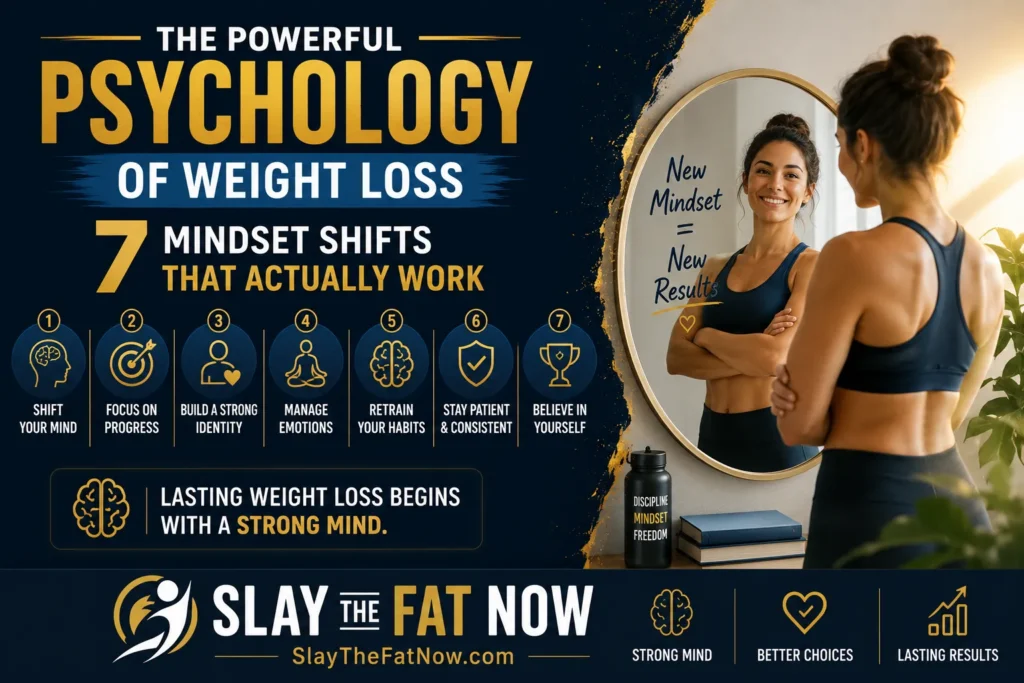
The Powerful Psychology of Weight Loss: 7 Mindset Shifts That Actually Work
By SlayTheFatNow Team
| The psychology of weight loss centers on changing deeply ingrained thought patterns, habits, and emotional triggers not just calories. Research shows that mindset, identity, and behavioral cues drive long-term success far more than willpower or restriction alone. People who understand their weight loss psychology are significantly more likely to maintain results. |
Are You Fighting Your Own Brain When You Try to Lose Weight?
You’ve started Monday with iron resolve. By Wednesday, a stressful meeting derailed your meal plan. By Friday, you’re back to old habits and beating yourself up about it.
Sound familiar? You’re not weak. You’re not lazy. You’re simply not working with your psychology of weight loss you’re working against it.
Most diets are designed around food. But the science is clear: the battle happens in your mind first. The reason 95% of dieters regain lost weight within five years isn’t a calorie problem. It’s a mindset problem.
What Is the Psychology of Weight Loss?
The psychology of weight loss is the study of how your thoughts, emotions, habits, beliefs, and identity shape your eating behavior and physical activity. It’s the “why” behind every binge, every skipped workout, and every time you restart on Monday.
Understanding your weight loss mindset doesn’t mean spending years in therapy. It means learning a handful of brainbased truths that make sustainable fat loss exponentially easier.
In this guide you’ll learn:
- Why willpower fails every diet eventually
- The 7 mindset shifts proven to drive lasting results
- What real research says about the brain body connection in weight loss
- Practical tools you can apply starting today
Whether you’re brand new to your journey or stuck in a frustrating plateau, this is the missing piece most coaches never talk about.
Why Your Mindset Matters More Than Your Meal Plan
Here’s the truth nobody puts on the front of a supplement bottle: your brain controls your body. Every food decision, every craving response, every “I’ll start tomorrow” is a psychological event before it’s a physical one.
When you master the psychology of weight loss, you:
- Stop white knuckling willpower — and start building automatic habits
- Eliminate guilt spirals — which are the #1 cause of binge cycles
- Create identitylevel change — so healthy choices become who you are, not what you try to do
- Handle stress without food — breaking the emotional eating loop
- Sustain results for years — instead of 6week cycles
This isn’t soft talk. This is the science of behavior change — and it’s the most underutilized tool in the weight loss world. Check out our deep dive on the all-or-nothing mindset in weight loss to see exactly how perfectionist thinking keeps people stuck.
What the Research Says About Weight Loss Psychology
| A study published in the National Library of Medicine found that psychological interventions targeting self regulation significantly improved weight loss outcomes compared to diet advice alone. |
The data paints a stark picture:
- According to the NIDDK, behavioral factors including stress, sleep, and emotional eating are among the most significant contributors to weight gain and difficulty losing weight.
- Research from the American Psychological Association shows that stress eating accounts for a meaningful portion of excess caloric intake in adults, particularly among those experiencing chronic work or financial stress.
- People who set “approach goals” (moving toward a healthy identity) lose more weight than those who set “avoidance goals” (trying not to eat bad food) a finding consistent across multiple behavioral studies.
- Habit formation not motivation is what determines whether someone sustains exercise after 3 months, according to research from University College London.
The bottom line: if you’re only managing food and ignoring the psychology of weight loss, you’re solving half the equation.
A RealWorld Example: How Mindset Changed Everything for Maria
Maria, 38, had tried seven diets in five years. She’d lose 15–20 lbs on each one, then regain all of it plus more. Sound familiar?
When she stopped focusing on what to eat and started examining why she ate, everything shifted. She discovered she ate when stressed at work not from hunger, but from anxiety she’d never learned to process another way. She identified that she labeled foods “clean” or “dirty,” which made any “cheat” feel like total failure, triggering a binge.
By working on her weight loss mindset practicing stress awareness, dropping food labels, and building an identity as someone who “moves her body” rather than someone who “exercises to burn off bad food” Maria lost 28 lbs over 11 months and has maintained it for over two years.
The food plan barely changed. The psychology did.
The 7 Mindset Shifts That Drive Real Weight Loss Psychology
1. Stop Relying on Willpower Build Systems Instead
Willpower is a finite resource. Studies show it depletes throughout the day a concept called “decision fatigue.” Successful weight loss psychology doesn’t ask more of your willpower; it makes the right choices the default choice.
Practical fix: Prep meals on Sunday. Keep unhealthy food out of your home. Set workout clothes out the night before. Remove the decision, remove the need for willpower.
2. Shift Your Identity, Not Just Your Behavior
James Clear, author of Atomic Habits, describes identitybased habits as the most powerful force in behavior change. Instead of “I’m trying to lose weight,” say “I’m someone who takes care of my body.” Every small action becomes a vote for that identity.
3. Understand Your Emotional Eating Triggers
Emotional eating is one of the most common barriers in weight loss psychology. Boredom, stress, loneliness, celebration food becomes the tool for managing emotion. The fix isn’t to white-knuckle through cravings; it’s to identify the trigger and create an alternate response. Start exploring your emotional eating triggers with our dedicated guide.
4. Embrace the “Good Enough” Standard
Perfectionism kills more diets than pizza does. When you believe you must eat perfectly or your whole effort is ruined, one off meal becomes a week off. Embracing the psychology that 80% consistency beats 100% perfection and that imperfect action always beats perfect inaction is transformative.
5. Reframe Failure as Data
Every slip, every missed workout, every emotional binge contains information. Why did it happen? What was the trigger? What environment, emotion, or event preceded it? When you treat setbacks as data instead of moral failures, you stop the shame spiral and start the improvement loop.
6. Focus on NonScale Victories
Your weight loss mindset needs evidence it’s working. The scale is one data point, but it fluctuates daily based on water, hormones, and sodium. Tracking energy levels, mood, sleep quality, clothing fit, and workout performance gives your brain more wins to reinforce new behavior.
7. Use Implementation Intentions
Research consistently shows that “when then” planning dramatically improves follow-through. “When I get stressed at work, then I will take a 5minute walk instead of going to the vending machine.” This precision short-circuits the reactive brain and gives the rational brain a winning script.
| Ready to Work With Your Brain, Not Against It? Discover personalized strategies to rewire your weight loss mindset and finally build habits that stick. → Start Your Transformation → |
Reality Check: Common Myths About Weight Loss Psychology
| ✗ Myth: “I just need more motivation.” Motivation is an emotion it comes and goes. Relying on it means your results are as inconsistent as your mood. Systems and habits replace the need for daily motivation. |
| ✗ Myth: “Thinking positive is enough.” Toxic positivity ignoring real obstacles is worse than realism. The most effective weight loss psychology uses “mental contrasting”: visualizing your goal AND the obstacles in your path, then making a concrete plan for each. |
| ✗ Myth: “If I loved myself, I’d already be healthy.” Shame is the least effective motivator for sustainable behavior change. Research shows that self-compassion not self-criticism drives longer adherence to healthy habits. You don’t hate yourself into a body you love. |
| ✗ Myth: “Willpower is a character trait some people have it, some don’t.” Willpower is a skill and a resource. It can be trained, and more importantly, it can be conserved through smart environmental design. High performers don’t have more willpower; they make fewer willpower dependent decisions. |
Practical Steps to Strengthen Your Weight Loss Mindset Today
What To Do
- Journal for 5 minutes after eating. Note what you ate, how hungry you were, and how you felt before eating. Patterns emerge fast.
- Set process goals, not outcome goals. “Walk 20 minutes every day” is more actionable and controllable than “lose 20 lbs.”
- Create a “why” document. Write down your 3 deepest reasons for wanting to change. Read it when motivation dips.
- Track habits, not just calories. Apps like Streaks or a simple paper habit tracker build the feedback loop your brain needs.
- Practice selfcompassion after setbacks. Literally say to yourself: “This is hard. Many people struggle with this. What can I learn?”
What To Avoid
- Don’t use food as your primary reward system it reinforces emotional eating patterns.
- Don’t weigh yourself daily if the number hijacks your mood. Weekly is usually healthier.
- Don’t follow plans that require eliminating entire food groups with no context restriction backfires psychologically.
- Don’t compare your chapter 1 to someone else’s chapter 20.
Willpower vs. HabitBased Weight Loss Psychology: A Comparison
| Factor | Willpower Approach | Mindset + Habit Approach |
| Sustainability | Low depletes over time | High becomes automatic |
| Stress resistance | Collapses under stress | Builtin coping systems |
| Relationship with food | Guilt, restriction, binary | Flexible, compassionate |
| Response to setbacks | Shame spiral, quit | Datadriven adjustment |
| Longterm results (5yr) | ~5% maintain loss | Significantly higher with support |
| Identity impact | “I’m on a diet” | “This is who I am” |
| Requires daily motivation? | Yes constantly | No habits run on autopilot |
The psychology of weight loss clearly favors the habit based approach. Want a deep dive into why diets become traps?
Frequently Asked Questions About the Psychology of Weight Loss
1. What is the psychology of weight loss?
The psychology of weight loss is the study of how thoughts, emotions, habits, and beliefs influence your ability to lose weight and maintain it. It addresses why willpower fails, how habits form, and what mental frameworks lead to lasting results.
2. Why does willpower fail on a diet?
Willpower is a limited cognitive resource that depletes with use a phenomenon researchers call “decision fatigue.” The more decisions you make throughout the day, the harder it becomes to resist temptation by evening. This is why most diet breaks happen at night, not the morning.
3. How does stress affect weight loss?
Chronic stress elevates cortisol, which increases appetite particularly for high calorie comfort foods and promotes fat storage in the abdominal area. Additionally, stress depletes willpower and triggers emotional eating, making it one of the most significant psychological barriers to weight loss.
4. What is emotional eating and how do I stop it?
Emotional eating is using food to manage feelings rather than physical hunger. To address it, identify your personal triggers (stress, boredom, loneliness), create alternative responses (walking, calling a friend, journaling), and practice pausing before eating to check in with your actual hunger level.
5. Does selfcompassion really help with weight loss?
Yes and this is one of the most counterintuitive findings in weight loss psychology. Research shows that people who treat themselves with kindness after a setback are more likely to get back on track quickly, while selfcriticism often triggers shame spirals that lead to more overeating.
6. How do I change my identity around weight and health?
Identity change starts with small, consistent actions that serve as “votes” for your new selfimage. Each time you choose a walk over the couch, cook instead of ordering out, or say no to a mindless snack, you’re casting a vote for the person you’re becoming. Over time, the identity follows the behavior.
7. What is the biggest psychological barrier to losing weight?
For most people, the allornothing mindset is the greatest psychological barrier. The belief that any deviation from the plan means total failure causes people to abandon good habits entirely after one slip. Learning to accept imperfection is often more impactful than any specific diet change.
8. Can mindfulness help with weight loss?
Mindfulness particularly mindful eating has strong research support for reducing emotional and binge eating. By eating slowly, without distraction, and paying attention to hunger and fullness cues, people naturally reduce calorie intake without restriction or counting.
9. How long does it take to build a new weight loss habit?
Research from University College London found that habits take an average of 66 days to become automatic not the popular myth of 21 days. The range varied widely (18 to 254 days) depending on the complexity of the habit and the individual.
10. What is body image and how does it affect weight loss?
Body image is how you see, think, and feel about your own body. Negative body image is associated with lower exercise adherence, higher emotional eating, and worse weight loss outcomes. Working on body neutrality accepting your body’s function over its appearance is linked to better longterm results.
11. Is it possible to rewire my brain for weight loss?
Yes. The brain is neuroplastic meaning it changes in response to repeated thoughts and behaviors. Building new habits, changing how you talk to yourself, and consistent practice of new responses to old triggers all literally reshape neural pathways over time. This is the foundation of cognitive behavioral approaches to weight management.
12. How does sleep affect weight loss psychology?
Poor sleep increases ghrelin (hunger hormone) and decreases leptin (fullness hormone), making you hungrier and less satisfied the next day. It also impairs prefrontal cortex function the brain region responsible for self-control and decision-making dietary decisions much harder.
13. Why do I sabotage my weight loss progress?
Self sabotage often stems from fear of failure, of success, of change, or of being seen. It can also reflect deep beliefs that you don’t deserve to be healthy or that lasting change isn’t possible for someone like you. These beliefs, often formed in childhood or through repeated failed attempts, require direct attention and reframing.
14. What is cognitive behavioral therapy (CBT) and how does it help with weight loss?
CBT is a therapeutic approach that identifies and challenges unhelpful thought patterns and replaces them with more realistic, productive ones. In weight loss, CBT helps address distorted thinking, emotional eating, allornothing beliefs, and body image issues. Multiple studies confirm it significantly improves longterm weight management outcomes.
15. How can I stay motivated during a long weight loss journey?
The key is to stop relying on motivation and start building systems. Track process habits (not just outcomes), celebrate nanoscale victories, reconnect regularly with your core “why,” build an accountability structure (partner, group, or coach), and accept that motivation will fluctuate your habits should not.
| Your Mindset Is the Missing Piece Stop fighting your brain. Get the tools, strategies, and community to make weight loss feel natural not like a punishment. → Join SlayTheFatNow Free → |
Final Thoughts: Work With Your Brain, Not Against It
The psychology of weight loss is not a trend or a wellness buzzword. It’s the most evidencebacked, underused lever in the entire weight management space.
Every sustainable transformation every person who lost the weight and actually kept it off did so by changing their thoughts and beliefs, not just their food. They stopped fighting their habits and started designing better ones. They replaced shame with curiosity. They shifted from “I’m dieting” to “this is who I am.”
You can do exactly the same. And it starts right now, with one decision: to understand the most important tool in your weight loss journey your own mind.
Explore more science backed strategies on SlayTheFatNow.com and take the first step toward permanent, sustainable change.
Sources:
National Library of Medicine — Psychological Interventions for Weight Loss
