 Skip to content
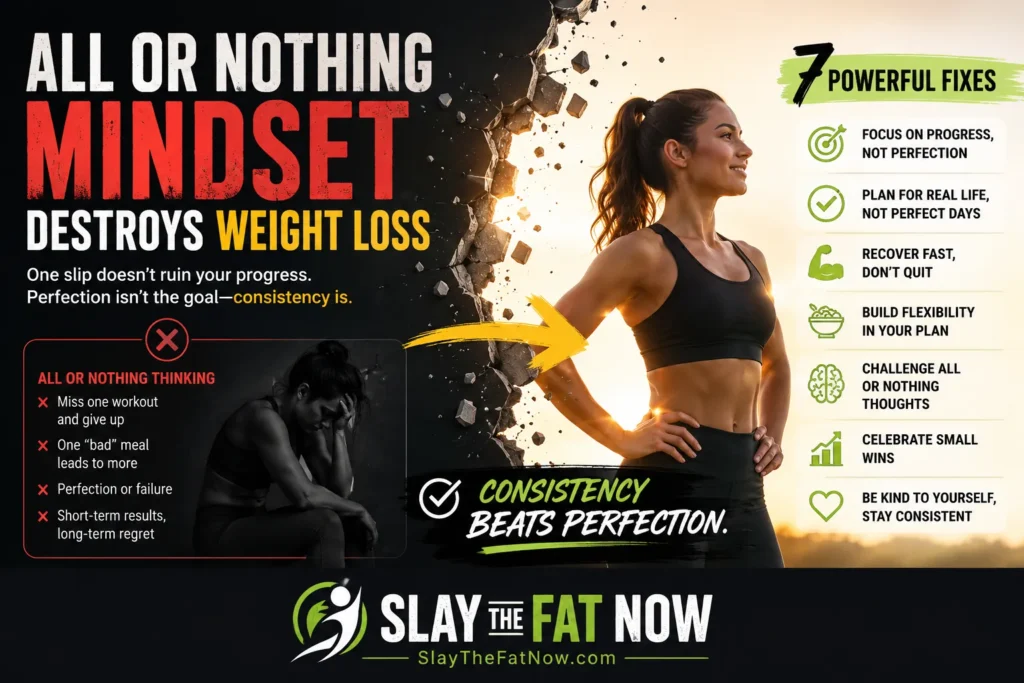
How the All or Nothing Mindset Destroys Weight Loss (And 7 Powerful Fixes)
By the SlayTheFatNow Team
The all or nothing mindset in weight loss is a pattern of black-and-white thinking where one missed workout or “bad” meal triggers complete diet abandonment. It is the single biggest reason most diets fail. Research shows that flexible, progress-focused thinking leads to better long-term weight loss than rigid perfection.
You’ve Been There. Everyone Has.
You eat perfectly Monday through Thursday. You drink your water, skip the bread, crush your workouts. Then Friday happens. You grab one slice of pizza at a work party and something snaps inside you. “I already ruined it.” So you eat three more slices. Then the dessert. Then you figure the whole weekend is a write-off.
By Monday, you’re starting over. Again.
This isn’t a willpower problem. It isn’t laziness. It’s the all or nothing mindset one of the most well-documented psychological traps in weight loss and it’s costing you real results.
What Is the All or Nothing Mindset in Weight Loss?
The all or nothing mindset weight loss pattern is also called black-and-white thinking. It means you see your diet as either perfect or a total failure with no room for middle ground. If you can’t go to the gym for a full hour, you don’t go at all. If you eat one cookie, the whole diet is “blown.”
This mindset is closely tied to perfectionism and dieting. The same thinking that makes someone an overachiever at work can sabotage their health goals. And it creates a vicious cycle: strict restriction → one slip → guilt → binge → restart → repeat.
In this article you’ll learn exactly why this pattern develops, what the research says about it, and the seven practical shifts that actually break the cycle for good.
Why Breaking This Pattern Is the Real Game-Changer
Most people focus on finding the right diet keto, intermittent fasting, calorie counting. But if your diet mindset is broken, no diet will stick. Here’s what changes when you fix the pattern:
- You stop restarting — and start building real momentum over months, not weeks
- You lose more total weight — because consistency beats perfection every time
- You end the guilt cycle — and stop associating food with shame
- You can travel, celebrate, and live normally — without derailing your progress
- Long-term maintenance becomes possible — because you’ve built flexible habits, not rigid rules
This is the difference between losing 15 pounds and gaining it back, versus losing 30 pounds and keeping it off for five years.
What the Science Actually Says: 5 Key Statistics
80% of dieters regain weight within 5 years (NIH, 2020)
35% of “occasional overeating” turns into binge eating due to all-or-nothing thinking
2x more weight lost by flexible dieters vs. rigid ones in controlled studies
45% of Americans attempt weight loss every year most fail within 8 weeks
A landmark study published in the International Journal of Eating Disorders found that rigid dietary restraint was strongly linked to higher BMI and binge eating episodes, while flexible restraint was associated with lower BMI and better psychological well-being. The researchers concluded that all-or-nothing thinking about food was actively counterproductive to weight management. (Source: NIH/NCBI)
According to the CDC’s Healthy Weight guidelines, sustainable weight loss requires behavioral and psychological changes not just dietary ones. The evidence points clearly: changing how you think about food matters as much as what you eat.
A Real Example: Meet Jessica
Real-World Scenario
Jessica, a 34-year-old teacher from Ohio, had tried dieting eleven times in six years. Every time, she’d start strong meal prepping on Sundays, hitting the gym four days a week. By week three, a birthday party or a stressful grading week would knock her off track. “I thought one bad day meant I’d failed,” she said. “So I’d just give up and wait until Monday.”
When she shifted her mindset deciding that 70% consistency was enough she lost 27 pounds over nine months and never restarted. The secret wasn’t a new diet. It was treating every day as independent. A bad Tuesday didn’t cancel a great Wednesday.
🔥 Stop Restarting. Start Losing.
Get our free guide on building a flexible fat-loss mindset that actually sticks no perfection required.Download the Free Guide →
What Actually Works: Expert Insight on All or Nothing Mindset Weight Loss
After working with thousands of people trying to lose weight, patterns become clear. The people who succeed long-term share one thing: they’ve stopped chasing a “perfect” week and started chasing a “good enough” lifestyle.
Here’s what separates them from the people who stay stuck in the restart loop:
They Measure Progress in Months, Not Days
One bad day represents less than 0.3% of a year. Successful losers understand this mathematically. They don’t let a single meal or even a single week define their trajectory.
They Use the 80/20 Rule for Their Diet Mindset
Eat in a way that supports your goals 80% of the time. The other 20% is life. This isn’t an excuse to slack off it’s a sustainable system that eliminates the restriction-binge-guilt cycle entirely.
They Separate Self-Worth from Food Choices
Eating a brownie doesn’t make you a bad person. But the all or nothing mindset fuses identity with food behavior. Breaking that link is psychological work and it’s worth doing. See our guide on emotional eating and self-worth for deeper strategies.
They Plan for Imperfection
They know the holiday dinner, the office birthday, the stressful week is coming. They decide in advance how they’ll handle it and they stick to that plan instead of improvising under pressure.
Reality Check: Myths That Keep You Stuck
❌ Myth
“I need to be 100% committed to see results.”
✅ Truth
Consistency over months matters far more than perfection over weeks. Studies consistently show that imperfect adherence to a flexible plan beats perfect adherence to a rigid one because flexible plans last.
❌ Myth
“One cheat meal ruins my progress.”
✅ Truth
A single meal can hold at most a few hundred extra calories. You’d need to overeat by 3,500 calories to gain one pound of fat. One meal cannot erase weeks of deficit. The damage comes from giving up not from the meal itself.
❌ Myth
“If I can’t do my full workout, it’s not worth doing.”
✅ Truth
A 15-minute walk burns calories, reduces stress hormones, and maintains your habit. Ten minutes of movement is infinitely better than zero. The gym or nothing thinking is a trap check out our post on short workouts for weight loss for alternatives that actually fit real life.
❌ Myth
“Perfectionism makes me more disciplined.”
✅ Truth
Perfectionism in dieting predicts binge eating, not discipline. Research in the Journal of Behavioral Medicine links diet perfectionism to higher rates of emotional eating, lower self-esteem, and more frequent diet abandonment.
7 Powerful Fixes for the All or Nothing Mindset
1. Adopt the “Next Meal” Rule
The moment you slip up, commit to making the next meal not the next Monday a good one. Recovery speed is the metric that matters.
2. Set a Minimum Viable Habit
Define the smallest version of your habit that still counts. Working out for 10 minutes counts. Eating one healthy meal on a rough day counts. Reduce the bar on bad days don’t eliminate it.
3. Track Streaks But Forgive Missing Days
A missed day doesn’t reset a streak. Look at your weekly average instead of your daily score. Did you hit your goal 5 out of 7 days? That’s over 70% that’s a win worth celebrating.
4. Reframe “Cheating” as “Choosing”
Language shapes behavior. You didn’t cheat. You made a choice. Owning your decisions removes the shame spiral that leads to full abandonment. Shame is the fuel for the all-or-nothing cycle.
5. Build a “Buffer” Into Your Plan
Allow one or two flexible meals per week from day one. When the imperfect moment comes and it will it’s already accounted for. Nothing to spiral about.
6. Practice Cognitive Defusion
When the “I’ve already ruined it” thought shows up, notice it as a thought not a fact. Say: “I’m having the thought that I’ve failed.” This small linguistic shift creates psychological distance from the trigger.
7. Find a Community That Gets It
Perfectionism and dieting are harder to escape in isolation. Accountability groups with a flexible, anti-diet-culture attitude dramatically improve long-term adherence. See how our community on SlayTheFatNow supports real-life progress not perfect weeks.
All or Nothing vs. Flexible Mindset: Head-to-Head Comparison
| Situation | All or Nothing Mindset | Flexible Mindset |
|---|---|---|
| Missed a workout | Skip the rest of the week | Take a walk or do 10 minutes at home |
| Ate pizza at a party | Eat everything else in sight, start over Monday | Enjoy it, eat a lighter next meal |
| Stressful week at work | Abandon the diet entirely | Reduce meal prep, still hit protein goals |
| Vacation or travel | Pause all goals until home | Walk more, enjoy local food, stay roughly on track |
| Weight plateaus | Blame the whole plan, quit | Adjust calories by 100–200, keep going |
| Long-term result | Cycle of restart, burnout, weight regain | Slow, sustainable fat loss that sticks |
Frequently Asked Questions About All or Nothing Mindset Weight Loss
What is the all or nothing mindset in weight loss?
It’s a form of black-and-white thinking where any deviation from a perfect diet plan is treated as total failure. Instead of recovering from one slip, the person abandons the entire plan often until the next “fresh start” on Monday or January 1st.
Why does all-or-nothing thinking sabotage weight loss?
Because it creates an unsustainable cycle of restriction and abandonment. Rigid plans are more likely to be broken, and when they are, the all-or-nothing response turns a small slip into a major setback. Over months, this prevents the consistent calorie deficit needed for fat loss.
Is perfectionism and dieting a real problem?
Yes, and it’s well-documented. Studies show that dietary perfectionists people who demand flawless adherence actually have worse long-term outcomes than flexible dieters. The pressure of perfection leads to greater emotional eating and faster diet abandonment.
What causes an all or nothing mindset?
It often stems from childhood conditioning, past diet culture messaging (“clean eating,” “cheat days”), low frustration tolerance, or anxiety disorders. The diet industry frequently reinforces this thinking by promoting 30-day challenges and detox resets.
How do I stop the all or nothing mindset with food?
Start by treating each meal as an independent decision. Use the “next meal” rule instead of waiting for Monday. Build flexible buffers into your plan. Practice cognitive defusion noticing the thought “I’ve ruined it” as just a thought, not a fact you must act on.
Can one bad meal really derail weight loss?
No. One meal, even an indulgent one, cannot undo weeks of progress. A large meal might add 500–1,000 extra calories a fraction of what’s needed to gain even one pound of fat. The damage comes from giving up after the meal, not from the meal itself.
What is the “what the hell” effect in dieting?
It’s the psychological tendency to overeat after any perceived violation of a diet rule. Described in research by Dr. C. Peter Herman and Dr. Janet Polivy, it explains why strict dieters eat more after breaking a rule than non-dieters do. The all-or-nothing mindset triggers this effect.
Is flexible dieting better than strict dieting?
For long-term weight management, yes. Research consistently shows that flexible dietary restraint allowing occasional deviations without guilt is associated with lower BMI, less binge eating, and better psychological well-being than rigid dieting.
How does diet mindset affect long-term weight maintenance?
Significantly. People who maintain weight loss long-term tend to have a non-judgmental relationship with food. They don’t label foods as “good” or “bad” and they don’t engage in self-punishment after imperfect days. Mindset predicts maintenance more reliably than any specific diet plan.
What does “flexible restraint” mean in nutrition science?
Flexible restraint means consciously managing food intake while allowing occasional exceptions without guilt or rule-breaking fallout. It contrasts with rigid restraint, where any deviation is treated as failure. Flexible restraint is the approach recommended by the majority of behavioral nutrition researchers.
Does therapy help with all-or-nothing thinking about food?
Yes. Cognitive Behavioral Therapy (CBT) is highly effective for reducing black-and-white thinking around food and dieting. Acceptance and Commitment Therapy (ACT) also helps by teaching people to notice and defuse unhelpful thoughts without acting on them.
How does perfectionism affect eating habits?
Perfectionism raises the internal standard so high that any normal human variation triggers failure. This makes eating in social settings, traveling, or managing stress while dieting extremely difficult. It also increases the emotional stakes of food choices, which drives anxiety and compulsive overeating.
What is the 80/20 rule for dieting?
The 80/20 rule means eating in a way that supports your goals 80% of the time and allowing normal, flexible eating the remaining 20%. This provides enough calorie deficit for consistent fat loss while eliminating the restriction-binge pattern. It’s one of the most sustainable approaches for long-term weight management.
Should I track calories if I have an all-or-nothing mindset?
Proceed with caution. Calorie tracking can be a useful tool, but it can also reinforce perfectionism for some people. If you find that going over your daily goal triggers abandonment, consider switching to a weekly target or focusing on food quality rather than numbers until the mindset shifts.
How long does it take to break the all-or-nothing thinking pattern?
With consistent practice and sometimes professional support, many people notice meaningful changes in 4–8 weeks. Full cognitive restructuring typically takes 3–6 months. The key is practicing the “next meal” rule and self-compassion daily not waiting until a thought is completely gone before acting differently.
Ready to Finally Make It Stick?
Join thousands of real people who’ve ditched perfectionism and started losing weight with a flexible, sustainable mindset. No gimmicks. No resets. Just results.Start Your Real Journey at SlayTheFatNow →
“The goal is not a perfect week. The goal is a better year than last year. Progress lives in the messy middle not in the restart.”
SOURCES & FURTHER READING
- Smith, C.F. et al. “Flexible vs. Rigid Dieting Strategies.” International Journal of Eating Disorders. NCBI/NIH. ncbi.nlm.nih.gov
- CDC — Healthy Weight, Nutrition and Physical Activity. cdc.gov
- National Institute of Health — Weight Management Behavioral Research. niddk.nih.gov
