 Skip to content
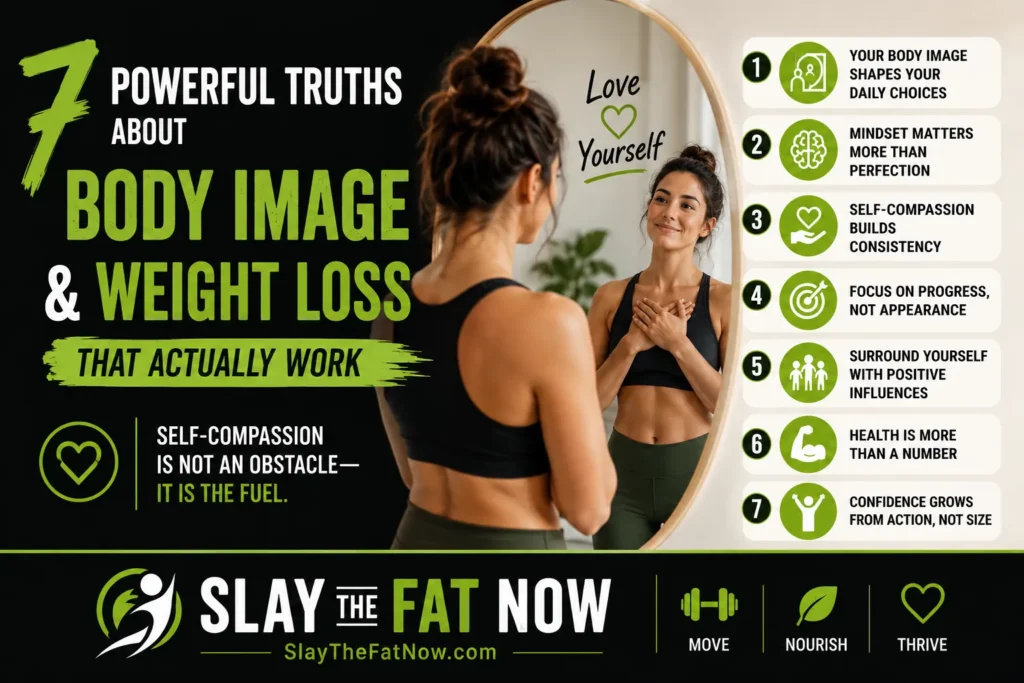
7 Powerful Truths About Body Image and Weight Loss That Actually Work
By the Editorial Team at SlayTheFatNow.com
Body image and weight loss are deeply connected. You can lose weight without loving your body first, but sustainable results almost always require a shift in how you see yourself. Research shows that people with a positive body image make healthier choices, stick to habits longer, and are far less likely to regain lost weight. Self-compassion is not an obstacle to weight loss it is the fuel.
The Mistake That’s Keeping You Stuck
Here’s the painful truth most weight loss programs won’t say out loud:
Hating your body into a smaller size almost never works long-term.
You’ve probably been there. You stand in front of the mirror, disgusted. You swear this Monday will be different. You white-knuckle through two weeks of salads and gym sessions, lose eight pounds, then a bad week at work undoes all of it. Sound familiar?
This cycle doesn’t happen because you’re weak. It happens because the entire premise that shame is motivation is physiologically backward. When you’re in a state of chronic self-loathing, your cortisol spikes, your hunger hormones go haywire, and your brain literally craves the very foods you’re trying to avoid.
The relationship between body image and weight loss is one of the most misunderstood dynamics in the health space. And once you understand it, everything changes.
What Is Body Image and Why Does It Affect Weight Loss?
Body image is how you perceive, think, and feel about your physical appearance not how you actually look. Two people with identical bodies can have completely opposite body images.
When your body image is negative, you operate in survival mode. You restrict, binge, punish, and repeat. When your body image is even neutral not positive, just neutral you start making decisions from a place of care rather than fear.
In this article, you’ll learn:
- Why body image and weight loss are scientifically linked
- What the research actually says about self-love and losing weight
- 7 practical strategies to build body confidence without abandoning your goals
- Common myths that are silently sabotaging your progress
- Answers to 15 questions real people are searching for right now
Whether you’ve tried every diet under the sun or you’re just starting out, this guide will give you a framework that actually lasts.
Why Getting Your Body Image Right Is the Key to Lasting Weight Loss
Most people treat weight loss as a purely physical problem calories in, calories out. But the psychological layer is where people succeed or fail, and body image sits right at the center of that layer.
Here’s what shifts when you start improving your relationship with your body:
- You stop self-sabotaging. Emotional eating drops dramatically when you’re no longer eating to punish or numb self-hatred.
- Exercise becomes enjoyable. People with better body confidence choose movement because it feels good, not because they’re trying to “earn” food.
- You make better food choices consistently. Not perfect, but consistent and consistency is what creates results.
- You recover faster from setbacks. A bad weekend doesn’t spiral into a bad month when you’re not driven by shame.
- Your results actually stick. Weight regain is dramatically lower among people who addressed their body image alongside their physical habits.
This isn’t just feel-good advice. The science backs every single one of these points.
What the Research Says About Body Image and Weight Loss
📊 Key Statistics You Need to Know
The data on body image and weight loss is sobering and empowering.
- According to the National Institute of Mental Health, negative body image is one of the strongest predictors of disordered eating behaviors, which directly interfere with sustainable weight management.
- A 2018 study published in Body Image journal found that women with higher body satisfaction lost more weight over a 12-month program and maintained it significantly better than those who started with negative body image.
- Research from UCLA found that 95% of dieters regain the weight within 1–5 years and psychological factors including body dissatisfaction are among the most cited contributors.
- A 2020 CDC report noted that over 41% of American adults have obesity, yet the primary interventions offered remain caloric restriction without any psychological support.
- Self-compassion a core component of positive body image has been shown in multiple studies to reduce binge eating and emotional eating, while increasing the likelihood of healthy lifestyle behaviors.
The bottom line: how you feel about your body is not separate from how you treat it.
A Real-World Scenario: Sarah’s Story
Sarah, 38, from Chicago, had been on and off diets since her early twenties. She’d lost 30 pounds three times and gained it all back each time. When she joined a program that combined nutrition coaching with mindset work, something unexpected happened.
In the first month, she didn’t focus on the scale at all. She focused on noticing when she ate due to stress versus actual hunger. She started a 10-minute daily walk not to burn calories, but to “get some air.” She started journaling one thing she appreciated about her body each day. It felt ridiculous at first.
By month three, she had lost 11 pounds without tracking a single calorie. By month six, 22 pounds. By month twelve, she had lost 34 pounds and this time, 18 months later, she has kept it all off.
What changed? Her body image. Her relationship with food. Her identity.
She stopped trying to lose weight because she hated herself. She started because she valued herself.
Sarah’s story isn’t unique. It’s a pattern. And you can follow it too with the right tools.
🔥 Ready to Tackle Both Your Body Image AND Your Weight?
Get access to proven strategies, meal guides, and mindset tools designed for real people in the real world.Start Your Transformation Today →
7 Powerful Strategies to Improve Body Image and Weight Loss Simultaneously
These aren’t theoretical tips. These are patterns observed across thousands of people who successfully changed both their bodies and their relationship with those bodies.
1. Separate Your Worth From the Scale
The scale is a data point nothing more. Your value as a human being is not encoded in a number. One of the most powerful shifts you can make is to broaden your success metrics: energy levels, sleep quality, mood, strength, and how your clothes fit are all valid measures of progress.
Start weighing yourself no more than once a week. Better yet, once every two weeks. Let other metrics lead.
2. Practice “Body Neutrality” Instead of Forced Positivity
You don’t have to love your body to treat it well. Body neutrality simply acknowledging your body as a functional vessel rather than judging it aesthetically is more achievable for most people and equally effective.
Try this: instead of “I hate my stomach,” try “My stomach digests my food and has carried me through 38 years of life.” Neutral. Not toxic positivity. Just factual acknowledgment.
3. Stop Restricting and Start Nourishing
Restriction-based dieting increases preoccupation with food, triggers binge cycles, and signals to your body that it’s in danger which raises cortisol and makes fat loss harder. Instead, think about adding nutrition rather than removing pleasure.
Add more protein. Add more vegetables. Add more water. Let the less-nutritious foods naturally take up less space without making them forbidden because forbidden foods become obsessions.
4. Move Your Body in Ways You Actually Enjoy
Exercise done as punishment doesn’t stick. Exercise chosen because it feels good becomes a lifestyle. If you hate running, stop running. Try dancing, swimming, hiking, yoga, pickleball, or lifting weights. The “best” workout is the one you’ll actually do next week.
5. Audit Your Social Media Feed
Research consistently shows that exposure to “idealized” bodies on social media increases body dissatisfaction. This isn’t about weakness it’s neurological. Your brain compares automatically.
Spend 20 minutes unfollowing accounts that make you feel worse about yourself. Replace them with accounts that show diverse bodies making healthy choices. This single action can shift your body image within weeks.
6. Address Emotional Eating at the Root
Emotional eating is not a character flaw. It’s a coping mechanism that worked until it didn’t. Identifying your triggers (loneliness, boredom, stress, celebration) and developing alternative responses is one of the highest leverage changes you can make.
Journaling, therapy, deep breathing, and even a 5-minute walk can interrupt the emotional-eating cycle effectively. Don’t white-knuckle it. Understand it.
7. Create an Identity Around Health, Not Thinness
People who say “I’m trying to lose weight” often quit when it gets hard. People who say “I’m someone who takes care of my health” find it much harder to quit because quitting means abandoning their identity.
This shift is simple but profound. Start calling yourself a healthy person. Act as that person would act not perfectly, but consistently.
Reality Check: What Nobody Tells You About Body Confidence and Weight Loss
⚠️ Myth-busting ahead. Some of these will be uncomfortable. All of them are important.
Myth #1: “You have to love yourself before you can lose weight.”
Not quite. You need to care about yourself even just a little. Full self-love is a journey, not a prerequisite. Starting with basic self-respect is enough.
Myth #2: “Body positivity means accepting being overweight as healthy.”
No. Body positivity means treating yourself with dignity regardless of your size while still pursuing health goals if you choose. You can want to lose weight AND respect your body right now. These aren’t contradictions.
Myth #3: “Once you lose the weight, you’ll feel better about your body.”
This is perhaps the most dangerous myth. Studies consistently show that body image does not automatically improve with weight loss. People who lose 50 pounds and still hate what they see in the mirror are very real and very common. The mindset work must happen alongside the physical work.
Myth #4: “Self-love is selfish and lazy.”
It’s the opposite. People who treat themselves with compassion have more energy, more consistency, and better outcomes across almost every health metric. Self-love is a performance enhancer.
Practical Action Plan: Body Image and Weight Loss Together
Here’s a simple 4-week framework to start shifting both simultaneously:
- Week 1 — Awareness: Track your self-talk for 7 days. Every time you think something negative about your body, write it down. Just observe.
- Week 2 — Interruption: Start replacing each negative thought with a neutral one. Not positive neutral. “My thighs carry me everywhere I need to go.”
- Week 3 — Action: Add one healthy habit and one joyful movement per day. Don’t remove anything yet.
- Week 4 — Community: Find one accountability partner a friend, an online group, or a coach who shares your values. Progress accelerates with support.
Check out our complete 30-day weight loss jumpstart plan that includes mindset exercises alongside nutrition and fitness guidance.
Shame-Based vs. Self-Compassion-Based Weight Loss: A Side-by-Side Comparison
| Factor | Shame-Based Approach | Self-Compassion Approach |
|---|---|---|
| Motivation Driver | Fear, disgust, punishment | Care, health, energy, longevity |
| Response to Setbacks | Spiral, give up, binge | Reflect, reset, continue |
| Relationship With Food | Restrict → binge → guilt | Nourish with occasional treats |
| Exercise Relationship | Punishment for eating “bad” | Joyful movement, energy booster |
| Long-Term Success Rate | Low (5–20% maintain loss) | Higher with mindset integration |
| Mental Health Impact | Anxiety, depression, shame | Improved mood, lower stress |
| Body Image After Loss | Often unchanged or worse | Improved proportionally |
“The goal is not to be thin. The goal is to be well in body, mind, and spirit. When you pursue wellness, the weight loss follows naturally and permanently.” Common observation from integrative health practitioners
Frequently Asked Questions About Body Image and Weight Loss
1. Can you lose weight without improving your body image?
Yes, in the short term. But research shows that without addressing body image, the vast majority of people regain the weight within 1 to 5 years. Sustainable loss almost always requires psychological work alongside the physical changes.
2. How does negative body image affect weight loss?
Negative body image increases cortisol (the stress hormone), which promotes fat storage, especially around the belly. It also drives emotional eating, reduces motivation for consistent exercise, and makes recovery from setbacks much harder.
3. What is body neutrality and is it better than body positivity for weight loss?
Body neutrality is the practice of viewing your body without strong positive or negative judgment simply as a functional vessel. For many people trying to lose weight, body neutrality is more realistic than body positivity and equally effective as a starting point for building healthy habits.
4. Does self-love and losing weight actually work together?
Absolutely. Multiple studies show that self-compassionate individuals are more likely to maintain healthy behaviors, recover from dietary lapses without spiraling, and achieve better long-term outcomes than those driven by self-criticism.
5. How do I start loving my body when I want to change it?
Start with respect rather than love. Acknowledge that your body is working hard right now breathing, pumping blood, digesting food. You can simultaneously want change and honor your body’s current effort. Journaling one thing your body does well each day is a powerful starting ritual.
6. Is it possible to have body confidence without being thin?
Yes, and it’s very common. Body confidence is an internal experience, not a body size. Many people at higher weights report strong body confidence, while many thin people report severe body dissatisfaction. The two are far less correlated than most people assume.
7. How long does it take to improve body image?
With consistent daily practice such as neutral self-talk, media auditing, and mindful movement most people report a noticeable shift in 4 to 8 weeks. Deeper, more lasting change typically takes 3 to 6 months of intentional effort.
8. Does social media make body image worse?
Yes, particularly exposure to highly filtered, idealized images. Research from the University of Pennsylvania found that limiting social media use to 30 minutes per day significantly reduced loneliness and depression both drivers of poor body image. Curating your feed matters enormously.
9. What role does therapy play in body image and weight loss?
Cognitive Behavioral Therapy (CBT) and Acceptance and Commitment Therapy (ACT) have strong evidence bases for improving both body image and weight loss outcomes. If emotional eating, disordered eating patterns, or severe body dissatisfaction are present, working with a therapist is highly recommended.
10. Can exercise actually improve body image even without weight loss?
Yes and this is one of the most exciting findings in the research. Exercise improves body image through functional confidence (feeling strong, capable) rather than purely through aesthetic change. People who exercise regularly report better body satisfaction even when the scale hasn’t moved.
11. Is emotional eating always related to body image?
Not always, but very often. Negative body image creates a shame cycle that fuels emotional eating eating for comfort after feeling bad about appearance, then feeling worse after eating, then repeating. Breaking this loop usually requires working on body image directly.
12. What foods help improve mood and body image?
Foods rich in omega-3 fatty acids (salmon, walnuts, flaxseed), magnesium (dark chocolate, spinach, nuts), and protein (chicken, legumes, Greek yogurt) support brain chemistry linked to mood regulation. Better mood tends to correlate with better body image and fewer cravings.
13. How do I deal with people who comment on my body during weight loss?
Set clear boundaries. You are not obligated to discuss your body or your weight loss journey with anyone. Prepare a brief, confident response: “I’m working on my health in a way that works for me, thanks.” Unsolicited body commentary from others including compliments can be disruptive to the process.
14. Can men struggle with body image issues related to weight loss too?
Absolutely. Body image issues are not exclusive to women. Men increasingly report dissatisfaction with their bodies particularly related to muscle mass and fat distribution. The shame-based approach to weight loss is equally harmful regardless of gender.
15. What’s the first step to take if I want to work on both body image and weight loss at the same time?
Start with awareness. Spend one week noticing without judgment how you talk to yourself about your body. Then, add one nourishing habit (not a restriction) and one joyful movement. You don’t need to overhaul your life in week one. You need to start treating yourself as someone worth caring for.
💪 Your Transformation Starts With How You See Yourself
At SlayTheFatNow.com, we believe real, lasting weight loss starts from the inside. Get our free starter guide that combines mindset tools with practical nutrition and fitness strategies built for real Americans with real lives.Get My Free Weight Loss Starter Guide →
The Bottom Line on Body Image and Weight Loss
The journey to lasting weight loss is not a straight line from shame to skinny. It’s a curve from self-neglect to self-respect, from punishment to care, from a number on a scale to a life that actually feels good to live.
Body image and weight loss are not separate conversations. They are one conversation, and the people who get lasting results are the ones who have the courage to have it.
You don’t have to love your body today. You just have to be willing to treat it a little better than you did yesterday.
That’s enough to start. And starting is everything.
Sources
