 Skip to content
How to Stop Binge Eating: 7 Proven Steps That Actually Work
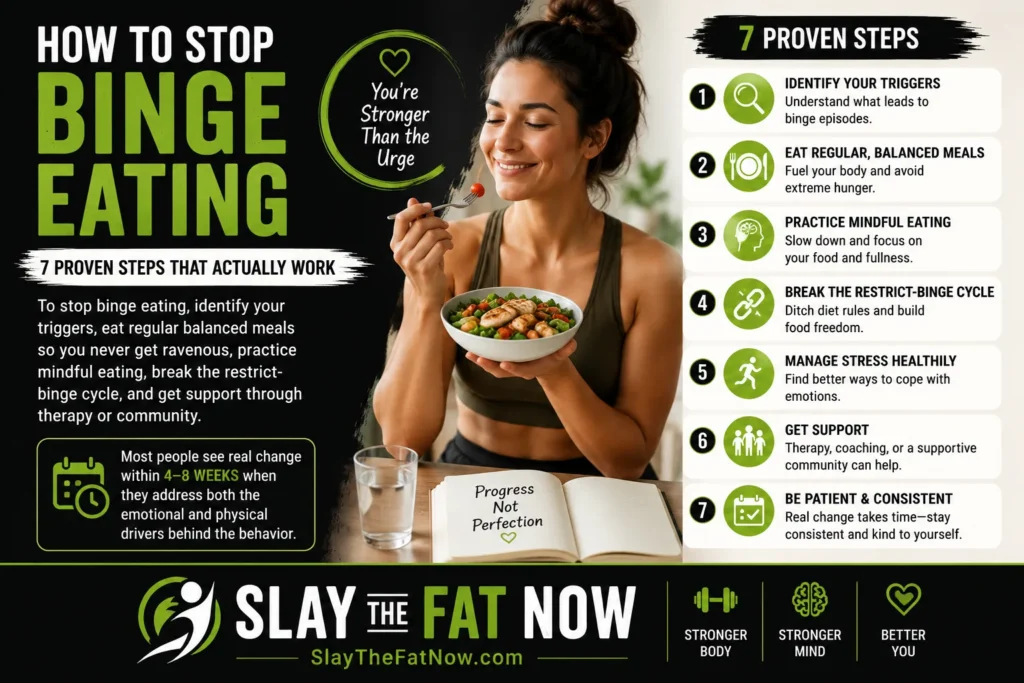
To stop binge eating, identify your triggers, eat regular balanced meals so you never get ravenous, practice mindful eating, break the restrict-binge cycle, and get support through therapy or community. Most people see real change within 4–8 weeks when they address both the emotional and physical drivers behind the behavior.
The Mistake That Keeps You Trapped in the Binge Cycle
You swore this morning would be different. You skipped breakfast determined to be “good.” By 3 PM, you were standing in the kitchen eating straight from the bag. By dinner, you’d consumed more food in two hours than you planned for the entire day. And then came the shame spiral the “I’ll start again Monday” promise and the cycle reset itself like clockwork.
Here’s the brutal truth most diet culture won’t tell you: the restriction itself is what causes the binge. You’re not weak. You’re not broken. Your body is responding exactly the way evolution designed it to by overriding willpower when it senses scarcity. But that doesn’t mean you’re stuck. Learning how to stop binge eating starts with understanding what’s actually driving it.
What Is Binge Eating and Why Is It So Hard to Stop?
Binge eating is defined as consuming a large amount of food in a short period while feeling a complete loss of control often followed by guilt, shame, or disgust. It’s not the same as overeating at Thanksgiving. It’s compulsive, distressing, and repeating.
In this guide, you’ll learn exactly how to stop binge eating using strategies rooted in behavioral science, nutrition, and real lived experience. We’ll cover the triggers, the neuroscience, the practical steps, and the honest truth about what recovery actually looks like. Whether you’re looking for binge eating disorder help or simply trying to break a recurring pattern, this guide is for you.
Why Breaking the Binge Cycle Changes Everything
If you’ve been fighting binge eating for months or years, here’s what’s at stake beyond the scale:
- Metabolic health: Chronic bingeing spikes insulin, disrupts gut bacteria, and promotes visceral fat the dangerous kind around your organs.
- Mental health: The shame loop that follows binges increases anxiety, depression, and social withdrawal.
- Sleep quality: Eating large quantities late at night wrecks deep-sleep cycles, leaving you tired and more likely to crave high-calorie food the next day.
- Long-term weight: Research shows binge eating not slow metabolism is the biggest barrier to sustainable fat loss for most people.
- Self-trust: Breaking the cycle rebuilds your confidence and your relationship with food on a fundamental level.
The good news? Binge eating recovery is absolutely achievable. It rarely happens overnight, but the people who commit to the right approach rarely go back.
The Real Numbers Behind Binge Eating in America
- Binge Eating Disorder (BED) is the most common eating disorder in the United States, affecting an estimated 2.8 million Americans, according to the National Institute of Mental Health (NIMH).
- BED is more prevalent than anorexia and bulimia combined.
- According to research published in the International Journal of Eating Disorders, only 43% of people with BED ever seek treatment meaning millions suffer in silence.
- Roughly 65% of people with BED are also living with obesity, creating a compounding health challenge.
- The condition is twice as common in women as in men, but male cases are significantly underreported.
- Dieting is the #1 behavioral trigger for binge episodes which is why most traditional diets make binge eating worse, not better.
These numbers matter because they confirm something important: you are not alone in this, and this is not a personal failing. It is a recognized clinical condition with evidence-based solutions.
A Real Scenario: How the Restrict-Binge Cycle Works
Meet Sarah. She’s 34, working full-time, trying to lose 30 pounds. Every Sunday night she plans her meals clean eating, 1,400 calories, no processed foods. By Wednesday afternoon she’s tired, irritable, and eating her way through whatever is in the pantry. By Thursday morning she’s back to restriction mode, telling herself she’ll “make up for it.”
What Sarah doesn’t realize is that her restriction is neurologically indistinguishable from a famine signal. Her brain releases more dopamine in response to food after periods of deprivation. Her hunger hormones particularly ghrelin spike. Her leptin (the satiety signal) drops. She’s not losing a battle of willpower. She’s fighting her own biology with no backup.
When Sarah shifted her approach eating three structured meals plus two snacks, removing the “forbidden foods” label, and working with a therapist on emotional triggers her bingeing dropped from 5 days a week to once in 6 weeks within two months. Then it stopped entirely.
🔥 Ready to break the binge-diet cycle for good?
Get our free guide on sustainable fat loss that works with your body not against it.
👉 Download Your Free Guide at SlayTheFatNow.com
What Actually Works: Expert Insight on Binge Eating Recovery
After working with hundreds of people navigating disordered eating patterns, certain truths show up again and again:
1. The brain is the problem and the solution
Binge eating has a strong neurological component. The reward system (dopamine pathways) in binge eaters responds differently to food cues. Cognitive Behavioral Therapy (CBT) is the most evidence-backed treatment because it targets these thought patterns directly not just the food behavior.
2. Hunger is a binge trigger, full stop
Most people who binge eat are also chronically under-eating during the day. If you’re skipping meals and relying on willpower, you are setting yourself up for a binge. Regular, adequate eating is the single most underrated intervention.
3. Labeling food as “bad” backfires
Studies consistently show that labeling foods as forbidden makes them more desirable and increases binge risk. Neutral language around food allowing yourself to eat a variety of foods in reasonable quantities removes the psychological charge that drives compulsive eating.
4. Emotional regulation is non-negotiable
For most binge eaters, food is serving an emotional function numbing anxiety, stress, loneliness, or boredom. Without building alternative coping mechanisms, the eating behavior persists even when the diet “strategy” changes.
Looking for more on building a healthy mindset around food? Read our article on overcoming emotional eating.
Reality Check: Myths About Binge Eating You Need to Drop
❌ Myth 1: “I just need more willpower”
This is the most damaging myth in diet culture. Willpower is a finite resource and is physiologically overwhelmed by severe calorie restriction. Relying on it alone doesn’t work and has never worked for sustained binge eating recovery.
❌ Myth 2: “If I lose weight, the bingeing will stop”
The disorder drives the weight gain not the other way around. Chasing weight loss without addressing the psychological component of binge eating almost always makes things worse.
❌ Myth 3: “Binge eating disorder isn’t a real disorder”
BED has been recognized in the DSM-5 (Diagnostic and Statistical Manual of Mental Disorders) since 2013. It is medically real, clinically diagnosable, and treatable. Getting binge eating disorder help from a professional is not an overreaction it’s appropriate care.
❌ Myth 4: “Eating intuitively means eating anything anytime”
Intuitive eating has clinical backing, but it’s not a free-for-all. It’s a framework that rebuilds trust with hunger and fullness cues which takes structured, guided practice, especially for people who have been dieting for years.
How to Stop Binge Eating: 7 Practical Steps That Work
- Eat regular, structured meals no skipping. Eat breakfast within 90 minutes of waking. Have lunch and dinner at consistent times. Add 1–2 snacks if gaps are longer than 4–5 hours. Predictable eating calms the biological binge triggers.
- Identify your top 3 binge triggers. Keep a simple food and mood journal for one week. You’ll likely notice patterns stress at work, boredom at night, loneliness on weekends. Naming the trigger is step one in dismantling it.
- Remove the “good food / bad food” binary. All foods are allowed in appropriate portions. When you stop treating certain foods as forbidden, their power over you diminishes significantly.
- Practice a 10-minute delay when a binge urge hits. Set a timer. Drink a glass of water. Take a short walk or call someone. A binge urge typically peaks and fades within 10–20 minutes if not acted upon. Over time, this trains the brain to recognize the urge without automatically feeding it.
- Build a toolkit for emotional regulation. Journaling, deep breathing, calling a friend, going outside, or any other non-food activity that reduces emotional intensity. The goal is to expand your emotional coping repertoire beyond food.
- Don’t compensate after a binge. Skipping meals or over-exercising after a binge episode reinforces the restrict-binge cycle. Eat normally at your next scheduled meal. This is not permission to eat recklessly; it’s recognizing that punishment makes the cycle worse.
- Get professional support it shortens recovery dramatically. CBT with a therapist who specializes in eating disorders is the gold-standard treatment. Dialectical Behavior Therapy (DBT) and Acceptance and Commitment Therapy (ACT) also show strong results. Even 8–12 sessions can produce lasting change.
Binge Eating Recovery Approaches: What Works and What Doesn’t
| Approach | Works? | Notes |
|---|---|---|
| Strict calorie restriction | ❌ No | Triggers biological binge response; worsens the cycle long-term |
| Cognitive Behavioral Therapy (CBT) | ✅ Yes | Gold standard; addresses thought-behavior loop. Most effective treatment |
| Medication (e.g., Vyvanse/lisdexamfetamine) | ✅ Partial | FDA-approved for BED; best combined with therapy, not standalone |
| Intuitive Eating (structured) | ✅ Yes | Rebuilds food trust; works best with professional guidance |
| Support groups / community | ✅ Yes | Reduces shame, increases accountability; powerful complementary tool |
| Elimination diets / detoxes | ❌ No | Increase food obsession and restrict-binge cycling |
| Meal planning with flexibility | ✅ Yes | Structures eating without rigidity; reduces decision fatigue |
| Mindfulness / meditation | ✅ Partial | Reduces emotional triggers; works best alongside therapy or coaching |
The takeaway: no single strategy works in isolation. The most successful recoveries combine regular eating structure, emotional regulation tools, and professional support ideally all three at once.
Want to know how to pair the right eating structure with your weight-loss goals? Read our resource on building a sustainable weight loss plan.
Frequently Asked Questions About Binge Eating
What is the fastest way to stop a binge in the moment?
The most effective immediate technique is the 10-minute delay: remove yourself from the food environment, set a timer, drink water, and engage in a physical or social activity. Most urges pass within 10–20 minutes if you don’t feed them. Deep breathing or a short walk can also interrupt the neurological loop before it escalates.
Is binge eating a mental health disorder?
Yes. Binge Eating Disorder (BED) is recognized in the DSM-5 as a diagnosable mental health condition. It involves recurrent episodes of eating large amounts of food with a feeling of loss of control, occurring at least once a week for three months, causing significant distress. It is not a lifestyle problem or character flaw.
How do I know if I have binge eating disorder?
Key signs include: eating unusually large amounts of food in a short time, feeling out of control during episodes, eating past the point of fullness, eating alone out of shame, and experiencing intense guilt or disgust afterward. If these patterns occur regularly and distress you, seek evaluation from a qualified mental health professional.
Can binge eating go away on its own?
Sometimes mild binge patterns reduce on their own when stressors resolve or eating habits improve. However, clinical BED rarely resolves without intervention. Research shows that untreated BED tends to persist or worsen over time. Seeking binge eating disorder help even briefly leads to significantly better outcomes.
Does intermittent fasting help with binge eating?
Generally, no and for many people it actively worsens it. Intermittent fasting involves extended periods of not eating, which can intensify hunger hormones and the biological drive to overeat. For people prone to binge eating, regular structured eating throughout the day is far safer and more effective.
What foods trigger binge eating the most?
Common binge trigger foods include ultra-processed foods high in sugar, salt, and fat chips, cookies, ice cream, fast food. But any food that is labeled as “forbidden” can become a trigger. The label matters as much as the food itself. Removing the psychological restriction often reduces the pull of these foods significantly.
Can therapy really stop binge eating?
Yes it’s the most proven intervention. Cognitive Behavioral Therapy (CBT) produces significant reduction in binge frequency in 50–80% of patients in clinical trials. CBT targets the thought distortions, emotional triggers, and behavioral patterns that maintain the binge cycle. Dialectical Behavior Therapy (DBT) is equally effective for those whose binges are driven primarily by emotional dysregulation.
How long does binge eating recovery take?
Most people notice meaningful improvement within 8–16 weeks of consistent treatment. Full recovery meaning long periods without episodes and reduced distress around food typically takes 6–18 months. Recovery is not linear; setbacks happen and are normal. Progress is measured in trends, not perfect weeks.
Does eating more during the day prevent nighttime bingeing?
Yes consistently. Nighttime bingeing is almost always preceded by under-eating during the day. Eating a protein-rich breakfast, a satisfying lunch, and a substantial dinner reduces nighttime hunger to a manageable level. If nighttime cravings persist, adding a small evening snack is more effective than white knuckling through hunger.
What is the difference between binge eating and overeating?
Overeating is eating more than you intended without a complete loss of control like finishing the whole pizza when you planned on three slices. Binge eating involves a distinct episode of consuming very large quantities with a feeling of being unable to stop, often in a dissociated or frenzied state, followed by significant distress. The psychological loss of control is the defining feature.
Is there a medication that helps with binge eating?
Yes. Lisdexamfetamine (brand name Vyvanse) is the only FDA-approved medication specifically for moderate-to-severe BED in adults. Certain antidepressants (SSRIs and SNRIs) have also shown benefit. Medication is most effective when combined with therapy, not used as a standalone treatment. Always work with a licensed physician or psychiatrist.
Can stress cause binge eating?
Absolutely. Stress elevates cortisol, which increases appetite and cravings particularly for high-calorie, high-fat foods. For many people, food also provides dopamine-mediated emotional relief in the short term, making it a highly reinforced stress-coping mechanism. Managing stress through non-food strategies is essential in long-term binge eating recovery.
Should I track calories when trying to stop binge eating?
For most people with a history of binge eating, calorie tracking is counterproductive early in recovery. It reinforces the restrict-binge mindset and increases anxiety around food. Focus on eating regular, balanced meals first. Once a more stable relationship with food is established often after several months light tracking may be appropriate if it feels neutral rather than obsessive.
What is a binge eating “trigger”?
A trigger is any emotional, environmental, or physiological cue that precedes a binge. Common triggers include: physical hunger from skipping meals, stress at work, boredom, loneliness, watching TV with easy access to snacks, or seeing specific foods. Mapping your personal triggers using a food-and-mood journal is one of the most powerful early steps in how to stop binge eating.
Can weight loss programs make binge eating worse?
Yes, many do. Programs that involve severe calorie restriction, rigid food rules, or elimination of food groups dramatically increase binge risk in vulnerable individuals. If you have a history of binge eating, look for approaches that emphasize sustainable, flexible eating rather than rigid dieting. Read more about our approach to sustainable fat loss that doesn’t fuel the binge cycle.
💪 You don’t have to white-knuckle your way through recovery alone.
At SlayTheFatNow.com, we help real people break free from the binge cycle and build a body and mindset they’re proud of without punishing restriction or shame.
👉 Start Your Journey at SlayTheFatNow.com
The Bottom Line on How to Stop Binge Eating
Binge eating is not a moral failing. It is a patterned response biological, psychological, and behavioral that developed for reasons, and can be unlearned with the right support. The most important thing you can do right now is stop treating it as a willpower problem and start treating it as what it actually is: a real condition that responds to real treatment.
Start with the basics: eat regularly, identify your triggers, and stop restricting entire food groups. Then build in the emotional tools and professional support to address the deeper drivers. Most people who commit to this process see meaningful improvement within weeks not months and lasting freedom over time.
You deserve to feel at peace around food. It is possible. And it starts with one honest step.
