 Skip to content
How to Get Back on Track with Diet: 7 Proven Steps That Actually Work
By the SlayTheFatNow Team
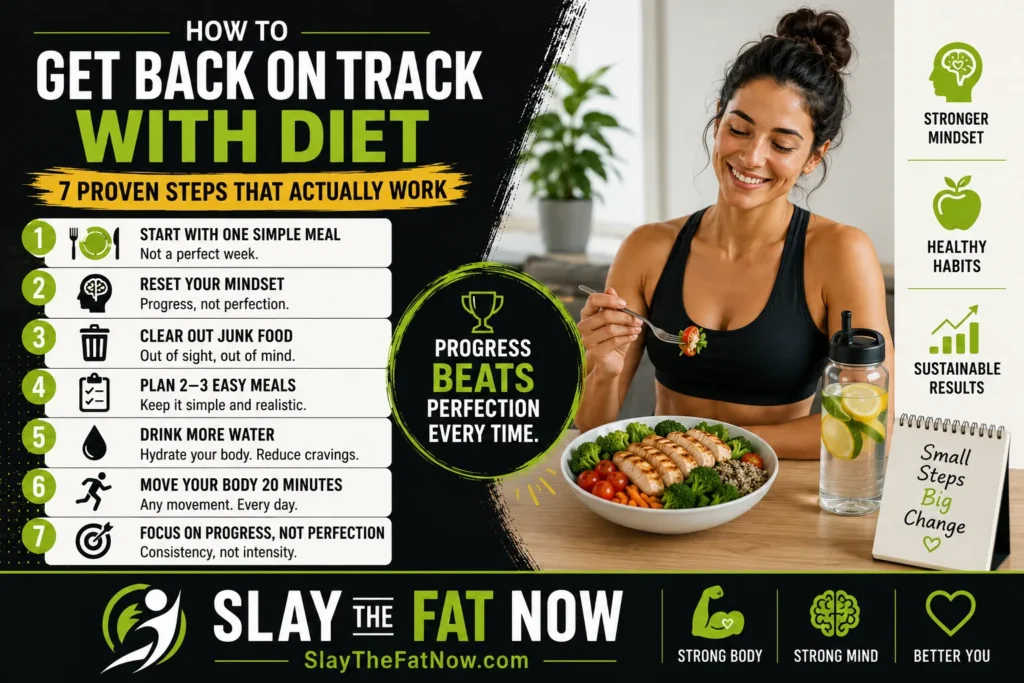
To get back on track with your diet, start with one simple meal not a perfect week. Reset your mindset, clear out junk food, plan two to three easy meals, drink more water, and move your body for 20 minutes. Progress beats perfection every time. Consistency, not intensity, is what restarts a weight loss journey.
You Didn’t Fail. You Just Stopped for a While.
It starts with one bad day. Then the weekend happens. Then a birthday. Then two weeks go by and you’ve somehow undone six weeks of hard work or at least it feels that way.
Sound familiar? You’re not broken. You’re human.
The biggest lie in the weight loss world is that slipping up means starting over. It doesn’t. But here’s what actually kills progress: the all-or-nothing thinking that convinces you to wait until Monday. Or January. Or after the holidays. Or after that work trip.
If you’ve been waiting for a sign to figure out how to get back on track with diet, this is it. No shame, no lectures just a clear, step-by-step guide built for real life.
What “Getting Back on Track” Actually Means
Getting back on track with your diet isn’t about punishment or restriction. It’s about rebuilding momentum one decision at a time.
Whether you’re trying to restart your weight loss journey after a binge, a stressful month, or just general life chaos, the process is the same: small resets, not dramatic overhauls.
In this guide, you’ll learn:
- The fastest way to mentally reset after going off track
- 7 practical steps to restart your weight loss journey today
- The common mistakes that keep people stuck in the same cycle
- Real strategies that work long-term, not just for a week
Whether you’ve been off for three days or three months, these steps will work.
Why Getting Back on Track Matters More Than You Think
Most people underestimate how quickly consistency compounds. When you get back on track with your diet even imperfectly several things happen at once:
- Your metabolism stabilizes. Erratic eating patterns spike cortisol and disrupt insulin sensitivity. Getting consistent again helps your body burn fat more efficiently.
- Your hunger hormones rebalance. Ghrelin (hunger hormone) calms down within 3–5 days of structured eating, making cravings easier to resist.
- Your mental health improves. The guilt spiral from being “off track” is one of the biggest barriers to weight loss. Restarting breaks that cycle immediately.
- You build the habit muscle. Every time you get back on track no matter how many times it takes you make it slightly easier the next time.
The goal isn’t perfection. The goal is getting back faster every time you fall off.
What the Research Says About Diet Setbacks
65% of people who lose weight regain it within one year but nearly all of those regain it because they stopped rather than because their plan didn’t work. (National Institute of Diabetes and Digestive and Kidney Diseases)
According to the CDC, even a 5–10% reduction in body weight leads to meaningful improvements in blood pressure, cholesterol, and blood sugar meaning getting partially back on track still delivers real health results.
A 2020 study published in Obesity Reviews found that people who practiced self-compassion after dietary lapses were significantly more likely to stay on a diet long-term compared to those who responded with guilt or shame.
Key stat: The average person makes over 200 food decisions per day (Cornell University research). Getting back on track doesn’t require getting all 200 right just enough of them.
Also, a 2022 survey by the International Food Information Council found that 52% of Americans said improving their diet is a top health goal but most struggle with consistency, not knowledge. You’re not alone.
A Real-Life Reset Story
Meet Sarah a 34-year-old nurse from Ohio. She lost 22 pounds over four months by tracking calories and doing evening walks. Then her hospital schedule changed to night shifts.
Within six weeks, she’d gained back 11 pounds. She stopped tracking, started ordering takeout on every shift, and told herself she’d “restart after things settle down.”
Three months later, nothing had settled down. But she made one decision: she prepped two days of lunches on Sunday just protein and vegetables. No calorie tracking, no gym. Just two days of intentional meals.
By week two, she added breakfast planning. By week three, she was back to evening walks three times a week. Four months later, she’d re-lost those 11 pounds and was down another 9.
“I stopped waiting to feel motivated. I just did the smallest possible thing and let it snowball.” Sarah, Ohio
That’s the entire playbook: start smaller than you think you need to.
Ready to Restart Your Weight Loss Journey?
Get our free 7-Day Diet Reset Plan built for people who’ve fallen off track and need a realistic, step-by-step restart. No extreme diets. No guilt trips. Just a plan that actually fits real life.👉 Grab My Free Reset Plan
What Actually Works: Expert Insight on How to Get Back on Track with Diet
After studying hundreds of weight loss journeys successful and failed a few patterns repeat over and over.
The People Who Stay on Track Have One Thing in Common
They don’t have more willpower. They have better systems. They’ve removed decisions from the equation meal prep on Sunday, a go-to breakfast, two or three “default” lunches. The fewer decisions they make about food, the less likely they are to make a bad one.
The People Who Keep Restarting Fall Into These Traps
- Starting too aggressively. 1,200 calories. Two hours at the gym. Cold turkey on sugar. That’s not a restart it’s a sprint to burnout.
- Waiting to feel ready. Motivation follows action, not the other way around. You won’t feel motivated until you start moving.
- Treating a lapse as a failure. One bad meal is not a bad diet. It’s just a bad meal. The research is clear: recovery speed predicts long-term success far more than perfection.
- Trying to make up for lost time. Crash dieting after a binge creates a binge-restrict cycle that makes long-term weight loss almost impossible.
What the Most Successful Restarters Do Differently
They treat every restart like it’s the first time without the baggage of past “failures.” They focus on the next 24 hours, not the next three months. And they ask one question every day: “What’s the one thing I can do today that my future self will thank me for?”
Let’s Be Honest: Things No One Tells You About Getting Back on Track
You Probably Didn’t Gain as Much Fat as You Think
After a binge or a rough few weeks, the scale spikes sometimes dramatically. But most of that weight is water, glycogen, and food volume, not actual fat. A true pound of fat requires roughly 3,500 calories above your needs. Three bad days won’t undo months of progress in terms of real fat gain.
The First Week Back Is the Hardest
Cravings will be loud. Energy might be low. You may feel like it isn’t working. That’s normal. The body adjusts in 5–10 days. Push through week one and the second week becomes significantly easier.
You Can’t Out-Exercise a Bad Diet
Exercise is powerful for health, metabolism, and mood but it doesn’t outweigh eating habits when it comes to fat loss. A 45-minute run burns about 400–500 calories. A single fast-food meal adds that right back. Food choices drive 80% of weight loss results.
Quick Fixes Won’t Fix the Underlying Pattern
Detoxes, cleanses, and extreme calorie cuts may produce fast early results but they don’t change the habits that led to going off track in the first place. Sustainable fat loss requires sustainable habits.
7 Steps to Get Back on Track with Your Diet Starting Today
Step 1: Drop the All-or-Nothing Mindset
Your diet doesn’t need to be perfect to work. Eating one healthy meal is infinitely better than eating zero because you “already blew it.” Reframe: done is better than perfect. 80% consistency beats 100% intention every time.
Step 2: Clean Up Your Environment
You won’t out-willpower a kitchen full of junk. Remove the worst offenders (the chips, cookies, sugary drinks) and stock easy defaults boiled eggs, Greek yogurt, fruit, pre-washed vegetables, canned tuna, rice cakes. If the healthy choice is the easy choice, you’ll make it more often.
Step 3: Eat Protein First
Protein is the most satiating macronutrient. Prioritizing it at every meal 25–40 grams reduces overall calorie intake naturally by keeping hunger at bay. Aim for chicken, eggs, fish, cottage cheese, or Greek yogurt at every meal before anything else hits the plate.
Step 4: Track What You Eat for Three Days
You don’t need to track forever. But tracking for 3 days after a reset is eye-opening. Most people underestimate their intake by 400–600 calories per day. Use a free app like MyFitnessPal or Cronometer to get a realistic view of what you’re actually consuming.
Step 5: Move Your Body Every Day (Not Necessarily the Gym)
A 20-minute walk after dinner does three powerful things: it burns calories, blunts the blood sugar spike from your meal, and signals to your brain that you’re in “healthy mode.” You don’t need a perfect workout to get back on track. Just move.
Step 6: Plan Two to Three Days of Meals in Advance
Hunger + no plan = bad decision. Every time. Even a loose plan “Breakfast: eggs and toast. Lunch: salad with chicken. Dinner: stir fry” removes the decision fatigue that derails most diets. You don’t need to prep all seven days. Start with two.
Step 7: Restart Your Weight Loss Journey with a Specific Goal
Vague goals fail. “I want to eat healthier” is not a plan. “I want to lose 1–1.5 pounds per week by eating 1,800 calories daily and walking 8,000 steps” is a plan. Write it down. Put it somewhere visible. Make the goal specific enough that you know when you’ve hit it each day.
Back on Track After Binge vs. Restart After Months Off: What’s the Difference?
| Situation | What Happened | Best Approach | Timeline to Feel on Track |
|---|---|---|---|
| Back on track after binge (1–3 days) | Overate for a short stretch | Return to normal eating immediately. Don’t restrict. Hydrate well. Move gently. | 2–4 days |
| Off track for 1–4 weeks | Consistent poor choices, minimal exercise | Reset one meal at a time. Reintroduce structure gradually. No crash dieting. | 1–2 weeks |
| Off track for months | Habits fully reverted, significant regain | Treat it as a fresh start. Go back to basics. Rebuild slowly. Seek accountability. | 3–6 weeks to full momentum |
| Chronic yo-yo pattern | Repeated binge-restrict cycles | Focus on behavior change, not weight. Consider working with a dietitian or coach. | Varies mindset work is key |
Which Approach Works Best Long-Term?
Regardless of how long you’ve been off track, the approach that works best long-term is the one you can sustain. A moderate calorie deficit (300–500 calories below maintenance), high protein, daily movement, and consistent sleep is the formula that produces fat loss without the brutal yo-yo cycle.
Explore our sustainable weight loss plan guide for a full breakdown of what “long-term” actually looks like.
Frequently Asked Questions: How to Get Back on Track with Diet
How do I get back on track with my diet after a week of bad eating?
Start with your very next meal, not your next Monday. Eat a high-protein meal, drink a glass of water, and go for a short walk. Don’t try to compensate by restricting just return to your normal healthy eating plan and let the momentum rebuild over 3–5 days.
How long does it take to get back on track with diet after a binge?
Most people feel physically back on track within 2–4 days after a binge. The bloating, cravings, and energy dips usually stabilize by day three, especially if you hydrate well, eat clean protein and vegetables, and move your body daily.
Should I fast after overeating to get back on track?
No. Fasting after a binge typically triggers another binge by intensifying hunger and cravings. Instead, return to your regular meal schedule and calorie targets. Compensatory restriction is one of the biggest drivers of the binge-restrict cycle.
What’s the easiest way to restart a weight loss journey?
The easiest restart is the one you’ll actually do. Choose one small, concrete action planning tomorrow’s breakfast, drinking more water, or walking 15 minutes today. Don’t try to overhaul everything at once. Build momentum with one decision and stack from there.
Is it normal to gain 5–10 pounds after going off diet?
Yes, and most of it isn’t real fat. After going off a lower-carb or calorie-controlled diet, your body retains more glycogen and water. A 5-pound scale jump in a week rarely represents more than 1–2 pounds of actual fat. The rest drops quickly once you return to your plan.
How do I stop emotional eating from derailing my diet?
Identify your emotional eating triggers stress, boredom, social pressure and create a “pause plan.” Before eating emotionally, do something for two minutes: drink water, go outside, text a friend. Putting a gap between the urge and the action reduces emotional eating significantly over time.
Can I lose weight without going to the gym after falling off track?
Absolutely. Weight loss is primarily driven by diet, not exercise. Daily walking, bodyweight exercises at home, and cleaning up your eating habits will produce real results without a gym membership. Exercise accelerates progress and improves health, but it’s not required to lose weight.
What should I eat the day after a binge?
Eat normally. Focus on lean protein, vegetables, and whole foods. Drink plenty of water. Avoid alcohol and high-sodium processed foods that worsen bloating. Don’t skip meals you need steady blood sugar to avoid triggering more cravings.
How do I stay motivated to stick to my diet?
Stop relying on motivation it’s unreliable. Instead, build systems: meal prep, scheduled workouts, a food diary, and an accountability partner. Motivation shows up after you take action, not before. Design your environment to make healthy choices the path of least resistance.
What foods help reset your diet after going off track?
Focus on water-rich vegetables (cucumber, leafy greens, zucchini), lean proteins (chicken, fish, eggs), and high-fiber foods (oats, legumes, berries). These reduce bloating, stabilize blood sugar, and curb cravings making it easier to stay consistent in the days after a setback.
How many calories should I eat to restart weight loss?
A safe deficit for weight loss is 300–500 calories below your Total Daily Energy Expenditure (TDEE). This produces roughly 0.5–1 pound of fat loss per week without extreme restriction. Use a TDEE calculator to find your number, then subtract 400–500 calories as a starting point.
Is meal prepping necessary to get back on track?
Not required, but highly effective. Even prepping just two meals in advance dramatically reduces the chance of making poor food choices when hungry. Start with one batch of protein (grilled chicken or hard-boiled eggs) and pre-cut vegetables that’s often enough to anchor your week.
How do I get back on track with diet while traveling or eating out?
Choose protein and vegetable-forward options at restaurants, skip the bread basket, drink water instead of soda or alcohol, and avoid appetizers and desserts unless it’s a special occasion. You can stay broadly on track while traveling without obsessing over every meal.
How do I know if I’m actually back on track vs. just starting the cycle again?
You’re truly back on track when you’re focused on building habits not just losing weight fast. Signs: you’re eating consistently, not perfectly; you’re not white-knuckling cravings; and you feel calm about food rather than anxious. If you’re in restriction mode and dreading every meal, that’s not sustainable that’s setup for another cycle.
What’s the difference between a diet reset and starting over?
A diet reset means you acknowledge a disruption and course-correct while keeping your overall goals intact. Starting over implies erasing progress, which is rarely accurate. Think of it as hitting pause, not delete. Your previous weeks of healthy eating still count you’re just picking up where you left off.
🔥 Your Reset Starts Right Now
You’ve read the guide. You know what to do. The only step left is doing it and the first step is smaller than you think.
At SlayTheFatNow, we help real people with real schedules, real cravings, and real setbacks finally make weight loss stick. No extreme diets. No judgment. Just practical tools that work.👉 Start My Weight Loss Reset Today
Sources:
1. National Institute of Diabetes and Digestive and Kidney Diseases — Weight Management
2. Centers for Disease Control and Prevention — Healthy Weight Loss
3. Lillis, J., et al. (2020). Self-compassion and dietary lapse recovery. Obesity Reviews.
4. Wansink, B. (Cornell University) — Food Decision Research, 2006–2015.
