 Skip to content
Calorie Deficit for Weight Loss: The Proven 5-Step Method (No Crash Diets)
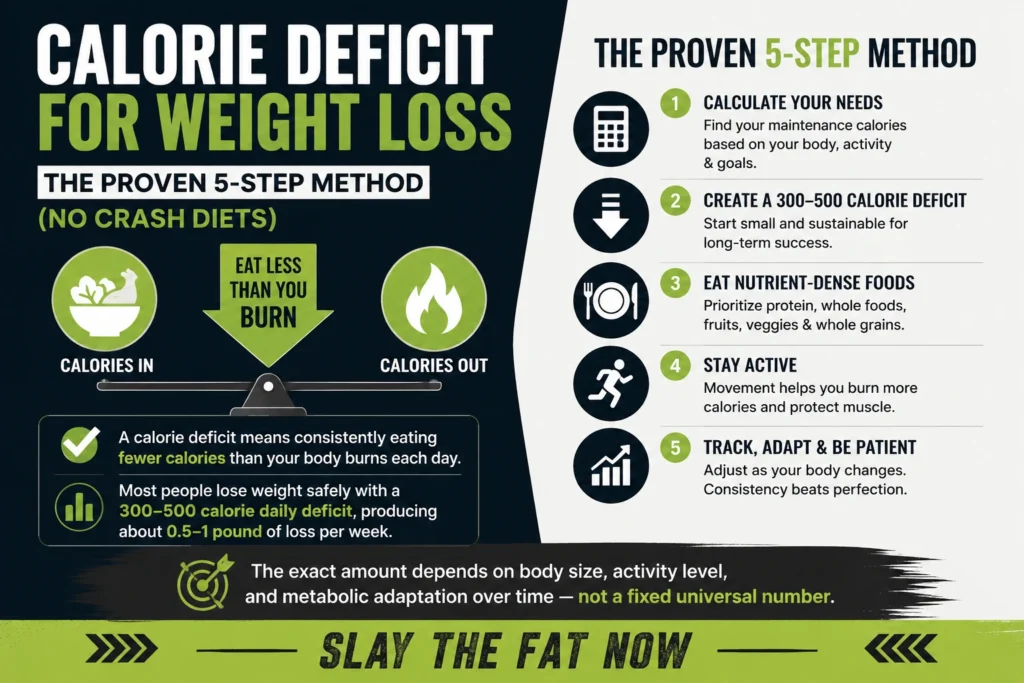
A calorie deficit for weight loss means consistently eating fewer calories than your body burns each day. Most people lose weight safely with a 300–500 calorie daily deficit, producing about 0.5–1 pound of loss per week. The exact amount depends on body size, activity level, and metabolic adaptation over time not a fixed universal number.
The Math You Were Taught Is Wrong
You’ve probably heard it a hundred times: cut 500 calories a day, lose a pound a week, simple math. So you did exactly that. You tracked every bite. You hit your number almost every day.
And six months in, the math stopped working. The pounds that came off easily in month one slowed to a crawl by month four, even though you hadn’t changed a thing.
Here’s what nobody explained: the famous “3,500 calories equal one pound” rule isn’t just oversimplified researchers have shown it actively overestimates real-world results once your body adapts. A calorie deficit for weight loss is real, and it works, but it’s not the fixed equation you were sold. It’s a moving target, and once you understand why, you stop blaming yourself for biology doing exactly what biology does.
What a Calorie Deficit for Weight Loss Actually Is
A calorie deficit for weight loss happens when you consistently consume fewer calories than your body needs to maintain its current weight, forcing it to pull the difference from stored energy primarily body fat. It sounds simple, and at the core, it is. But how you create that deficit determines whether you lose mostly fat or a frustrating mix of fat, muscle, and water.
In this guide, you’ll learn:
- Why the old 3,500-calorie rule is misleading, according to NIH research
- How to calculate a calorie deficit for weight loss that’s realistic for your body
- What actually happens metabolically once you sustain a deficit for weeks or months
- A real example of how deficit size affects results over time
- The exact steps to build a deficit you can sustain and the mistakes that wreck it
Why Getting Your Calorie Deficit Right Matters
This isn’t just a numbers exercise. Getting your calorie deficit for weight loss right instead of guessing changes real outcomes:
- Results: A deficit that’s too aggressive often costs you muscle, not just fat, leaving you lighter but not necessarily leaner.
- Time: Understanding metabolic adaptation means you stop wasting months wondering why “the same plan” stopped working.
- Health: The National Heart, Lung, and Blood Institute notes that diets under 800 calories per day require medical supervision and aren’t more effective long-term than moderate deficits.
- Long-term impact: A deficit you can actually sustain for months beats a brutal one you abandon after two weeks, every single time.
The Research Behind Calorie Deficit for Weight Loss
This is where most weight loss advice quietly falls apart and where the real science gets interesting:
- A 2013 commentary in the International Journal of Obesity, by NIH researcher Kevin Hall and colleagues, demonstrated that the 3,500-calorie-per-pound rule significantly overestimates real-world weight loss because it ignores metabolic adaptation over time.
- The National Heart, Lung, and Blood Institute recommends a deficit of 300 to 500 calories per day for most adults with overweight, which typically produces roughly 0.5 pounds of weight loss per week.
- NHLBI guidelines also note that an average of 8% of body weight can realistically be lost over a 6-month period using moderate calorie deficits.
- Research modeling from Hall’s NIH lab shows that for every 10 calories cut per day through quantity restriction alone, the body loses roughly 1 pound over about 3 years with about half of that loss occurring in year one a far cry from the simplistic 3,500-calorie math.
- The thermic effect of food differs by macronutrient: protein burns roughly 20–30% of its own calories during digestion, compared to 5–10% for carbohydrates and 0–3% for fat, meaning the composition of your deficit matters, not just the size.
Sources: NIH/NHLBI, International Journal of Obesity, NIH Body Weight Planner research full citations in the FAQ section below.
The bottom line: a calorie deficit for weight loss isn’t a fixed equation you set once. It’s a dynamic process your body actively resists the longer you maintain it.
A Real Example: Two Deficits, Two Very Different Outcomes
Consider “Rachel” and “Dana,” a composite comparison reflecting a pattern seen constantly in real coaching scenarios. Both wanted to lose 30 pounds.
Rachel cut 1,000 calories a day immediately, eating around 1,200 total. She lost 12 pounds in the first month fast, motivating, exciting. By month three, she was exhausted, missing workouts, and had regained 6 pounds after a single rough week derailed her entirely.
Dana cut a more moderate 450 calories a day, staying near 1,650 calories with higher protein intake. Her first month showed only 5 pounds lost slower, less exciting. But by month six, she’d lost 24 pounds total, kept her energy and strength up, and hadn’t needed a single “reset” week.
Same goal. Same calorie math taught in school. Wildly different results, because one deficit was sustainable and one wasn’t.
Expert Insight: What Actually Determines Success With a Calorie Deficit
After years of watching people set up a calorie deficit for weight loss, the pattern repeats constantly: the size of the deficit matters far less than whether someone can actually sustain it.
1. Moderate deficits outlast aggressive ones
A 300–500 calorie deficit feels almost unnoticeable day to day, which is exactly why it survives birthdays, bad weeks, and busy months that destroy more extreme plans.
2. Protein protects the outcome you actually want
Without adequate protein, a calorie deficit pulls from muscle as readily as fat. Higher protein intake during a deficit consistently preserves more lean mass, so the weight lost is more fat, less muscle.
3. The deficit needs to shrink as you do
A smaller body needs fewer calories to maintain itself. The 500-calorie deficit that worked at 200 pounds often needs adjusting by the time you reach 170, simply because your maintenance calories dropped too.
Reality Check: Myths About Calorie Deficit for Weight Loss
Myth: “3,500 calories always equals exactly one pound of fat.”
Reality: NIH research has shown this rule overestimates long-term results because it ignores how metabolism adapts as you lose weight and change body composition.
Myth: “A bigger deficit always means faster, better results.”
Reality: Very low-calorie diets under 800 calories per day aren’t more effective than moderate deficits long-term, and they significantly raise the risk of muscle loss and rebound weight gain.
Myth: “If I’m not losing weight, my deficit isn’t big enough.”
Reality: Often the issue is metabolic adaptation, inconsistent tracking, or water retention not an insufficient deficit. Cutting further can backfire before it helps.
Myth: “All calorie deficits produce the same kind of weight loss.”
Reality: A deficit without enough protein or resistance training tends to cost more muscle, while a well-structured deficit preserves lean mass and targets fat more specifically.
Practical Advice: How to Build a Calorie Deficit for Weight Loss That Lasts
Do this:
- Start with a moderate 300–500 calorie deficit. This range, recommended by NHLBI guidelines, balances real progress with long-term sustainability.
- Prioritize protein at every meal. Aim for a protein-forward plate to protect muscle mass while in a deficit.
- Recalculate every 10–15 pounds lost. Your maintenance calories drop as your body shrinks, so your deficit needs periodic adjustment.
- Track consistently, not perfectly. A rough but consistent log beats an exact log you abandon after a week.
- Add movement instead of only cutting food. Combining activity with a moderate deficit reduces how much you need to restrict calories alone.
Avoid this:
- Dropping below 1,200 calories (women) or 1,500 calories (men) without medical guidance.
- Treating one stalled week as proof your deficit isn’t big enough.
- Cutting calories aggressively while ignoring protein intake entirely.
- Keeping the same calorie target for six months straight without ever recalculating.
Want help building a deficit you can actually stick to? Explore our 1:1 weight loss coaching program, built around sustainable calorie deficits, not crash diets.
Comparison: Which Calorie Deficit Approach Fits You?
| Deficit Size | Daily Cut | Typical Weekly Loss | Sustainability | Muscle Loss Risk |
|---|---|---|---|---|
| Mild | 150–250 kcal | 0.25–0.5 lb | Very high | Low |
| Moderate (recommended) | 300–500 kcal | 0.5–1 lb | High | Low–Medium |
| Aggressive | 700–1,000 kcal | 1–2 lb | Low | Medium–High |
| Very low-calorie diet | Under 800 kcal total | Highly variable | Very low | High (medical supervision required) |
For most people, the moderate range is the sweet spot enough of a calorie deficit for weight loss to see consistent progress, without the burnout that derails aggressive plans.
Frequently Asked Questions About Calorie Deficit for Weight Loss
What is a calorie deficit for weight loss?
A calorie deficit for weight loss happens when you eat fewer calories than your body burns each day, prompting it to use stored fat for energy over time.
How many calories should I cut to lose weight?
Most adults see safe, sustainable results with a 300 to 500 calorie daily deficit, which typically produces about 0.5 to 1 pound of weight loss per week according to NIH guidelines.
Is the 3,500-calorie rule for losing a pound accurate?
No. NIH research has shown this rule overestimates real-world weight loss because it doesn’t account for metabolic adaptation as your body composition changes.
How do I calculate my calorie deficit?
Start by calculating your maintenance calories (the amount needed to maintain current weight), then subtract 300 to 500 calories to create a moderate, sustainable deficit.
Can I lose weight with a small calorie deficit?
Yes. Even a modest 150 to 250 calorie deficit produces gradual fat loss over time and tends to be far easier to sustain than larger, more aggressive cuts.
Why did my weight loss slow down on the same calorie deficit?
This is typically metabolic adaptation as you lose weight, your body needs fewer calories to maintain itself, which gradually shrinks the size of your original deficit.
Is a 1,000-calorie deficit too aggressive?
For many people, yes. Deficits this large increase the risk of muscle loss, fatigue, and rebound weight gain, and are generally less sustainable than moderate deficits.
Does protein intake matter during a calorie deficit?
Yes, significantly. Higher protein intake during a deficit helps preserve muscle mass, meaning more of the weight lost comes from fat rather than lean tissue.
How often should I recalculate my calorie deficit?
Recalculate roughly every 10 to 15 pounds lost, since your maintenance calorie needs decrease as your body weight decreases.
What’s the lowest safe calorie deficit for weight loss?
Diets below 800 total calories per day require medical supervision, and NHLBI guidelines note they aren’t more effective long-term than moderate, well-structured deficits.
Does exercise help create a calorie deficit faster?
Yes. Combining physical activity with a moderate dietary calorie deficit reduces how much you need to restrict food alone, and is generally considered more effective for weight loss.
Why am I not losing weight despite being in a calorie deficit?
Common causes include inconsistent tracking, underestimated portion sizes, water retention masking fat loss, or a deficit that’s shrunk due to metabolic adaptation since you started.
Is it better to cut calories or increase activity for a deficit?
Most research and clinical guidelines favor combining both calorie reduction and physical activity, rather than relying entirely on one approach for your calorie deficit.
How long does it take to see results from a calorie deficit?
Visible results often take 3 to 4 weeks since early scale changes reflect water and glycogen shifts more than fat loss, which becomes more apparent over the following weeks.
Can a calorie deficit damage my metabolism long-term?
Extreme or prolonged deficits can produce lasting metabolic adaptation, but moderate, well-structured deficits combined with adequate protein and activity are not associated with permanent metabolic damage.
Your Next Step
A calorie deficit for weight loss isn’t about finding the perfect number once and never adjusting it. It’s about building a deficit you can sustain through busy weeks, slow months, and the inevitable plateau and adjusting it as your body changes.
Start moderate. Track consistently. Recalculate as you go.
Sources cited:
National Heart, Lung, and Blood Institute (NHLBI) clinical guidelines;
NIH researcher Kevin Hall’s published commentary in the International Journal of Obesity (2013);
