 Skip to content
7 Powerful Weight Loss Identity Habits That Actually Rewire Your Brain
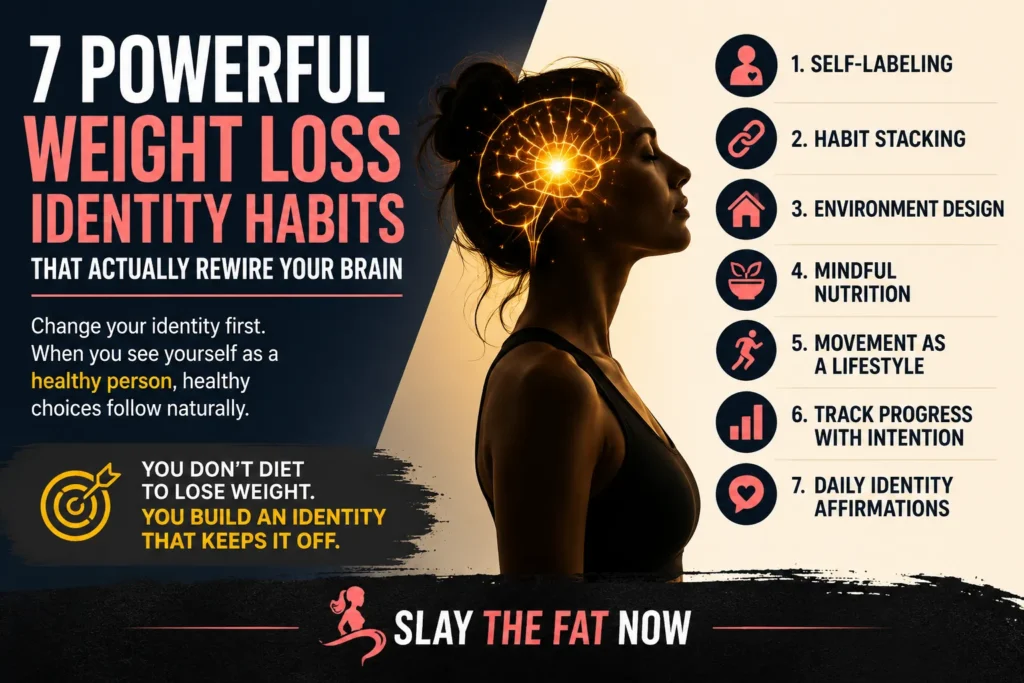
Weight loss identity habits are daily behaviors and mindset patterns that shift how you see yourself from someone trying to lose weight to someone who is a healthy person. When you change your identity first, healthy choices follow naturally. The 7 core habits include self-labeling, habit stacking, environment design, and tracking progress with intention.
The Real Reason Your Weight Loss Efforts Keep Failing
You’ve tried the diets. You’ve done the 30-day challenges. You’ve tracked every calorie, bought every supplement, and still the weight comes back. Or worse, it never leaves.
Here’s what no one tells you: the problem isn’t your meal plan. It’s your identity.
Most people try to change their behavior without changing who they believe they are. They say, “I’m trying to eat healthier,” instead of “I am a healthy person.” That single shift in language is backed by behavioral science and it’s the foundation of every lasting transformation I’ve seen.
In this article, you’ll discover exactly what weight loss identity habits are, why they work when everything else fails, and how to build them starting today.
What Are Weight Loss Identity Habits?
Weight loss identity habits are behaviors that reinforce a new self-image one rooted in health, discipline, and long-term thinking. The concept comes from behavioral psychology and was popularized by James Clear in Atomic Habits, but the science goes much deeper.
Instead of asking “What do I need to do to lose weight?” you start asking “What would a healthy person do in this moment?” That reframe changes everything your food choices, your movement, your sleep, and even your social decisions.
Think of it as building your weight loss from the inside out, not the outside in.
We’ll cover the 7 most effective identity-based habits, the research supporting them, and a step-by-step implementation plan you can start this week.
Why Weight Loss Identity Habits Outperform Every Diet
Diets are external rules. Identity habits are internal truth. Here’s why that distinction matters for your results:
- They’re self-sustaining. When a behavior matches who you believe you are, you don’t need willpower to maintain it.
- They compound over time. Small identity-consistent actions build momentum that diets can’t replicate.
- They reduce decision fatigue. A person who identifies as a non-junk-food-eater doesn’t debate whether to order fries. The decision is already made.
- They prevent relapse. Slipping once doesn’t erase your identity so you bounce back faster.
- They create a mindset shift for weight loss that makes the process feel natural, not punishing.
What the Research Actually Says About Identity and Weight Loss
- A study published in the Journal of Consumer Research found that people who said “I don’t eat that” were more successful at resisting temptation than those who said “I can’t eat that” a 64% higher success rate.
- According to the CDC, only 1 in 5 people who lose weight keep it off for more than a year mostly those who built consistent behavioral systems, not short-term diets.
- Research from the University of Scranton shows that 92% of people who set weight loss goals as intentions (not identity) fail by February.
- A 2021 meta-analysis found that self-concept-based interventions produced 2x more sustained behavior change than motivation-only approaches.
The takeaway is clear: changing your identity isn’t soft science it’s the most evidence-backed strategy for lasting weight loss habits.
Real-World Example: How Marcus Lost 47 Pounds Without Counting Calories
Marcus, a 38-year-old project manager from Austin, Texas, had tried six different diets in four years. He’d lose 10–15 pounds, hit a plateau, get frustrated, and gain it all back plus a few extra pounds each time.
When he finally stopped focusing on what to eat and started asking “Who do I want to become?”, everything changed. He told himself: “I’m someone who moves every day and eats food that fuels me.”
He didn’t join a gym immediately. He started with a 10-minute walk every morning because “that’s what healthy people do.” He swapped his morning soda for water not because of calories, but because “that’s who I am now.”
Six months later: 47 pounds gone. More importantly, he stopped thinking about it as weight loss. He was just living like himself.
That’s the power of a mindset shift for weight loss built on identity, not restriction.
Ready to Shift Your Identity and Finally Lose the Weight?
Get our free 7-Day Weight Loss Mindset Reset proven daily prompts that rewire how you think about food, fitness, and yourself. 🔥 Grab My Free Reset Plan
7 Weight Loss Identity Habits That Create Real Change
After studying thousands of transformation stories and the underlying behavioral science, here are the 7 identity habits that consistently produce results:
1. Adopt the “I Am” Language Pattern
Replace “I’m trying to” with “I am.” Say “I am someone who exercises regularly” even before you fully believe it. Neurologically, this activates different neural pathways than goal-setting language. Write it down every morning. It feels awkward at first. Do it anyway.
2. Design Your Environment Like a Healthy Person Would
A healthy-identity person doesn’t rely on willpower they remove friction. Keep fruits visible on the counter. Move the junk to the back of the pantry (or don’t buy it). Lay out your workout clothes the night before. Your environment votes for or against your identity every single day.
3. Build a “Never Miss Twice” Rule
Missing one workout doesn’t make you a lazy person. Missing two in a row starts rewriting your identity. The never-miss-twice rule is one of the most powerful weight loss habits because it protects your self-image after slipping. One bad day is a blip. Two bad days is a pattern.
4. Use Habit Stacking to Anchor New Behaviors
Attach new healthy habits to existing ones. “After I brew my morning coffee, I drink 16 oz of water first.” “After I sit down at my desk, I spend 2 minutes planning my meals.” Habit stacking builds an automatic, identity-consistent daily rhythm without requiring extra motivation.
5. Track Behavior, Not Just Weight
Your weight fluctuates daily based on water, hormones, and digestion. If you only track the number, you’ll constantly feel defeated. Track identity-affirming behaviors instead: Did I move today? Did I drink my water? Did I sleep 7+ hours? These wins reinforce your identity and build lasting weight loss habits.
6. Find Your “Why” That’s Bigger Than a Number
Nobody stays consistent for a pants size. They stay consistent because they want to play on the floor with their kids, hike the Grand Canyon, or feel confident in their own skin. Your weight loss mindset must be rooted in something emotionally real not an arbitrary number on a scale.
7. Join a Community That Reflects Your New Identity
We become who we surround ourselves with. If everyone in your social circle eats fast food and skips workouts, your identity will drift back. Find people online or in person who embody the person you’re becoming.
The Honest Truth: What Weight Loss Identity Habits Won’t Do
⚠️ Reality Check: Identity habits are not magic. They don’t override a severe caloric surplus, untreated hormonal conditions, or chronic sleep deprivation. They are a foundation not a replacement for sound nutrition and movement.
Here are a few myths worth breaking:
- Myth: “Just believe you’re healthy and the weight falls off.” No. Identity change primes better decisions, but you still need to eat, move, and sleep well.
- Myth: “You have to feel motivated to start.” Wrong. Action precedes motivation. Start acting like the person you want to become the feeling follows.
- Myth: “Identity habits work overnight.” Research suggests it takes 18–254 days to form a habit (average 66 days). Be patient with the process.
- Myth: “This is just positive thinking.” Identity-based habit formation is backed by decades of behavioral science it’s cognitive restructuring, not wishful thinking.
How to Start Building Weight Loss Identity Habits This Week
What To Do:
- Write 3 “I am” statements that describe your future self. Read them every morning.
- Pick ONE habit to stack onto an existing routine this week don’t overhaul everything.
- Redesign one environment your kitchen counter, your desk, or your bedroom to support your new identity.
- Create a behavioral tracking sheet (not just a scale log). Check off 3 identity-affirming actions daily.
- Find an accountability partner or join an online community aligned with your goals.
What To Avoid:
- Trying to change 10 habits at once it dilutes identity reinforcement.
- Weighing yourself every day and letting the number define your identity.
- Waiting until you “feel ready” readiness is a feeling; identity is a decision.
- Using negative self-talk after slipping it reinforces the old identity.
Identity-Based Habits vs. Traditional Dieting: A Side-by-Side Comparison
| Factor | Traditional Dieting | Weight Loss Identity Habits |
|---|---|---|
| Motivation source | External rules & willpower | Internal identity & values |
| Sustainability | Short-term (weeks to months) | Long-term (years to lifetime) |
| Relapse recovery | Often leads to full relapse | Bounces back quickly (“never miss twice”) |
| Mental burden | High (constant decisions) | Low (automatic behaviors) |
| Requires perfect adherence? | Yes, one cheat day = failure | No imperfection is expected |
| Focus | What you eat | Who you are becoming |
| Starting point | Behavior change | Belief change → behavior change |
Frequently Asked Questions About Weight Loss Identity Habits
What are weight loss identity habits?
Weight loss identity habits are daily behaviors anchored in a new self-image the belief that you are already a healthy person. Instead of forcing behavior change through rules, you make choices that feel consistent with who you believe yourself to be.
How long does a mindset shift for weight loss actually take?
Research from University College London found that habits take an average of 66 days to become automatic, with a range of 18 to 254 days depending on complexity. Identity shifts can begin immediately but solidify gradually through consistent action.
Can changing my identity actually make me lose weight?
Yes indirectly. Identity change influences behavior consistently, and consistent behavior drives weight loss. Studies show identity-based interventions produce more sustained results than motivation or restriction-only approaches.
What is the most important weight loss habit to build first?
Start with your identity statement. Write down who you want to become and read it daily. This primes every other habit by giving it a reason to exist. From there, focus on one behavioral habit consistent movement or consistent hydration before adding more.
What is the “I don’t” vs “I can’t” approach in weight loss?
Research shows that saying “I don’t eat junk food” is significantly more effective than “I can’t eat junk food.” The former reflects a choice rooted in identity; the latter reflects an external restriction. Identity language empowers; restriction language creates resentment and eventual rebellion.
Do I need to feel motivated to build weight loss identity habits?
No. Motivation follows action, not the other way around. Start with the smallest identity-consistent action a 5-minute walk, a glass of water and let the feeling catch up. Waiting to feel motivated is one of the biggest barriers to lasting change.
How do I stop self-sabotaging my weight loss?
Self-sabotage usually happens when your behaviors conflict with your current self-image. If you still see yourself as “someone who always gains weight back,” you’ll unconsciously act consistently with that belief. Rebuilding your identity at the core through journaling, affirmations, and community breaks the cycle.
What is habit stacking in weight loss?
Habit stacking means attaching a new behavior to an existing routine. For example: “After I brush my teeth, I drink a full glass of water.” It works because the existing habit acts as an automatic trigger, reducing the effort needed to start the new behavior.
Should I track weight or behaviors when losing weight?
Track both but prioritize behavior tracking, especially early on. Behavior metrics (days exercised, water consumed, hours slept) are within your control and reinforce your identity. The scale number varies daily due to water, hormones, and digestion, and can be discouraging if used as your only measure.
Is a mindset shift for weight loss enough on its own?
No but it’s the most important starting point. A mindset shift without action produces no results. However, action without a mindset shift rarely lasts. The combination of a changed identity and consistent behavior is what drives permanent transformation.
How do I build a weight loss mindset when I keep failing?
Reframe what failure means. Every slip is evidence you’re in the process of change, not proof that you can’t change. Adopt the “never miss twice” rule, write in a daily reflection journal, and surround yourself with people who reinforce your new identity. Failure only counts if you stop.
What role does environment play in weight loss habits?
Environment is one of the most underestimated drivers of behavior. A well-designed environment makes healthy choices the default visible fruit, prepped meals, workout clothes by the door. A poorly designed environment forces you to fight temptation constantly. Change your environment to support your identity, not compete with it.
Can social media help or hurt weight loss identity habits?
Both. Following accounts that model the identity you’re building can be deeply motivating and reinforce your self-image. But comparing your Chapter 3 to someone’s Chapter 30 can erode confidence. Curate your feed intentionally follow people who inspire action, not unrealistic ideals.
Do I need to join a gym to build weight loss identity habits?
Absolutely not. The gym is a tool, not a requirement. What matters is consistent movement that aligns with your identity. Walking, home workouts, cycling, dancing any activity works if it’s something a “healthy you” would do regularly. Start where you are, not where you think you should be.
How do I maintain weight loss identity habits long-term?
Long-term maintenance comes from three pillars: identity reinforcement (regular journaling or affirmations), environment consistency (keeping your spaces aligned with your goals), and community (staying connected with people who model your desired identity). Review and refresh your “I am” statements every 90 days as you evolve.
Stop Dieting. Start Becoming.
You’ve read the strategy. Now it’s time to act. Join thousands of people at SlayTheFatNow who are building weight loss identity habits that actually stick no fad diets, no shame, no going back.🚀 Start My Transformation Today
The Bottom Line on Weight Loss Identity Habits
Lasting weight loss isn’t a discipline problem it’s an identity problem. When you change who you believe you are, your habits follow automatically. The 7 identity habits in this article from “I am” language to environment design to community aren’t quick fixes. They’re the architecture of a permanent transformation.
Every day you make one identity-consistent choice, you cast a vote for the person you’re becoming. Cast enough votes, and the outcome is inevitable.
You don’t need another diet. You need a new story about who you are.
Start writing it today at SlayTheFatNow.com.
Sources:
Journal of Consumer Research – Identity-Based Behavior Change
