 Skip to content
Meal Plan for Weight Loss Women: The Effective 7-Day Plan That Actually Works
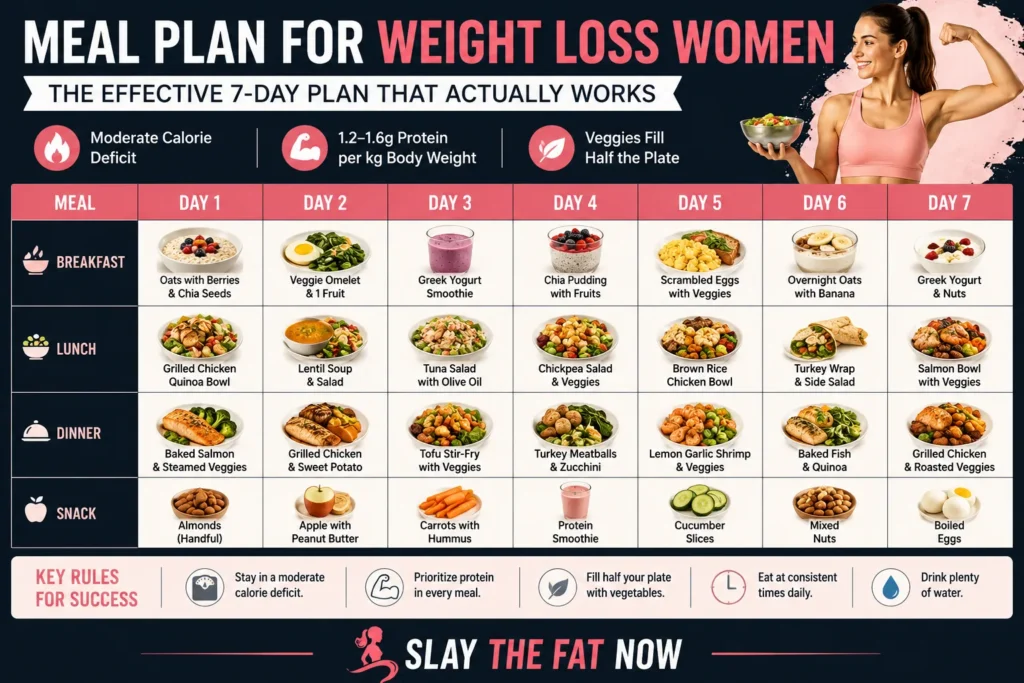
An effective meal plan for weight loss women combines a moderate calorie deficit with 1.2–1.6 grams of protein per kilogram of body weight, vegetables filling half the plate, and consistent meal timing. The goal is steady, sustainable fat loss without extreme restriction that leads to muscle loss or burnout.
Why Most Meal Plans for Women Fail by Week Two
You’ve downloaded the PDF. Color-coded, pretty, full of recipes with ingredients you’ve never heard of and definitely don’t have in your pantry. By day three, you’re back to whatever’s fastest, and the guilt sets in right alongside the hunger.
The problem usually isn’t your discipline. It’s that most meal plans for weight loss women are built for an Instagram photo, not a real week with a job, kids, or a body that needs more than 1,200 calories to function. A meal plan that ignores how women’s bodies actually respond to a calorie deficit especially around protein and muscle preservation sets you up to lose weight you don’t want to lose, like strength and energy, while barely touching the fat you do want gone.
What an Effective Meal Plan for Weight Loss Women Looks Like
A solid meal plan for weight loss women isn’t about eating the least amount of food possible. It’s a structured, repeatable way of eating that creates a moderate calorie deficit while prioritizing protein, fiber, and consistency three factors directly tied to keeping muscle, managing hunger, and actually sticking with the plan past week one.
In this guide, you’ll learn:
- What the latest USDA and clinical research actually recommends for women’s protein and calorie needs
- A full 7-day meal plan structure you can adapt to your own preferences
- A real example of how this plays out for someone with a packed schedule
- The most common mistakes that quietly sabotage women’s meal plans
- Exactly how to build your own plan around your calorie target
Why the Right Meal Plan Matters More for Women
Getting a meal plan for weight loss women right isn’t just about the number on the scale:
- Muscle preservation: Women in a calorie deficit are especially prone to losing lean muscle without adequate protein, which can slow metabolism over time.
- Hormonal stability: Severely restrictive plans are more likely to disrupt menstrual cycles and energy levels in women than moderate, well-structured deficits.
- Time: A repeatable weekly structure removes the daily decision fatigue of “what do I eat now” that derails most diets.
- Long-term impact: A meal plan built around real food and real schedules is one you can sustain for months, not days.
Want this plan built around your exact calories? Use our free calorie deficit calculator to personalize the meal plan below to your body and goals.
The Research Behind This Meal Plan for Weight Loss Women
This plan isn’t built on guesswork it reflects current nutrition science specific to women’s needs:
- The 2025–2030 Dietary Guidelines for Americans recommend a daily protein target of 1.2 to 1.6 grams per kilogram of body weight, adjusted to individual caloric needs. According to the U.S. Department of Agriculture and Department of Health and Human Services, individual calorie and protein needs should be based on age, activity level, and body composition.
External Source: https://www.dietaryguidelines.gov - A systematic review and meta-analysis found that higher protein intakes of 1.2–1.6 g/kg/day, compared to standard intakes of 0.8 g/kg/day, better preserve lean muscle mass and physical function during weight loss in adults with overweight or obesity.
- Research from the International Weight Control Registry found that higher protein intake during weight loss consistently predicted a leaner final body composition among participants.
- USDA’s MyPlate guidance recommends filling half your plate with fruits and vegetables to increase fiber intake and improve fullness while naturally lowering calorie intake. This simple strategy has been shown to support sustainable weight management.
- Research on women specifically suggests an even higher protein range of 1.6 to 2.2 g/kg/day may be appropriate for those who are older, highly active, or pursuing a more aggressive calorie deficit.
The takeaway: a meal plan for weight loss women that skips protein targets isn’t just less effective it’s working against the body’s biology during a deficit.
The 7-Day Meal Plan Structure
This is a flexible framework, not a rigid script. Adjust portions to fit your personal calorie target.
| Day | Breakfast | Lunch | Dinner |
|---|---|---|---|
| Mon | Greek yogurt, berries, chia seeds | Grilled chicken salad, mixed greens | Baked salmon, roasted broccoli, quinoa |
| Tue | Veggie egg scramble, whole grain toast | Turkey and vegetable wrap | Lean ground beef stir-fry, brown rice |
| Wed | Protein smoothie with spinach and banana | Lentil soup with side salad | Grilled shrimp, roasted vegetables, sweet potato |
| Thu | Overnight oats with protein powder | Leftover stir-fry from Tuesday | Baked chicken thighs, steamed green beans |
| Fri | Cottage cheese with pineapple | Tuna salad over greens | Turkey chili, side salad |
| Sat | Veggie omelet | Grilled chicken bowl with vegetables and rice | Flexible meal out prioritize protein and vegetables |
| Sun | Protein pancakes with fruit | Leftover turkey chili | Sheet-pan salmon and vegetables (meal prep for the week) |
Notice the pattern: protein at every meal, vegetables at lunch and dinner, and built-in leftovers so you’re not cooking from scratch every single day.
A Real Example: How This Plan Fits a Real Week
Consider “Sarah,” a composite scenario reflecting a common situation: a working mom with two kids and almost no spare time for meal prep. Her past meal plans for weight loss had always failed by Wednesday because they demanded fresh cooking at every meal.
She adapted the structure above by doubling Sunday’s salmon and Tuesday’s stir-fry to create two days of intentional leftovers. She kept breakfast nearly identical all week Greek yogurt and overnight oats rotated because decision fatigue, not food boredom, had always been her real obstacle.
Within a month, she’d stayed consistent for the first time in over a year, not because the food was exciting, but because it required almost no daily decision-making once the structure was set.
Expert Insight: What Makes a Meal Plan for Weight Loss Women Actually Work
After years of building meal plans for women specifically, the same patterns show up again and again, regardless of the exact foods involved.
1. Protein at every meal isn’t optional, it’s the foundation
Women who consistently hit a protein target at each meal report less hunger and better adherence than those who “save” protein for dinner or treat it as an afterthought.
2. Repetition beats variety for sustainability
The most successful meal plans for weight loss women repeat 80% of meals weekly, with only 20% changing. Constant variety sounds appealing but is rarely sustainable for busy schedules.
3. Built-in flexibility prevents all-or-nothing thinking
Plans with one intentionally flexible meal, like Saturday dinner above, see far fewer total derailments than plans that demand perfection every single day.
Reality Check: Myths About Meal Plans for Weight Loss Women
Myth: “Women need far fewer calories than men to lose weight.”
Reality: Calorie needs depend on body size, activity level, and metabolism, not gender alone. Many active women need more calories than commonly assumed by generic 1,200-calorie plans.
Myth: “Carbs should be avoided entirely on a weight loss meal plan.”
Reality: USDA guidelines and clinical research support balanced meals including whole grains; complete avoidance isn’t necessary for fat loss and is harder to sustain.
Myth: “Skipping meals speeds up weight loss.”
Reality: Consistent meal timing supports better hunger regulation for most women, and skipped meals often lead to overeating later in the day.
Myth: “A meal plan has to be followed perfectly to work.”
Reality: Plans with built-in flexibility, like one adaptable meal per week, are more sustainable and just as effective as rigid, zero-flexibility plans.
Practical Advice: How to Build Your Own Meal Plan for Weight Loss
Do this:
- Set your protein target first. Aim for 1.2–1.6 g/kg of body weight daily, adjusting upward if you’re very active.
- Fill half your plate with vegetables at lunch and dinner. This single MyPlate-based habit does most of the heavy lifting for fullness.
- Repeat meals intentionally. Pick 2–3 breakfast and lunch options and rotate them weekly instead of reinventing meals daily.
- Batch cook on one day. Doubling one or two dinners creates automatic leftovers for busier days.
- Build in one flexible meal per week. This reduces all-or-nothing thinking and improves long-term adherence.
Avoid this:
- Following generic 1,200-calorie templates without adjusting for your own activity level and size.
- Treating protein as optional or an afterthought at meals.
- Demanding 100% variety and zero repetition, which usually collapses by week two.
- Skipping meals to “save calories,” which often backfires later in the day.
Want a meal plan built specifically around your schedule? Explore our 1:1 coaching program, where we design a sustainable weekly structure around your real life.
Comparison: Which Meal Plan Style Fits You?
| Style | Best For | Prep Time | Flexibility |
|---|---|---|---|
| Repeating weekly structure (above) | Busy schedules, beginners | Low–Medium | High |
| Fully custom daily meals | People who enjoy cooking variety | High | Medium |
| Meal delivery service | No time to cook at all | Very low | Low–Medium |
| Intermittent fasting structure | Fewer, larger meals preferred | Low–Medium | Medium |
For most women juggling work and family, the repeating weekly structure consistently produces the best long-term adherence. If you want this calculated specifically for your calories, pair it with our calorie deficit calculator first.
Frequently Asked Questions About Meal Plans for Weight Loss Women
What is the best meal plan for weight loss for women?
The most effective plans combine a moderate calorie deficit, 1.2 to 1.6 grams of protein per kilogram of body weight, and vegetables filling half the plate at most meals.
How many calories should a woman eat to lose weight?
This depends on body size and activity level, but most women see sustainable results with a 300 to 500 calorie daily deficit below their maintenance calories, not a fixed universal number like 1,200.
How much protein do women need for weight loss?
Current Dietary Guidelines for Americans and clinical research support 1.2 to 1.6 grams of protein per kilogram of body weight daily, with active or older women sometimes benefiting from slightly higher amounts.
Is a 7-day meal plan enough structure for weight loss?
Yes, for most people. A repeating 7-day structure with intentional leftovers and one flexible meal provides enough variety while remaining sustainable long-term.
Should women avoid carbs on a weight loss meal plan?
No. USDA dietary guidelines support including whole grains and balanced carbohydrates as part of a sustainable, effective weight loss meal plan.
Is meal prepping necessary for this kind of meal plan?
It’s not required, but batch cooking one or two meals per week significantly increases the odds of sticking with the plan through busy days.
Can this meal plan work for vegetarians?
Yes, by substituting plant-based proteins like lentils, tofu, and legumes for the animal proteins listed, while still aiming for the same overall protein target.
How often should meals repeat in a weight loss meal plan?
Many successful meal plans for women repeat about 70 to 80 percent of meals weekly, which reduces decision fatigue while still allowing some variety.
What should women eat for breakfast to support weight loss?
A protein-forward breakfast such as Greek yogurt, eggs, or a protein smoothie tends to support better satiety and fewer cravings later in the day.
Is intermittent fasting better than a structured meal plan for women?
Neither is inherently superior; the better choice depends on personal preference, with some women preferring fewer larger meals and others doing better with regular, smaller meals.
How long should I follow a meal plan before expecting results?
Most women notice initial changes within 3 to 4 weeks of consistent adherence, though early scale movement often reflects water shifts more than fat loss specifically.
Can this meal plan be adjusted for higher activity levels?
Yes. Active women typically need higher overall calories and may benefit from protein intakes toward the upper end of the 1.2 to 2.2 g/kg range.
Is it okay to eat the same lunch every day on this plan?
Yes. Repetition in meal plans is associated with better long-term adherence for many people, as long as the meals meet protein and nutrient needs.
What if I don’t like cooking can this meal plan still work?
Yes, by leaning more heavily on batch cooking, simple prep meals, or substituting some meals with quality meal delivery options while keeping the same protein and vegetable structure.
Does this meal plan account for hormonal changes during the month?
The structure itself stays consistent, but it’s common and normal to adjust portions or include the flexible meal more often during higher-hunger phases of the menstrual cycle.
Your Next Step
The best meal plan for weight loss women isn’t the most complicated one it’s the one you can actually repeat for months without burning out or losing the muscle you worked to build.
Start with the 7-day structure above, adjust portions to your calorie target, and give yourself one flexible meal a week.
Ready to personalize this plan? Use our free calorie deficit calculator or explore the full weight loss library on Slay The Fat Now for your next step.
Sources cited:
USDA/HHS 2025–2030 Dietary Guidelines for Americans;
