 Skip to content
7 Proven Ways to Break a Weight Loss Plateau Fast
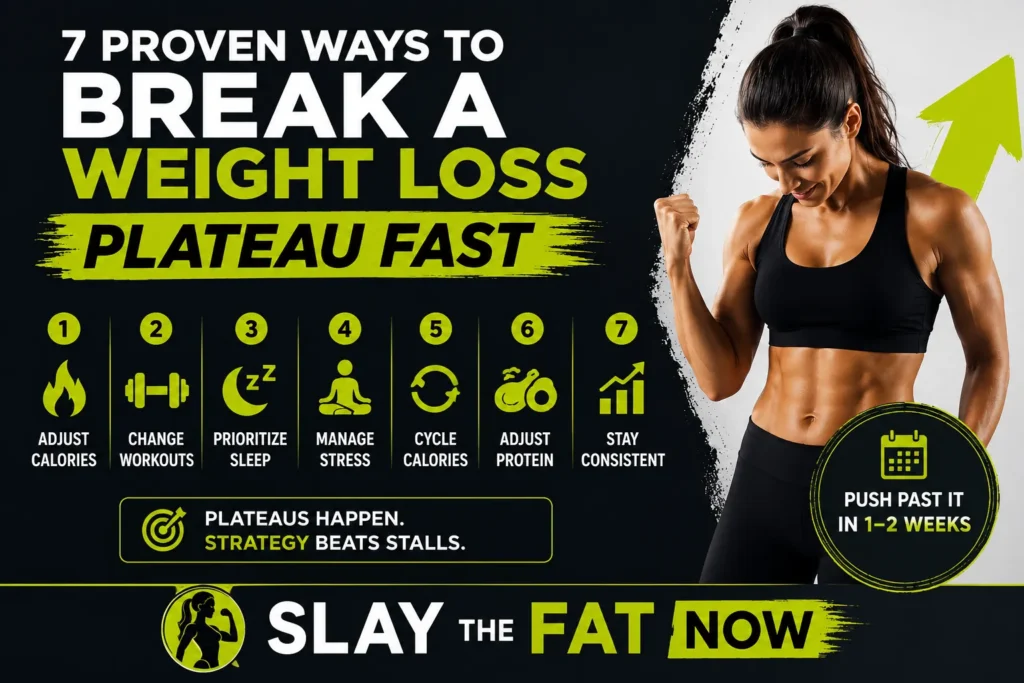
To break a weight loss plateau, you need to recalibrate your approach: reassess your calorie intake, vary your exercise routine, prioritize sleep and stress management, and consider cycling calories or adjusting your protein intake. A plateau in weight loss happens when your metabolism adapts not because you’ve failed. Most people can push past it within 1–2 weeks with the right strategy.
You were doing everything right. The scale was moving. You felt unstoppable. Then nothing. Weeks go by and the number doesn’t budge. You wonder if you’re broken. You start doubting everything.
Here’s the truth: a weight loss stall is not a sign of failure. It’s a sign that your body is smart maybe too smart. And the same discipline that got you this far is exactly what’s going to get you through this.
This article is going to show you how to break a weight loss plateau using strategies grounded in real physiology, not Instagram myths. By the time you finish reading, you’ll know exactly what’s happening in your body, and exactly what to do about it.
What Is a Weight Loss Plateau, Really?
A plateau in weight loss occurs when you stop losing weight despite continuing to follow your diet and exercise plan. It’s one of the most frustrating experiences in any fat-loss journey, and it happens to virtually everyone who has lost a meaningful amount of weight.
The mechanism is well understood as you lose fat and muscle mass, your body burns fewer calories at rest. Your metabolism slows. What used to be a calorie deficit becomes maintenance. The scale freezes. This is called metabolic adaptation, and its biology working exactly as designed.
Understanding this shifts how you respond. This isn’t a mystery it’s a math problem you can solve. Learn more about the foundations on how to start losing weight the right way before diving into plateau-busting tactics.
Why Breaking Your Plateau Now Matters
The longer you stay in a weight loss stall without addressing it, the more likely you are to give up entirely. Studies show that people who experience prolonged plateaus are significantly more likely to regain all their lost weight within 12 months.
More importantly, the habits and mindset shifts you build while fighting through a plateau are what separate people who reach their goal from those who settle. The tools below aren’t just plateau-breakers they’re lifelong skills.
The Science Behind a Weight Loss Stall
94% of dieters regain lost weight within 5 years without sustained behavioral change
~200 fewer calories/day burned after losing just 10% of body weight (metabolic adaptation)
6–8 wksaverage time most people hit their first significant plateau after starting a diet
A landmark study published by the National Institutes of Health found that metabolic adaptation can reduce resting energy expenditure by up to 500 calories per day in formerly obese individuals far more than most people realize. This means the calorie target that worked in month one may be completely inadequate by month three.
The CDC also confirms that slow, steady weight loss of 1–2 pounds per week leads to far better long-term outcomes partly because gradual loss reduces the severity of metabolic adaptation.
Sarah’s Story: 6 Weeks Stuck, Then 22 More Pounds Gone
Sarah, 38, from Ohio, lost 31 pounds over four months following a 1,600-calorie plan. Then she hit a wall. Six weeks of zero movement on the scale despite sticking to her plan perfectly.
She came to SlayTheFatNow’s weight loss strategy hub looking for answers. The culprit? Her calorie target hadn’t been updated to reflect her new, lighter body. She was now 31 pounds lighter, and her maintenance calories had dropped by roughly 180 calories per day.
After recalculating her TDEE, adding two strength training sessions per week, and increasing her daily protein to 130g, she broke the plateau within 10 days. She went on to lose 22 more pounds over the following five months.
How to Break a Weight Loss Plateau: 7 Strategies That Actually Work
These aren’t tricks. They’re evidence-based adjustments that address the real root causes of a weight loss stall.
- 1. Recalculate Your Calorie Needs Your body at 180 lbs burns fewer calories than it did at 210 lbs. Use a TDEE calculator to find your new maintenance and subtract 300–500 calories. Don’t keep eating the same amount you started with that’s the most common mistake people make in a weight loss stall.
- 2. Try Calorie Cycling (Refeed Days) Eating at maintenance calories for 1–2 days per week can temporarily boost leptin levels, which helps regulate metabolism and hunger hormones. This isn’t a cheat day it’s a strategic refeed. Focus on carbohydrates, not fat, for the refeed to be effective.
- 3. Increase Protein Intake Protein has the highest thermic effect of any macronutrient your body burns roughly 25–30% of protein calories just digesting it. Aim for 0.7–1g of protein per pound of body weight. This preserves muscle, boosts satiety, and keeps your metabolism from slowing further.
- 4.Change Your Exercise Stimulus Your body adapts to exercise just like it does to food. If you’ve been running three miles every day for two months, your body has become efficient at it burning fewer calories per session. Add strength training, try HIIT, or change your cardio modality entirely.
- 5. Audit Your Food Tracking Research shows most people underestimate calorie intake by 20–40%. Start weighing food instead of measuring by volume. A tablespoon of peanut butter can vary by 60 calories depending on whether you level it or heap it. Small errors compound over time.
- 6. Prioritize Sleep (Seriously)Poor sleep raises cortisol and ghrelin the hunger hormone while crashing leptin. One study found people who slept 5.5 hours lost 55% less fat than those who slept 8.5 hours on the same calorie deficit. Sleep is a fat loss tool, not a luxury. Check out how sleep affects your fat loss for a deep dive.
- 7. Manage Chronic Stress Elevated cortisol promotes fat storage especially around the abdomen and makes the body resist fat loss even in a calorie deficit. Meditation, walking, journaling, and even proper rest days can meaningfully lower cortisol and restart progress.
Reality Check: Common Myths About a Plateau in Weight Loss
❌ Myth You just need to eat even less to break the plateau.
✅ Truth Eating too little can further suppress your metabolism and increase muscle loss making the plateau worse.
❌ Myth If the scale isn’t moving, you’re not losing fat.
✅ Truth Water retention, menstrual cycle, and inflammation from new exercise can mask fat loss for 2–3 weeks.
❌ Myth You’ve reached your natural “set point” and can’t go lower.
✅ Truth Set points are real but flexible. Sustained behavior change over months can reset your body’s defended weight.
❌ Myth Cardio is the best way to break a weight loss stall.
✅ Truth Strength training preserves muscle and raises resting metabolic rate more effectively than cardio alone over the long term.
Comparing Strategies to Break a Weight Loss Plateau
| Strategy | Speed | Sustainability | Effort | Best For |
|---|---|---|---|---|
| Recalculate Calories | ⚡ Fast (1–2 wks) | ✔ High | Low | Everyone |
| Calorie Cycling / Refeed | ⚡ Moderate | ✔ High | Medium | Long-term dieters |
| More Protein | ⚡ Moderate | ✔ High | Low | Everyone |
| New Exercise Type | Slow (3–4 wks) | ✔ High | High | Gym-goers |
| Fasting (Intermittent) | ⚡ Fast | ✘ Variable | Medium | Some people |
| Drastic Calorie Cut | Appears fast | ✘ Low | High | Not recommended |
Practical Steps to Break a Weight Loss Plateau This Week
Do This:
✅ Recalculate your TDEE using your current weight.
✅ Track food with a food scale for 7 days straight.
✅ Add 2–3 strength training sessions if you’re doing only cardio.
✅ Hit 0.8g protein per pound of bodyweight daily.
✅ Aim for 7–9 hours of sleep.
✅ Take measurements (waist, hips) the scale may lie, tape doesn’t.
Avoid This:
❌ Cutting below 1,200 calories (women) or 1,500 calories (men) without medical supervision.
❌ Doing more cardio on top of an already-high volume.
❌ Weighing yourself only once and panicking.
❌ Trying a completely new diet overhaul all at once.
❌ Skipping rest days thinking more exercise always equals more results.
Pro Tip: Weigh yourself every morning under the same conditions (after waking, before eating, after using the bathroom) and track a 7-day rolling average. Day-to-day fluctuations are noise. Weekly trends are signal.
“The most common reason people plateau is that they’re not eating as little as they think they are, or they’ve been at the same calorie level for so long that their metabolism has caught up. The fix is almost always a recalibration, not a complete overhaul.” Based on patterns observed across thousands of fat loss journeys and supported by research in metabolic adaptation.
Frequently Asked Questions About How to Break a Weight Loss Plateau
How long does a weight loss plateau typically last?
Most plateaus last 2–6 weeks if you do nothing different. With the right adjustments primarily recalculating calories and changing your exercise stimulus most people break through within 1–2 weeks.
Is a weight loss stall the same as a plateau in weight loss?
Yes, these terms are often used interchangeably. A weight loss stall refers to a period where the scale stops moving. A plateau is the same phenomenon your body has adapted and weight loss has paused despite continued effort.
Should I eat more or less to break a weight loss plateau?
It depends. If you’ve been in a calorie deficit for many months, a 1–2 week refeed at maintenance can actually restart weight loss. But if your tracking has gotten sloppy, you may simply need to tighten it up, not eat less.
Does intermittent fasting help break a plateau?
It can but only if it helps you eat fewer calories overall. Intermittent fasting is not magic. It works by creating a time-restricted eating window that many people find reduces snacking. If it doesn’t create a deficit, it won’t break the plateau.
Can stress cause a weight loss plateau?
Absolutely. Chronic stress elevates cortisol, which promotes fat storage and increases water retention. Many people see an overnight drop of 2–4 lbs after a period of stress resolves the fat was being burned all along, but water was masking it.
Will adding more cardio break my plateau?
More cardio can help if you’re currently very sedentary, but it’s rarely the best tool for a plateau. Strength training preserves and builds muscle, which raises your resting metabolism. More cardio on top of high volume can actually increase cortisol and worsen the stall.
How do I know if I’ve hit a true plateau or just a slow week?
A true plateau is generally defined as no movement (or less than 0.5 lbs/week change) over 3–4 weeks, despite adherence to your plan. One or two weeks of no change can just be water fluctuation. Track your 7-day rolling average before panicking.
Is it possible to break a weight loss plateau without changing my diet?
Sometimes. Adding strength training, improving sleep, and reducing stress can shift things. But in most cases, some dietary adjustment even a small one like an extra 20g of protein or a refeed day is the most reliable lever.
What macros help break a weight loss stall?
Higher protein is the most consistently effective macro shift. Aim for 0.7–1g per pound of bodyweight. Some people also benefit from reducing refined carbohydrates temporarily to manage water retention and improve insulin sensitivity.
How does sleep affect a plateau in weight loss?
Sleep deprivation raises ghrelin (hunger hormone), lowers leptin (fullness hormone), and increases cortisol all of which directly impede fat loss. Even one week of improving sleep to 7–9 hours can meaningfully shift the hormonal environment and restart progress.
Can medications cause a weight loss plateau?
Yes. Certain antidepressants, beta-blockers, antipsychotics, corticosteroids, and diabetes medications are known to affect weight and metabolism. If you suspect a medication is causing your stall, speak with your prescribing physician before making any changes.
Does thyroid function affect weight loss plateaus?
Yes. Hypothyroidism (underactive thyroid) significantly lowers metabolic rate and is one of the most common medical reasons for unexplained weight loss stalls. If you’ve been struggling for months with no explanation, ask your doctor for a full thyroid panel.
Should I take a diet break to break my plateau?
Research supports the concept of a “diet break” eating at maintenance for 1–2 weeks every 8–12 weeks of dieting. This can partially restore leptin and metabolic rate, making the subsequent deficit more effective. It is NOT a free-for-all; it’s structured maintenance eating.
Is body decomposition a sign of a plateau?
Often, yes in the best possible way. If you’re adding muscle while losing fat, your scale weight may not change even as your body is visibly changing. Always track measurements and progress photo alongside scale weight.
What is the fastest way to break a weight loss plateau?
The fastest single step is accurate food tracking with a food scale for 7 days. Most people discover they’re eating 200–400 more calories than they thought. Fixing that alone, combined with adequate protein, breaks most plateaus within 10–14 days.
Ready to Start Moving Again?
SlayTheFatNow has helped thousands of people push through weight loss stalls with practical, no-nonsense strategies. Explore our full resource library and find your next move.Explore SlayTheFatNow →
The Bottom Line on How to Break a Weight Loss Plateau
A plateau in weight loss is not a dead end it’s a signal. Your body has adapted. That means you adapted successfully enough to need a new challenge. The people who break through plateaus and reach their goals aren’t the ones with more willpower; they’re the ones who understand what’s actually happening and make the right adjustments.
Recalculate your numbers. Tighten your tracking. Increase your protein. Add or change your exercise. Sleep more. Stress less. Give it two weeks of consistent effort before declaring it isn’t working.
You didn’t come this far to stop here. For more no-BS weight loss content, explore the SlayTheFatNow blog updated weekly with evidence-based strategies for real people.
Sources:
1. NIH — Metabolic Adaptation to Weight Loss
2. CDC — Losing Weight
© 2026 SlayTheFatNow.com · All rights reserved · Not medical advice. Consult a qualified healthcare provider before making significant dietary or exercise changes.
