 Skip to content
Low Carb vs Low Fat for Weight Loss: 7 Science-Backed Truths That Actually Matter
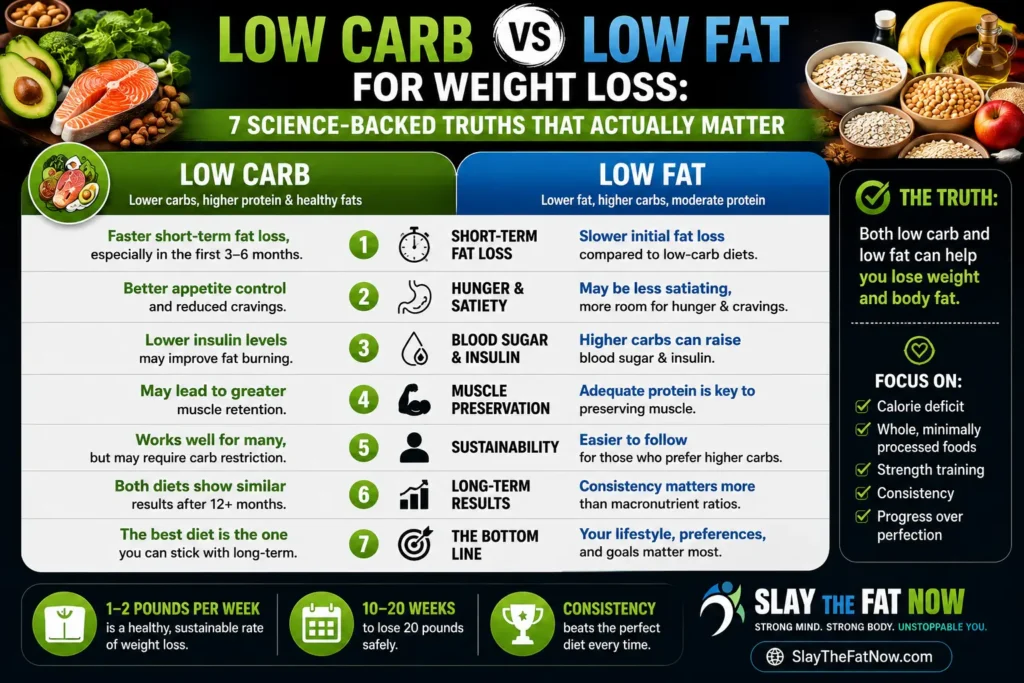
When comparing low carb vs low fat for weight loss, research shows low-carb diets typically produce faster short-term fat loss, especially in the first 3–6 months. However, both approaches deliver similar results long-term if you stick to them. The best diet for fat loss is the one you can maintain consistently your lifestyle, food preferences, and health goals matter more than the macros.
The Diet Debate That’s Costing You Results
You’ve been doing everything “right.” Counting calories. Avoiding bread. Eating salads you don’t enjoy. Yet the scale barely moves. Sound familiar?
Here’s what’s actually happening: millions of Americans are caught in the middle of a decades-long nutrition war low carb vs low fat for weight loss and they’re losing. Not fat. Time. Years of bouncing between diets that half-work, quitting, restarting, and blaming themselves.
The fitness industry profits from your confusion. Low-fat yogurt, keto bars, fat-free cookies all marketed as “healthy” while you spin your wheels. This article cuts through the noise with real research, real patterns from real people, and a verdict you can actually use.
What Low Carb vs Low Fat Actually Means
Before we dive into the science, let’s define what we’re comparing. These aren’t vague concepts they’re specific eating strategies with different mechanisms.
What Is a Low-Carb Diet?
A low-carb diet typically restricts carbohydrate intake to under 100–150g per day. The most extreme version ketogenic (keto) drops below 50g of carbs daily, forcing your body into ketosis, a metabolic state where it burns fat for fuel instead of glucose. Foods allowed: meat, fish, eggs, cheese, non-starchy vegetables, nuts, and healthy fats. Foods limited: bread, pasta, rice, most fruit, beans, and sugar.
What Is a Low-Fat Diet?
A traditional low-fat diet caps fat intake at 20–30% of total calories (roughly 44–65g per day on a 2,000-calorie diet). It emphasizes whole grains, legumes, fruits, vegetables, and lean proteins. Think of the classic “food pyramid” approach your doctor may have recommended 20 years ago.
In this guide, you’ll learn exactly how these two approaches compare across speed of results, sustainability, hormones, hunger, muscle retention, and long-term health markers so you can stop guessing and start losing.
Why the Low Carb vs Low Fat Debate Matters for You
This isn’t just an academic argument. Your choice of dietary strategy affects:
- How fast you lose weight in the first 30–90 days
- How hungry you feel day to day
- Your blood sugar and insulin levels critical if you’re pre-diabetic
- Your energy levels at work and in the gym
- Whether you actually stick to it long-term
- Your cholesterol, triglycerides, and heart health
Picking the wrong approach for your body type and lifestyle can mean 6–12 months of effort with minimal results. Picking the right one can mean dropping 20–30 lbs in the same period. That’s why this decision genuinely matters.
What the Science Actually Says: 7 Key Data Points
3–6 lbs More weight lost on low-carb in first 6 months (NIH meta-analysis)
~0% Difference in fat loss at 12+ months between both diets (Stanford DIETFITS)
60% Americans who’ve tried at least 2 different diets in the past year
37% Adults with obesity in the US the highest rate ever recorded (CDC, 2024)
Study 1: The Stanford DIETFITS Trial
One of the most rigorous head-to-head comparisons was the 2018 Stanford DIETFITS study, published in JAMA. Over 600 adults followed either a healthy low-fat or healthy low-carb diet for 12 months. The result? No significant difference in weight loss between groups. Average loss was about 11–13 lbs in both camps. What mattered was diet quality not the macro split.
Study 2: NIH Meta-Analysis on Keto vs Low Fat
A comprehensive National Institutes of Health meta-analysis reviewed 13 randomized controlled trials comparing low-carb and low-fat diets. Low-carb produced meaningfully greater weight loss at 6 months, but by 12 months, the advantage nearly disappeared. Low-carb did maintain superior improvements in triglycerides and HDL (“good”) cholesterol.
Study 3: Insulin and Fat Storage
Research from Brigham and Women’s Hospital found that low-carb diets significantly reduce insulin levels a key fat-storage hormone. Lower insulin means your body more readily accesses stored fat for energy. This is one reason low-carb tends to win in the short run, particularly for people who are insulin-resistant or pre-diabetic.
📌Key Takeaway: Low-carb wins short-term. Both are roughly equal long-term. But for people with insulin resistance, diabetes risk, or metabolic syndrome, low-carb may offer sustained health advantages beyond the scale.
A Real-World Scenario: Two Approaches, One Goal
Meet Marcus and Diane. Both 38, both carrying 35 lbs of excess weight, both starting their fat loss journey in January.
Marcus chose low-carb (keto). Within 2 weeks he dropped 9 lbs mostly water weight from glycogen depletion, but the scale motivated him. By month 3 he was down 22 lbs. His energy stabilized, his hunger virtually disappeared (a hallmark of ketosis), and his triglycerides dropped 40 points. He hit a plateau in month 4 and had to adjust calories, but he stuck with it.
Diane chose low-fat. Her first 2 weeks: 3 lbs down. Slower, but she wasn’t giving up pasta entirely. By month 3 she was down 14 lbs. She didn’t experience the same energy dips Marcus had in his “keto flu” phase. By month 6, they were within 4 lbs of each other. By month 12? Both had lost roughly 28–30 lbs.
The difference wasn’t the diet. It was their consistency, their food environment, and how well each strategy fit their lives. Diane couldn’t imagine cutting carbs long-term; Marcus couldn’t stomach counting fat grams. They both won by choosing what worked for them.
What Actually Works: Patterns From Years in the Trenches
“After working with hundreds of clients, the single biggest predictor of fat loss success isn’t the macro split it’s whether someone can see themselves eating this way in 18 months.” Nutrition coaching principle followed by top fat-loss practitioners
Here’s what I see consistently across successful weight loss clients:
People Who Thrive on Low-Carb Tend To:
- Love meat, eggs, cheese, and vegetables
- Feel better with stable blood sugar (fewer energy crashes)
- Have insulin resistance or pre-diabetes
- Hate counting calories but don’t mind avoiding certain foods
- Experience strong carb cravings that disappear once carbs are eliminated
People Who Thrive on Low-Fat Tend To:
- Enjoy grains, fruits, and legumes
- Exercise heavily and need glycogen for performance
- Have normal insulin sensitivity
- Prefer eating higher volumes of food
- Have cultural food traditions centered on carbs (rice, bread, tortillas)
There’s a third camp that consistently outperforms both: people who combine moderate protein, moderate fat, and modest carbs essentially a balanced whole-foods approach. The research on this is growing. The Harvard T.H. Chan School of Public Health’s Healthy Eating Plate reflects this middle path well.
Stop Guessing. Start Losing.
Get our free 7-Day Fat Loss Kickstart Plan tailored for both low-carb and low-fat approaches. Real meals. Real results. No fluff.Download Free Plan →
The Hard Truths Nobody Tells You
Myth #1“Eating fat makes you fat.”
False. Decades of low-fat dietary guidelines contributed to an obesity epidemic, partly because low-fat processed foods replaced fat with sugar. Dietary fat is essential for hormones, brain function, and nutrient absorption.
Myth #2“Carbs are the enemy.”
Also false. Whole-food carbohydrates vegetables, legumes, whole grains are associated with lower rates of obesity, heart disease, and diabetes. The problem is ultra-processed refined carbs, not carbs as a category.
Myth #3“Keto is the fastest way to lose fat.”
The early scale victories on keto are largely water weight (your body dumps stored glycogen, which holds water). True fat loss rates normalize after the first few weeks. At 6 months, the advantage shrinks considerably.
Myth #4“A low-fat diet is heart-healthy by default.”
Not if you replace fat with refined carbs and sugar. The Women’s Health Initiative one of the largest diet studies ever found that a low-fat diet did not significantly reduce cardiovascular risk compared to a regular diet.
The uncomfortable truth about the low carb vs low fat debate? Neither approach works if your overall caloric intake doesn’t support a deficit. Mechanisms differ, but physics doesn’t bend. You still need to consume fewer calories than you burn both diets just use different levers to help you get there.
How to Choose and Execute Your Strategy
Step-by-Step: Picking the Right Approach
- Assess your insulin sensitivity. If you have pre-diabetes, PCOS, or metabolic syndrome, low-carb may offer added metabolic benefits. Ask your doctor for a fasting insulin test.
- Audit your current diet. What are you actually eating most of? If your diet is already 60% carbs, low-carb will feel like a massive shift. If you eat primarily fats and protein, low-fat will require bigger changes.
- Consider your workout type. High-intensity training (CrossFit, HIIT, sprint work) runs on glucose. Low-carb can impair performance. Endurance athletes can adapt to fat-burning, but it takes 4–8 weeks.
- Test for 30 days, then evaluate. Neither diet will show its true results in 2 weeks. Commit to a full 30 days, track your results, and decide based on real data not early frustration.
- Prioritize protein regardless. Both approaches benefit from high protein intake (0.7–1g per lb of body weight). Protein protects muscle, increases satiety, and boosts metabolism. This is non-negotiable.
- Don’t neglect sleep and stress. Cortisol from poor sleep or chronic stress raises blood sugar and promotes fat storage no diet overcomes a cortisol problem. See our guide to how sleep affects fat loss at SlayTheFatNow.com →
What to Avoid on Either Diet
- Ultra-processed versions marketed as “keto” or “low-fat” they’re usually junk with a health halo
- Ignoring vegetables both diets should be built on a foundation of non-starchy vegetables
- Eating in a surplus and calling it “clean eating” macros matter, but calories still count
- Switching approaches every 2–3 weeks this prevents adaptation and destroys consistency
Low Carb vs Low Fat for Weight Loss: Head-to-Head Comparison
| Factor | Low Carb / Keto | Low Fat |
|---|---|---|
| Short-term weight loss (1–3 mo) | ✓ Faster (3–6 lbs more) | Slower initial drop |
| Long-term weight loss (12+ mo) | ≈ Similar | ≈ Similar |
| Hunger control / satiety | ✓ Superior (fat + protein fill you up) | Moderate hunger control |
| Triglycerides | ✓ Better reduction | Moderate improvement |
| LDL Cholesterol | May increase in some people | ✓ Often reduced |
| Athletic performance | Lower (especially early on) | ✓ Better carb availability |
| Ease of adherence | Harder socially (bread, pasta, fruit limits) | ✓ Easier for most social situations |
| Best for insulin resistance | ✓ Strongly recommended | Moderate benefit |
| Cost | Can be higher (meat, cheese, nuts) | ✓ Often more affordable (beans, grains) |
| Muscle preservation | ✓ Better (when protein is high) | Good with adequate protein |
Low Carb Wins When You:
- Have insulin resistance or pre-diabetes
- Want faster early results for motivation
- Struggle with hunger on other diets
- Don’t rely on high-intensity exercise
- Love fatty, protein-rich foods
Low Carb Struggles When You:
- Train intensely 4+ times per week
- Have a family or social life centered on carbs
- Have elevated LDL cholesterol
- Can’t sustain very restrictive eating
- Dislike high amounts of meat and fat
Frequently Asked Questions: Low Carb vs Low Fat for Weight Loss
Is low carb or low fat better for belly fat specifically?
Low-carb diets tend to reduce visceral fat (the dangerous fat around your organs and abdomen) more effectively, particularly in people with insulin resistance. Studies show keto and very low-carb diets reduce waist circumference more than isocaloric low-fat diets in short-term trials.
Which diet is better for women over 40?
Both can work, but many women over 40 find low-carb particularly helpful due to hormonal changes that increase insulin resistance during perimenopause. However, thyroid function which influences metabolism can be sensitive to very low-carb intake, so it’s worth monitoring with your doctor.
Can I build muscle on a low-carb diet?
Yes, but it’s harder. Muscle protein synthesis benefits from insulin, which carbs stimulate. Low-carb dieters can preserve muscle well with adequate protein, but gaining significant muscle mass is easier with carbohydrates available around workouts.
What is the fastest diet for weight loss?
For speed in the first 30–60 days, low-carb and especially keto produce faster scale results, largely due to water weight loss from glycogen depletion. However, the fastest sustainable fat loss comes from a moderate caloric deficit (300–500 calories/day) with high protein, regardless of macro split.
Do low-carb diets cause muscle loss?
Not if protein intake is adequate. Studies show that when protein is matched between diets, low-carb dieters preserve lean mass just as well as low-fat dieters sometimes better, due to the muscle-sparing effect of ketones.
Is keto the same as low carb?
Not exactly. Keto is the most extreme form of low-carb, restricting carbs to under 20–50g daily to induce ketosis. General low-carb diets allow 50–150g of carbs per day, which is more flexible and easier to sustain without triggering full ketosis.
Which diet is better for people with diabetes?
Low-carb and keto diets show strong evidence for improving blood sugar control in Type 2 diabetes. Multiple studies show patients reducing or eliminating medication under medical supervision. Always consult your doctor before changing your diet if you have diabetes.
Will a low-fat diet raise my blood sugar?
It depends what replaces the fat. If you replace fat calories with whole grains, legumes, and vegetables, blood sugar typically stays stable. If you replace fat with refined carbs and sugars (as many commercial low-fat products do), blood sugar and insulin will spike.
How long does it take to see results on keto?
Most people see scale movement within 1–2 weeks, primarily from water loss. Visible fat loss typically becomes apparent between weeks 4–8. The “keto flu” fatigue, headaches, irritability usually passes within 3–7 days as your body adapts.
Can I do low carb without going full keto?
Absolutely. Many people find success at 80–130g of carbs per day low enough to reduce insulin and control hunger, but flexible enough to include fruit, legumes, and occasional whole grains. This “moderate low-carb” approach is often more sustainable than strict keto.
Does a low-fat diet increase carb cravings?
For many people, yes. Fat increases satiety by slowing gastric emptying and triggering fullness hormones. Low-fat meals digest quickly, which can lead to faster hunger return and carb cravings especially in the afternoon or evening.
What is the best diet for fat loss in 2024?
Research consistently shows that the best diet for fat loss is the one you adhere to consistently. A whole-foods approach with a caloric deficit and high protein outperforms any specific macro strategy when matched for compliance. Low-carb wins if you’re insulin-resistant; low-fat works if it fits your lifestyle and food preferences.
Do I need to count calories on a low-carb diet?
Not always. Many people naturally eat less on low-carb because protein and fat are more satiating. But if fat loss stalls, tracking calories (even temporarily) is a reliable way to identify and correct over-eating keto foods like nuts, cheese, and oils are calorie-dense.
Is low carb safe long-term?
For most healthy adults, yes. Long-term studies (2+ years) on low-carb diets show no significant safety concerns when the diet is built on whole foods. Concerns arise primarily when low-carb means high in processed meats and trans fats. Focus on quality fat sources: avocado, olive oil, nuts, and fatty fish.
Can I combine low-carb and low-fat eating?
Technically, but it’s very restrictive and can be difficult to meet caloric needs. Some people cycle between approaches low-carb on rest days, slightly higher carbs around workouts. This “carb cycling” strategy works well for active individuals trying to balance performance and fat loss.
Ready to Finally Slay the Fat?
Whether you go low-carb or low-fat, your results depend on execution, not theory. Get our free 7-Day Kickstart Plan and start making real progress this week.Get My Fat Loss Plan
The Verdict on Low Carb vs Low Fat for Weight Loss
The low carb vs low fat debate will probably never fully end and that’s fine. Science rarely deals in absolutes, especially when it comes to human metabolism and individual variation.
What the evidence does clearly show:
- Low-carb produces faster results in 3–6 months, especially for people with insulin resistance
- Both diets produce similar fat loss by 12 months when calories and protein are matched
- The best diet is the one you actually stick to
- Both approaches work best when built on whole, minimally processed foods
- Protein is the non-negotiable variable in both strategies
Stop waiting for the perfect diet. Pick one, give it 30 days of real effort, track your results, and adjust. Your body will tell you what it responds to. And when you’re ready for structured support, explore our proven weight loss programs at SlayTheFatNow.com →
This article is for informational purposes only and does not constitute medical advice. Always consult a qualified healthcare provider before starting a new diet, especially if you have a medical condition.
