 Skip to content
How to Lose 20 Pounds Fat Fast: The Ultimate 7-Step Proven Plan (Without Gaining It Back)
Losing 20 pounds safely takes 10 to 20 weeks at a rate of 1–2 pounds per week. The fastest reliable method combines a 500–750 calorie daily deficit, 0.7–1g of protein per pound of bodyweight, strength training 3x/week, and 8,000+ daily steps. Crash diets and extreme calorie cuts cause faster initial loss but almost always end in regain.
Here’s the hard truth most weight loss articles won’t say out loud: you’ve probably already lost 20 pounds before you just gained it all back.
Sound familiar? You did the crash diet. You cut carbs for three weeks. You started going to the gym five days a week in January. And for a while? It worked. Then life happened, hunger kicked in, motivation faded, and the scale crept right back up.
That’s not a willpower problem. That’s a strategy problem. And this article is going to fix that.
If you’re serious about learning how to lose 20 pounds and actually keep it off, you need a real plan not a fad, not a detox, not a 7-day juice cleanse. You need the kind of approach that works with your body, not against it.
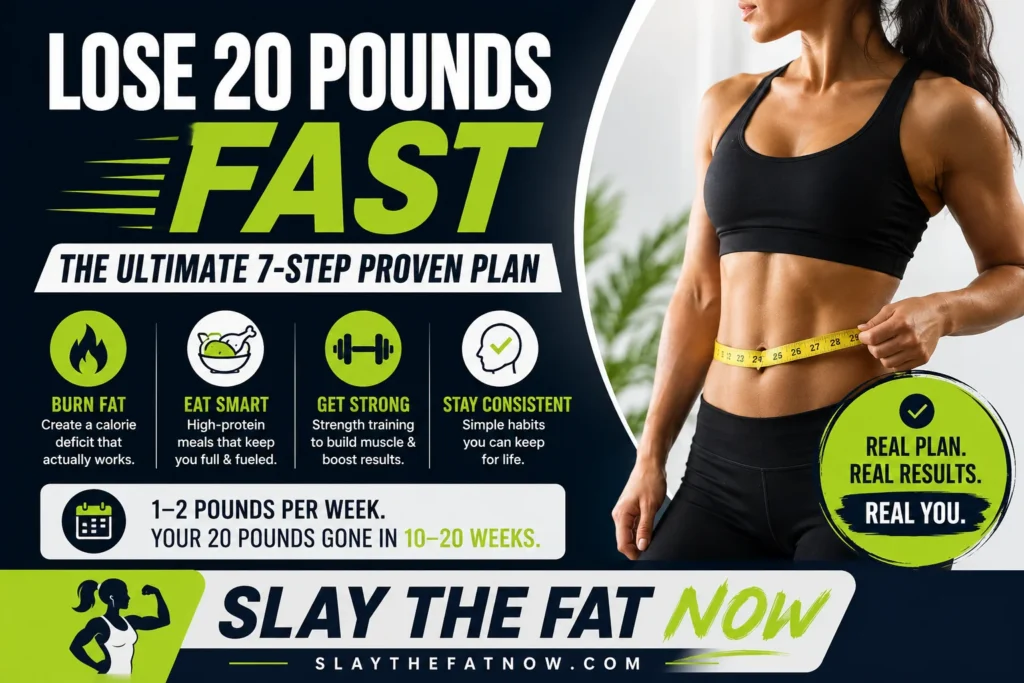
You’ve Probably Already Lost 20 Pounds Before
Here’s the part most weight loss articles skip: if you’re reading this, there’s a good chance you’ve already lost 20 pounds once. Maybe more than once. You cut carbs for three weeks. You hit the gym five days a week every January. It worked — for a while. Then life happened, hunger won, motivation faded, and the scale crept back.
That’s not a willpower failure. It’s a strategy failure. This guide fixes the strategy, not your discipline.
If you’re searching “how to lose 20 pounds,” you don’t need another 7-day cleanse. You need a plan built around how your body actually works — one you can still be following in month six.
Want the shortcut version? Grab the 10-Day Metabolism Reset Book by Benjamin Sley for a done-for-you meal and movement plan.
What You’ll Learn: Your Complete 20-Pound Weight Loss Plan
In this guide, we’re covering everything you actually need to know about a real 20 pound weight loss plan: how long it takes, what to eat, how to exercise, which mistakes to avoid, and how to stay consistent when motivation wears off.
We’re drawing from published research, CDC data, and years of experience working with people who’ve been exactly where you are right now frustrated, determined, and ready to finally make it happen.
Let’s get into it.
Why 20 Pounds Is the Number That Changes Everything
Twenty pounds isn’t arbitrary — it’s a physiological tipping point:
- Blood pressure drops. A 5–10% reduction in body weight can meaningfully lower blood pressure.
- Joint stress drops fast. Every pound lost removes roughly four pounds of load from your knees.
- Energy goes up. Less mass to carry means less fatigue moving through your day.
- Sleep improves, especially if extra weight was contributing to sleep apnea.
- Confidence resets, which changes how you show up everywhere else.
This isn’t about appearance. It’s about function, longevity, and feeling like yourself again — whether you’re starting from zero or breaking through a stalled plateau. If you’re over 40, the hormonal landscape shifts the playbook slightly — our guide to proven fat-loss strategies for women over 40 covers what changes and why.
Why Losing 20 Pounds Changes Everything
Twenty pounds isn’t just a number. It’s a tipping point. Here’s what happens when you hit that goal:
- Your blood pressure drops even a 5–10% reduction in body weight can meaningfully lower blood pressure.
- Your joints thank you — for every pound of body weight lost, the load on your knees reduces by roughly four pounds.
- Your energy goes up — less mass to carry around means less fatigue during daily activities.
- Your sleep improves — especially if excess weight is contributing to sleep apnea or disrupted sleep.
- Your confidence returns and that changes how you show up in every area of your life.
This isn’t about vanity. It’s about function, longevity, and feeling like yourself again. Whether you’re looking to start your weight loss journey as a beginner or break through a frustrating plateau, 20 pounds is a goal with real, measurable health payoffs.
The Real Data Behind Weight Loss in America
40%of U.S. adults currently live with obesity affecting about 1 in 2 Americans, according to CDC data. Yet for the first time in over a decade, the number of states with obesity rates above 35% dropped in 2024 a hopeful sign that change is possible.
In 2024, all U.S. states and territories had an obesity prevalence of 25% or higher, meaning at least 1 in 4 adults in every state is living with obesity. Nineteen states had obesity rates of 35% or higher in 2024, down from 23 states the year before the first real decline in over a decade.
The sustainable rate for lasting results is 0.5–2 pounds weekly, or 1–2% of body weight monthly. This pace preserves muscle mass while showing meaningful progress.
Here’s what that means practically: at 1–2 lbs/week, losing 20 pounds takes 10–20 weeks. At the slower end, that’s about 5 months. At the faster end if your diet and training are dialed in closer to 2–3 months.
Breaking down larger goals into smaller, actionable steps builds confidence and momentum. Instead of aiming to lose 20 pounds all at once, focus on losing 1–2 pounds per week by adopting specific behaviors like eating more vegetables or exercising three times a week.
A Real-World Example: What 20 Pounds Actually Looks Like
Let’s look at a realistic scenario. Meet Sarah, 38, from Ohio. She weighs 182 lbs, works a desk job, and has two kids. She’s tried Weight Watchers twice and lost some weight but always regained it when life got busy.
Sarah decided to stop trying to be perfect and start trying to be consistent. Here’s what her 14-week plan looked like:
- Weeks 1–2: Audit and Reset
Sarah tracked everything she ate for two weeks without changing anything. She discovered she was eating 2,600+ calories daily, mostly from snacking after dinner and mindless portions. She set a daily target of 1,800 calories. - Weeks 3–6: High-Protein, Lower Carb
She shifted toward 30% protein, 40% carbs, 30% fat prioritizing chicken, eggs, Greek yogurt, and vegetables. She lost 9 lbs. in this phase. - Weeks 7–10: Add Strength Training
Three 45-minute strength sessions per week, with daily walks. The scale slowed down, but her clothes got noticeably looser she was building muscle and burning fat simultaneously. - Weeks 11–14: The Home Stretch
Sarah hit the 18-lb mark and stalled for 10 days. She slightly reduced evening calories and added one extra walking session per week. By week 14, she was down 22 lbs and still eating foods she actually enjoyed.
Sarah’s story isn’t unusual. It’s what actually happens when someone follows a real plan instead of an extreme one.
Ready to Start Your 20-Pound Journey?
Get our free 7-day kickstart guide meal plans, workout templates, and the exact strategy top losers use to stay consistent.Claim Your Free Plan →
What Actually Works: 7 Steps to Lose 20 Pounds
After seeing hundreds of weight loss journeys both successes and relapses here are the seven strategies that consistently separate people who lose 20 pounds and keep it off from those who lose it and regain it.
Step 1: Build a Real Calorie Deficit (Not a Starvation Diet)
Fat loss comes down to energy balance. To lose one pound of fat, you need to burn roughly 3,500 more calories than you consume. A daily deficit of 500–750 calories puts you on track to lose 1–1.5 lbs per week without triggering your body’s starvation response.
Don’t go below 1,200 calories (women) or 1,500 calories (men). Eating too little kills your metabolism, tanks your energy, and leads to muscle loss the exact opposite of what you want.
Step 2: Prioritize Protein at Every Meal
Protein is the single most important macronutrient for fat loss. It preserves muscle while you’re in a deficit, keeps you fuller longer, and requires more energy to digest than carbs or fat.
Aim for 0.7–1 gram of protein per pound of body weight per day. At 180 lbs, that’s 126–180g of protein daily. Think: eggs, chicken, fish, Greek yogurt, cottage cheese, tofu, and legumes.
Step 3: Strength Train at Least 3 Days Per Week
Cardio burns calories during the workout. Strength training burns calories for 24–48 hours afterward and it reshapes your body, so you look leaner even before you hit your goal weight. HIIT can increase your metabolism for hours after the workout through excess post-exercise oxygen consumption (EPOC), meaning you continue to burn fat even after you’ve finished exercising.
For beginners, three full-body strength sessions per week is enough. No gym required bodyweight squats, push-ups, rows, and lunges all work beautifully.
Step 4: Walk More Than You Think You Should
Non-exercise activity thermogenesis (NEAT) all the movement you do outside of formal workouts can account for 300–500 extra calories burned per day. A daily 30-minute walk burns roughly 150 calories and dramatically reduces the risk of weight loss plateaus.
Aim for 8,000–10,000 steps per day. Get up from your desk every hour. Take stairs. Park further away. These small habits compound massively over 14 weeks.
Step 5: Sleep 7–9 Hours Every Night
Sleep deprivation is one of the most underrated drivers of weight gain. When you sleep less than 6 hours, your hunger hormones (ghrelin) spike and your satiety hormones (leptin) plummet you literally wake up hungrier and less able to feel full.
Studies consistently show that people who sleep 7+ hours lose significantly more fat and less muscle during a calorie deficit than those who sleep 5–6 hours.
Step 6: Manage Stress Aggressively
Chronic stress elevates cortisol, which signals your body to store fat especially around the abdomen. It also triggers emotional eating. This isn’t soft advice. Stress management is a direct fat loss tool.
Walk. Breathe deeply. Cut screen time before bed. Say no to commitments that drain you. These aren’t luxuries. They’re part of your plan.
Step 7: Track Progress Weekly Not Daily
Your weight can fluctuate 2–5 lbs in a single day based on water, sodium, hormones, and food volume. Weighing yourself daily and reacting emotionally to every swing is a recipe for quitting. Weigh in once per week, same time, same conditions. Track trends over 4-week windows, not day to day.
Reality Check: Myths About How to Lose 20 Pounds
❌ Myth“I need to do two hours of cardio every day.”
Excessive cardio increases hunger dramatically, raises cortisol, breaks down muscle, and causes burnout within weeks. Strategic cardio (30–45 min, 3–4x/week) combined with strength training produces far better and more sustainable results.
❌ Myth“Carbs make you fat.”
Carbohydrates don’t cause fat gain excess calories do. Many people lose 20 pounds while eating rice, oats, fruit, and potatoes. The key is total calorie intake and food quality, not demonizing entire food groups.
❌ Myth“Losing 20 pounds in a month is realistic.”
While rapid weight loss may seem appealing, it’s often unsustainable. Behavioral interventions typically lead to 5–10% average weight loss, and extreme methods lead to rebound. One to two pounds per week is where long-term success actually lives.
❌ Myth“You have to be hungry all the time to lose weight.”
A high-protein, high-fiber diet keeps hunger well-managed even in a calorie deficit. A plate filled with vegetables, protein, and fiber provides fewer calories yet greater satiety than a smaller portion of high-fat, processed foods. Hunger is a symptom of a poor diet strategy, not a requirement for fat loss.
The Real Numbers Behind Weight Loss in America
About 40% of U.S. adults currently live with obesity, according to CDC data — roughly 1 in 2 Americans. For the first time in over a decade, the number of states with obesity rates above 35% actually dropped in 2024, falling from 23 states to 19.
Every U.S. state still has an obesity rate of 25% or higher, meaning at least 1 in 4 adults nationwide is affected. The takeaway: this is a widespread, systemic challenge — not a personal failing — and the data shows real progress is possible with the right approach.
The sustainable pace for lasting fat loss is 0.5–2 pounds per week, or 1–2% of bodyweight per month. That pace preserves muscle while still showing visible weekly progress.
| Pace | Time to Lose 20 lbs | Best For |
|---|---|---|
| 0.5 lbs/week | ~40 weeks | Near goal weight, age 50+ |
| 1 lb/week | ~20 weeks | Most people — sustainable |
| 1.5 lbs/week | ~13–14 weeks | 30+ lbs overweight, high consistency |
| 2 lbs/week | ~10 weeks | Short aggressive phase only |
For most people, 10–20 weeks is the honest range. Accepting that timeline is what keeps you from quitting after week three.
Get the 10-Day Metabolism Reset Book for a structured way to kick off week one.
How Long to Lose 20 Pounds: Realistic Timelines
The question “how long to lose 20 pounds?” depends on your starting point, deficit size, and consistency. Here’s a practical breakdown:
| Weekly Loss Rate | Time to Lose 20 lbs | Recommended For |
|---|---|---|
| 0.5 lbs/week | ~40 weeks (10 months) | Those close to goal weight, age 50+ |
| 1 lb/week | ~20 weeks (5 months) | Most people sustainable and effective |
| 1.5 lbs/week | ~13–14 weeks (~3.5 months) | Those 30+ lbs overweight, high consistency |
| 2 lbs/week | ~10 weeks (~2.5 months) | Short-term aggressive phase only requires strict discipline |
“Sustainable weight loss isn’t about finding the fastest route it’s about building the system that keeps working after motivation fades.”SlayTheFatNow Editorial Team
For most people, 10–20 weeks is the honest, realistic range for losing 20 pounds in a healthy way. Accept this timeline, and you’ll stop falling for 30-day promises that leave you right back where you started.
Comparing the Most Popular Weight Loss Approaches
Not all diets are created equal. Here’s how the most common approaches stack up for a 20-pound weight loss goal:
| Approach | Effective? | Sustainable? | Muscle Preserving? | Best For |
|---|---|---|---|---|
| High-Protein + Calorie Deficit | ✓ Yes | ✓ Yes | ✓ Yes | Most people |
| Intermittent Fasting (16:8) | ✓ Yes | ✓ Often | ✓ With protein | Those who skip breakfast naturally |
| Ketogenic Diet | ✓ Yes | ✗ Hard to maintain | ✓ Yes | Short-term / insulin-resistant |
| Extreme Low Calorie (<1,200) | ✗ Short term only | ✗ No | ✗ No | Nobody not recommended |
| Juice Cleanses / Detox | ✗ No | ✗ No | ✗ No | Nobody unsupported by evidence |
The winner for most people? High-protein eating within a moderate calorie deficit, paired with strength training and daily walking. Simple, proven, and doesn’t require giving up your social life.
Real Example: What 20 Pounds Actually Looks Like
Meet Sarah — 38, from Ohio, 182 lbs, full-time desk job, two kids, two failed rounds of Weight Watchers behind her. This time, she stopped trying to be perfect and focused on being consistent.
Weeks 1–2 — Audit, don’t change anything yet. Sarah tracked her actual intake and discovered she was eating 2,600+ calories a day, mostly from after-dinner snacking. She set a target of 1,800 calories.
Weeks 3–6 — Shift the macros. She moved to roughly 30% protein / 40% carbs / 30% fat, built around chicken, eggs, Greek yogurt, and vegetables. Result: 9 lbs down.
Weeks 7–10 — Add strength training. Three 45-minute sessions per week plus daily walks. The scale slowed, but her clothes loosened noticeably — she was building muscle while losing fat.
Weeks 11–14 — Push through the stall. Sarah hit 18 lbs lost and plateaued for 10 days. She trimmed evening calories slightly and added one more walk per week. By week 14: 22 lbs down, still eating food she actually liked.
Sarah’s story isn’t the exception. It’s what a real plan looks like when it’s followed instead of abandoned.
The 7 Steps That Actually Get You There
1. Build a Real Deficit — Not a Starvation Diet
Fat loss is energy balance: roughly 3,500 calories burned beyond intake equals one pound of fat lost. A daily deficit of 500–750 calories puts you at 1–1.5 lbs/week without triggering the metabolic slowdown that comes with extreme restriction.
Don’t go below 1,200 calories (women) or 1,500 calories (men). Eating too little tanks your metabolism, kills your energy, and burns muscle instead of fat — the opposite of the goal.
2. Prioritize Protein at Every Meal
Protein preserves muscle during a deficit, keeps you full longer, and costs more energy to digest than carbs or fat. Target 0.7–1g per pound of bodyweight — at 180 lbs, that’s 126–180g daily. Lean on eggs, chicken, fish, Greek yogurt, cottage cheese, tofu, and legumes — see our full list of best fat-burning foods for women for more options, and check out the best morning foods for fat loss to set your day up right.
3. Strength Train at Least 3 Days a Week
Cardio burns calories during the workout. Strength training keeps burning for 24–48 hours after, and it’s what reshapes your body so you look leaner even before the scale catches up. HIIT adds extra afterburn through excess post-exercise oxygen consumption (EPOC).
Beginners don’t need a gym. Three full-body sessions a week — bodyweight squats, push-ups, rows, lunges — is genuinely enough to start.
4. Walk More Than Feels Necessary
Non-exercise activity (NEAT) — all the movement outside formal workouts — can account for 300–500 extra calories burned daily. A 30-minute walk alone burns roughly 150 calories and meaningfully reduces plateau risk.
Target 8,000–10,000 steps a day. Stand up hourly. Take the stairs. These small habits compound over 14 weeks more than any single workout does.
5. Sleep 7–9 Hours, Non-Negotiable
Under 6 hours of sleep spikes ghrelin (hunger) and crashes leptin (satiety) — you wake up hungrier and less able to feel full. People sleeping 7+ hours consistently lose more fat and retain more muscle in a deficit than those sleeping 5–6 hours.
6. Manage Stress Like a Fat-Loss Tool, Not an Afterthought
Chronic stress elevates cortisol, which promotes abdominal fat storage and triggers emotional eating. Walking, deep breathing, cutting pre-bed screen time, and saying no to draining commitments aren’t soft advice — they’re part of the mechanism. If belly fat is your specific frustration, our guide to 10 powerful ways to lose belly fat for women goes deeper on the cortisol connection.
7. Track Weekly, Not Daily
Bodyweight can swing 2–5 lbs in a single day from water, sodium, and food volume. Daily weigh-ins invite emotional overreaction and quitting. Weigh in once a week, same time, same conditions, and judge progress over 4-week windows. Pairing your weigh-in routine with a consistent morning ritual — like the best morning drink for weight loss — also makes it easier to stay accountable day to day.
The full system, broken into a day-by-day plan, is inside the 10-Day Metabolism Reset Book by Benjamin Sley.
Myths That Are Quietly Sabotaging You
“I need two hours of cardio daily.” Excessive cardio spikes hunger, raises cortisol, breaks down muscle, and burns people out within weeks. 30–45 minutes, 3–4x/week, paired with strength training, outperforms it — see our full breakdown of whether cardio actually burns fat for the science.
“Carbs make you fat.” Excess calories cause fat gain — not carbs specifically. Plenty of people lose 20 lbs while still eating rice, oats, fruit, and potatoes. Total intake and food quality matter more than banning a macro.
“20 pounds in a month is realistic.” Rapid loss is rarely sustainable. Most behavioral approaches produce 5–10% average weight loss, and extreme methods routinely rebound. 1–2 lbs/week is where lasting results actually live.
“You have to be hungry the whole time.” A high-protein, high-fiber plate provides more satiety per calorie than smaller portions of processed food. Hunger signals a flawed strategy — not a requirement for fat loss.
Comparing the Most Popular Approaches
| Approach | Effective | Sustainable | Muscle-Preserving | Best For |
|---|---|---|---|---|
| High-Protein + Deficit | Yes | Yes | Yes | Most people |
| Intermittent Fasting (16:8) | Yes | Often | With protein | Natural breakfast-skippers |
| Ketogenic Diet | Yes | Hard to maintain | Yes | Short-term / insulin-resistant |
| Extreme Low-Calorie (<1,200) | Short-term only | No | No | Not recommended |
| Juice Cleanses / Detox | No | No | No | Not recommended |
The combination that wins for most people: a moderate deficit, high protein, strength training, and daily walking. No social-life sacrifice required.
Frequently Asked Questions About Losing 20 Pounds
How long does it realistically take to lose 20 pounds?
At a healthy and sustainable pace of 1–2 pounds per week, losing 20 pounds takes approximately 10 to 20 weeks. Most people who stay consistent reach the goal in 3–5 months.
Can I lose 20 pounds without exercise?
Yes, weight loss is primarily driven by diet. However, adding exercise especially strength training preserves muscle, speeds up fat loss, and dramatically lowers your risk of regaining the weight.
How many calories should I eat to lose 20 pounds?
Start by calculating your Total Daily Energy Expenditure (TDEE), then subtract 500–750 calories. Most women lose weight eating 1,400–1,700 calories per day; most men on 1,700–2,100 calories per day.
Is it safe to lose 20 pounds in 30 days?
No. Losing 20 pounds in 30 days would require an extreme and dangerous deficit of 2,333 calories per day. It’s not physiologically realistic without serious medical intervention and risks serious muscle loss, nutrient deficiencies, and gallstones.
What’s the best diet to lose 20 pounds fast?
A high-protein, whole-food diet with a moderate calorie deficit is consistently the most effective approach. Focus on lean proteins, vegetables, legumes, and complex carbs. Minimize processed food, liquid calories, and ultra-refined sugars.
Will I have loose skin after losing 20 pounds?
For most people, no 20 pounds is typically not enough to cause noticeable loose skin, especially when lost gradually. Strength training helps fill in the space as fat leaves. Loose skin is more of a concern with 50+ pound losses.
How much weight can I lose in a week on this plan?
Realistically, 1–2 pounds per week of actual fat loss. You may see faster drops on the scale initially due to water weight and glycogen depletion this is normal but doesn’t represent fat loss.
Do I need to count calories to lose 20 pounds?
Tracking calories, even for just a few weeks, dramatically improves awareness of what you’re eating. You don’t have to count forever, but most people are shocked to discover how many calories are in their “healthy” choices.
What is the best exercise to lose 20 pounds?
A combination of strength training (3x/week) and daily walking is the most effective and sustainable approach. HIIT 2x/week can accelerate results. Avoid doing exclusively cardio it increases hunger and breaks down muscle.
How much water should I drink to lose weight?
Aim for at least half your body weight in ounces per day (e.g., 180 lbs = 90 oz). Drinking 16–20 oz of water before meals can reduce calorie intake by helping you feel fuller faster.
Can intermittent fasting help me lose 20 pounds?
Yes intermittent fasting (especially the 16:8 method) can be highly effective because it naturally reduces your eating window, making it easier to hit a calorie deficit without obsessive tracking. It works best combined with high-protein meals.
Why did I stop losing weight after losing 10 pounds?
Weight loss plateaus are completely normal. As you lose weight, your body burns fewer calories at rest. To break a plateau: recalculate your calorie needs, slightly increase protein, add a new form of exercise, or try a brief calorie cycling strategy.
Is losing 20 pounds noticeable?
Absolutely most people begin to notice a visible difference in their face, waist, and overall silhouette around the 10–15 pound mark. By 20 pounds, the change is significant and widely noticed by others.
Can stress prevent weight loss?
Yes. Elevated cortisol from chronic stress actively promotes fat storage especially belly fat and triggers cravings for high-calorie foods. Managing stress through sleep, exercise, and mindfulness is as important as diet in any serious 20 pound weight loss plan.
What are the best foods to eat to lose 20 pounds?
Focus on: eggs, chicken breast, salmon, Greek yogurt, cottage cheese, lentils, broccoli, spinach, sweet potatoes, oats, berries, and avocado. These are nutrient-dense, filling, and calorie-efficient the foundation of any successful weight loss strategy.
Sources: CDC Obesity Data and Statistics
National Heart, Lung, and Blood Institute — Overweight & Obesity
Your 20-Pound Transformation Starts Today
Stop searching and start doing. Get the free SlayTheFatNow weight loss starter pack complete with a 7-day meal plan, beginner workout schedule, and our top fat-loss checklist. Start Your Plan Now It’s Free
