 Skip to content
Fat Loss Guide
Does Cardio Burn Fat? 7 Proven Truths That Will Finally Transform Your Results
By SlayTheFatNow Editorial Team | Updated May 2026 | 10 min read
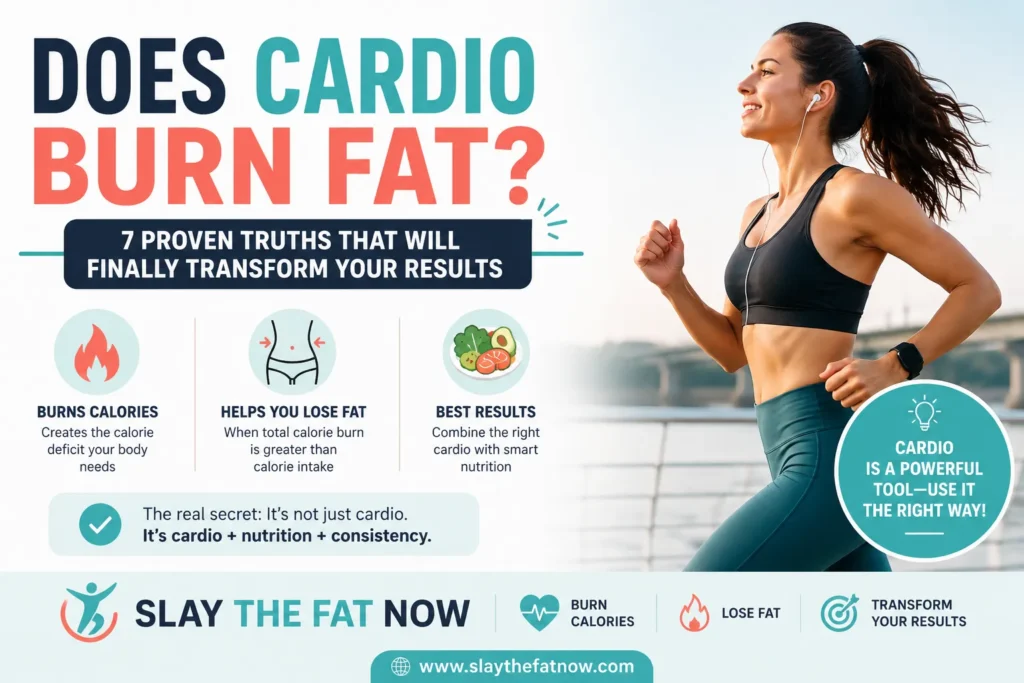
Yes, cardio does burn fat but not in the way most people think. Cardio burns calories, and when your total calorie burn exceeds your intake, your body taps into stored fat for energy. The real secret is combining the right type of cardio with smart nutrition. Done correctly, cardio for weight loss is one of the most powerful tools you have.
The Painful Mistake Millions of Americans Are Making Right Now
Picture this: You drag yourself out of bed at 6 a.m., lace up your sneakers, and log 45 minutes on the treadmill. You do this five days a week. You’re sweating, you’re sore, and your feet hurt.
Six weeks later, the scale hasn’t moved.
You’re furious. You’re exhausted. And a voice in your head starts whispering: “Maybe cardio just doesn’t work for me.”
Here’s the hard truth cardio absolutely works. But most people are doing it wrong, doing too little of it, or expecting it to fix a bad diet. This article will show you exactly what the science says about does cardio burn fat, how much you actually need, and what actually produces visible results.
What Does “Cardio Burns Fat” Really Mean?
When people ask does cardio burn fat, they usually imagine fat cells disappearing mid-workout. That’s not quite how it works. Your body burns a blend of carbohydrates and fat for fuel during any exercise the ratio shifts depending on intensity.
At lower intensities (think: brisk walking, easy cycling), your body burns a higher percentage of calories from fat. At higher intensities (sprinting, HIIT), you burn more total calories, but a larger chunk comes from glycogen (stored carbs).
The bottom line: cardio for weight loss works by creating a calorie deficit. When you consistently burn more than you eat, your body is forced to raid its fat stores. That is fat loss in action.
In this article, you’ll learn how cardio triggers fat burning at a physiological level, how much cardio to lose weight at different fitness levels, which types work fastest, and what the research actually says not just gym folklore.
Why Cardio for Weight Loss Matters More Than You Think
Cardio isn’t just about dropping pounds. When you understand the full picture, you’ll want to do it for the long haul.
1. Burns Visceral Fat First
Research published in peer-reviewed journals shows that people who do cardio regularly lose significant amounts of visceral fat the dangerous fat around your organs linked to heart disease and type 2 diabetes. That’s not just cosmetic. That’s life changing.
2. Creates a Calorie Deficit Without Extreme Dieting
When you burn calories through cardio, you don’t have to slash your food intake as dramatically. That means you can eat real, balanced meals and still lose fat a massive quality-of-life advantage over crash diets.
3. Supports Long-Term Weight Maintenance
According to the Mayo Clinic, physical activity has a stronger effect on keeping weight off after loss than on initial weight loss itself. In other words, the people who keep the weight off long-term are almost always the ones doing cardio consistently.
4. Boosts Mood, Motivation, and Mental Clarity
Cardio floods your brain with endorphins. More motivation means more consistency. More consistency means more fat loss. It’s a compounding cycle that works in your favor.
Want to learn how to build this kind of momentum from scratch? Check out our guide on how to start losing weight when you don’t know where to begin.
Does Cardio Burn Fat? Here’s What the Data Actually Says
Let’s stop guessing and look at what real research and government health organizations tell us about cardio for weight loss.
150
Minutes/week of moderate cardio recommended by CDC for weight management
295
Calories burned in 30 min of vigorous cycling (154 lb person, per CDC)
3,500
Calorie deficit needed to lose approximately 1 pound of fat
485
Calories burned in 45 minutes of HIIT (varies by weight & intensity)
According to the CDC, a 154-pound person burns between 140–295 calories in just 30 minutes of cardio depending on the exercise type and intensity. That’s meaningful progress toward a daily deficit.
A landmark analysis of 149 different studies all involving overweight or obese participants confirmed that people who engaged in cardiovascular exercise consistently achieved both fat and weight loss. Every single study. That’s not anecdotal. That’s a pattern you can trust.
The Mayo Clinic confirms that most people need to cut about 500–750 calories per day to lose 1–1.5 pounds per week. Cardio makes hitting that target dramatically easier.
A Real-World Scenario: What Cardio for Weight Loss Looks Like in Practice
Meet Sarah, a 38-year-old nurse from Ohio. She weighs 187 pounds and wants to lose 25 pounds. She doesn’t have time for an elaborate gym routine. Here’s what a realistic plan looked like for her:
Weeks 1–2: She started with 30-minute brisk walks, 4 days a week. Total weekly calorie burn from cardio: roughly 700 calories.
Weeks 3–6: She added two days of cycling at moderate intensity, replacing two walk days. Weekly cardio burn climbed to ~1,400 calories. She also made small food swaps no crash diet, just fewer processed snacks.
Week 8: She had lost 6 pounds. Her blood pressure improved. She was sleeping better and had more energy at work.
The cardio didn’t torch fat overnight. But it steadily created a deficit that her body couldn’t ignore. By month three, she was down 14 pounds without starving herself once.
This is the unsexy truth about does cardio burn fat: it absolutely does, but it requires consistency over weeks, not days.
Ready to Start Burning Fat the Right Way?
Get our free fat-loss starter plan built for real people with real schedules, no gym required. Grab Your Free Plan →
What 10 Years of Coaching Actually Teaches You About Cardio and Fat Loss
After years of watching people try and fail to lose weight through cardio alone, a few patterns become crystal clear:
Pattern #1: Volume beats intensity for beginners. Beginners who push themselves into high-intensity workouts too fast burn out within three weeks. Consistency over 12 weeks at moderate intensity beats two weeks of max effort every time.
Pattern #2: People underestimate what they eat and overestimate what they burn. A 45-minute run burns roughly 400–500 calories. One grande Frappuccino is 500 calories. Cardio without dietary awareness is like bailing out a leaky boat with a teaspoon.
Pattern #3: The best cardio is the one you’ll actually do. Cycling, swimming, hiking, dancing, rowing they all burn calories. The “optimal” workout that you skip is far worse than the “suboptimal” one you do consistently.
“A lot of people think that if you want to lose weight, you need to go out and run. But our findings show that even when you combine consistent movement with good nutrition, you have real options cardio is just one powerful piece of that puzzle.” Dr. Mandy Hagstrom, Exercise Physiologist, UNSW Medicine & Health
Reality Check: Myths About Cardio and Fat Burning That Are Holding You Back
❌ Myth“You need to do cardio every single day to burn fat.”
Rest days are when your body repairs and adapts. Doing cardio 4–5 days per week with recovery days produces better long-term results than daily overtraining, which leads to injury and burnout.
❌ Myth“Fasted cardio burns more fat.”
While fasted cardio does increase fat oxidation during exercise, a 2017 systematic review found that it doesn’t translate into greater long-term fat loss compared to exercising after eating. Total calorie deficit over days and weeks is what counts.
❌ Myth“The ‘fat-burning zone’ is the best intensity for fat loss.”
Yes, lower intensity burns a higher percentage of fat. But higher-intensity cardio burns more total calories in less time and those extra calories come from fat stores too, just later. Total calorie burn is the real driver of fat loss.
❌ Myth“Cardio will make you lose muscle.”
Only if you do extreme amounts without adequate protein intake or strength training. Moderate cardio alongside a high-protein diet actually helps preserve muscle while burning fat.
How Much Cardio to Lose Weight: Your Practical Action Plan
Here’s the framework that actually works for cardio for weight loss, based on your starting point.
1. Start with the CDC baseline: 150 minutes of moderate cardio per week.
That’s 30 minutes, 5 days a week. Brisk walking counts. Cycling counts. Swimming counts. Pick something you won’t hate.
2. Aim for 3–5 sessions per week, 30–45 minutes each.
According to certified trainers and CDC guidance, this is the sweet spot for meaningful fat burning without burnout risk.
3. Add 1–2 HIIT sessions per week after 3 weeks.
HIIT can burn up to 485 calories in 45 minutes and creates an “afterburn” effect (EPOC) that keeps your metabolism elevated for hours post-workout.
4. Pair cardio with a modest calorie deficit of 300–500 calories per day.
This produces sustainable fat loss of 0.5–1.5 lbs per week without destroying your metabolism or energy levels.
5. Add strength training 2–3 days per week.
Muscle burns more calories at rest. More muscle = faster resting metabolism = more fat burned around the clock, not just during cardio.
Cardio vs. Strength Training vs. HIIT: Which Burns Fat Fastest?
One of the most common questions people have once they understand does cardio burn fat is: what type should they do? Here’s an honest comparison.
| Method | Calories Burned (30 min) | Fat Burn During | After-Burn Effect | Muscle Preservation | Best For |
|---|---|---|---|---|---|
| Steady-State Cardio (brisk walk, jog) | 150–320 | High % | Low | Moderate | Beginners, daily activity |
| HIIT | 250–400+ | Moderate % | High (EPOC) | Good | Time-efficient fat loss |
| Strength Training | 90–130 | Low % | Very High | Excellent | Metabolism boost, long-term |
| Cardio + Strength (Combined) | 200–350+ | High % | High | Best | Maximum fat loss results |
The winner? Combining cardio with strength training consistently outperforms doing either alone. A 2022 network meta-analysis of 81 randomized controlled trials confirmed that combined aerobic and resistance exercise produces superior cardiometabolic outcomes compared to cardio or weights alone.
Frequently Asked Questions About Cardio and Fat Burning
Does cardio burn fat or muscle?
Cardio primarily burns calories from fat and carbohydrates not muscle. Muscle loss only becomes a risk with extreme cardio volumes combined with very low protein intake. Eating enough protein (0.7–1g per pound of body weight) while doing moderate cardio protects muscle effectively.
How long does it take for cardio to start burning fat?
Your body begins using fat for fuel within 15–20 minutes of moderate cardio, once glycogen stores start depleting. However, visible fat loss results typically take 3–6 weeks of consistent effort combined with a calorie deficit.
Does cardio burn belly fat specifically?
You can’t spot-reduce fat. Cardio burns fat from all over your body based on genetics and hormones. However, research consistently shows that regular cardio is particularly effective at reducing visceral (belly) fat the dangerous kind around your organs.
How much cardio do I need to lose weight?
The CDC recommends 150–300 minutes of moderate-intensity cardio per week for weight management. For active fat loss, aim for 200–300 minutes per week (about 40–60 minutes, 4–5 days) paired with a modest calorie deficit.
Is 30 minutes of cardio a day enough to lose weight?
Yes, 30 minutes of cardio a day can support fat loss especially when combined with a clean diet. A 154-pound person burns 140–295 calories in 30 minutes depending on intensity. Over a week, that adds up to a meaningful deficit.
Is walking considered cardio for weight loss?
Absolutely. Brisk walking is one of the most underrated cardio options for fat loss. It’s low-impact, sustainable, and accessible to almost everyone. A 30-minute brisk walk burns roughly 120–180 calories and counts toward your weekly cardio target.
What type of cardio burns the most fat?
HIIT (High-Intensity Interval Training) burns the most calories in the shortest time and creates a significant afterburn effect. However, the “best” cardio is the one you’ll do consistently. Swimming, running, cycling, and even dancing are all effective.
Does cardio alone work for weight loss without dieting?
Cardio can create a calorie deficit, but many people unconsciously compensate by eating more or moving less the rest of the day. Cardio combined with a mindful diet is significantly more effective than cardio alone for sustainable fat loss.
Can I do cardio every day to lose weight faster?
You can do low-to-moderate intensity cardio (like walking) daily without much risk. However, intense cardio every day without rest increases injury risk and can lead to overtraining syndrome, which slows progress. Aim for 4–5 days with 2 recovery or light activity days.
Does cardio in the morning burn more fat?
Morning cardio doesn’t significantly outperform evening cardio for total fat loss. Fasted morning cardio may burn a slightly higher percentage of fat during the workout, but research shows this doesn’t translate to meaningfully greater fat loss over time. The best time to do cardio is when you’ll actually do it.
How many calories does 1 hour of cardio burn?
It varies by activity and body weight. For a 154-pound person: running burns approximately 590–800 calories per hour, cycling 480–590, swimming 510 calories, and brisk walking around 280–360 calories per hour.
Is HIIT or steady-state cardio better for fat loss?
HIIT burns more calories in less time and creates a stronger afterburn effect. Steady-state cardio is easier to sustain daily and is less taxing on the body. For most people, a mix of both 2 HIIT sessions and 2–3 steady-state sessions per week produces the best results.
Does strength training burn more fat than cardio?
Strength training burns fewer calories during the session than cardio, but it builds muscle, which raises your resting metabolism. Over time, more muscle means your body burns more fat even at rest. The combination of both is superior to either alone.
Why am I not losing weight despite doing cardio?
The most common reasons include: eating back the calories burned, not being in a calorie deficit overall, water retention from inflammation, doing too little cardio, or compensating with less movement throughout the day. Tracking food intake for even two weeks often reveals the culprit.
How long should a cardio session be for fat burning?
For moderate intensity, aim for at least 30–45 minutes per session to meaningfully elevate your calorie burn. Some experts suggest it takes about 20 minutes to fully enter fat-burning mode during steady-state cardio, so longer sessions are more efficient per minute at that point.
Stop Guessing. Start Losing.
Join thousands of Americans who’ve used the SlayTheFatNow system to burn real fat with a plan built around your life, not someone else’s.Start Your Fat Loss Journey Today →
The Final Word: Does Cardio Burn Fat?
Yes. Unequivocally, yes. But cardio burns fat best when it’s part of a bigger system one that includes mindful eating, adequate protein, strength training, and above all, consistency.
The people who fail with cardio are usually the ones who treat it as a magic eraser for a bad diet, or who push too hard for two weeks and then quit. The people who succeed are the ones who find cardio they don’t hate, build the habit slowly, and let the calorie math do the work over weeks and months.
Start where you are. Walk if you need to walk. Swim if swimming’s your thing. Just move, move consistently, and track what you eat. The fat will come off.
And when you’re ready to level up, SlayTheFatNow.com has everything you need to make it permanent.
© 2026 SlayTheFatNow.com All rights reserved. This article is for informational purposes only and does not constitute medical advice. Consult a healthcare professional before starting any new exercise program.
