 Skip to content
Why Do I Self-Sabotage My Diet? 7 Powerful Reasons (and How to Finally Stop)
By The SlayTheFatNow Team
You self-sabotage your diet because of unconscious psychological triggers not weak willpower. The root causes include emotional eating habits, fear of failure, all-or-nothing thinking, stress hormones, unmet emotional needs, social pressure, and past diet trauma. Understanding why this happens is the first step to breaking the cycle for good.
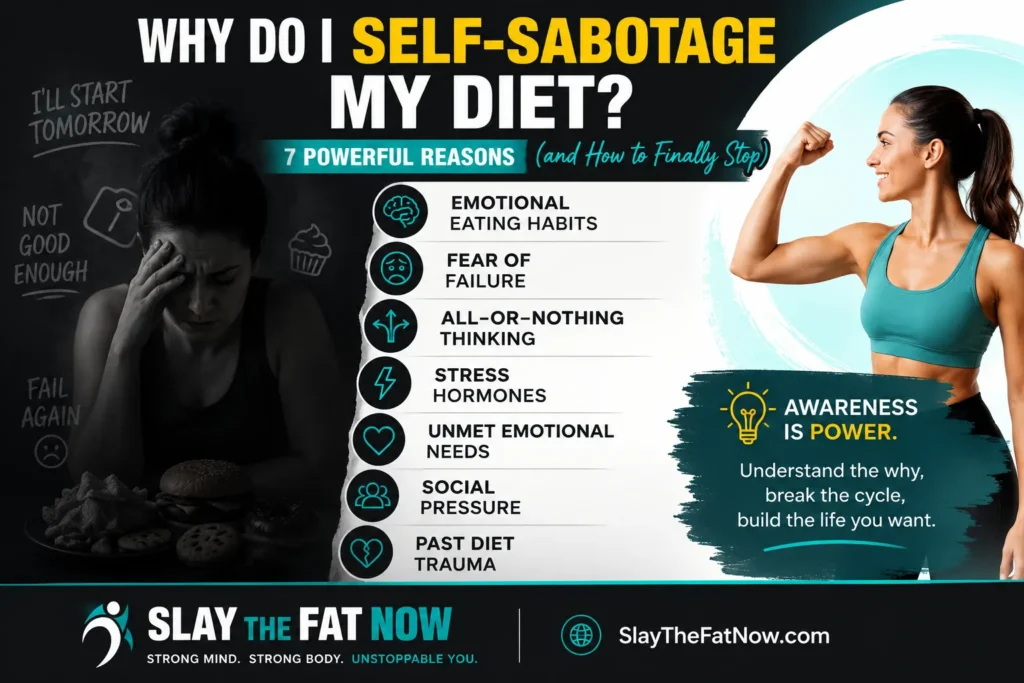
You’re Not Weak You’re Wired This Way
You start Monday strong. Meal prepped. Motivated. Tracking everything. By Thursday night you’ve eaten half a bag of chips standing in front of the pantry, telling yourself “I’ll restart Monday.”
Sound familiar? You’re not alone and here’s the most important thing nobody tells you: this isn’t a willpower problem.
Most people who ask themselves “why do I self-sabotage my diet” are operating under the false belief that if they just tried harder, wanted it more, or had more discipline, they’d finally succeed. But decades of psychology research point to a completely different answer. The problem isn’t your desire to lose weight. The problem is what’s happening in your brain and emotional patterns underneath the surface.
Diet self-sabotage is deeply tied to emotional eating habits, identity, fear, and your nervous system not your character. And once you understand the actual reasons, you can finally do something about them.
What Is Diet Self-Sabotage, Really?
Diet self-sabotage happens when you consciously want to eat healthier or lose weight, but your unconscious behavior consistently pulls you in the opposite direction. You eat when you’re not hungry. You “celebrate” with food. You think “I’ve already blown it, so I might as well eat everything.” You avoid social events to avoid eating, then binge at home alone.
These aren’t random slip-ups. They’re patterns and patterns have causes you can trace and fix. In this article, you’ll discover the 7 most powerful reasons people self-sabotage their diets, what the research says about emotional eating habits, and the specific strategies that actually work to break the cycle.
Why Breaking Diet Self-Sabotage Matters More Than Your Meal Plan
You could have the most perfectly designed meal plan in the world and still fail if your psychological patterns aren’t addressed. Here’s what’s at stake:
- Sustained weight loss requires consistent behavior, not perfect behavior for two weeks
- Emotional eating can undo weeks of caloric deficit in a single night
- People who understand their food triggers are far more likely to maintain results long-term
- Breaking the restriction-binge cycle protects your relationship with food for life
- Addressing root causes reduces stress, anxiety, and guilt around eating
If you want to stop spinning your wheels on diets that “work for everyone else,” this is where real change begins.
The Shocking Statistics Behind Diet Self-Sabotage in America
79% of Americans revert to old eating habits after dieting
20.5% of U.S. adults emotionally eat often or very often
5 average number of diets attempted by Americans who’ve dieted
9 in 10 dieters underestimate the emotional component of weight loss
Sources: Medifast/Newsweek survey (2022); NIH/PubMed cross-sectional study of 5,863 U.S. adults; Orlando Health National Survey
A large-scale U.S. study published in PMC analyzing 5,863 adults found that over 20% regularly engaged in emotional eating and those who struggled with impulse control were 18% more likely to reach for food when upset. Meanwhile, a Medifast-commissioned survey of 2,000 Americans revealed that people have tried an average of five different diets, yet 79% say they’re likely to go back to their old eating patterns. An Orlando Health survey found that only 1 in 10 people thinks emotional wellbeing plays a role in weight loss and that gap in understanding may explain why so many people keep failing despite trying so hard.
The data is clear: most people are treating a psychological problem with a nutritional solution. That’s why diets don’t stick.
7 Powerful Reasons You Self-Sabotage Your Diet
1. Emotional Eating Habits You Don’t Even Recognize
Emotional eating is the most common driver of diet self-sabotage and the sneakiest. It doesn’t always look like crying over a tub of ice cream. It looks like snacking while watching TV to unwind. Eating at work because you’re bored. Reaching for something crunchy when you’re angry. Cleaning your plate because you feel guilty.
These are emotional eating habits. And because they’re so normalized in our culture, most people don’t even realize they’re doing it. Your brain has learned to associate certain emotions with food as a coping mechanism and that association is incredibly powerful.
The fix isn’t to stop having emotions. It’s to build alternative coping strategies. More on that in the practical section below.
2. All-or-Nothing Thinking Destroys More Diets Than Junk Food
You eat one “bad” thing, decide you’ve ruined your day, and spiral into eating everything in sight. This cognitive distortion called all-or-nothing thinking is one of the biggest drivers of diet self-sabotage.
People who struggle with this pattern treat their diet like a pane of glass: the moment it cracks, they shatter it completely. But progress isn’t linear, and one imperfect meal isn’t a failure it’s a Tuesday.
Cognitive behavioral research consistently shows that people who adopt a “flexible restraint” approach allowing occasional treats without guilt sustain weight loss far better than people who use rigid restriction.
3. You’re Using Food to Meet Emotional Needs
Food provides comfort, pleasure, connection, reward, and relief from stress. If those emotional needs aren’t being met elsewhere in your life, food becomes a stand-in.
Are you lonely? Bored? Stressed at work? Feeling unappreciated? Anxious about the future? Food is the fastest, cheapest, most socially acceptable drug available. And unlike alcohol or cigarettes, nobody tells you to stop eating. This is why diet self-sabotage often intensifies during stressful life periods not because you’re weak, but because food is filling an emotional void.
“Most people focus almost entirely on the physical aspects of weight loss like diet and exercise. But there is an emotional component to food that the vast majority of people simply overlook, and it can quickly sabotage their efforts.” Diane Robinson, PhD, Neuropsychologist, Orlando Health
4. Fear of Success (Yes, This Is Real)
This one surprise people, but fear of success is a documented psychological barrier to weight loss. If losing weight would mean more attention, changing your identity, navigating new relationship dynamics, or losing the excuse that’s been holding you back your unconscious mind may resist it.
Some people have been “the heavy one” in their family or social circle for so long that losing weight feels like losing a part of themselves. Others worry that if they lose the weight and still aren’t happy, there are no more excuses. Diet self-sabotage becomes a protection mechanism.
5. Chronic Stress Physically Drives You to Overeat
When you’re chronically stressed, your body floods with cortisol a hormone that directly increases cravings for high-fat, high-sugar foods. This is biology, not moral failure. Cortisol also promotes fat storage, particularly around the abdomen, creating a vicious cycle.
American adults are among the most chronically stressed populations in the world. If you’re trying to diet while running on empty juggling work, family, finances, and sleep deprivation you are fighting your own hormones every single day.
6. Past Diet Trauma Creates Subconscious Resistance
If you’ve been on restrictive diets before, your body and brain remember. Repeated cycles of severe restriction create a neurological and physiological backlash. Your brain interprets intense dieting as a threat to survival, and it will fight back with hunger hormones, increased food reward signals, and mental obsession with food.
Research shows that even a 25% reduction in caloric intake significantly increases hunger and food reward signaling making hyperpalatable foods (think: chips, cookies, pizza) feel even more appealing than normal. Your diet self-sabotage may literally be your body trying to protect you.
7. Social Pressure and Environment Undermine Your Willpower
You can have iron resolve at home, but office birthday cake, family dinners, and Friday happy hours are a different story. We are social creatures, and food is deeply intertwined with belonging. Turning down food can feel like rejecting people and that social discomfort is real.
Beyond social situations, your physical environment matters enormously. If your kitchen is full of trigger foods, if you drive past fast food on your commute, if your family doesn’t support your goals your environment is working against you 24/7. This is an underrated cause of diet self-sabotage.
Learn how to set up your environment for success in our guide on building lasting healthy eating habits.
Ready to Break the Cycle for Good?
Get our free Weight Loss Mindset Guide the exact psychology-based framework used by people who lose weight and actually keep it off.Get the Free Guide →
A Real Example: Meet “Sarah” Does This Sound Familiar?
📖 Real-Life Scenario
Sarah, 38, from Ohio, has tried seven diets in five years keto, calorie counting, intermittent fasting, Weight Watchers, and more. Each time, she loses 8–12 pounds in the first few weeks, feels amazing, then something happens. A stressful work week. A fight with her spouse. A holiday. Suddenly she’s eating whatever’s in the house at 10pm and the scale is creeping back up.
Sarah thinks she lacks discipline. The truth? Sarah has never addressed her emotional eating habits. Food is her primary coping tool for stress and conflict. Every time her diet gets hard, the real challenge isn’t the diet it’s the unaddressed emotions underneath. Once Sarah started working on the psychological patterns not just the meal plan she lost 22 pounds in four months and hasn’t regained it.
What changed? She identified her top 3 emotional triggers. She built a “comfort toolkit” with non-food alternatives. She stopped labeling foods as good or bad. And she stopped starting over every Monday instead treating every meal as its own fresh start.
What Actually Works: Expert Insights on Stopping Diet Self-Sabotage
After looking at years of behavioral research and client patterns, a few things stand out consistently about what separates people who break diet self-sabotage from those who stay stuck:
They stop dieting and start building habits. Diets have endpoints. Habits don’t. People who succeed long-term think in terms of “how do I want to eat for the rest of my life” not “what can I tolerate for 30 days.”
They identify their specific triggers. Not “stress” but Tuesday nights after work, or Sunday mornings when they feel lonely. The more specific the trigger identification, the more effective the intervention.
They repair their relationship with food first. When you stop treating food as the enemy and start seeing it as neutral just food the psychological charge around eating decreases dramatically.
They build support systems. Research consistently shows that social support dramatically improves weight loss outcomes. People who go it alone fail far more often than those with accountability.
Explore our complete guide to stopping emotional eating for a deeper breakdown of these strategies.
Reality Check: Common Myths About Diet Self-Sabotage
❌ Myth If I just had more willpower, I’d succeed.
✅ Fact Willpower is a finite resource. Systems, environment design, and emotional skills matter far more.
❌ Myth I need to be 100% strict to see results.
✅ Fact Flexible eaters sustain weight loss longer than rigid dieters. Consistency beats perfection.
❌ Myth Eating emotionally means I’m weak.
✅ Fact Emotional eating habits form in childhood as coping strategies. They’re learned and they can be unlearned.
❌ Myth Self-sabotage means I don’t really want it enough.
✅ Fact Diet self-sabotage is often unconscious protection fear of failure, change, or identity loss.
How to Stop Self-Sabotaging Your Diet: 8 Practical Steps
- Identify your top 3 emotional triggers. Keep a 7-day food and emotion journal. Note what you ate, when, and how you were feeling emotionally. Patterns will emerge quickly.
- Build a non-food comfort toolkit. List 5–10 things that give you comfort or stress relief without food: a walk, a hot shower, journaling, calling a friend, 10 minutes of deep breathing.
- Stop labeling foods as “good” or “bad.” Moral labeling of food increases guilt, which drives overeating. Food is just food some is more nutritious than others, but none of it defines your worth.
- Practice the 10-minute rule with cravings. When a craving hits, wait 10 minutes before acting on it. This simple pause activates your prefrontal cortex and gives you choice rather than reflex.
- Design your food environment intentionally. Don’t rely on willpower. Keep trigger foods out of the house. Keep healthy options front and center. Your environment shapes 80% of your eating behavior.
- Ditch the “restart Monday” mentality. Every meal is a fresh start. One imperfect meal doesn’t ruin a diet. Return to your goals at the very next eating opportunity not next week.
- Address stress at the source. If stress is your primary trigger, no diet will work long-term until stress management is part of your strategy. Prioritize sleep, movement, and mental health support.
- Get support and accountability. Tell someone your goals. Join a community. Find a coach. The research is overwhelming social support dramatically increases weight loss success and maintenance.
💡 Pro tip from the SlayTheFatNow community: Combine steps 1 and 2 to build what we call a “trigger-response swap.” For every emotional trigger you identify, assign a specific non-food response. Example: “When I’m stressed after work → I take a 15-minute walk before entering the kitchen.” Specific beats vague every time.
Restriction vs. Mindful Eating: Which Approach Beats Diet Self-Sabotage?
| Factor | Strict Restriction | Mindful / Flexible Eating |
|---|---|---|
| Short-term results | Fast | Moderate |
| Long-term sustainability | Low | High |
| Addresses emotional eating | No | Yes |
| Risk of binge-restrict cycle | High | Low |
| Relationship with food | Often worsens | Improves over time |
| Handles diet self-sabotage triggers | No framework | Built-in tools |
| Social flexibility | Very rigid | Adaptable |
Strict restriction can work short-term, but it fuels the exact binge-restrict cycle that causes diet self-sabotage. A flexible, mindful approach addresses the psychological root causes and builds habits that last. The goal isn’t 30 perfect days. It’s 30 years of mostly good choices.
Frequently Asked Questions About Diet Self-Sabotage
1. Why do I self-sabotage my diet even when I really want to lose weight?
Because wanting something consciously doesn’t override unconscious emotional patterns. Diet self-sabotage is usually driven by emotional eating habits, fear, identity conflict, or stress responses none of which are fixed by desire alone. You need to address the root causes.
2. Is diet self-sabotage a form of self-destructive behavior?
Not necessarily. In many cases, it’s actually your nervous system trying to protect you from restriction, stress, or change. Understanding it as protection not destruction helps you respond more compassionately and effectively.
3. What is the psychology behind emotional eating habits?
Emotional eating develops when we learn often in childhood to use food for comfort, reward, or stress relief. Over time, this becomes an automatic response. Negative emotions like anxiety, loneliness, or boredom trigger automatic eating behaviors even when you’re not physically hungry.
4. How do I know if I’m an emotional eater?
Ask yourself: Do you eat when you’re not physically hungry? Do emotions like stress, sadness, or boredom trigger eating? Do you feel guilt or shame after eating? Do you eat to reward yourself? If you said yes to two or more, emotional eating habits are likely affecting your diet.
5. Can stress cause diet self-sabotage?
Yes significantly. Chronic stress elevates cortisol, which increases cravings for sugary and fatty foods, impairs decision-making in the prefrontal cortex, and makes it harder to resist impulse eating. Stress management is not optional if you want to stop self-sabotaging your diet.
6. Why do I always “blow my diet” on weekends?
Weekends typically involve more social eating, less structure, greater access to food, and accumulated stress from the week. The “weekend effect” is one of the most common patterns in diet self-sabotage. Planning ahead for weekend triggers is essential.
7. Is all-or-nothing thinking why I fail my diet?
It’s one of the top reasons. All-or-nothing thinking turns minor slips into complete spirals. Developing a “progress over perfection” mindset where one imperfect meal doesn’t ruin the day is one of the most important shifts in overcoming diet self-sabotage.
8. Why do I eat more when I’m trying to diet?
Two reasons: first, restriction increases biological hunger signals and food reward responses your body literally fights back. Second, hyper-focusing on food through tracking and rules can increase psychological preoccupation with eating. A more flexible approach often reduces this paradox.
9. Can fear of success cause diet self-sabotage?
Yes. If weight loss means confronting deeper life changes identity shifts, relationship dynamics, or the removal of excuses your unconscious mind may resist it. This is more common than most people realize and often requires honest self-reflection or professional support to address.
10. What is the difference between a cheat day and self-sabotage?
A planned, conscious indulgence in the context of an overall healthy pattern is different from unconscious, guilt-driven overeating. The key difference is intentionality and your emotional state around the eating. Planned flexibility is healthy; reactive emotional eating is self-sabotage.
11. Does binge eating count as diet self-sabotage?
Binge eating is often the most extreme expression of diet self-sabotage and emotional eating habits. It’s frequently triggered by restriction, emotional distress, or shame spirals. If you’re binging regularly, it’s worth speaking with a therapist or dietitian who specializes in disordered eating.
12. How long does it take to break emotional eating habits?
Research on habit formation suggests meaningful behavioral change takes 60–90 days of consistent practice not 21 days as the popular myth claims. But progress begins quickly once you start identifying triggers and building alternative responses.
13. Should I see a therapist for diet self-sabotage?
If your diet self-sabotage is tied to deep emotional trauma, disordered eating patterns, or significant anxiety/depression, yes a therapist or registered dietitian is a valuable resource. Cognitive behavioral therapy (CBT) has strong evidence for improving emotional eating habits.
14. What foods trigger emotional eating most?
Highly processed, hyperpalatable foods those high in salt, fat, and sugar are the most common emotional eating triggers. These include chips, cookies, ice cream, pizza, and fast food. These foods activate the brain’s dopamine reward system, making them especially powerful during emotional distress.
15. Can mindful eating really stop diet self-sabotage?
Yes, mindful eating is one of the most evidence-backed interventions for both emotional eating habits and diet self-sabotage. It doesn’t require following a specific diet. Instead, it teaches you to eat with awareness, honor hunger cues, and interrupt automatic eating patterns. Multiple studies support its effectiveness for weight loss maintenance.
Stop Starting Over. Start Slaying.
You’ve learned the 7 reasons behind your diet self-sabotage. Now it’s time to take action. Join thousands of Americans who’ve broken the cycle using our proven approach.Start Your Journey at SlayTheFatNow →
The Bottom Line on Diet Self-Sabotage
When you ask yourself, “why do I self-sabotage my diet,” the answer is never simple but it’s always findable. Diet self-sabotage isn’t about weakness, laziness, or not wanting it badly enough. It’s about unaddressed emotional eating habits, cognitive patterns, stress responses, and an environment that works against you.
The good news? Every single one of these causes is addressable. Not by trying harder but by understanding what’s actually driving your behavior and building a smarter strategy around it.
Start by identifying your top emotional eating triggers this week. Then build one new non-food coping response. Small shifts, done consistently, create the lasting change that no diet plan alone ever could.
For more psychology-based weight loss strategies, explore these resources on SlayTheFatNow:
Sources:
NIH/PMC — Emotional Eating in U.S. Adults ·
Newsweek — Medifast Diet Survey ·
ScienceDaily — Orlando Health Survey on Emotional Weight Loss Barriers ·
