 Skip to content
High Volume Eating for Weight Loss: The Surprising 7-Food Method That Lets You Eat More
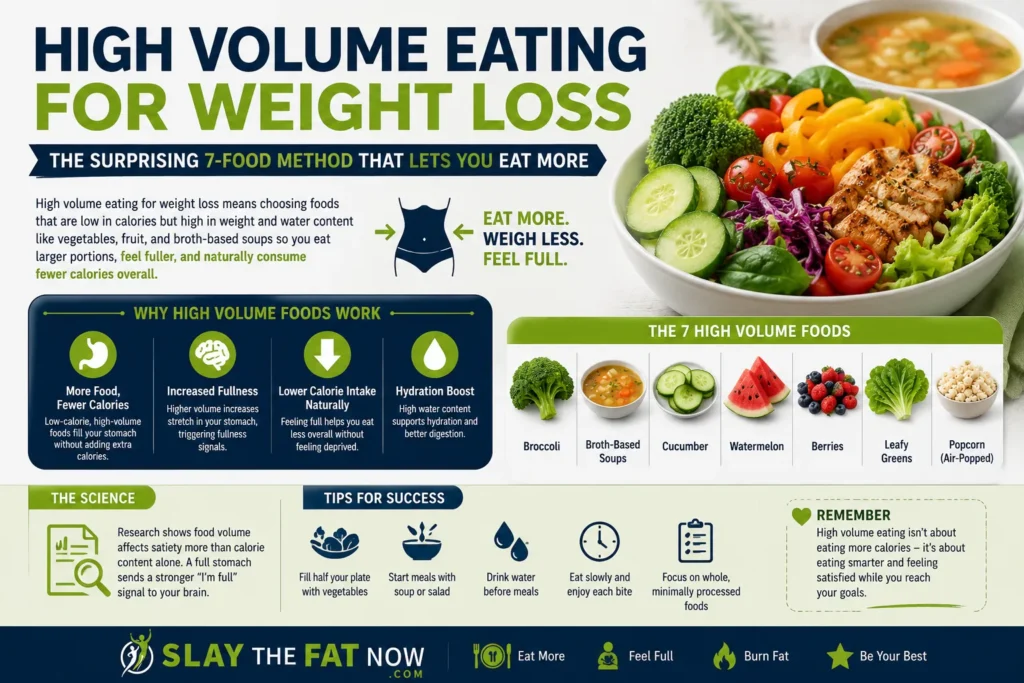
High volume eating for weight loss means choosing foods that are low in calories but high in weight and water content like vegetables, fruit, and broth-based soups so you eat larger portions, feel fuller, and naturally consume fewer calories overall. Research shows food volume affects satiety more than calorie content alone.
The Diet Mistake That Makes People Quit by Day Five
You’ve felt it before: a “diet” plate that looks like it belongs to a child. A few ounces of chicken, a small scoop of rice, maybe six asparagus spears arranged to look like more than they are. You eat it in four minutes and you’re hungry again by six.
That hunger isn’t weakness. It’s physics. Your stomach has stretch receptors that signal fullness based largely on the volume and weight of food sitting in it not the calorie count. A tiny, calorie-dense plate simply doesn’t trigger that signal, no matter how “on plan” it is. Most people don’t quit diets because they lack willpower. They quit because they’re starving on plates that were never going to satisfy them in the first place.
What High Volume Eating for Weight Loss Actually Means
High volume eating for weight loss is a strategy built around choosing foods with low energy density meaning a high ratio of weight or volume to calories so you can eat satisfying portion sizes while staying in a calorie deficit. Think a big bowl of vegetable soup instead of a small handful of crackers with the same calorie count.
In this guide, you’ll learn:
- The actual science behind why food volume affects hunger more than calories alone
- Which foods make high volume eating for weight loss realistic, not restrictive
- A real example of how this plays out on an actual plate
- Common mistakes people make when they first try eating this way
- Exactly how to build a volume-eating plate that keeps you full and on track
Why High Volume Eating Matters for Long-Term Results
This approach isn’t a gimmick it directly addresses the biggest reason diets fail:
- Hunger management: Feeling satisfied at meals is one of the strongest predictors of whether someone sticks with a calorie deficit past the first few weeks.
- Time: You stop white-knuckling through hunger and constantly thinking about food between meals.
- Money: Volume foods like vegetables, fruit, and lean proteins are typically far cheaper per meal than processed “diet” snack products.
- Long-term impact: A way of eating that doesn’t require constant hunger is one you can realistically sustain for years, not weeks.
The Research Behind High Volume Eating for Weight Loss
This isn’t a wellness trend it’s backed by decades of nutrition science:
- A systematic review and meta-analysis of randomized controlled trials found that lowering the energy density of meals consistently reduced total energy intake across both children and adults.
- Research on stomach distension shows that food volume not energy content is more decisive for triggering feelings of fullness, based on studies using intragastric infusions that bypassed taste and smell entirely.
- A clinical study published in the American Journal of Clinical Nutrition found that eating a low-energy-dense soup as a first course reduced total calorie intake at the meal without increasing reported hunger.
- An 18-month weight loss trial found that increasing the number of low-energy-dense foods in the diet was associated with greater sustained weight loss compared to simply removing high-energy-dense foods alone.
- Research also shows the duration of chewing and oral exposure to food contributes to reduced energy intake at least as much as the volume reaching the stomach, supporting why whole, high-volume foods outperform liquid calories for fullness.
Sources: PMC/NIH peer-reviewed systematic reviews, American Journal of Clinical Nutrition full citations in the FAQ section below.
The science is consistent: when you eat foods that take up more space and weight per calorie, your body registers fullness sooner and you tend to eat less overall without consciously trying to restrict.
A Real Example: The Same Calories, Two Completely Different Plates
Consider “Tom,” a composite scenario reflecting a common pattern. He was eating roughly 1,800 calories a day but built mostly around calorie-dense, low-volume foods a small portion of pasta, some cheese, a granola bar. He was constantly hungry and snacking off-plan by 3 p.m. most days.
Without changing his calorie target at all, he restructured his plate around high volume eating for weight loss principles:
- Breakfast: Swapped a granola bar for a large bowl of oats with berries and a scoop of protein powder same calories, far more volume.
- Lunch: Started meals with a vegetable-based soup before the main course, a technique directly supported by satiety research.
- Dinner: Built plates around a large base of non-starchy vegetables with lean protein, instead of starting with the smallest, most calorie-dense item.
Same 1,800 calories. Within two weeks, the 3 p.m. cravings disappeared, and he reported feeling more satisfied after meals than he had on a diet with the exact same calorie target built around smaller, denser foods.
Expert Insight: What High Volume Eating Gets Right (and Where It Falls Short)
After years of working with people who feel constantly hungry on a deficit, the pattern is almost always the same: their calories aren’t necessarily too low, but their food choices are too calorie-dense for the volume their stomach actually needs to feel full.
1. Vegetables and fruit aren’t “filler” they’re a strategy
People often treat vegetables as the boring side dish. In a volume-eating approach, they’re the main mechanism keeping you satisfied without going over your calorie target.
2. Protein and volume work together, not against each other
High volume eating for weight loss works best paired with adequate protein, since protein independently supports satiety while volume foods provide the physical fullness protein alone may not.
3. It doesn’t replace tracking it makes tracking easier
Volume eating doesn’t mean unlimited food. It means your calorie budget goes further and feels less restrictive, which makes consistent tracking far easier to sustain.
Reality Check: Myths About High Volume Eating for Weight Loss
Myth: “Volume eating means I can eat unlimited amounts of anything.”
Reality: Calories still count. Volume eating simply means choosing foods where you can eat a satisfying amount within your existing calorie target, not eating without limits.
Myth: “If a food is low-calorie, it automatically fills me up.”
Reality: Low-calorie liquids and processed low-calorie snacks often don’t trigger the same fullness signals as whole, high-volume foods like vegetables and fruit.
Myth: “Volume eating only works for vegetables.”
Reality: Broth-based soups, fruit, popcorn, and high-water proteins like white fish and shrimp can all support a volume-eating approach beyond just vegetables.
Myth: “Diet drinks and zero-calorie liquids count as volume eating.”
Reality: Research specifically notes that the energy-density-satiety relationship is weaker for liquids than for solid foods, so liquid “volume” doesn’t fill you up the same way solid food does.
Practical Advice: How to Build a High Volume Eating Plate
Do this:
- Start meals with a low-energy-dense food. A vegetable soup or large salad before the main dish reduces total calories eaten without increasing hunger.
- Fill half your plate with non-starchy vegetables. This single habit is the fastest way to increase food volume without significantly raising calories.
- Choose water-rich proteins when possible. White fish, shrimp, and chicken breast offer high protein with relatively low energy density.
- Add fruit instead of calorie-dense snacks. Fruit’s water and fiber content increases volume for relatively few calories compared to processed snack foods.
- Combine volume eating with protein and fiber goals. The three work together to maximize fullness per calorie.
Avoid this:
- Relying on zero-calorie drinks or diet sodas as your main “volume” strategy.
- Skipping protein in favor of only bulking up meals with vegetables.
- Assuming any “low-calorie” packaged snack automatically supports satiety.
- Treating volume eating as a free pass to ignore your overall calorie target.
Want help building plates like this every day? Check out our 1:1 coaching program, where we build sustainable, high volume eating plans around your calorie target.
Comparison: Volume Eating vs. Other Common Approaches
| Approach | Hunger Control | Ease of Sticking To It | Best For |
|---|---|---|---|
| High volume eating | High | High | People who feel constantly hungry on a deficit |
| Strict calorie counting (any foods) | Low–Medium | Medium | People who prioritize flexibility over fullness |
| Intermittent fasting | Medium | Medium | People who prefer fewer, larger meals |
| Liquid meal replacements | Low | Low–Medium | Short-term convenience, not long-term satiety |
Most people get the best results combining volume eating principles with a structured calorie target rather than choosing one approach exclusively. If you want this built out for your specific calories, pair this with our calorie deficit calculator to set your target first.
Frequently Asked Questions About High Volume Eating for Weight Loss
What is high volume eating for weight loss?
It’s an approach focused on choosing foods low in calories but high in weight or water content, so you can eat satisfying portions while staying in a calorie deficit.
Does eating more food really help you lose weight?
Yes, when the additional food is low in energy density. Research shows this increases satiety and reduces total calorie intake compared to smaller, calorie-dense meals.
What foods are best for high volume eating?
Non-starchy vegetables, fruit, broth-based soups, popcorn, and water-rich proteins like white fish and shrimp are commonly used staples for high volume eating.
Can volume eating help with constant hunger on a diet?
Yes. Since fullness is strongly influenced by food volume in the stomach, switching to higher volume, lower calorie foods can reduce hunger without changing your calorie target.
Is volume eating the same as eating unlimited calories?
No. Volume eating still operates within a calorie target it simply changes which foods you choose so that target feels far less restrictive.
Do liquids count toward volume eating the same way solid food does?
Not exactly. Research suggests the relationship between energy density and satiety is weaker for liquids, so solid high-volume foods are generally more effective for fullness.
Why does starting a meal with soup help with weight loss?
Clinical research has shown that eating a low-energy-dense soup before a meal reduces total calorie intake at that meal without increasing reported hunger afterward.
Can high volume eating work alongside intermittent fasting?
Yes. Many people combine fewer, larger eating windows with volume-eating principles, filling those meals with low-energy-dense foods to manage hunger within a shorter timeframe.
Does protein matter if I’m focused on volume eating?
Yes, significantly. Protein supports satiety independently of food volume, so combining both strategies tends to be more effective than relying on volume alone.
Are fruits too high in sugar for volume eating?
For most people, whole fruit’s fiber and water content support satiety effectively and fit well within a volume-eating approach, unlike fruit juice or dried fruit.
What’s the easiest way to start high volume eating?
Start by filling half your plate with non-starchy vegetables at lunch and dinner before adding your protein and carbohydrate portions.
Does chewing more help with high volume eating?
Yes. Research indicates the time spent chewing and the oral exposure to food contributes to reduced calorie intake, which is part of why whole foods outperform processed, easy-to-eat options.
Can high volume eating work for someone who eats out often?
Yes, by prioritizing salads, vegetable-based starters, and broth soups when ordering, and asking for extra vegetables in place of starchy sides.
Is high volume eating suitable for keto or low-carb diets?
It can be more difficult, since many low-energy-dense foods are carbohydrate-based, though non-starchy vegetables and water-rich proteins can still be incorporated.
How long does it take to notice less hunger from volume eating?
Many people notice a difference within the first one to two weeks of consistently restructuring meals around lower energy density foods.
Your Next Step
High volume eating for weight loss isn’t about eating less it’s about eating smarter, so your calorie deficit stops feeling like a punishment and starts feeling like a plate you actually want to finish.
Start with one meal today. Build it around vegetables and protein first, then fill in the rest.
Ready to build meals that keep you full? Grab our free high volume meal plan or explore the full weight loss library on Slay The Fat Now for your next step.
Sources cited:
Systematic review and Meta-analysis on energy density and energy intake (NIH)
Clinical satiety research published via the American Journal of Clinical Nutrition
18-month weight loss trial data on low-energy-dense food intake.
