 Skip to content
High Protein Meal Prep for Weight Loss: 7 Steps That Actually Work in 2026
High protein meal prep for weight loss works by pre-portioning meals with 25–40g of protein each, so you stay full, protect muscle, and stop relying on willpower at mealtime. Aim for 1.2–1.6g of protein per kg of bodyweight daily, prep 2–3 times per week, and pair it with a modest calorie deficit for steady, sustainable fat loss.
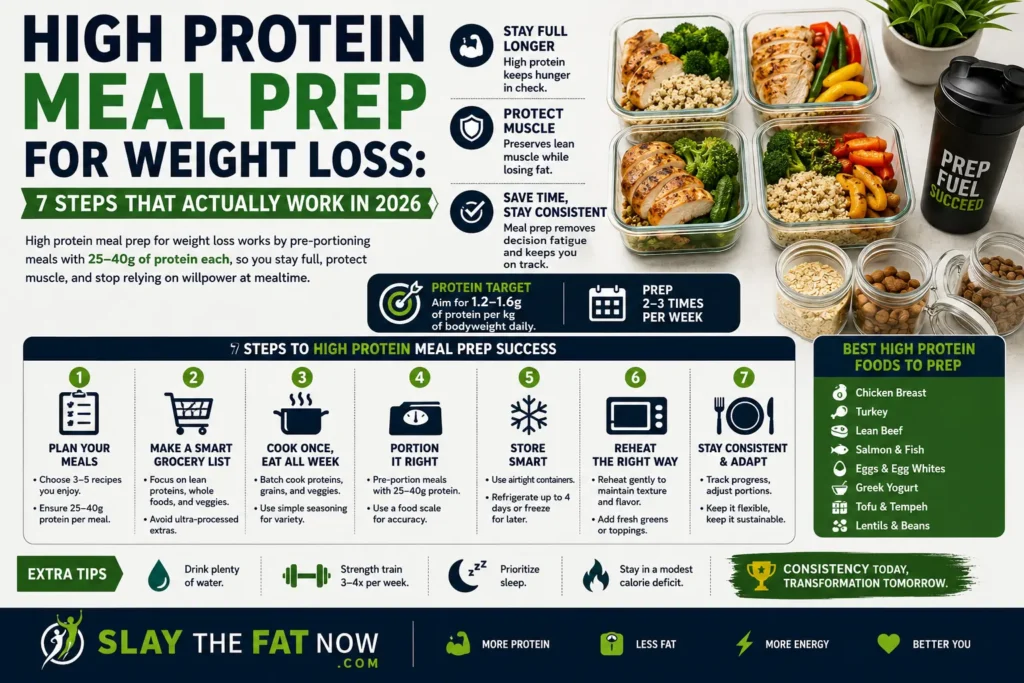
High Protein Meal Prep for Weight Loss: The 7-Step System That Works
Most people don’t fail at weight loss because they lack motivation on Monday morning. They fail at 7:42 PM on a Wednesday, starving, staring into a fridge with nothing ready to eat, and a delivery app one tap away.
I’ve watched this pattern play out with more clients than I can count. They start the week with a clean kitchen and good intentions. By day three, decision fatigue wins. The takeout order isn’t a willpower failure it’s a planning failure. And it’s exactly what high protein meal prep for weight loss is built to fix.
This isn’t another “eat clean” lecture. It’s a system. By the end of this article, you’ll know exactly how much protein you need, how to prep it without living in the kitchen, and how to avoid the mistakes that quietly stall fat loss for months.
What Is High Protein Meal Prep for Weight Loss (Overview)
High protein meal prep for weight loss means preparing meals in advance usually in batches for 2 to 5 days built around a protein source that hits roughly 25 to 40 grams per meal, with the rest of the plate filled by fiber-rich carbs and vegetables.
The “high protein” part matters because protein does three things almost nothing else in food does well at the same time:
- It keeps you full longer than carbs or fat per calorie
- It costs your body more energy to digest (the thermic effect of food)
- It protects lean muscle while you’re in a calorie deficit
The “meal prep” part matters because meal prep for fat loss removes the moment-to-moment decisions that derail most diets. You’re not deciding what to eat when you’re tired and hungry. You already decided, three days ago, when you had a clear head.
By the end of this guide, you’ll have a full system: how much protein to eat, what to prep, how data backs this approach, a real example week, and the mistakes that quietly sabotage even disciplined people.
Key Benefits of High Protein Meal Prep
Why This Combination Works Better Than Either Alone
1. You stop white-knuckling hunger. Protein is the most satiating macronutrient, meal for meal. Combine that with food that’s already cooked and waiting, and the two biggest triggers for diet failure hunger and convenience are handled before they become a problem.
2. You protect the muscle you have. A calorie deficit without enough protein doesn’t just burn fat. It eats into muscle too. Less muscle means a slower metabolism long after the diet ends, which is exactly why so many people regain weight faster than they lost it.
3. You save real money and real time. Restaurant and delivery meals average more calories, more sodium, and more cost than a home-prepped equivalent. Batch cooking once or twice a week is almost always cheaper than ordering out four or five times.
4. You remove decision fatigue. This is the underrated one. Every decision you don’t have to make at 6 PM is willpower you get to spend somewhere else.
5. You build a habit that survives stress, travel, and bad weeks. Diets built entirely on willpower collapse the first time life gets hard. Systems built on protein meal prep ideas you’ve already practiced tend to survive a bad week, because the structure doesn’t depend on how you feel that day.
Data and Facts: What the Research Actually Shows
This isn’t a trend. The research on high protein meal prep weight loss strategies is some of the most consistent in all of nutrition science.
A 2025 secondary analysis from the International Weight Control Registry, conducted across multiple US universities, found that higher dietary protein intake was directly associated with leaner body composition among people actively trying to lose weight in a study examining the relationship between protein intake, physical activity, and body weight and composition during purposeful weight loss attempts.
A clinical review published by the Korean Society for the Study of Obesity analyzed over 1,000 participants across high-protein versus standard-protein diet groups with matched calorie intake. The high-protein group showed a significantly greater reduction in body weight and fat mass, along with a significant increase in fat-free mass and resting energy expenditure, compared to the standard-protein group. In plain English: more protein, more fat lost, more muscle kept, even when calories were the same.
Updated national guidance backs this up directly. The 2025–2030 Dietary Guidelines for Americans now prioritize including a protein source at every meal and recommend adults consume between 1.2 and 1.6 grams of protein per kilogram of body weight daily. That range isn’t arbitrary it’s the range most weight-loss research lands on for preserving muscle during a deficit.
On the meal prep side specifically, a controlled study on prepackaged, pre-portioned meals found measurable advantages over typical self-managed dieting. Participants who received pre-portioned foods lost more than 8% of their body weight on average, compared to 6% in the group managing their own meals without pre-portioning.
A separate meal-prep behavior study found something just as telling about consistency: participants who prepared home-cooked meals once a week went from eating just over half their meals at home to eating 86% of meals at home by the end of the study. That shift more home meals, fewer impulsive ones is the real mechanism behind why prepping works.
And on safety, a common worry: a multicentric study assessing kidney function in overweight and obese patients following a structured high-protein weight loss program found no meaningful negative impact. The study concluded that the high-protein weight loss program did not impair renal function in patients who were overweight or obese. (This applies to people with normal kidney function more on exceptions in the Reality Check section.)
Real Example: A Realistic Week of Meal Prep in Action
Meet “Dana” not a real client name, but a composite of a pattern I’ve seen dozens of times.
Dana works a 9-to-5, has two kids, and had tried five different diets in three years. Each one worked for about two weeks before life got busy and the wheels came off.
Here’s what changed when Dana switched to protein meal prep ideas instead of a “diet”:
- Sunday, 90 minutes: Grilled 3 lbs of chicken thighs, roasted two trays of vegetables, cooked a big batch of jasmine rice
- Monday–Wednesday: Pre-portioned containers, 35g protein each, grab-and-go for lunch
- Wednesday evening: Quick 20-minute reset cooked a batch of ground turkey and swapped in sweet potato
- Result after 8 weeks: Down 11 lbs, but more importantly, Dana described it as “the first time I wasn’t thinking about food all day”
That last line is the actual win. The weight loss was the side effect of removing 15 daily decisions, not the result of more discipline.
Expert Insight: What Actually Separates Success From Failure
After years of watching this play out with real people, a few patterns show up again and again patterns most generic advice misses.
The plateau isn’t usually a metabolism problem. It’s a portion creep problem. People start accurately measuring their prepped meals, then slowly stop weighing things after week three. A “6 oz chicken breast” becomes 8 oz. Nobody’s lying to themselves on purpose it just happens. This is why I tell clients to re-weigh proteins every couple of weeks, even after they “know” their portions.
Protein variety prevents quitting more than any other single factor. Chicken breast five days a week is a recipe for burnout by week three. The clients who stick with high protein meal prep weight loss long-term rotate between at least 4–5 protein sources: chicken thighs, ground turkey, white fish, eggs, Greek yogurt, tofu, and occasionally leaner beef cuts.
The first two weeks are about systems, not perfection. The people who succeed long-term aren’t the ones who nail every macro on day one. They’re the ones who showed up to prep on Sunday even when the prep was mediocre, because showing up is the actual skill being built.
Sauce and seasoning budget matters more than people think. Bland prepped chicken is how people quit. Budget calories for sauces, marinades, and seasoning blends it’s the difference between food you look forward to and food you choke down out of obligation.
Reality Check: Myths That Quietly Sabotage Progress
Myth: “More protein always equals more fat loss.” Reality: Protein helps within a calorie deficit it doesn’t replace one. You can eat 200g of protein a day and still gain weight if total calories are too high.
Myth: “Meal prep means eating the same boring thing all week.” Reality: Smart meal prep separates components (protein, carb, veg, sauce) and lets you remix them into different meals, so day 4 doesn’t taste like day 1.
Myth: “High protein diets damage your kidneys.” Reality: For people with normal kidney function, the research doesn’t support this. A structured high-protein weight loss program assessed across thousands of patients showed no impairment to renal function. This guidance is different for people with pre-existing kidney disease they should follow their doctor’s specific protein recommendations, not general weight-loss advice.
Myth: “You need to meal prep every single day to see results.” Reality: Most successful preppers cook 2–3 times per week, not daily. Daily fresh cooking is a recipe for burnout, not better results.
Myth: “Meal prep is only for bodybuilders.” Reality: The data above on pre-portioned meals and home-cooked frequency wasn’t drawn from bodybuilders it came from general weight-loss populations, including people not even actively trying to lose weight.
Practical Advice: How to Start High Protein Meal Prep This Week
Do This:
- Calculate your protein target first. Multiply your bodyweight in kg by 1.2–1.6. That’s your daily gram target, in line with current national guidance.
- Pick 2–3 protein sources for the week. Rotate them so you’re not eating identical meals seven days straight.
- Batch-cook a starch and a vegetable separately from the protein. This lets you mix and match instead of eating the exact same plate daily.
- Use a kitchen scale for at least the first month. This single habit prevents the portion creep that quietly stalls progress.
- Prep sauces and seasonings in small containers. Bland food is the #1 reason people abandon meal prep by week two.
- Schedule your prep like an appointment. Sunday and Wednesday, 60–90 minutes each, works for most schedules.
Avoid This:
- Don’t prep five days of the exact same meal burnout kills consistency
- Don’t skip vegetables to save prep time fiber matters for fullness and digestion
- Don’t eyeball portions indefinitely re-check with a scale periodically
- Don’t freeze high-protein meals for more than 2–3 months texture degrades, especially with lean proteins
- Don’t try to overhaul your entire diet in one week start with lunches, then expand
Comparison: Which Meal Prep Approach Fits You?
| Approach | Best For | Time Investment | Flexibility |
|---|---|---|---|
| Full batch prep (5 days) | Busy schedules, beginners who want zero daily decisions | High upfront (2–3 hrs), low daily | Low same meals all week |
| Component prep (mix & match) | People who get bored easily, intermediate preppers | Medium (90 min, 2x/week) | High combine differently daily |
| Partial prep + fresh cooking | People who enjoy cooking but want a protein safety net | Low-medium | Highest prep proteins only, cook fresh sides |
| Prepackaged meal services | No time to cook, higher budget | Lowest | Medium limited to menu options |
For most people starting out, component prep offers the best balance: enough structure to remove decision fatigue, enough variety to avoid burnout.
If you’re not sure which protein sources fit your goals and budget, guide on budget-friendly high protein foods for fat loss breaks down cost-per-gram of protein across common options.
Frequently Asked Questions
How much protein do I need for high protein meal prep weight loss?
Most adults aiming for fat loss should target 1.2–1.6 grams of protein per kilogram of body weight daily, in line with updated 2025–2030 federal dietary guidance.
Can high protein meal prep help with belly fat specifically?
Protein doesn’t target fat in one specific area, but it does support overall fat loss while preserving muscle, which improves body composition and makes fat loss more visible over time, including around the midsection.
How many meals should I prep per week?
Most people start with 2–3 prepped meals per day for 4–5 days, then adjust based on schedule, appetite, and how quickly food gets eaten or frozen.
Is meal prep cheaper than eating out?
Yes, in nearly every case. Buying proteins, carbs, and vegetables in bulk and cooking them yourself costs significantly less per meal than restaurant or delivery food of comparable size.
What are the best protein sources for meal prep?
Chicken thighs and breasts, ground turkey, eggs, Greek yogurt, white fish, tofu, and lean beef cuts are reliable, affordable, and easy to batch cook.
How long does prepped high protein food last in the fridge?
Most cooked proteins stay fresh for 3–4 days refrigerated. For longer storage, freeze portions and thaw as needed, ideally using meals within 2–3 months for best texture.
Will high protein meal prep make me bulky?
No. Building noticeable muscle mass requires a calorie surplus and structured resistance training over months. Higher protein during a deficit simply helps preserve the muscle you already have.
Can I do high protein meal prep on a vegetarian diet?
Yes. Tofu, tempeh, legumes, Greek yogurt, cottage cheese, and eggs (if not strictly vegan) all provide concentrated protein that works well in batch cooking.
Is it safe to eat the same high protein meal every day?
It’s safe nutritionally, but most people experience taste fatigue within a week or two, which increases the risk of abandoning the plan. Variety improves long-term adherence.
Do I need a food scale for meal prep to work?
You don’t strictly need one, but using a scale, at least for the first few weeks, significantly improves accuracy and prevents the portion creep that stalls many diets.
How quickly will I see weight loss results from high protein meal prep?
Most people notice changes in hunger and energy within the first 1–2 weeks, with visible weight changes typically showing up around weeks 3–4, depending on starting point and consistency.
Does high protein meal prep hurt your kidneys?
For people with normal kidney function, current research shows no negative impact from structured high-protein weight loss programs. Anyone with existing kidney disease should follow their doctor’s specific protein guidance.
What’s the difference between meal prep and meal planning?
Meal planning is deciding what you’ll eat in advance. Meal prep goes a step further by actually cooking and portioning the food ahead of time, removing both the decision and the cooking step from your busy days.
Can high protein meal prep work with intermittent fasting?
Yes, the two pair well together. Prepped, protein-dense meals make it easier to hit your protein target within a shorter eating window without constant cooking.
What containers are best for high protein meal prep?
Glass containers with airtight lids are ideal they don’t stain or absorb odors like plastic, reheat safely in the microwave, and hold up well in the freezer.
Final Thoughts: Your Next Step
High protein meal prep for weight loss isn’t a trend you try for two weeks and abandon. It’s a system that removes the exact moment most diets fail: the tired, hungry decision at the end of a long day.
Start small. Pick two proteins, one carb, one vegetable. Prep three days at a time. Use a scale for the first month. Adjust as you go.
You don’t need more willpower. You need a system that doesn’t rely on it.
Sources:
2025–2030 Dietary Guidelines for Americans,
American Institute for Cancer Research prepackaged meals study,
