 Skip to content
Should You Track Calories to Lose Weight? 7 Truths Backed by Science
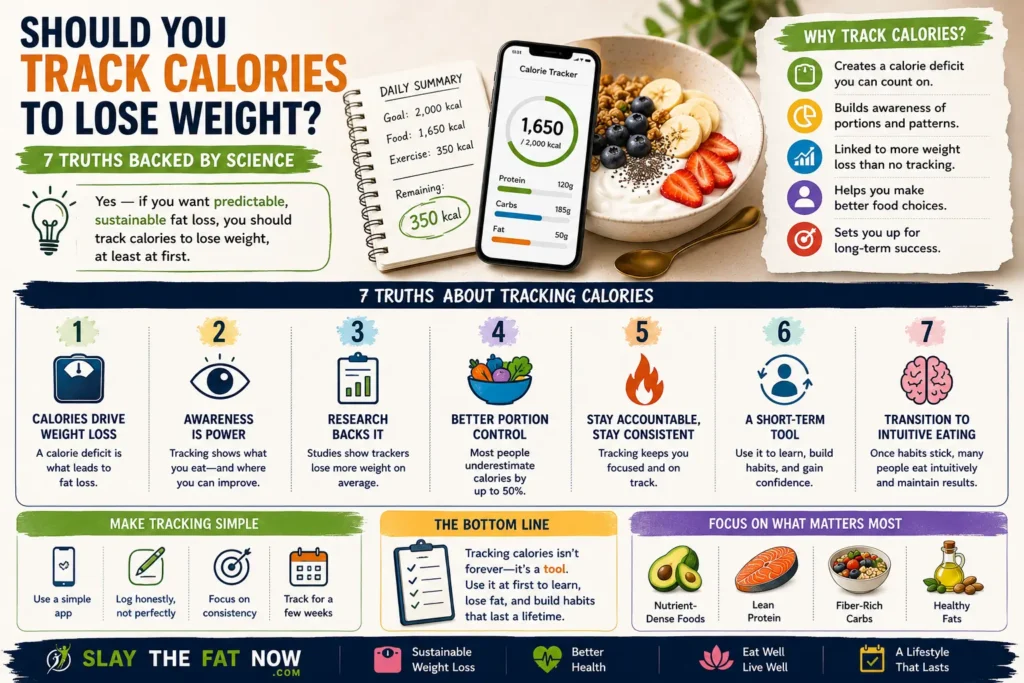
Yes if you want predictable, sustainable fat loss, you should track calories to lose weight, at least at first. Research consistently links calorie tracking with greater weight loss than no tracking. It builds awareness of portions and patterns most people misjudge by nearly half. Once those habits stick, many people transition to intuitive eating for long-term maintenance.
The Mistake That Keeps People Stuck (Even When They’re “Trying Hard”)
Here’s a pattern I’ve seen hundreds of times: someone swears they’re “eating healthy,” they cut out soda, they started walking more, and the scale still won’t move. They feel betrayed by their own body. They start to wonder if their metabolism is broken.
It usually isn’t. What’s broken is their picture of how much they’re actually eating.
A landmark study in the New England Journal of Medicine found that people underestimate their daily calorie intake by an average of 47%. Not 5%. Not 10%. Nearly half. That handful of “healthy” snacks, the olive oil glugged into the pan, the three bites of your kid’s mac and cheese none of it gets counted in your head, but all of it gets counted on your waistline.
This is the gap that calorie tracking closes. Not because counting is magic, but because you can’t manage what you can’t see.
Should I Track Calories to Lose Weight? Here’s the Honest Overview
Calorie tracking means logging the food and drink you consume so you can compare it against your daily target a process built on the simple law that weight loss happens when you consistently eat less energy than you burn. It sounds tedious, and the old-school version (typing every ingredient into a database) often was. But the core question should I track calories to lose weight has a clear, evidence-backed answer for most people: yes, especially in the first 8 to 12 weeks of a weight loss effort.
In this guide, you’ll learn exactly when tracking helps, when it can backfire, how it compares to intuitive eating, and a realistic step-by-step way to start without it taking over your life. By the end, you’ll know which approach or which blend of the two actually fits your situation.
Key Benefits of Calorie Tracking for Weight Loss
- Closes the awareness gap. You stop guessing and start seeing your real intake, which is the first step to changing it.
- Faster, more predictable results. A defined calorie deficit gives you a measurable lever to pull instead of vague “eat better” intentions.
- Built-in accountability. Logging creates a feedback loop: eat, log, see where you stand, adjust the next meal.
- Money saved on guesswork. Fewer wasted weeks on plans that “should” be working but aren’t, because you can actually audit what’s happening.
- Long-term skill building. Most experienced trackers eventually internalize portion sizes well enough to estimate without logging tracking trains intuition, it doesn’t replace it.
The Data on Tracking Calories to Lose Weight
This isn’t just theory. Here’s what the research actually shows:
- A systematic review in the Journal of the American Dietetic Association analyzed 22 studies and found dietary self-monitoring was consistently associated with greater weight loss than not tracking.
- A 2021 meta-analysis in Obesity Reviews found digital self-monitoring of diet and activity produced an average weight loss of 2.87 kg more than control groups.
- In a study published via PMC (National Library of Medicine), participants who logged into their food journal more frequently per day were significantly more likely to lose 5% or more of their body weight even though daily logging time shrank from 23 minutes in month one to under 15 minutes by month six.
- A six-month University of Vermont study reported by Fox News found the most successful dieters whittled their tracking time down to roughly 14.6 minutes a day proving consistency matters more than perfection.
- A 2019 randomized trial in the Journal of Behavioral Medicine found consistent trackers using a commercial app lost significantly more weight at 1, 3, and 6 months than inconsistent trackers roughly 2 extra kilograms by month six.
The throughline across nearly every major study: it’s not whether you track, it’s how consistently you track. Sporadic logging barely beats not logging at all. Steady logging even imperfect, rounded-number logging reliably outperforms going in blind.
A Real-World Example: What This Looks Like in Practice
Consider “Maria,” a composite of clients I’ve coached a 38-year-old working mom who’d lost and regained the same 20 pounds three times. She wasn’t lazy or undisciplined; she just had no idea that her “healthy” granola habit was adding 600 hidden calories a day.
Week one of tracking was eye-opening and a little uncomfortable. She wasn’t eating poorly she was eating more than she thought, and at the wrong times for her hunger patterns. By week three, she’d trimmed 400 calories a day just from portion awareness, no major food changes required. By month three, she was down 14 pounds, and this is the important part she’d started recognizing portion sizes by sight, without opening the app every time.
That’s the real goal of calorie tracking: not a permanent chore, but a temporary training wheel that teaches your eye and your stomach to recalibrate.
Expert Insight: What Actually Works After Years of Coaching This
After years of watching people start and abandon tracking apps, a few patterns repeat constantly:
- People who succeed log food before they eat it, not after. Logging retroactively turns into guesswork and excuse-making.
- People who succeed track protein and fiber, not just total calories. Calories control the scale; protein and fiber control hunger, and hunger control determines whether you can sustain a deficit at all.
- People who fail tend to chase perfect daily numbers instead of a weekly average. One “bad” day doesn’t undo three good ones but in their head, it feels like total failure, so they quit.
- The biggest predictor of long-term success isn’t the app, the macros, or the diet style it’s whether tracking still happens on the hard days, not just the easy ones.
If there’s one thing I wish more people understood before they start: calorie tracking is a feedback system, not a moral scoreboard. The number isn’t “good” or “bad.” It’s information.
| Want a plan that does the calorie math for you? Stop guessing portions and start seeing real numbers. Our free calorie calculator builds a custom daily target based on your body, goals, and activity level in under two minutes. Get Your Free Calorie Target → |
Reality Check: Where Calorie Counting Falls Short
Calorie tracking isn’t a perfect system, and pretending otherwise does readers a disservice.
- Calorie labels are estimates, not exact figures. The FDA allows labeling inaccuracies, and restaurant meals can vary widely from their stated counts tracking gets you close, not perfect.
- It can become obsessive. For people with a history of disordered eating, rigid calorie counting can reinforce anxious or restrictive patterns. This is the strongest argument for intuitive eating or working with a registered dietitian instead.
- It doesn’t fix emotional or stress eating on its own. Tracking shows you the what, not always the why. Some people need behavioral or therapeutic support alongside the numbers.
- Self-monitoring naturally declines over time. Research shows logging frequency drops the longer an intervention runs which is exactly why building intuitive skills during tracking matters so much.
The honest takeaway: calorie tracking is a tool, not a religion. It deserves a clear-eyed view of both its power and its limits.
Practical Advice: How to Track Calories Without It Taking Over Your Life
What to Do
- Start with your maintenance calories. Use a TDEE calculator, then subtract 300-500 calories for a sustainable weekly deficit of roughly 0.5-1 pound.
- Log food before you eat it, not after. This single habit shift prevents the most common tracking failures.
- Weigh your food for the first two weeks only. After that, your eyeballing accuracy improves dramatically this is the “training wheels” phase.
- Track a weekly average, not a daily perfect score. A 2,000-calorie Tuesday and an 1,800-calorie Wednesday both count toward the same weekly trend.
- Prioritize protein (0.7-1g per pound of goal body weight) to protect muscle and control hunger while in a deficit.
What to Avoid
- Don’t chase decimal-point precision rounding to the nearest 10-20 calories is plenty accurate for real-world results.
- Don’t use tracking as punishment. If a number triggers shame rather than information, that’s a sign to step back and reassess your approach, possibly with a professional.
- Don’t track forever by default. Plan periodic “intuitive eating” breaks once your portion sense improves, then re-check with a short tracking window every few months.
Calorie Counting vs. Intuitive Eating: Which One Is Right for You?
This is the comparison most people actually want answered: is calorie counting necessary, or can intuitive eating get you there instead? The honest answer is that they serve different goals and often work best as sequential phases rather than rival camps.
| Factor | Calorie Tracking | Intuitive Eating |
| Best for | Clear, measurable fat loss goals | Repairing your relationship with food |
| Learning curve | Moderate (1-2 weeks to get accurate) | Slow (months to rebuild hunger cues) |
| Precision | High exact deficit control | Low no calorie data |
| Time cost | 5-15 min/day after first 2 weeks | Minimal logging, more mindfulness practice |
| Risk for disordered eating history | Can be triggering use caution | Generally gentler, still needs guidance |
| Evidence for weight loss | Strong, well-documented | Mixed better for maintenance and wellbeing |
| Long-term sustainability | Depends on building intuition over time | High once skills are developed |
Research on intuitive eating tells a consistent story: it’s strongly linked to better psychological outcomes improved body image, less disordered eating, and higher quality of life and modestly linked to lower BMI in observational data. But intervention studies show intuitive eating produces small, sometimes short-lived changes in weight specifically, even though it shines for long-term relationship-with-food outcomes.
In other words: calorie counting is generally the stronger tool for active fat loss. Intuitive eating is generally the stronger tool for maintaining results and healing your relationship with food once the weight is off. Many of the most successful long-term clients I’ve worked with use both tracking during an active cut, then transitioning toward intuitive eating once their target weight and hunger awareness are dialed in.
If you have a history of an eating disorder, please work with a doctor or registered dietitian before starting any structured tracking approach intuitive eating or a guided non-diet approach may be the safer starting point.
FAQs: Should I Track Calories to Lose Weight?
Should I track calories to lose weight if I’m just starting out?
Yes. Beginners benefit the most from tracking because it reveals the gap between perceived and actual intake, which is usually the single biggest reason early weight loss attempts stall.
Is calorie counting necessary to lose weight, or can I lose weight without it?
It’s not strictly necessary weight loss is possible through portion control, whole-food eating, or intuitive eating but tracking makes the process faster, more measurable, and easier to troubleshoot when progress stalls.
How long should I track calories before switching to intuitive eating?
Most people see meaningful portion-awareness gains within 8 to 12 weeks of consistent tracking, which is a reasonable point to start blending in intuitive eating principles.
Does calorie counting work better than intuitive eating for weight loss?
For active fat loss specifically, yes calorie counting has stronger evidence for producing measurable weight loss, while intuitive eating shows stronger evidence for psychological wellbeing and long-term maintenance.
Is calorie counting bad for mental health?
It can be for some people, especially those with a history of disordered eating or anxiety around food. If counting starts to feel obsessive or causes distress, switch to a gentler approach and consider professional support.
How accurate do I need to be when tracking calories?
Rounding to the nearest 10-20 calories is accurate enough. Research shows consistency in logging matters far more than decimal-point precision.
Can I lose weight by just eating healthy without counting calories?
Sometimes, especially if you cut out ultra-processed foods, which tend to be calorie-dense. But “healthy” foods can still create a surplus in large portions, which is why many people plateau without ever tracking.
What’s the best way to track calories without an app?
A simple notebook or spreadsheet with food, portion, and an estimated calorie count works fine. The method matters less than the consistency.
Why do I underestimate how many calories I eat?
Research published in the New England Journal of Medicine found people underestimate intake by an average of 47%, largely because of unmeasured cooking oils, drinks, condiments, and “taste tests” while preparing food.
Should I track calories every single day?
Daily tracking produces the most reliable data, but research shows even inconsistent trackers who log most days of the week still outperform people who don’t track at all.
Is intuitive eating just an excuse to stop tracking?
Not when it’s done properly. True intuitive eating is a structured skill involving hunger and fullness cues, not a free pass to eat without awareness but it does take longer to produce measurable weight loss than calorie counting.
How many calories should I eat to lose weight?
Most people lose weight sustainably with a 300-500 calorie daily deficit below maintenance, but your exact number depends on your age, weight, activity level, and goals a calculator gives a much more reliable starting point than a generic number.
Does calorie counting slow down my metabolism?
Extended, aggressive calorie restriction can lower metabolic rate over time, which is why moderate, sustainable deficits and periodic maintenance breaks are safer than extreme cuts.
Can I combine calorie counting and intuitive eating?
Yes, and many long-term successful dieters do exactly this tracking during active weight loss phases, then shifting toward intuitive eating during maintenance, with occasional tracking check-ins.
What app should I use to track calories?
Any consistent method works, including MyFitnessPal, Cronometer, or a simple spreadsheet. The best app is the one you’ll actually use every day without it feeling like a burden.
Your Next Step
Here’s the truth: should you track calories to lose weight? For most people starting out, yes at least long enough to close the awareness gap and build real portion intuition. From there, you get to choose how much structure you keep.
You don’t need to overhaul your whole life this week. You need one accurate number to start from and a simple system you’ll actually stick with.
| Ready to find your number? Get a personalized daily calorie target in under two minutes, built around your body and goals no guesswork, no spreadsheets. Calculate My Calorie Target → |
Related reading on Slay The Fat Now:
• How to Calculate Your TDEE Accurately
• Intuitive Eating: A Beginner’s Guide
• High-Protein Meal Plans for Weight Loss
