 Skip to content
How to Stop Eating at Night: 9 Real Strategies That Actually Work
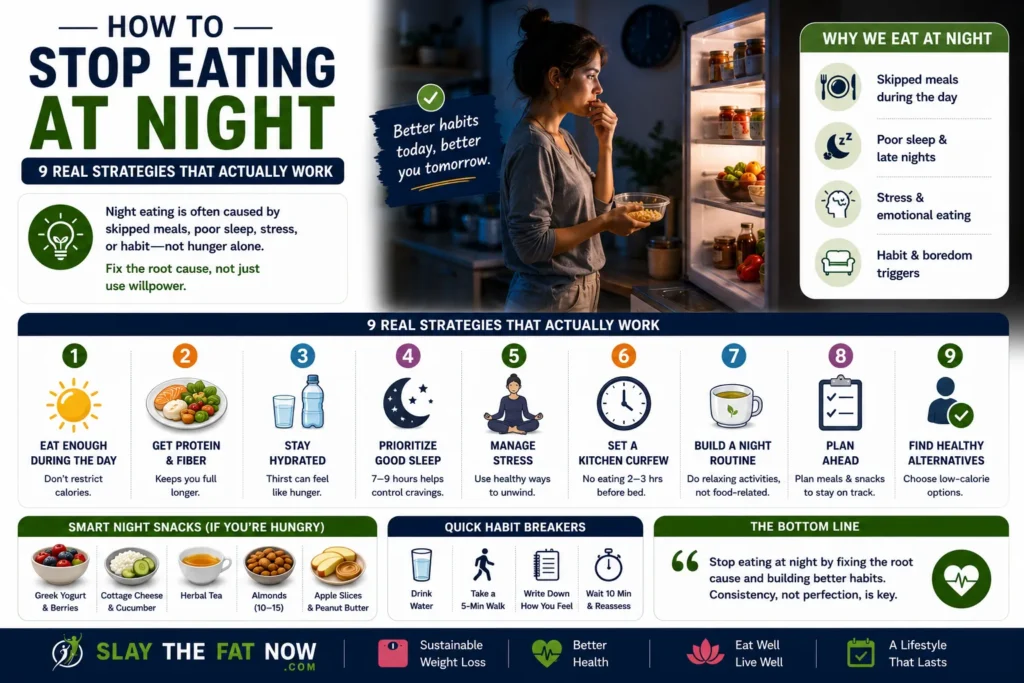
To stop eating at night, address the root cause first: most night eating is driven by skipped meals, poor sleep, stress, or habit loops, not hunger alone. The strategies below eating enough during the day, fixing your sleep schedule, and breaking the kitchen-at-midnight habit work for most people within a few weeks. If nighttime eating feels out of your control, that’s a sign to talk to a doctor, not just a willpower problem.
The Mistake Almost Everyone Makes
Here’s a pattern that shows up again and again: someone restricts food all day to “be good,” gets through dinner on willpower, and then loses the plot completely at 10 PM in front of the fridge. The next morning brings guilt and often, harder restriction, which sets up the exact same crash the following night.
If that sounds familiar, it’s not a lack of discipline. It’s usually the body and brain sending a clear signal that something upstream is off not enough food earlier in the day, not enough sleep, or stress with nowhere else to go.
Learning how to stop eating at night starts with understanding why it’s happening for you specifically, because the fix for “I skipped lunch and I’m starving” looks completely different from the fix for “I can’t sleep so I eat instead.”
What’s Actually Going On When You Eat at Night
For most people, night eating is a habit loop: stress or boredom shows up, food relieves it, and the brain files that away as a solution worth repeating. Over time, the kitchen becomes the place to go when tired, anxious, or avoiding something else not just when hungry.
For a smaller group, it’s something more specific. Night eating syndrome (NES) is a recognized clinical pattern involving eating a significant portion of daily food after dinner, and/or waking during the night specifically to eat, often alongside disrupted sleep and a low mood that worsens in the evening. It’s listed in psychiatric diagnostic references as a feeding and eating condition, not simply a bad habit.
A diagnosis isn’t required to start making changes. But the distinction matters: casual late-night snacking tends to respond well to habit changes alone, while a clinical pattern usually benefits from professional support layered on top of those same habits.
Why Addressing Night Eating Matters
Left alone, night eating tends to compound in a few specific ways:
- Sleep quality slips. Eating late, especially heavier or sugary food, can interfere with the deep sleep the body needs to feel rested which then fuels more night eating the next day.
- The pattern reinforces itself. Each time food relieves stress or helps someone fall back asleep, the brain learns that association a little more strongly.
- Morning patterns shift. Heavy night eating often blunts morning appetite, which pushes more eating later in the day the cycle feeds itself.
- It can mask what’s really going on. Stress, anxiety, loneliness, and poor sleep hygiene often hide behind “I just like snacking at night,” with the snacking as the only visible symptom.
The goal isn’t white-knuckle restriction. It’s removing the reasons the body or brain reaches for food late at night in the first place.
What the Research Actually Shows
This has been studied for decades, and the data is worth knowing:
- Night eating syndrome was first described by researcher Albert Stunkard in 1955, and is now recognized in psychiatric diagnostic manuals as an “Other Specified Feeding and Eating Disorder.”
- A large, representative German population study found a night eating syndrome screening rate of 1.1%, with positive screens linked to depression, anxiety, eating disorder symptoms, and body weight.
- Research specific to the United States places night eating syndrome prevalence at roughly 1.5% of the population.
- Rates run notably higher in clinical populations up to roughly 8% among people with obesity or those who’ve had bariatric surgery which is part of why clinicians now screen for it more routinely.
- Inpatient research found that people eating between 11 PM and 5 AM showed metabolic patterns associated with burning less fat and storing more energy compared to daytime eaters, supporting the idea that timing matters, not just total intake.
- People who are naturally “evening types” late to bed, late to rise, alert at night show a stronger tendency toward night eating and other disrupted eating attitudes than “morning types” do.
The throughline: this is a well-documented pattern with real biological roots, not a personal failing.
If a structured weight-loss plan keeps getting derailed by night eating, our guide on building a sustainable evening routine walks through restructuring evenings around this exact problem.
A Realistic Example
Picture someone call her Maria who eats a light breakfast, a rushed lunch at her desk, and tells herself she’ll “make up for it” with a sensible dinner. By 9 PM she’s exhausted, under-fed, and scrolling her phone on the couch. The chips come out not from weakness, but because her body has been asking for fuel since 1 PM and her brain is too tired to make a deliberate choice anymore.
The fix for Maria isn’t a night-eating rule. It’s eating enough, consistently, earlier in the day, so that by 9 PM her body isn’t running on empty and making the decision for her.
Compare that to someone who eats normally all day but still finds themselves up at 1 AM eating cereal standing at the counter, with little memory of deciding to do it. That’s a different problem closer to a sleep and circadian rhythm issue and it deserves a different kind of attention, including, often, a conversation with a doctor.
What Tends to Work, Pattern After Pattern
A few things stand out across years of looking at this exact problem:
- It’s almost never about the food itself. Food rules “don’t eat after 8 PM,” keeping junk out of the house help at the margins but rarely fix the underlying driver.
- Under-eating during the day is the single most common cause. Far more often than not, the person eating at night skipped or shortchanged meals earlier. The body isn’t being dramatic it’s genuinely short on fuel.
- Sleep is the second biggest lever, and the most ignored one. Poor or inconsistent sleep raises hunger-related signals and lowers the brain’s capacity for deliberate choices late at night.
- Stress relief without food is the missing skill, not the missing willpower. Most people who eat at night have never built another reliable way to come down from a stressful day.
- Shame makes it worse, every time. The people who make progress fastest are the ones who stop treating a 9 PM snack as a moral failure and start treating it as information.
Reality Check: What Most Articles Won’t Say
- “Just don’t eat after a certain time” isn’t a real strategy for most people. Arbitrary cutoffs ignore why the eating is happening and often just delay it or trigger a restrict-binge cycle the next day.
- This usually isn’t fixed in a weekend. Sleep and stress patterns that took months or years to form take real, sustained time to shift.
- Sometimes it isn’t a “habit” at all. Regularly waking specifically to eat, having little memory of it, or feeling unable to stop the pattern despite real effort is outside the range of typical late-night snacking and is worth raising with a doctor or therapist especially alongside low mood, anxiety, or major sleep disruption.
- One night doesn’t undo progress. Treating a single lapse as a catastrophe is one of the most common reasons people abandon changing the pattern altogether.
Practical Steps That Actually Move the Needle
- Eat real meals earlier in the day. Don’t let breakfast or lunch become an afterthought consistent, satisfying meals earlier reduce the physical drive to eat late.
- Build a buffer between dinner and bed. A walk, a shower, reading anything that puts a different activity between “finished eating” and “lying in bed” helps break the automatic kitchen trip.
- Fix the sleep schedule before the eating schedule. Consistent bed and wake times, even on weekends, directly affect next-day hunger signals.
- Identify the actual trigger. For one week, note what was happening right before eating at night bored, stressed, lonely, genuinely hungry, habit. Patterns show up fast.
- Have a non-food response ready for stress. A specific plan beats vague willpower a call to a friend, a short walk, a hot shower, music decided before the urge hits, not during it.
- Keep the kitchen “closed” after a set point, visually. Dimming kitchen lights, brushing teeth right after dinner, or moving to another room reduces mindless trips driven by environment and habit.
- Don’t restrict hard the next day. Eating less the day after a night-eating episode tends to make it more likely to happen again that night.
- Watch caffeine and alcohol in the evening. Both can disrupt sleep quality, which circles back to drive more night eating.
- Get evaluated if it feels out of your control. If none of the above touches it, or eating happens while not fully awake, this deserves a real conversation with a doctor.
What to avoid: extreme food rules, skipping meals to compensate, shaming yourself after a slip, and trying to overhaul sleep, eating, and stress management all at once. Pick one lever and work it for two weeks before adding another.
Comparing Your Options
| Approach | Best For | Limitations |
| Habit and environment changes | Most people with casual late-night snacking driven by stress, boredom, or under-eating | Takes weeks of consistency; won’t resolve a true clinical pattern alone |
| Sleep-focused intervention | People whose night eating tracks closely with poor or irregular sleep | Requires addressing sleep hygiene broadly, not just bedtime snacking |
| Working with a therapist (CBT-based) | Stress- or emotion-driven eating, especially with shame and guilt in the mix | Takes longer to see results; requires finding the right provider |
| Medical evaluation for Night Eating Syndrome | Recurrent nighttime awakenings to eat, morning appetite loss, or symptoms lasting 3+ months | Needs a clinician for proper diagnosis; self-diagnosis isn’t reliable here |
| Structured nutrition support | People whose daytime eating is genuinely inconsistent or insufficient | Most effective combined with habit changes, not as a replacement |
Frequently Asked Questions
What causes night eating?
Most often it’s a combination of under-eating earlier in the day, poor or irregular sleep, and using food to manage stress, boredom, or loneliness. In a smaller number of cases, it’s tied to a recognized clinical pattern called night eating syndrome.
Is night eating syndrome a real medical condition?
Yes. It’s recognized in psychiatric diagnostic references as a feeding and eating disorder, characterized by eating a large share of daily food after the evening meal and/or waking specifically to eat, along with sleep disruption and distress about the pattern.
How common is night eating syndrome?
Estimates vary by population. In the general U.S. population, prevalence is estimated around 1.5%, but rates climb to roughly 8% in clinical groups such as people with obesity or those who’ve had bariatric surgery.
Can stress alone cause someone to eat at night?
Yes. Stress is one of the most common drivers of night eating, since food can offer fast, reliable relief when someone hasn’t built another way to manage stress in the evening.
Does eating late at night affect weight on its own?
Research on timing alone is mixed, but studies suggest late-night eating is associated with metabolic patterns that favor energy storage over fat burning compared to daytime eating. Overall intake and sleep quality matter just as much as the clock.
Why am I not hungry in the morning but very hungry at night?
This is a classic sign of a delayed eating pattern often connected to eating more late in the day, poor sleep timing, or in some cases, night eating syndrome specifically. It’s worth tracking and discussing with a doctor if it’s persistent.
Will skipping dinner stop me from eating at night?
Usually it backfires. Skipping meals increases the odds of a stronger urge to eat later, often less mindfully. A satisfying dinner is part of the solution, not the problem.
Is it normal to wake up and eat in the middle of the night?
Occasionally, it’s not a concern. Regularly, and especially with little memory of doing it, this is a pattern worth raising with a healthcare provider, since it can overlap with both night eating syndrome and certain sleep disorders.
How long does it take to break a night-eating pattern?
Most people need several weeks of consistent changes better daytime eating, improved sleep timing, and a stress-management plan before the pattern meaningfully loosens. It’s rarely an overnight fix.
Can poor sleep really cause night eating?
Yes. Sleep and appetite are closely linked. People with a later sleep-wake pattern show a stronger tendency toward night eating than those with earlier patterns, and inconsistent sleep raises hunger cues generally.
Should I just avoid keeping snacks in the house?
It can help reduce mindless eating, but it doesn’t address why the urge shows up. Pair it with addressing the underlying driver stress, sleep, or daytime intake rather than relying on it alone.
Is night eating the same as binge eating?
They can overlap, but they’re not identical. Night eating syndrome centers on the timing of intake, while binge eating disorder centers on episodes of eating with a sense of loss of control, regardless of time of day. A clinician can help sort out which pattern fits.
Does alcohol make night eating worse?
Often, yes. Alcohol can lower inhibition around food choices and disrupt the sleep that follows it, both of which make late-night eating more likely.
Can therapy actually help with night eating?
Yes, particularly approaches like cognitive behavioral therapy, which are commonly used for eating- and sleep-related patterns and focus on identifying triggers and building alternative responses.
What’s the difference between casual late-night snacking and a real problem?
Frequency, control, and distress are the key markers. Occasional snacking that’s chosen and enjoyed isn’t a concern. A pattern that happens most nights, feels hard to stop, includes eating while not fully awake, or comes with significant guilt is worth discussing with a professional.
When should I see a doctor about night eating?
If it’s happening several times a week, has lasted more than a few months, involves waking specifically to eat, or comes with low mood, anxiety, or major sleep problems, it’s time for a real evaluation rather than another self-guided attempt.
Where to Go From Here
Night eating is common, well-studied, and for most people very changeable once the actual cause is targeted instead of just the symptom. Start with one lever: eat enough earlier in the day, fix sleep timing, or build a real plan for evening stress. Give it two honest weeks before judging whether it’s working.
For a structured, step-by-step way to rebuild a daily eating rhythm so night eating stops being the default, see our full weight loss program overview built around exactly this kind of sustainable, non-restrictive change.
And if this feels bigger than habit frequent night waking to eat, real distress, or a pattern that hasn’t budged no matter what’s been tried please bring it to a doctor or therapist. That’s not a failure to handle it alone. It’s the right next step.
In the U.S., the 988 Suicide & Crisis Lifeline (call or text 988) is available if you’re in distress. For eating-disorder-specific support, the National Alliance for Eating Disorders offers a helpline and treatment referrals.
Sources
