 Skip to content
Anti-Inflammatory Diet Weight Loss: 8 Proven Steps to Break the Cycle
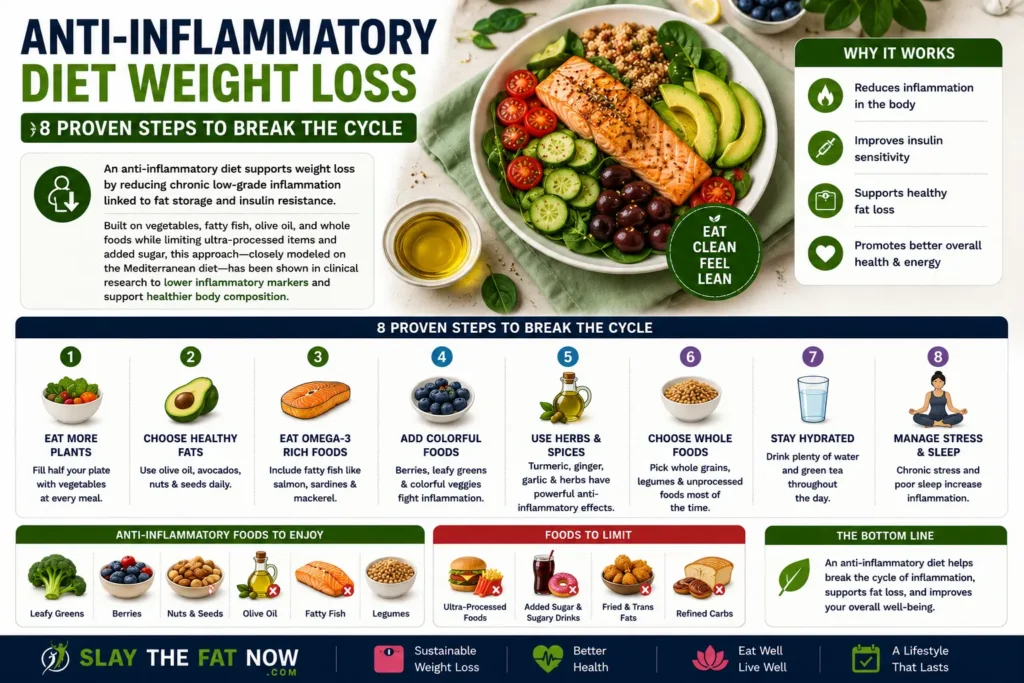
An anti-inflammatory diet supports weight loss by reducing chronic low-grade inflammation linked to fat storage and insulin resistance. Built on vegetables, fatty fish, olive oil, and whole foods while limiting ultra-processed items and added sugar, this approach closely modeled on the Mediterranean diet has been shown in clinical research to lower inflammatory markers and support healthier body composition.
Anti-Inflammatory Diet Weight Loss: Why Your Body Might Be Working Against You
You’re eating less. You’re “trying.” And the scale still won’t move.
For a lot of people, this isn’t a discipline problem. It’s a biology problem hiding in plain sight chronic, low-grade inflammation quietly working against every effort to lose fat.
I’ve sat across the table from clients doing everything textbook-right on paper counting calories, hitting their steps and still stuck. More often than people expect, the missing piece wasn’t more restriction. It was addressing inflammation first.
This guide walks through anti-inflammatory diet weight loss in full: what the actual science says (including where it’s genuinely uncertain), which foods help, which foods quietly work against you, and a clear plan to start this week.
What Is an Anti-Inflammatory Diet for Weight Loss (Overview)
An anti-inflammatory diet for weight loss is an eating pattern built around whole, minimally processed foods vegetables, fruit, fatty fish, olive oil, nuts, and legumes while minimizing ultra-processed foods, refined sugar, and industrial seed oils known to promote inflammatory activity in the body.
The connection between inflammation and weight gain runs both directions, and that’s important to understand honestly. Excess body fat, especially visceral fat, produces inflammatory compounds. At the same time, certain dietary patterns appear to either calm or fuel that inflammatory response, independent of weight change alone.
This isn’t a fad diet built on banning entire food groups out of fear. It’s a pattern with real research behind it most closely resembling the Mediterranean diet, one of the most studied eating patterns for inflammatory markers in the world.
By the end of this article, you’ll understand the data, see a realistic example of how this plays out, know exactly what to eat and what to limit, and get straight answers to the questions people search most.
Key Benefits of an Anti-Inflammatory Approach
Why This Matters Beyond the Scale
1. It targets a mechanism, not just a calorie count. Most diets focus exclusively on calories in versus calories out. An anti-inflammatory approach also addresses a biological process that may be working against fat loss in the background.
2. It tends to improve energy and joint comfort, not just weight. Clients often report feeling less achy and less foggy within a few weeks frequently before any meaningful change shows up on the scale.
3. It supports long-term metabolic health, not just short-term loss. Lower inflammatory markers are associated with better insulin sensitivity and reduced risk for several chronic conditions, not just a smaller waistline.
4. It’s sustainable because it isn’t about elimination. Unlike diets that ban entire macronutrients, this approach emphasizes adding nutrient-dense foods first, which tends to crowd out the inflammatory ones naturally.
5. It often improves digestion and reduces bloating. Many clients notice less bloating and more regular digestion within the first two to three weeks, likely related to reduced processed food and added sugar intake.
Data and Facts: What the Research Actually Shows
This is where I want to be especially honest, because the inflammation-and-weight-loss conversation has a lot of oversimplified claims floating around. Here’s what credible research actually says.
Obesity creates a self-perpetuating inflammatory cycle. A 2025 narrative review describes how enlarged fat cells and infiltrating immune cells release pro-inflammatory compounds including TNF-alpha, IL-6, and IL-1beta, creating a cycle where inflammation and fat accumulation reinforce each other.
The Mediterranean diet has the strongest evidence among anti-inflammatory eating patterns. A 2025 umbrella review covering 60 meta-analyses found a significant beneficial association between the Mediterranean diet and key inflammatory markers, including CRP, interleukin-6, and adiponectin, with evidence ranging from high to low certainty depending on the specific marker.
A large meta-analysis confirms measurable marker reductions. A systematic review and meta-analysis of 33 randomized controlled trials involving 3,476 participants found that the Mediterranean diet group showed significant reductions in high-sensitivity CRP, IL-6, and IL-17 compared to control diets.
Weight loss itself appears to reduce inflammation, somewhat independent of diet pattern. A controlled feeding study in men with metabolic syndrome found that the Mediterranean diet combined with weight loss significantly reduced CRP concentrations by over 26%, along with reductions in a broader inflammatory score.
But the cause-and-effect direction is genuinely debated by researchers. This matters: some research suggests inflammatory markers are highly associated with obesity but don’t necessarily predict future weight gain, leading some researchers to argue inflammation may largely be a downstream result of obesity rather than a primary driver of it. The honest takeaway is that the relationship between inflammation and weight gain is bidirectional and still being actively studied anti-inflammatory eating is a supportive strategy, not a guaranteed weight-loss mechanism on its own.
Anti-inflammatory eating patterns may help most when combined with overall calorie awareness. A separate meta-analysis noted that many of the studies showing inflammation reduction did not report substantial weight loss as the driver, suggesting the dietary pattern itself not just the pounds lost contributes to lower inflammatory markers.
Real Example: A Realistic Scenario
Meet “Renee” a composite drawn from a recurring pattern with clients in their 40s and 50s.
Renee had plateaued for nearly four months despite consistent calorie tracking. She also dealt with regular joint stiffness and afternoon energy crashes that she’d written off as “just getting older.”
Here’s what shifted over 12 weeks using an anti-inflammatory foods list as the foundation, without dramatically cutting calories further:
- Swapped: Daily soda and packaged snack bars → sparkling water and a handful of walnuts
- Added: Fatty fish twice a week (salmon, sardines) instead of relying solely on chicken breast
- Added: A daily side of leafy greens and colorful vegetables at lunch and dinner
- Reduced: Fried foods and refined white bread to occasional, not daily
- Kept: The same overall calorie target this wasn’t a more restrictive diet
Result: Joint stiffness noticeably improved by week three. The scale plateau broke by week six, and Renee lost 7 lbs over the remaining six weeks without changing her exercise routine or cutting calories further than before.
The takeaway isn’t that anti-inflammatory eating is magic. It’s that addressing the quality of intake sometimes unlocks progress that quantity-focused tracking alone couldn’t.
Expert Insight: What Actually Works After Years of Doing This
A few patterns consistently show up with clients pursuing anti-inflammatory diet weight loss strategies.
Sugar and refined carbs do more damage than people expect, even within calorie limits. A client can hit their calorie target perfectly while still eating mostly refined, processed foods. The inflammatory load from that pattern tends to show up as bloating, energy crashes, and stalled progress even when the math “should” work.
Omega-3 sources matter more than supplements alone. Fatty fish two to three times weekly tends to outperform fish oil supplements in client-reported results, likely due to the broader nutrient profile fish provides beyond just omega-3s.
The biggest wins come from subtraction, not addition. Adding kale to a diet full of fried food and soda does very little. Removing the ultra-processed staples first, then building meals around whole foods, produces far more noticeable results.
Joint comfort and energy often improve before the scale does. This is one of the most consistent patterns I’ve seen. Clients frequently report feeling less stiff and less foggy within 2–3 weeks, well before any meaningful weight change. That early signal is often what keeps people consistent long enough to see the scale move too.
This approach works best as a foundation, not a strict rulebook. The clients who stick with it long-term think of it as “mostly whole foods, occasionally processed” rather than a rigid list of forbidden items.
Reality Check: Myths That Quietly Mislead People
Myth: “Inflammation is the main cause of obesity.” Reality: The research relationship is more nuanced. Some studies suggest inflammatory markers may largely result from existing obesity rather than directly cause future weight gain. Treat inflammation reduction as a supportive strategy, not a magic mechanism that replaces calorie awareness.
Myth: “You have to cut out entire food groups to fight inflammation.” Reality: The strongest evidence supports a Mediterranean-style pattern vegetables, fish, olive oil, legumes not extreme elimination diets. Whole grains and most fruits are typically fine and even beneficial.
Myth: “Anti-inflammatory supplements work as well as real food.” Reality: Most clinical research demonstrating benefit comes from whole dietary patterns, not isolated supplements. Turmeric capsules and fish oil pills are not equivalent to eating real fish and vegetables consistently.
Myth: “If I’m not in pain, inflammation isn’t affecting my weight.” Reality: Chronic low-grade inflammation is largely silent. Joint pain isn’t required for inflammatory processes to be active in fat tissue and metabolism.
Myth: “This diet works fast, like a detox.” Reality: Inflammatory marker changes in clinical trials are typically measured over 8–22 weeks, not days. This is a sustained pattern, not a quick reset.
Practical Advice: What to Eat and What to Limit
Anti-Inflammatory Foods List Build Meals Around These for Real Anti-Inflammatory Diet Weight Loss:
- Fatty fish: salmon, sardines, mackerel, anchovies (2–3x weekly)
- Extra virgin olive oil as your primary cooking fat
- Leafy greens and colorful vegetables: spinach, kale, peppers, broccoli
- Berries: blueberries, strawberries, raspberries
- Nuts and seeds: walnuts, almonds, flaxseed, chia seeds
- Legumes: lentils, chickpeas, black beans
- Whole grains: oats, quinoa, brown rice (in moderate portions)
- Herbs and spices: turmeric, ginger, garlic
Do This:
- Replace one processed snack per day with a whole-food option this alone moves the needle more than people expect.
- Add fatty fish to your weekly rotation, even if it’s just twice a week to start.
- Cook with olive oil instead of butter or vegetable oil for most meals.
- Build half your plate with vegetables at lunch and dinner as a default habit.
- Track how you feel, not just the scale, for the first 3–4 weeks energy and joint comfort often shift first.
Avoid This:
- Don’t eliminate entire food groups (grains, all fats, all dairy) without a specific medical reason
- Don’t rely on supplements as a substitute for actual dietary change
- Don’t expect rapid results give this pattern at least 8 weeks before judging it
- Don’t ignore added sugar in “healthy” packaged foods granola bars and flavored yogurts are common hidden sources
- Don’t skip protein while focusing on anti-inflammatory foods both matter for weight loss together
Comparison: Anti-Inflammatory Diet vs. Other Common Approaches
| Approach | Inflammation Evidence | Sustainability | Best For |
|---|---|---|---|
| Mediterranean-style (anti-inflammatory) | Strong, broad RCT support for CRP, IL-6 reduction | High no major food groups banned | Long-term health + weight loss |
| Ketogenic diet | Mixed; some studies show improvement in specific markers (IL-6, IL-17) for certain conditions | Medium harder to sustain long-term | Short-to-medium term, specific conditions |
| Standard low-calorie diet (no quality focus) | Limited direct inflammation evidence | Medium | Weight loss alone, not inflammation-focused |
| Elimination diets (gluten-free, dairy-free without diagnosis) | Weak general evidence without specific intolerance | Low often abandoned, nutrient gaps possible | Only with diagnosed intolerance |
For most people focused on both inflammation and sustainable weight loss, the Mediterranean-style anti-inflammatory pattern has the broadest, most consistent research support of any option in this table making it the clearest path to anti-inflammatory diet weight loss for most people starting out.
Frequently Asked Questions
Does an anti-inflammatory diet actually help with weight loss?
It can support weight loss by improving diet quality, reducing ultra-processed food intake, and addressing inflammatory markers associated with metabolic dysfunction, though it works best alongside general calorie awareness rather than as a standalone fix.
What foods cause the most inflammation?
Ultra-processed foods, refined sugar, fried foods, and industrial seed oils are most commonly linked to elevated inflammatory markers in research on dietary patterns.
How long does it take to see results from an anti-inflammatory diet?
Most clinical studies measuring inflammatory marker changes track results over 8 to 22 weeks, so meaningful changes typically take several weeks to months of consistency.
Is the Mediterranean diet the same as an anti-inflammatory diet?
They overlap heavily. The Mediterranean diet is the most extensively studied eating pattern for reducing inflammatory markers like CRP and IL-6, making it the closest evidence-backed model for anti-inflammatory eating.
Can inflammation really cause weight gain, or is it the other way around?
Research suggests the relationship goes both directions excess fat tissue produces inflammatory compounds, while some studies indicate inflammation may largely follow obesity rather than directly cause future weight gain. The science is still evolving.
Do I need to cut out all carbs on an anti-inflammatory diet?
No. Whole grains like oats and quinoa are generally included in anti-inflammatory eating patterns. The concern is mainly refined carbs and added sugars, not whole grains overall.
What are the best anti-inflammatory foods for fat loss specifically?
Fatty fish, olive oil, leafy greens, berries, nuts, and legumes form the core of most anti-inflammatory eating patterns shown to support healthier body composition in research.
Can supplements replace anti-inflammatory foods?
Not effectively. Most research showing benefit comes from whole dietary patterns rather than isolated supplements like fish oil or turmeric capsules alone.
Is dairy inflammatory and should I avoid it?
For most people without a specific intolerance, moderate dairy isn’t strongly linked to increased inflammation. Elimination is typically only necessary with a diagnosed sensitivity.
How is an anti-inflammatory diet different from a regular low-calorie diet?
A standard low-calorie diet focuses purely on calorie totals, while an anti-inflammatory diet also emphasizes food quality and specific nutrients shown to influence inflammatory markers.
Can stress and lack of sleep cancel out an anti-inflammatory diet?
Chronic stress and poor sleep both independently contribute to inflammation, so addressing diet alone without managing these factors may limit results.
Will an anti-inflammatory diet help with joint pain too?
Many people report improved joint comfort within a few weeks of adopting this eating pattern, often before noticing significant changes on the scale.
Is intermittent fasting compatible with an anti-inflammatory diet?
Yes, the two can be combined. Anti-inflammatory food choices can be eaten within any eating window structure, including intermittent fasting protocols.
What’s the fastest way to start eating anti-inflammatory without overhauling everything at once?
Begin by swapping one processed snack per day for a whole-food option and adding fatty fish twice weekly this is the simplest entry point into anti-inflammatory diet weight loss without a full overhaul.
Are anti-inflammatory diets safe for people with autoimmune conditions?
Generally yes, and some research even shows benefit for inflammatory conditions like rheumatoid arthritis and psoriatic arthritis, though anyone with a diagnosed condition should coordinate dietary changes with their physician.
Final Thoughts: Your Next Step
Anti-inflammatory diet weight loss isn’t about chasing a trend or banning entire food groups out of fear. It’s about recognizing that food quality, not just food quantity, plays a real role in how your body responds to a deficit.
Start with the foods list above. Swap one processed item a day. Add fish twice a week. Give it eight weeks before judging the results.
Your body isn’t working against you on purpose. Give it the right inputs, and it stops fighting you back. Slay The Fat Now
Sources:
2025 narrative review on chronic inflammation in obesity (PMC),
2025 umbrella review of anti-inflammatory dietary patterns (Nutrition Reviews/Oxford Academic),
meta-analysis of 33 RCTs on Mediterranean diet and inflammation (PubMed)
