 Skip to content
Body Recomposition for Women: 7 Proven Steps to Lose Fat and Build Muscle
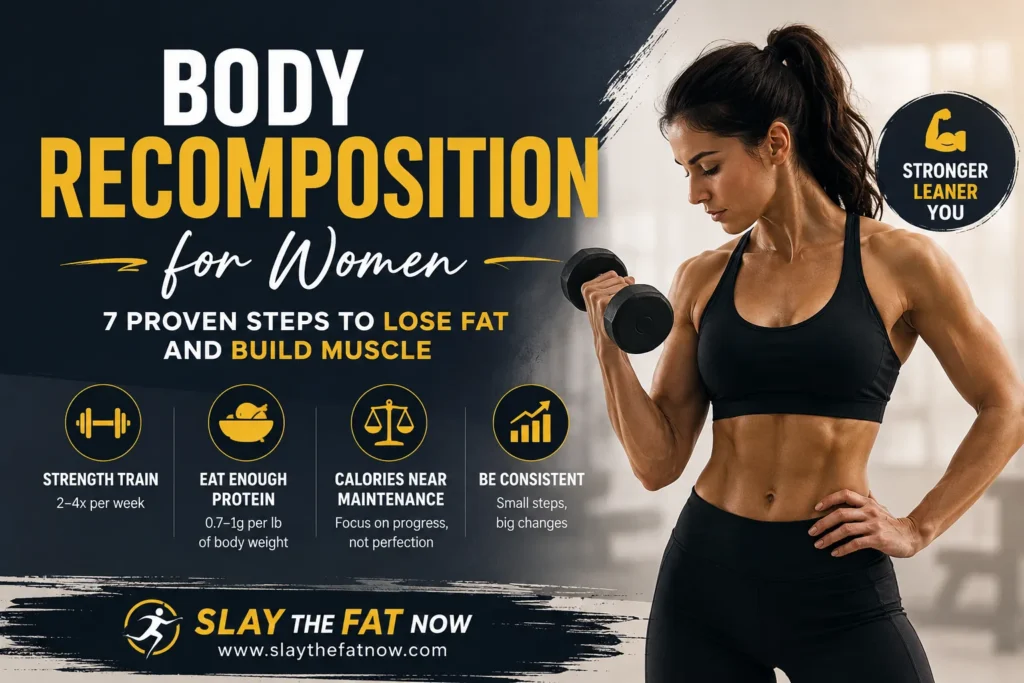
Body recomposition for women means losing fat and building muscle at the same time through strength training two to four times a week, eating enough protein (about 0.7 to 1 gram per pound of body weight), and keeping calories near maintenance instead of chasing an aggressive deficit.
The Mistake Most Women Make Before They Discover Body Recomposition
You have done the cardio. You have eaten the salads. You have watched the number on the scale creep down a pound, then bounce right back up. And yet your jeans fit the same, your arms still feel soft, and the mirror does not look any different than it did three months ago.
This is the moment most women give up on their goals, convinced their body is somehow broken or resistant to change. It is not. The problem is the plan. Chasing a lower number on the scale through starvation and endless cardio is exactly why so many women feel stuck, exhausted, and defeated. If this sounds familiar, it might help to revisit your realistic weight loss goals before going further, because the scale was never the right target to begin with.
What Is Body Recomposition for Women?
Body recomposition for women is the process of losing body fat and building lean muscle at the same time, rather than focusing on weight loss alone. Instead of watching a single number on the scale, you are reshaping what your body is made of, less fat, more muscle, so you end up leaner, stronger, and more defined even if your total body weight barely changes.
This approach works because fat loss and muscle gain are separate physiological processes. One does not have to wait for the other to finish. With the right combination of resistance training and protein intake, both can happen in the same window of time. By the end of this article, you will understand exactly how to structure your training, your meals, and your expectations so body recomposition actually works for you.
Who Body Recomposition Works Best For
Body recomposition for women is not a one-size-fits-all strategy, but it works especially well for a few specific situations. Beginners to strength training tend to see the fastest results because their muscles respond strongly to a new training stimulus. Women returning to the gym after a break, whether from pregnancy, injury, or simply life getting busy, also tend to see rapid recomposition because their bodies remember movement patterns quickly.
Women carrying extra body fat, generally more than 25 to 30 percent, often see the clearest recomposition results because there is more stored energy available to fuel muscle growth even while eating at maintenance or a small deficit. Advanced lifters with very low body fat and years of training experience tend to see recomposition happen more slowly, since their bodies are already closer to their genetic ceiling for easy gains.
Key Benefits of Body Recomposition Over Traditional Weight Loss
Traditional dieting often shrinks you, fat and muscle both disappear together, leaving you looking thinner but softer, sometimes called “skinny fat.” Body recomposition targets a different outcome entirely.
- A visibly toned, defined shape instead of just a smaller version of the same soft silhouette.
- A faster metabolism over time, since muscle tissue burns more calories at rest than fat tissue.
- Stronger bones and joints, which matters more with each passing decade, especially for women approaching perimenopause.
- Better long-term results, because muscle you build tends to stick around longer than weight lost through diet alone.
- Freedom from the scale, since your measurements and strength numbers become the real markers of progress.
What the Research Says About Body Recomposition for Women
Body recomposition is not a fitness influencer myth. A 2020 review published in the Strength and Conditioning Journal examined multiple randomized controlled trials in resistance-trained individuals and concluded that a growing body of chronic training studies has demonstrated people can build muscle and lose fat during the same window of time, directly challenging the old assumption that this was impossible.
Newer research backs this up specifically for women. A recent clinical study on resistance training and weight loss found that participants who strength trained preserved and even gained lean muscle mass while reducing fat mass, even though their total weight loss was statistically similar to non-lifting groups. In other words, the scale told one story while their bodies were quietly writing a completely different one, a textbook example of body recomposition documented under clinical conditions.
Protein intake matters just as much as training. A study on dietary protein and muscle in women found that participants who ate below the standard recommended daily protein allowance had measurably lower muscle mass, and those farthest below a higher protein benchmark faced a meaningfully greater risk of physical limitations later on. On the exercise side, current federal physical activity guidance calls for adults to get 150 to 300 minutes of moderate aerobic activity weekly, plus muscle-strengthening work on two or more days a week. Despite that guidance, an estimated 80 percent of American adults fall short of meeting it. That gap between the guideline and what women are actually doing is exactly where most stalled recomposition results are being lost.
A Real Example: What Body Recomposition Looks Like in Practice
Picture a 34-year-old woman, five foot five, 165 pounds, who has done years of cardio-only workouts with little to show for it. She switches to a full-body strength routine three days a week, raises her protein to around 130 grams a day, and keeps her calories close to maintenance instead of slashing them.
At week four, the scale has moved only two pounds. She is frustrated. But her waist measurement is down an inch and a half, her jeans fit looser through the hips, and she added 20 pounds to her squat. By week twelve, her body weight is nearly identical to where she started, yet she has visibly smaller measurements, noticeably more muscle definition in her arms and legs, and clothes that fit completely differently. This is the disconnect between the scale and real progress that trips up so many women pursuing the psychology of weight loss the wrong way.
Compare that to her sister, who spent the same twelve weeks doing an hour of cardio daily on 1,200 calories. She lost nine pounds on the scale, faster than her sister’s two-pound shift. But her body fat percentage barely changed, her energy stayed low all day, and her photos showed nearly the same soft shape, just at a smaller size. Two women, two very different twelve-week outcomes, and the scale alone told almost none of the real story.
This is exactly why body recomposition asks you to measure differently. The woman lifting weights ends her twelve weeks stronger, more energized, and visibly leaner in the mirror. The woman who only cut calories ends hers smaller on paper but no closer to the toned, defined look she actually wanted.
Expert Insight: What Actually Drives Body Recomposition Results
After years of watching women attempt fat loss through diet alone, the pattern is always the same: women who add consistent, progressive strength training see body composition changes that women who rely purely on calorie cutting never do.
The biggest lever is not the workout program, it is consistency with protein and recovery. Women who eat enough protein and sleep enough hours recover faster between sessions, which means more effective training volume over time. Women who under-eat protein while over-training with cardio almost always end up losing muscle along with fat, the exact outcome body recomposition is meant to avoid.
Reality Check: Body Recomposition Myths You Need to Stop Believing
Not every claim about body recomposition for women holds up. A few myths need to be retired.
Myth: You need a big calorie deficit to lose fat. In reality, an aggressive deficit often backfires by triggering muscle loss and intense hunger, making the maintenance-calorie approach far more sustainable for most women.
Myth: Lifting heavy weights makes women bulky. Visible bulk requires years of surplus-calorie training and hormone levels most women simply do not have. Strength training builds a toned, lean appearance, not bulk.
Myth: The scale tells the whole story. It does not. Two women at the same weight can look completely different depending on their ratio of muscle to fat.
Myth: Cardio is the fastest way to change your shape. Cardio burns calories, but it does not build the muscle that gives a toned, defined look. This is often tied to all-or-nothing thinking about weight loss, where women assume more cardio always equals more progress.
Ready to Build a Plan That Actually Works?
Get a clear, step-by-step starting point built for real results, not more frustration.Start Your Plan Today
Practical Steps: How to Start Body Recomposition This Week
Here is exactly how to put body recomposition for women into practice, without overhauling your entire life overnight.
- Set calories near maintenance. Skip the extreme deficit. A slight deficit of 200 to 300 calories, or even maintenance calories for beginners, supports both fat loss and muscle growth.
- Prioritize protein at every meal. Aim for roughly 0.7 to 1 gram per pound of body weight, spread across three to five meals.
- Strength train two to four times a week. Focus on compound movements: squats, deadlifts, rows, presses, and lunges.
- Add light movement daily. Walking supports recovery and calorie balance without interfering with strength gains.
- Sleep seven to nine hours. Recovery is where muscle is actually built, not in the gym itself.
- Track measurements, not just weight. Use a tape measure, progress photos, and workout logs monthly.
- Be patient for at least eight to twelve weeks. Body recomposition is a slower, steadier process than crash dieting, but the results last.
Avoid: skipping meals, cutting protein to save calories, doing cardio every single day while neglecting strength work, and judging progress solely by the bathroom scale.
Body Recomposition vs. Traditional Dieting: A Side-by-Side Comparison
| Factor | Traditional Weight Loss Diet | Body Recomposition |
|---|---|---|
| Primary goal | Lower number on the scale | Lower body fat, higher muscle mass |
| Calorie approach | Large deficit | Maintenance or small deficit |
| Training focus | Mostly cardio | Strength training plus light cardio |
| Protein intake | Often overlooked | Prioritized, roughly 0.7 to 1 g/lb |
| Typical outcome | Smaller but softer physique | Leaner, more toned, defined physique |
| Long-term sustainability | Often regained | More likely to be maintained |
Frequently Asked Questions About Body Recomposition for Women
Can women really lose fat and build muscle at the same time?
Yes. Research on resistance-trained women confirms simultaneous fat loss and muscle gain is possible, especially for beginners, women returning to training, and women who eat enough protein while lifting weights consistently.
How long does body recomposition take for women?
Most women notice visible changes in body composition within 8 to 12 weeks of consistent strength training and proper nutrition, though the scale may not move much during this time.
Why does the scale not move during body recomposition?
Because you are losing fat weight and gaining muscle weight at similar rates, your total body weight can stay flat or barely shift even though your body shape and measurements are changing significantly.
How much protein do women need for body recomposition?
Most research supports roughly 0.7 to 1 gram of protein per pound of body weight daily for women focused on body recomposition, spread across 3 to 5 meals to support muscle repair and appetite control.
Do I need to be in a calorie deficit to build muscle?
Not always. Many women build muscle while losing fat by eating at maintenance calories or a very small deficit, especially if they are new to strength training or carrying extra body fat.
What is the best workout split for body recomposition?
A full-body strength training routine 3 to 4 days a week, using compound lifts like squats, deadlifts, rows, and presses, is one of the most effective and time-efficient approaches for women new to recomposition.
Is cardio necessary for body recomposition?
Cardio is not required to lose fat, but light to moderate cardio, such as walking, can support recovery, heart health, and calorie balance without interfering with strength gains.
Can beginners really recomp faster than experienced lifters?
Yes. Beginners and women returning to training after a break tend to see the fastest recomposition results because their bodies are highly responsive to new strength training stimulus.
Will lifting weights make women bulky?
No. Building visibly bulky muscle requires years of dedicated training, a calorie surplus, and typically higher testosterone levels than most women naturally have, so strength training leads to a toned, lean look instead.
How do I track progress if the scale is not moving?
Use body measurements, progress photos, how clothing fits, and strength gains in the gym as your main markers, since these reflect body composition changes that the scale alone cannot show.
What should a body recomposition meal plan look like?
A solid meal plan centers on a lean protein source, a fibrous vegetable, and a complex carbohydrate at most meals, with calories set near maintenance and protein prioritized at every meal.
Does age affect body recomposition for women?
Age does not prevent recomposition, but hormonal shifts during perimenopause and menopause can make it slower, which makes resistance training and adequate protein even more important for women over 40.
How often should I strength train each week?
Most women see strong recomposition results training each major muscle group two to three times per week, which lines up with public health guidance for muscle-strengthening activity.
Can I do body recomposition without a gym?
Yes, resistance bands, bodyweight training, and household items can build strength effectively, though a gym with progressive dumbbells or barbells typically speeds up muscle gain.
What is the biggest mistake women make with body recomposition?
The most common mistake is under-eating protein and over-relying on cardio while skipping strength training, which leads to muscle loss instead of the toned, lean physique most women actually want.
How do I know body recomposition is working?
You are progressing if your clothes fit differently, your measurements shift, your strength numbers climb, and progress photos show visible change, even if the scale barely moves.
Final Thoughts: Body Recomposition Is a Mindset Shift, Not Just a Plan
Body recomposition for women is not about doing more, it is about doing the right things consistently: strength training, sufficient protein, and patience with a process that outlasts any crash diet. If you have spent years chasing a number on the scale, letting that go can feel uncomfortable at first. That discomfort often connects back to a deeper relationship with body image and weight loss that is worth examining honestly.
The good news is that this approach does not require perfection. It requires showing up for your workouts, eating enough protein, and building a healthy relationship with food that supports your goals instead of working against them.
Your Body Recomposition Plan Starts Here
Sources:
“A 2020 review published in the Strength and Conditioning Journal examined multiple randomized controlled trials in resistance-trained individuals…”
“A recent clinical study on resistance training and weight loss found that participants who strength trained preserved and even gained lean muscle mass…”
“A study on dietary protein and muscle in women found that participants who ate below the standard recommended daily protein allowance had measurably lower muscle mass…”
