 Skip to content
Why You’re Not Losing Weight (And How to Finally Fix It)
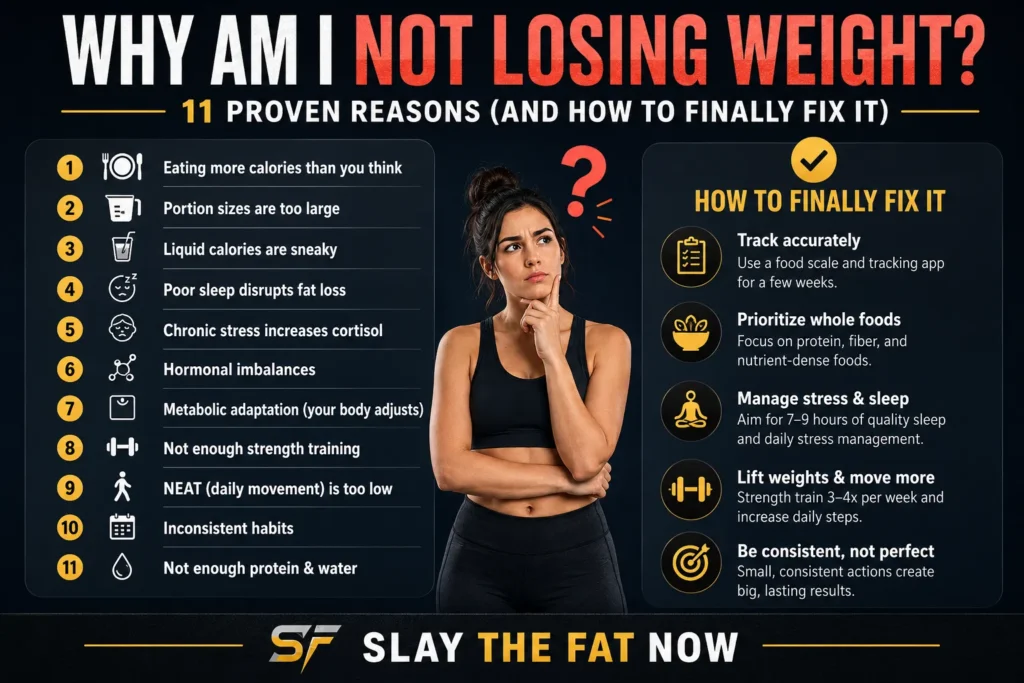
Why am I not losing weight? You’re likely not losing weight because of one or more hidden factors: eating more calories than you think, chronic stress, poor sleep, hormonal imbalances, or metabolic adaptation. Most people underestimate their calorie intake by 30–50%. Fixing these specific issues not just “eating less and moving more” is what actually breaks a plateau.
You’re Doing Everything Right. So Why Isn’t the Scale Moving?
You’re eating salads. You skipped dessert three days in a row. You even dragged yourself to the gym. And yet nothing. The scale hasn’t budged in two weeks, maybe longer.
It feels personal. Like your body is working against you.
Here’s the truth: it’s not that you’re lazy or weak. The problem is most weight loss advice skips the real reasons people stall. They hand you a meal plan and call it a day. But if the underlying cause isn’t addressed, you’ll spin your wheels indefinitely.
This article breaks down why you’re not losing weight specifically, clearly, and with real solutions you can start using today.
What You’ll Learn
In this guide, you’ll discover:
- The most common (and most overlooked) reasons fat loss stops
- What the research actually says about metabolism and plateaus
- Practical, no-fluff fixes you can implement immediately
- What separates people who succeed long-term from those who don’t
Whether you’ve been stuck for two weeks or six months, the answer is in here somewhere. Let’s find it.
Why This Matters More Than You Think
Weight loss isn’t just about appearance. Carrying excess body fat particularly visceral fat around the midsection is directly linked to type 2 diabetes, cardiovascular disease, sleep apnea, and joint deterioration.
According to the CDC, over 41% of American adults are classified as obese. That number has climbed steadily for two decades not because people stopped trying, but because standard advice keeps failing them.
Understanding why fat loss stalls is the difference between short-term frustration and long-term transformation. And the stakes couldn’t be higher.
The Data on Weight Loss Plateaus
Here’s what the research actually shows:
- A landmark study published in the American Journal of Clinical Nutrition found that participants underreported their calorie intake by an average of 47%.
- The National Weight Control Registry, which tracks over 10,000 people who lost 30+ lbs and kept it off, found that consistent self-monitoring was the #1 predictor of long-term success.
- Research from the NIH shows that metabolic adaptation where your body burns fewer calories in response to dieting can reduce your energy expenditure by up to 500 calories per day over time.
- Sleep deprivation increases hunger hormones (ghrelin) by up to 28%, according to research published in PLOS Medicine.
The message is clear: this is biology, not willpower.
11 Reasons Why You’re Not Losing Weight
1. You’re Eating More Than You Think
This is the #1 reason. Not because you’re dishonest but because calorie estimation is notoriously inaccurate. Cooking oils, dressings, handfuls of nuts, bites of your kid’s food it adds up fast.
Fix it: Track everything for at least two weeks using a food scale and an app like MyFitnessPal. Don’t guess. Measure.
2. Metabolic Adaptation Has Kicked In
When you eat less, your body is smart enough to burn less. This is called metabolic adaptation or “adaptive thermogenesis.” Your resting metabolic rate drops, you move less unconsciously (NEAT non-exercise activity thermogenesis), and suddenly your calorie deficit disappears.
Fix it: Take a diet break every 8–12 weeks. Eat at maintenance calories for 1–2 weeks to reset metabolic rate before cutting again. This is supported by research from the University of Tasmania.
3. You’re Not Eating Enough Protein
Protein keeps you full, preserves lean muscle, and burns more calories to digest than fat or carbs (the “thermic effect of food”). Most people eating a reduced-calorie diet are dramatically under-eating protein.
Fix it: Aim for 0.7–1g of protein per pound of bodyweight. Prioritize chicken breast, eggs, Greek yogurt, cottage cheese, and lean beef. Want specific meal plans?
4. Your Sleep Is Wrecking Your Hormones
Poor sleep doesn’t just make you tired it actively fights fat loss. It spikes cortisol (a fat-storage hormone), increases ghrelin (hunger), decreases leptin (fullness), and tanks growth hormone (which aids fat burning).
Fix it: Prioritize 7–9 hours. Keep a consistent sleep schedule. Eliminate screens 60 minutes before bed and keep your room cool and dark.
5. Stress Is Causing Cortisol to Spike
Chronic stress keeps cortisol elevated around the clock. Cortisol signals your body to hold onto fat particularly belly fat and to break down muscle instead. You can be in a perfect caloric deficit and still not lose fat if cortisol is chronically elevated.
Fix it: Add stress reduction practices: 10-minute walks, breathwork, journaling, or even reducing caffeine. The goal is to lower your physiological stress load, not just feel less anxious.
6. You’re Not Moving Enough Outside the Gym
Most people think “exercise” means their 45-minute gym session. But NEAT all the movement you do the rest of the day can account for 300–700+ extra calories burned daily. When you start dieting, NEAT often drops without you realizing it.
Fix it: Aim for 8,000–10,000 steps daily regardless of workouts. Take the stairs. Park farther. Walk while on calls. Small things compound dramatically.
7. You Have an Undiagnosed Hormonal Issue
Hypothyroidism, PCOS, insulin resistance, and low testosterone (in men) can all severely hamper fat loss even when diet and exercise are dialed in. These are more common than most people think, especially in women over 30.
Fix it: If you’ve been consistently on point for 6+ weeks with no results, ask your doctor for a full hormonal panel: TSH, free T3/T4, fasting insulin, and sex hormones.
8. You’re Drinking Your Calories
Smoothies, protein shakes, juice, alcohol, fancy coffees liquid calories are one of the most common blind spots. They don’t trigger fullness signals the way solid food does, so they bypass your hunger regulation entirely.
Fix it: Stick to water, black coffee, plain tea, and sparkling water. If you drink alcohol, understand it contributes 7 calories per gram and it also temporarily halts fat oxidation while your liver processes it.
9. Weekend Eating Is Undoing Your Weekday Effort
A study from the Cornell Food and Brand Lab found that people who ate well Monday–Friday often fully compensated on weekends enough to eliminate the week’s entire calorie deficit. Sound familiar?
Fix it: You don’t have to eat perfectly on weekends. But stay broadly consistent. One or two treats are fine. Three days of unrestricted eating is not.
10. You’ve Lost Muscle (and Your Metabolism With It)
If you’re cutting calories without strength training, you’re likely losing muscle alongside fat. Less muscle means a slower metabolism which means fewer calories burned at rest. This compounds over time.
Fix it: Lift weights 2–4 times per week even while in a calorie deficit. This preserves muscle, boosts metabolic rate, and helps you look better as the fat comes off.
11. You’ve Hit a True Plateau (And Need to Adjust)
Sometimes everything is correct and you still plateau. This is normal. As you lose weight, your body becomes lighter and needs fewer calories. What worked at 200 lbs may not work at 180 lbs.
Fix it: Recalculate your TDEE (total daily energy expenditure) every 10–15 lbs lost. Adjust your calorie target downward slightly, or increase activity. Don’t keep doing the same thing expecting different results.
Real Example: What a Stall Actually Looks Like
Meet Sarah. 38, works a desk job, two kids. She started a diet six months ago and lost 14 lbs in the first two months. Then: nothing. For four months, the scale barely moved.
What was happening?
- She was eating “clean” but not tracking and her portions had slowly crept up
- She’d reduced her gym sessions from 4x to 2x per week due to work stress
- Her sleep averaged 5.5 hours due to a toddler’s sleep disruptions
- She wasn’t eating nearly enough protein around 60g/day instead of the ~120g she needed
Once she addressed all four factors simultaneously not just one she lost another 18 lbs over the next three months. The key wasn’t working harder. It was working smarter.
Expert Insight: What Actually Separates People Who Win
After years of observing what works for real people trying to lose real weight, a few consistent patterns emerge:
Winners track. They don’t guess. They measure. Awareness is the foundation.
Winners don’t go all-or-nothing. They don’t start over every Monday. They make small adjustments when they stall and keep moving forward.
Winners build habits, not streaks. A missed workout isn’t a failure it’s just a missed workout. They show up the next day.
Winners address everything. Not just food. Sleep, stress, movement, and mindset all matter. Anyone who tells you it’s only about calories is selling you a partial truth.
Reality Check: Things You Need to Hear
Cardio alone won’t do it. Hours on the treadmill won’t outrun a poor diet. Nutrition accounts for roughly 80% of fat loss results.
“Eating healthy” is not the same as eating at a deficit. Avocado, nuts, olive oil, and whole-grain bread are healthy. They’re also calorie-dense. You can absolutely gain weight eating clean food.
Supplements don’t fix a broken foundation. Fat burners, detox teas, and metabolism boosters are largely marketing. They don’t replace real food, sleep, and movement.
Slow progress is still progress. Losing 0.5–1 lb per week is medically sound and often more sustainable than aggressive cuts that cause muscle loss and metabolic damage.
Practical Steps to Break Your Plateau
This week:
- Start tracking food with a scale and app (not eyeballing)
- Add a 20-minute walk after dinner every night
- Set a non-negotiable 7.5-hour sleep target
This month:
- Add or increase strength training to 3x per week
- Calculate your protein goal and hit it daily
- Identify and reduce your top stress trigger
Ongoing:
- Recalculate your calorie needs every 10–15 lbs lost
- Take a 1-2 week diet break every 8–12 weeks
- Stay consistent Monday through Sunday not just weekdays
For a complete day-by-day system to eliminate all guesswork, visit our fat loss starter program designed for real people with real schedules.
Approaches Compared: Which Strategy Works Best?
| Approach | Pros | Cons | Best For |
|---|---|---|---|
| Calorie counting | Most effective, data-driven | Requires effort, can cause obsession | Data-oriented people |
| Intuitive eating | Sustainable, reduces stress | Slow, requires body awareness | People with diet fatigue |
| Intermittent fasting | Easy to implement, reduces snacking | Can trigger overeating in some | Busy schedules, late eaters |
| Low-carb/keto | Fast initial results, reduces hunger | Restrictive, hard socially | Insulin-resistant individuals |
| Flexible dieting (IIFYM) | Freedom, sustainable | Requires tracking | People who hate food rules |
There is no single “best” approach. The best diet is the one you can actually stick to. But all of them only work when calories, protein, sleep, and stress are broadly addressed.
Frequently Asked Questions
1. Why am I not losing weight even though I’m eating less?
You may be eating less, but still above your calorie deficit. Metabolic adaptation, liquid calories, or underestimated portion sizes are common culprits. Start tracking precisely.
2. Can stress stop weight loss?
Yes. Elevated cortisol promotes fat storage and can completely offset a calorie deficit in chronically stressed individuals.
3. Why am I not losing belly fat specifically?
Belly fat (visceral fat) is the last to go for most people and is strongly driven by cortisol and insulin. Total body fat loss through consistent deficit and stress management is the only way to reduce it.
4. How long does a weight loss plateau last?
A true plateau typically lasts 2–6 weeks. If you’ve truly been consistent for longer than that, it’s time to reassess calorie intake, protein, activity levels, and hormonal health.
5. Can eating too little stop weight loss?
Yes severe undereating leads to muscle loss and metabolic slowdown. Your body adapts to extreme restriction. Eating at a moderate deficit (300–500 calories below TDEE) is more effective long-term.
6. Why am I not losing weight on a 1200 calorie diet?
Either you’re consuming more than 1200 (tracking errors are common), or your metabolic rate has adapted down. Many people also cannot sustain 1200 calories, leading to unconscious weekend overeating.
7. Does drinking water help with weight loss?
Yes. Staying well-hydrated supports metabolism, reduces false hunger signals, and helps the body flush metabolic byproducts. Aim for at least 64–80 oz daily.
8. Can thyroid problems stop weight loss?
Absolutely. An underactive thyroid (hypothyroidism) dramatically slows metabolism. If you suspect this, ask your doctor for a TSH and free T4 test.
9. Why am I not losing weight working out every day?
Exercise increases appetite in many people, which leads to eating back calories burned. Overtraining can also raise cortisol, promoting fat retention. Rest days matter.
10. Am I not losing weight because of my age?
\Age-related hormonal shifts and muscle loss do slow metabolism, but they don’t stop weight loss. They make precise calorie control and strength training even more important, not impossible.
11. Does alcohol prevent weight loss?
Yes. Alcohol halts fat oxidation while it’s being metabolized and adds empty calories. It also impairs sleep and lowers inhibition, making overeating more likely.
12. Why do I lose weight then gain it back?
Usually because the approach wasn’t sustainable. Extreme diets cause muscle loss, metabolic adaptation, and psychological deprivation all of which make regain almost inevitable.
13. Is it possible to not lose weight despite a calorie deficit?
Mathematically, a true deficit will produce weight loss. But most people aren’t actually in a deficit they’re estimating. Weigh your food for two weeks and you’ll likely find the discrepancy.
14. What medications can cause weight loss resistance?
SSRIs, certain antidepressants, beta-blockers, corticosteroids, and some birth control pills can promote water retention or increased appetite. Talk to your doctor before stopping any medication.
15. How do I know if my metabolism is slow?
A registered dietitian can calculate your resting metabolic rate (RMR) via metabolic testing. Online calculators give a reasonable estimate, but they’re not perfect for everyone. If your calculator says you need 2,000 calories and you’re gaining weight on 1,500, further investigation is warranted.
Take the Next Step
If you’ve read this far, you’re serious about figuring out why you’re not losing weight and that’s already half the battle.
The problem isn’t your willpower. The problem is missing information and the wrong strategy.
At SlayTheFatNow.com, everything we publish is built around one goal: giving you the tools to lose fat in a way that actually lasts without crash diets, unsustainable plans, or guessing.
You’ve waited long enough. Let’s fix this for real, this time.
Sources:
