 Skip to content
Best Breakfast for Weight Loss That Actually Works in 2026
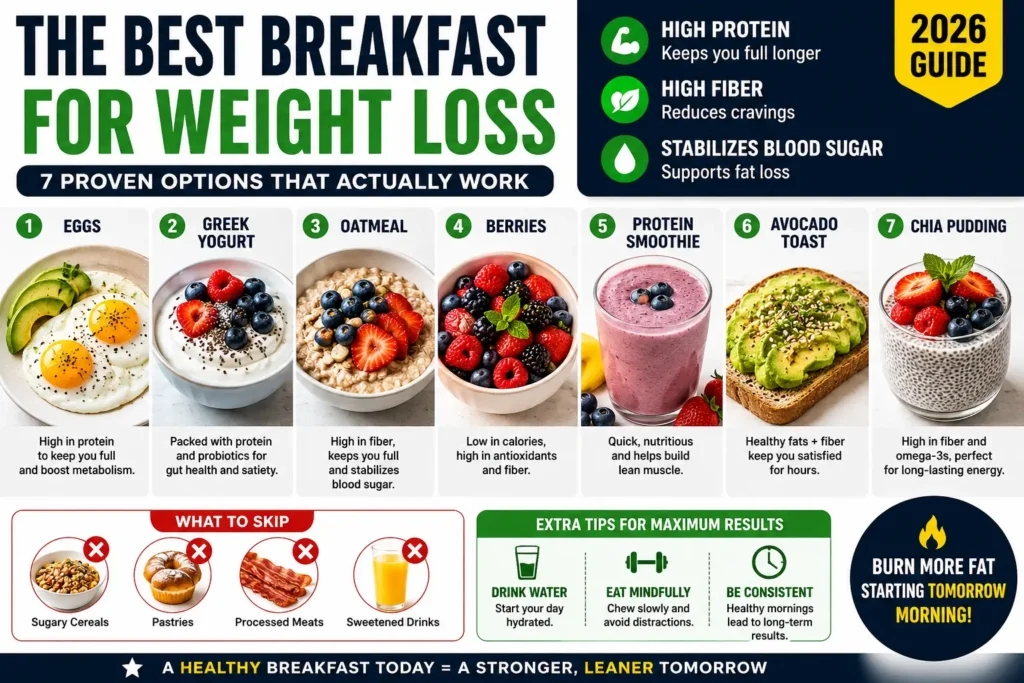
The best breakfast for weight loss includes high-protein, high-fiber foods like eggs, Greek yogurt, oatmeal, and berries. These options keep you full longer, reduce cravings, and stabilize blood sugar all of which make it easier to eat less throughout the day without feeling deprived or exhausted.
You’ve Been Eating Breakfast Wrong This Whole Time
Here’s something most people get completely wrong: they skip breakfast thinking it’ll save calories, or they grab a granola bar and a coffee and wonder why they’re starving by 10 AM.
Sound familiar?
The truth is, what you eat for breakfast sets the metabolic tone for your entire day. A poor breakfast doesn’t just leave you hungry it sends your blood sugar on a rollercoaster that leads to cravings, overeating, and zero energy for exercise.
If you’ve been struggling to lose weight despite “eating healthy,” your breakfast might be the hidden problem. And the good news? It’s one of the easiest things to fix.
What Is the Best Breakfast for Weight Loss, Really?
When we talk about the best breakfast for weight loss, we’re not talking about eating as little as possible. We’re talking about eating strategically foods that work with your hormones, not against them.
The ideal weight-loss breakfast does three things:
- Keeps you full until your next meal (no mid-morning snack attacks)
- Stabilizes blood sugar to prevent energy crashes and cravings
- Supports muscle so your body burns fat, not muscle tissue
In this article, you’ll learn exactly which breakfast foods deliver all three, what the science actually says, what a real-world weight loss breakfast looks like, and what most people get dangerously wrong.
Whether you’re just starting your weight loss journey or you’ve been stuck at the same plateau for months, this guide will give you the clarity you need.
Why Breakfast Matters More Than You Think for Weight Loss
Before we get to the specific foods, let’s address the “why” because understanding the mechanism makes it much easier to stick with.
It Controls Hunger Hormones
Ghrelin is your hunger hormone. When you skip breakfast or eat a sugar-heavy one, ghrelin spikes and stays elevated. That’s why you feel ravenous by noon. A protein-rich breakfast suppresses ghrelin more effectively than any other macronutrient.
It Prevents the Binge Cycle
Studies consistently show that people who eat a satisfying breakfast consume fewer total calories throughout the day. The opposite is also true: skipping breakfast is correlated with higher total caloric intake by evening often in the form of high-fat, high-sugar “comfort” foods.
It Sets Your Metabolism in Motion
Your body’s thermic effect of food (TEF) the energy it burns digesting what you eat is highest in the morning. Protein has the highest TEF of any macronutrient at 20–35%. That means eating a protein-rich breakfast literally burns more calories just through digestion.
What the Research Actually Shows
The data on breakfast and weight loss is compelling.
According to the National Weight Control Registry, which tracks over 10,000 individuals who lost at least 30 pounds and kept it off for more than a year, 78% of those who maintained weight loss eat breakfast every single day.
A 2020 study published in Obesity found that participants who consumed a high-protein breakfast (35g+ of protein) experienced significantly reduced daily calorie intake by as much as 441 calories compared to those who ate a low-protein breakfast.
Research from the American Journal of Clinical Nutrition confirms that dietary fiber particularly soluble fiber found in oats and fruits reduces visceral (belly) fat more effectively than caloric restriction alone.
The CDC’s dietary guidelines also note that breakfast skippers are 4.5 times more likely to be obese than regular breakfast eaters.
The pattern is clear: the right breakfast isn’t just helpful for weight loss it may be essential.
The 7 Best Breakfast Foods for Weight Loss
1. Eggs
Eggs are arguably the single most powerful weight-loss breakfast food. Three large eggs deliver about 18–21g of protein, plus essential fats that keep you satisfied for hours. Research shows people who eat eggs for breakfast consume up to 400 fewer calories over the rest of the day.
How to eat them: Scrambled with spinach and feta, hard-boiled for meal prep, or as a veggie-packed omelet.
2. Greek Yogurt (Plain, Full-Fat)
One cup of plain Greek yogurt delivers 17–20g of protein and live probiotic cultures that support gut health which is increasingly linked to healthy weight regulation. Avoid the flavored varieties; they’re often loaded with added sugar.
How to eat it: Top with fresh berries and a tablespoon of chia seeds for fiber and omega-3s.
3. Oatmeal (Steel-Cut or Rolled)
Oats are rich in beta-glucan, a soluble fiber that slows digestion and keeps blood sugar stable. They also promote the release of peptide YY (PYY), a fullness hormone. Avoid instant oats they’re processed and spike blood sugar almost as fast as table sugar.
How to eat it: Cook with almond milk, top with a tablespoon of almond butter and cinnamon.
4. Berries (Blueberries, Raspberries, Strawberries)
Low in calories, high in fiber, and packed with antioxidants, berries are one of the best additions to any weight-loss breakfast. A cup of raspberries has 8g of fiber and only 65 calories. Their natural sweetness also satisfies sugar cravings without the blood sugar crash.
How to eat them: Mixed into Greek yogurt, blended into a protein smoothie, or eaten fresh with eggs on the side.
5. Chia Seeds
Ounce for ounce, chia seeds are among the most fiber-dense foods on the planet 10g of fiber per ounce. They also expand in liquid, physically increasing the volume of food in your stomach and triggering fullness signals.
How to eat them: Make overnight chia pudding with unsweetened almond milk, or stir into oatmeal.
6. Avocado
The healthy monounsaturated fats in avocado slow gastric emptying, meaning food stays in your stomach longer. Half an avocado with two eggs is one of the most filling, metabolism-supporting breakfasts you can eat.
How to eat it: Sliced on top of eggs, mashed onto high-fiber whole grain toast, or blended into a smoothie.
7. Protein Smoothies
When done right protein powder, leafy greens, berries, unsweetened nut milk, and no added sugar a protein smoothie can deliver 25–35g of protein in under three minutes. This is the go-to for people who aren’t hungry in the morning but need something that performs.
How to make one: 1 scoop whey or plant protein, 1 cup spinach, ½ cup berries, 1 tbsp almond butter, 1 cup unsweetened almond milk, ice.
A Real-World Example: What Sarah Did Differently
Sarah, 38, had been trying to lose weight for two years. She wasn’t eating junk food, but her breakfast was a store-bought “protein bar” and a large iced coffee with sweetened creamer. She was consuming about 450 calories at breakfast mostly sugar and was starving by 10:30 AM.
She made one change: she switched to two scrambled eggs, half an avocado, a side of berries, and black coffee.
Her breakfast calories dropped to around 380. But more importantly, she stopped snacking before lunch entirely. Within three weeks, she’d dropped 6 pounds not from dieting more aggressively, but from simply fixing her breakfast.
This isn’t a miracle story. It’s what happens when you replace blood-sugar-spiking foods with protein and fiber.
Expert Insight: What Actually Separates Successful Weight Loss Breakfasts
After working with weight loss clients and studying the research, certain patterns emerge consistently:
Pattern 1: Protein is non-negotiable. Successful weight loss breakfasts almost always include 20–35g of protein. Anything less and you’ll be fighting hunger all morning.
Pattern 2: Fiber amplifies everything. Protein alone is good. Protein plus fiber is excellent. The combination slows digestion, stabilizes blood sugar, and keeps hormones in check for hours.
Pattern 3: Liquid calories are a trap. Juice, flavored coffee drinks, smoothies with added syrup these are calorie-dense, fiber-free, and gone in seconds. They do nothing for fullness.
Pattern 4: Timing matters less than composition. Despite what intermittent fasting proponents might say, the research on fasting vs. breakfast-eating for weight loss is inconclusive for most people. What is very clear is that when you eat doesn’t matter nearly as much as what you eat. Focus there first.
Reality Check: What People Don’t Want to Hear
Let’s be honest about a few things.
“Healthy” granola is often worse than cereal. A single cup of store-bought granola can have 500 calories and 30g of sugar. Most commercial granola is a candy bar in disguise.
Fruit juice is not a breakfast. Orange juice has nearly as much sugar as Coca-Cola, without the fiber that makes eating an actual orange weight-loss-friendly.
Smoothies can sabotage you. If your “healthy smoothie” has banana, mango, honey, orange juice, and protein powder you might be drinking 600+ calories without realizing it. Smoothies made without intentional structure are one of the most common breakfast weight-loss mistakes.
Skipping breakfast works for some people but not most. If you practice intermittent fasting and it’s working for you, great. But if you’re skipping breakfast and constantly overeating at night, that’s a sign your strategy is backfiring.
“Low-fat” options are often higher in sugar. Low-fat yogurt, low-fat peanut butter, fat-free cream cheese manufacturers replace fat with sugar to maintain flavor. Check the label.
Practical Advice: How to Build the Best Weight Loss Breakfast
Do This:
- Aim for 20–35g of protein at breakfast eggs, Greek yogurt, protein powder, cottage cheese, or smoked salmon.
- Add at least 5–10g of fiber berries, oats, chia seeds, flaxseed, or vegetables.
- Include a healthy fat avocado, eggs, nuts, or olive oil.
- Drink water first. Often what feels like hunger is dehydration. Drink 16 oz of water before eating.
- Prep the night before. Overnight oats, hard-boiled eggs, or chia pudding take 5 minutes the night before and zero time the morning.
Avoid This:
- Sugary cereals, even ones marketed as “healthy” or “whole grain”
- Fruit juice and flavored coffee drinks
- Store-bought smoothies and protein bars (most are glorified candy)
- Processed breakfast meats high in sodium and preservatives
- High-carb, low-protein combinations (toast + jam + OJ = blood sugar disaster)
Comparison: Which Breakfast Strategy Is Right for You?
| Approach | Best For | Protein | Fiber | Prep Time |
|---|---|---|---|---|
| Eggs + Avocado | Most people | High | Medium | 10 min |
| Greek Yogurt + Berries | Busy mornings | High | Medium | 2 min |
| Overnight Oats | Meal preppers | Medium | High | 5 min (night before) |
| Protein Smoothie | Non-breakfast people | High | Medium | 3 min |
| Chia Pudding | Meal preppers, plant-based | Medium | Very High | 5 min (night before) |
| Cottage Cheese + Fruit | Budget-conscious | Very High | Medium | 2 min |
Not every option works for every lifestyle. If you’re not a morning person, overnight oats or chia pudding are your friends. If you want maximum fat-burning power and have 10 minutes, eggs and avocado win every time.
For more targeted guidance based on your calorie needs, check out our Weight Loss Calorie Calculator to figure out exactly how many calories your breakfast should contain.
15 Frequently Asked Questions About Breakfast and Weight Loss
1. What is the single best breakfast for weight loss?
Eggs are consistently ranked #1 due to their complete protein profile, satiety effect, and low calorie count. Two to three eggs with vegetables is a near-perfect weight-loss breakfast.
2. Is it okay to skip breakfast when trying to lose weight?
For some people, intermittent fasting works well. For most, skipping breakfast leads to overeating later in the day. If skipping breakfast doesn’t cause cravings or nighttime bingeing, it may work for you.
3. How many calories should breakfast be for weight loss?
A good range is 300–500 calories, with at least 20g of protein and 5g+ of fiber. The composition matters more than the calorie count.
4. Is oatmeal good for weight loss?
Yes, especially steel-cut or rolled oats. They’re high in soluble fiber (beta-glucan) which reduces hunger and stabilizes blood sugar. Avoid instant oats and flavored packets.
5. Are eggs every day bad for you?
Current research shows that for most healthy adults, eating one to two eggs per day does not significantly affect cardiovascular risk. Eggs are an excellent daily breakfast food.
6. What should I drink with breakfast for weight loss?
Water, black coffee, or unsweetened green tea. Avoid juice, sweetened coffee drinks, and soda.
7. Is Greek yogurt good for weight loss?
Yes. Plain, full-fat Greek yogurt is high in protein and probiotics. Avoid flavored yogurts, which are often high in added sugar.
8. Can I eat fruit for breakfast and lose weight?
Yes, but fruit alone isn’t enough it lacks protein and fat to keep you full. Pair fruit with protein (eggs, Greek yogurt, cottage cheese) for a balanced meal.
9. What’s the best high-protein breakfast for weight loss?
Eggs (scrambled or boiled), cottage cheese, Greek yogurt, smoked salmon, or a whey/plant protein smoothie. Aim for 25–35g of protein.
10. Is a protein shake a good breakfast for weight loss?
Yes, if made correctly. Use a quality protein powder, add fiber (spinach, chia seeds, flaxseed), and avoid added sugars. A well-made shake can rival eggs in terms of satiety.
11. What breakfast foods cause weight gain?
Sugary cereals, pastries, flavored yogurts, fruit juice, white toast with jam, and commercial granola are the biggest offenders. They’re calorie-dense, nutrient-poor, and spike blood sugar rapidly.
12. Does eating breakfast boost metabolism?
There’s no strong evidence that breakfast itself “boosts” metabolism. However, the thermic effect of protein at any meal does and eating protein at breakfast helps regulate hunger hormones all day.
13. How much protein do I need at breakfast to lose weight?
Research suggests 25–35g of protein at breakfast significantly reduces hunger and daily caloric intake. Less than 15g has minimal effect on fullness.
14. What is the best quick breakfast for weight loss?
Plain Greek yogurt with berries (2 minutes), hard-boiled eggs prepped ahead (grab and go), or a protein smoothie (3 minutes) are the fastest high-impact options.
15. Should I eat breakfast before or after exercise?
This depends on your body. Fasted cardio works for some people. For most, eating protein before exercise improves performance and muscle retention. Experiment and see what feels better for you.
The Bottom Line
The best breakfast for weight loss isn’t complicated, expensive, or time-consuming. It’s built on a simple foundation: protein + fiber + healthy fat, every morning, consistently.
You don’t need a diet overhaul. You need a breakfast upgrade.
Start with one change this week. Swap your cereal or granola bar for two eggs and some berries. Or prep overnight oats tonight for tomorrow morning. These small shifts compound into real, lasting fat loss without misery, restriction, or willpower battles.
The people who win at weight loss aren’t the ones with the most discipline. They’re the ones with the best systems. Breakfast is where that system starts.
🔥 Take the next step. If you’re ready to go beyond breakfast and build a complete fat-loss eating plan, explore our 14-Day Weight Loss Kickstart Program built around real food, real science, and results that last. No crash diets. No gimmicks. Just a plan that works.
Sources
- National Weight Control Registry – Research Findings
- CDC – Healthy Weight, Nutrition, and Physical Activity
This article is for informational purposes only and does not constitute medical advice. Consult a healthcare provider before making significant dietary changes.
