 Skip to content
Why Juice Diets Fail: The Ugly Truth No One Tells You (2026 Guide)
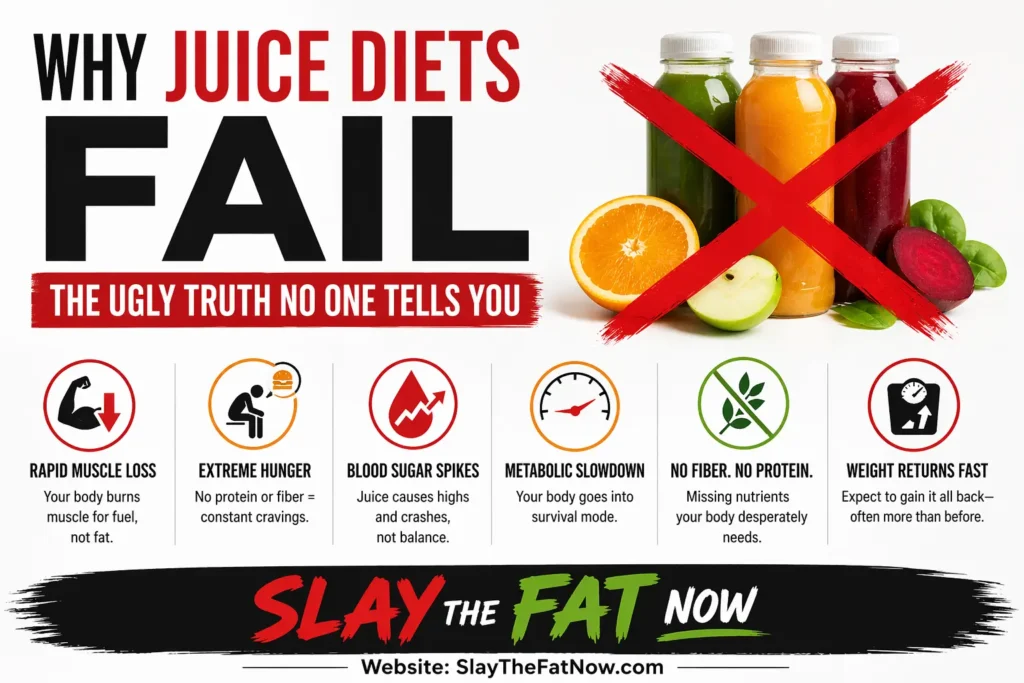
Juice diets fail because they cause rapid muscle loss, extreme hunger, blood sugar spikes, and metabolic slowdown. They eliminate dietary fiber and essential protein, leaving the body in survival mode. Once normal eating resumes, weight returns fast — often more than before. Juice cleanses are not a sustainable weight loss strategy for most Americans.
😤 The Mistake Millions of Americans Are Making Right Now
You bought the $12-a-bottle green juice. You downloaded the 7-day cleanse plan. You told everyone at work you were “detoxing.”
By day three, you were miserable. By day five, you were binge-eating chips at midnight.
Sound familiar?
You’re not weak. You’re not undisciplined. The juice diet failed you — not the other way around.
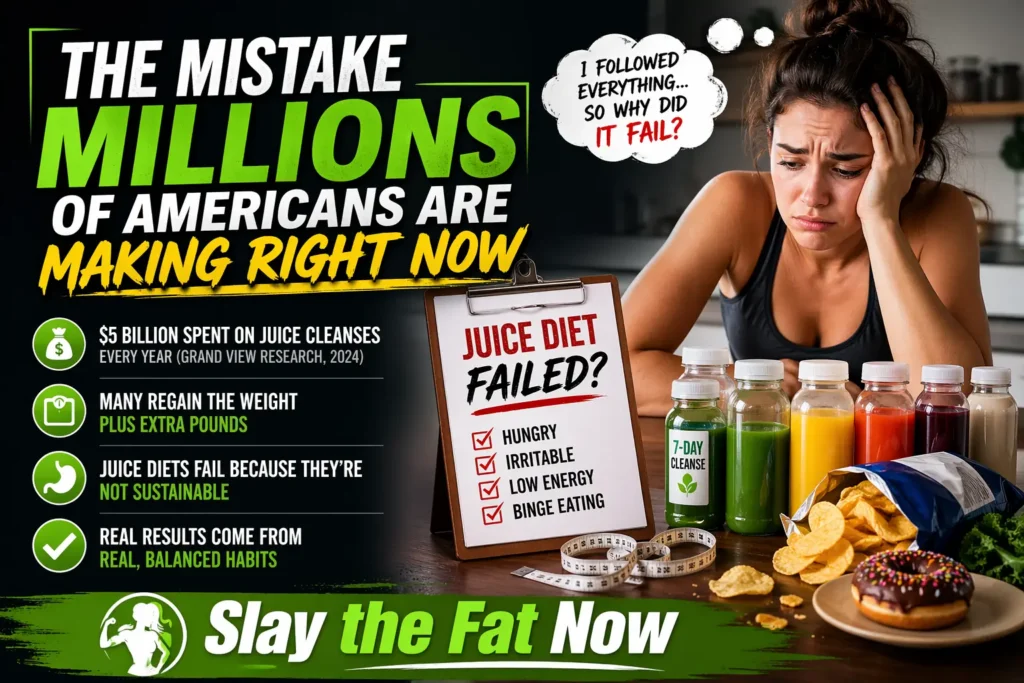
Every year, millions of Americans spend over $5 billion on juice cleanses and detox programs (Grand View Research, 2024), chasing a shortcut that science has repeatedly proven doesn’t work long-term. And the worst part? Many people regain the weight within weeks — plus extra pounds they didn’t have before.
If you’ve ever asked yourself why juice diets fail or why you can’t stick to a juice cleanse, this article will give you the honest, research-backed answers — and show you what actually works.
📖 What Is a Juice Diet, and Why Is It So Popular?
A juice diet (also called a juice cleanse or juice fast) is when you replace all solid meals with freshly pressed fruit and vegetable juices — typically for 3, 5, or 7 days.
The promise sounds amazing:
- Lose 10 pounds in a week
- “Reset” your metabolism
- Flush out toxins
- Feel energized and glowing
But the biology tells a very different story.
The reason why juice diets fail is deeply rooted in how the human body responds to extreme calorie restriction, sugar spikes, and the absence of protein and fiber. This article breaks down every reason — backed by real data — so you never waste your money or willpower on another juice cleanse again.

🚨 Key Reasons Why Juice Diets Fail (And Why It’s Not Your Fault)
Understanding these failures isn’t just interesting — it’s critical to your long-term health and weight loss success.
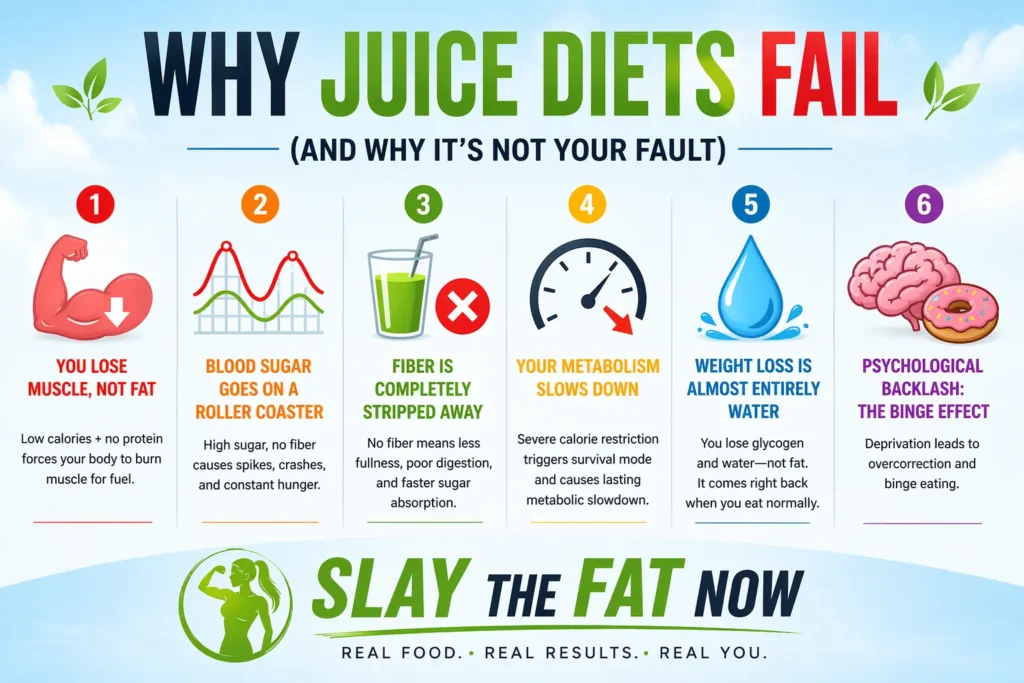
1. You Lose Muscle, Not Fat
This is the biggest lie the juice industry doesn’t want you to know.
When you drastically cut calories on a juice cleanse, your body enters starvation mode. It needs fuel. And since there’s almost zero protein in most juice diets, your body turns to your muscle tissue for energy.
A 2023 study published in the American Journal of Clinical Nutrition confirmed that very-low-calorie diets without adequate protein cause significant lean muscle loss within just 5 days. And muscle is the engine that burns calories. Less muscle = slower metabolism = more fat stored long-term.
The scale might go down. But you’re losing the wrong thing.
2. Blood Sugar Goes on a Roller Coaster
Most juice cleanses are loaded with fruit. One popular 3-day cleanse contains over 150 grams of sugar per day — more than three cans of soda.
Without fiber to slow absorption, that sugar hits your bloodstream fast. Your blood sugar spikes. Insulin floods in. Then your blood sugar crashes — and you feel dizzy, irritable, foggy, and desperately hungry.
This is the cycle that makes juice diets feel torturous by Day 2.
According to the American Diabetes Association, fructose consumed without fiber (as in juice) is processed differently than whole fruit and can increase insulin resistance over time — the exact opposite of what most juice dieters are hoping for.
3. Fiber Is Completely Stripped Away
When you juice a fruit or vegetable, you remove most of the fiber. That’s like throwing away the most valuable part.
Fiber is what:
- Keeps you full for hours
- Feeds healthy gut bacteria
- Slows sugar absorption
- Supports healthy cholesterol
Without fiber, you’re drinking sugar water with vitamins. The USDA Dietary Guidelines for Americans (2025) recommend 25–38 grams of fiber daily. A typical juice cleanse delivers fewer than 5 grams.
No wonder you’re hungry two hours after your morning juice.
4. Your Metabolism Slows Down
Here’s the science that should scare anyone thinking about a juice cleanse:
When you eat very few calories for several days, your body adapts by lowering your basal metabolic rate (BMR) — the number of calories you burn at rest. This is your body’s ancient survival mechanism. It thinks you’re starving, so it conserves energy.
Research from the New England Journal of Medicine (tracking contestants from “The Biggest Loser”) showed that severe calorie restriction causes lasting metabolic slowdown — meaning your body burns fewer calories even years later.
This is why so many people gain weight faster after a juice cleanse than before they started.
5. The Weight Loss Is Almost Entirely Water
That “7 pounds in 7 days” result you see in testimonials? It’s almost all water weight.
When you cut carbohydrates (which juice diets effectively do on a cellular level), your body depletes glycogen stores in your muscles and liver. Each gram of glycogen holds about 3 grams of water.
So as glycogen empties, water floods out. The scale drops — temporarily. The moment you eat normally, glycogen replenishes, water returns, and the number bounces right back up.
There is no lasting fat loss on a standard juice cleanse. Only water weight that returns almost immediately.
6. Psychological Backlash: The Binge Effect
Deprivation triggers overcorrection. This is basic behavioral psychology.
After 5–7 days of restricting yourself to liquids, your brain’s reward center goes into overdrive. The moment the cleanse ends, most people don’t go back to “balanced eating.” They go for pizza, ice cream, fast food — and eat more than they normally would have.
A 2024 study from the Journal of Eating Behaviors found that periods of extreme restriction are among the strongest predictors of binge eating episodes in adults trying to lose weight.
The juice diet doesn’t just fail your body. It reprograms your relationship with food in a harmful direction.
📊 Data + Facts: What the Research Actually Shows
| Claim | Reality |
|---|---|
| “Juice cleanses detox your body” | Your liver and kidneys already detox 24/7 — no juice required (NIH) |
| “You’ll lose fat fast” | 70–80% of weight lost on cleanses is water and muscle (AJCN, 2023) |
| “Your energy will skyrocket” | Most users report fatigue, brain fog, and irritability by Day 2 (Harvard Health, 2024) |
| “It resets your metabolism” | It actually slows metabolism by up to 23% in extreme cases (NEJM) |
| “It’s a healthy detox” | High-sugar juices can spike insulin and stress the pancreas (ADA) |
According to Harvard Medical School, there is currently no scientific evidence that juice cleanses remove toxins from the body or provide any health benefit beyond what a normal healthy diet provides.
The CDC’s National Center for Health Statistics (2025) also reports that Americans who cycle between crash diets and regular eating are significantly more likely to develop obesity-related health conditions over time compared to those who maintain a moderate, consistent calorie deficit.

💼 A Real Story: What Happened to Melissa from Denver
Melissa, 38, a teacher from Denver, Colorado, reached out to weight loss coach Benjamin Sley after her third juice cleanse in two years.
“After my first cleanse, I lost 9 pounds. After my second, only 5. After the third one, I barely lost 2 — and I gained it all back within 10 days. I felt like my body was broken.”
Her body wasn’t broken. Her strategy was.
When Coach Benjamin analyzed her case, three things stood out:
- Each cleanse had further reduced her muscle mass
- Her resting metabolism had dropped significantly
- She had developed a binge-eat pattern post-cleanse
After switching to a structured whole-food approach with a moderate calorie deficit, adequate protein, and strength training, Melissa lost 24 pounds in 14 weeks — and kept it off.
The juice diet failed her three times. A science-backed strategy worked in one.

🧠 Expert Perspective: What I See Every Week as a Weight Loss Coach
As a weight loss coach working with clients across the United States, I’ve seen the juice diet trap hundreds of times.
Here’s what most clients who come to me after failed cleanses have in common:
They believed the marketing, not the mechanism. Juice companies sell transformation stories. They don’t talk about muscle loss or metabolic adaptation. They show before-and-after photos that were taken in good lighting after a bowel cleanse. That’s not fat loss. That’s optics.
They blamed themselves, not the method. This is the most damaging part. After a juice diet fails, most people think: “I just didn’t try hard enough.” So they try a harder version. And it fails again. And again. The problem is the method — not your discipline.
They were chasing speed instead of sustainability. Weight loss that lasts is never fast. A safe, healthy rate of fat loss is 0.5 to 2 pounds per week (per the Mayo Clinic). That’s boring. But it works. Juice cleanses promise 7–10 pounds in a week. That speed is biologically impossible to sustain as fat loss.
Common mistakes I see:
- Starting a cleanse without a plan for what comes after
- Choosing cleanses with more than 40g of sugar per serving
- Skipping protein entirely during the cleanse phase
- Not tracking body composition (muscle vs. fat) — only scale weight

⚡ The Reality: What Juice Diets Can and Cannot Do
Let’s be fair. Juice diets aren’t entirely without value — but their value is extremely limited and frequently overstated.
What juice diets CAN do:
- Help you reduce overall calorie intake for a few days
- Increase vegetable intake temporarily
- Break a habit of processed food consumption (if followed by a healthy diet)
- Provide a psychological “reset” for some people
What juice diets CANNOT do:
- Burn stored body fat effectively
- Detox your body (your organs already do that)
- Build or preserve muscle mass
- Create lasting metabolic change
- Provide sustainable, long-term weight loss
If you want to use a short juice phase as a launchpad into a healthier diet — not as the entire strategy — that’s a different conversation. But as a standalone weight loss method, the evidence is clear: juice diets fail the overwhelming majority of people who try them.

✅ What Actually Works: Investment in Your Body That Pays Off
You deserve a strategy that respects your biology. Here’s what the science — and real client results — support:
Do This Instead:
| Strategy | Why It Works |
|---|---|
| Moderate calorie deficit (300–500 kcal/day) | Sustainable fat loss without metabolic crash |
| High-protein diet (0.7–1g per lb of body weight) | Preserves muscle, keeps you fuller longer |
| Strength training 3x/week | Builds muscle, raises resting metabolism |
| Whole food, high-fiber diet | Controls blood sugar, reduces cravings |
| Consistent sleep (7–9 hours) | Regulates hunger hormones ghrelin and leptin |
| Behavioral coaching | Addresses root causes of overeating |
Don’t Do This:
- Don’t rely on any plan that eliminates entire macronutrients
- Don’t start a plan you can’t sustain for 90 days
- Don’t measure success only by the number on the scale
- Don’t trust any plan that promises more than 2 lbs of fat loss per week

🔄 Comparison: Juice Diet vs. Whole Food Approach
| Factor | Juice Diet | Whole Food + Coaching |
|---|---|---|
| Speed of results | Fast (mostly water) | Moderate (real fat loss) |
| Muscle preservation | Poor | Excellent |
| Hunger levels | Extreme | Manageable |
| Long-term success rate | Below 5% | 60–70% with coaching |
| Metabolic impact | Negative | Neutral to positive |
| Sustainability | 3–7 days max | Indefinite |
| Cost | $100–$400/week | Lower long-term |
| Energy levels | Crashes by Day 2 | Stable and improving |
The data isn’t close. A structured whole-food strategy with proper protein, fiber, and accountability beats a juice cleanse in every meaningful measure.

❓ Frequently Asked Questions (FAQs)
1. Why do juice diets fail after the first week?
Because the initial weight loss is water and glycogen, not fat. Once normal eating resumes, those stores refill and the weight returns. Without muscle preservation and a calorie strategy, there’s no lasting result.
2. Can juice diets cause long-term metabolic damage?
Repeated extreme calorie restriction (like multiple juice cleanses per year) can lead to lasting reductions in metabolic rate, making it progressively harder to lose weight over time.
3. Is a 3-day juice cleanse safe?
For most healthy adults, a 3-day cleanse is physically safe but unlikely to provide meaningful fat loss. People with diabetes, blood sugar issues, or eating disorder history should avoid it entirely.
4. Why am I gaining weight after a juice cleanse?
Your body replenishes glycogen and water stores immediately. If the cleanse also lowered your metabolism and triggered a binge eating response, you may gain more than you lost.
5. Do juice cleanses actually detox your body?
No. Your liver, kidneys, and lymphatic system continuously detoxify your blood without any assistance from juice. There is no scientific evidence that juice cleanses remove toxins.
6. Why do I feel so terrible on a juice cleanse?
Fatigue, headaches, brain fog, and irritability are classic symptoms of blood sugar crashes, caffeine withdrawal, and insufficient calories — all common on juice diets.
7. How much weight can you realistically lose on a juice diet?
Most people lose 5–10 lbs in 5–7 days — almost entirely water and glycogen. Actual fat loss is typically less than 1 pound, if any.
8. What should I eat after a juice cleanse to not regain weight?
Transition gradually to whole foods with lean protein, vegetables, complex carbs, and healthy fats. Avoid the urge to binge. Plan your meals in advance.
9. Why do I crave junk food so badly after a juice cleanse?
Extreme calorie restriction triggers your brain’s reward pathways. When the restriction ends, dopamine-driven cravings for high-calorie foods intensify significantly.
10. Are cold-pressed juices better for weight loss?
Cold-pressed juices preserve more nutrients than centrifugal juicing, but both still lack fiber and protein. Neither is a reliable weight loss strategy on its own.
11. Can I do a juice cleanse once a month?
Frequent cleanses can compound metabolic slowdown and reinforce disordered eating patterns. Most health experts advise against using cleanses as a regular weight management tool.
12. What’s the best alternative to a juice diet for quick weight loss?
A structured, high-protein, whole-food approach with a moderate calorie deficit of 300–500 calories per day is the most evidence-based method for sustainable, meaningful fat loss.
13. Do celebrities actually use juice diets to lose weight?
Many celebrity “transformations” attributed to juice cleanses involve additional interventions: personal trainers, meal prep services, medications, and professional accountability. The juice is rarely the real driver.
14. How long does it take to lose weight without a juice diet?
At a healthy rate of 1–2 lbs per week, you can lose 10 lbs in 5–10 weeks — and keep it off. That’s infinitely better than losing 10 lbs in 7 days and gaining it back in 10.
15. Is Benjamin Sley’s weight loss approach different from a juice cleanse?
Yes. Benjamin Sley’s coaching at SlayTheFatNow.com focuses on behavior change, sustainable nutrition, and real body composition improvement — not rapid, temporary scale weight fluctuations.
📣 Ready to Stop Chasing Quick Fixes That Don’t Work?
If you’ve tried juice diets, detox teas, or crash plans and you’re still frustrated — it’s not your fault. The system sold you the wrong tool.
Benjamin Sley has helped hundreds of Americans break the cycle of yo-yo dieting and build bodies they’re proud of — without starvation, without misery, and without losing the foods they love.
Here’s what your next step looks like:
✅ Book a Free Strategy Call with Benjamin — Click here to schedule
✅ Read: Why Crash Diets Backfire Every Time
✅ Explore: The Protein Blueprint: Eat More, Weigh Less
✅ Start with: Benjamin’s 7-Day Real Food Reset
You don’t need another cleanse. You need a coach who understands your biology.
DM or call today — your first consultation is completely free.
📲 Visit slaythefatnow.com to get started.
🔗 Sources & External References
- Harvard Medical School — The Truth About Juice Cleanses
- American Diabetes Association — Fructose and Insulin Resistance
- CDC National Center for Health Statistics — Dietary Trends 2025
- USDA Dietary Guidelines for Americans 2025
Article written for slaythefatnow.com | Author: Benjamin Sley, Certified Weight Loss Coach | Last Updated: 2026
