 Skip to content

Cordova Weight Loss: The Complete 2026 Guide to Losing Weight and Keeping It Off
The most effective Cordova weight loss strategy combines a personalized nutrition plan, consistent strength and cardio training, behavioral coaching, and — where clinically appropriate — medically supervised support such as GLP-1 medications. Sustainable fat loss requires more than a crash diet. It demands a system built around your body, your lifestyle, and your long-term health goals.
The Mistake Most People in Cordova Make When Trying to Lose Weight
You’ve tried it before. The crash diet. The 30-day challenge. The meal kit subscription. The gym membership you stopped using by February.
You lost a few pounds. Then life happened. Stress, late nights, fast food, and suddenly the scale crept right back up — and then some.
Here’s the hard truth: the problem isn’t your willpower. It’s the plan.
Most weight loss advice you’ve seen online — from Reddit threads to viral TikTok routines — is designed for clicks, not results. It’s generic. It doesn’t account for your age, your hormones, your stress levels, or your schedule.
If you’re living in the Cordova area and you’re serious about losing weight for real this time, you need a different approach. One that’s built on science, not trends. One that fits your actual life.
That’s exactly what this guide is about.
What Is Cordova Weight Loss — And Why It Matters in 2026
“Cordova weight loss” isn’t just a search term. It represents a growing movement of people in the Cordova, Tennessee region — and across the United States — who are done with quick fixes and ready for real, lasting change.
In 2026, the weight loss landscape has shifted dramatically. Medical science has given us better tools than ever before. Behavioral coaching has become more personalized. And the public conversation around obesity has finally matured beyond “just eat less and move more.”
This article will walk you through:
- The real facts about weight and health in America right now
- What actually works for sustainable fat loss
- How to evaluate your options — from diet plans to medical programs
- What mistakes to avoid
- How to get real support from coaches and clinicians who know what they’re doing
Whether you’re 20 pounds overweight or 100, whether you’ve tried everything or you’re just getting started — this guide is for you.
Why Your Weight Loss Journey Actually Matters: Key Benefits
Let’s be clear: this isn’t about aesthetics. It’s about your life.
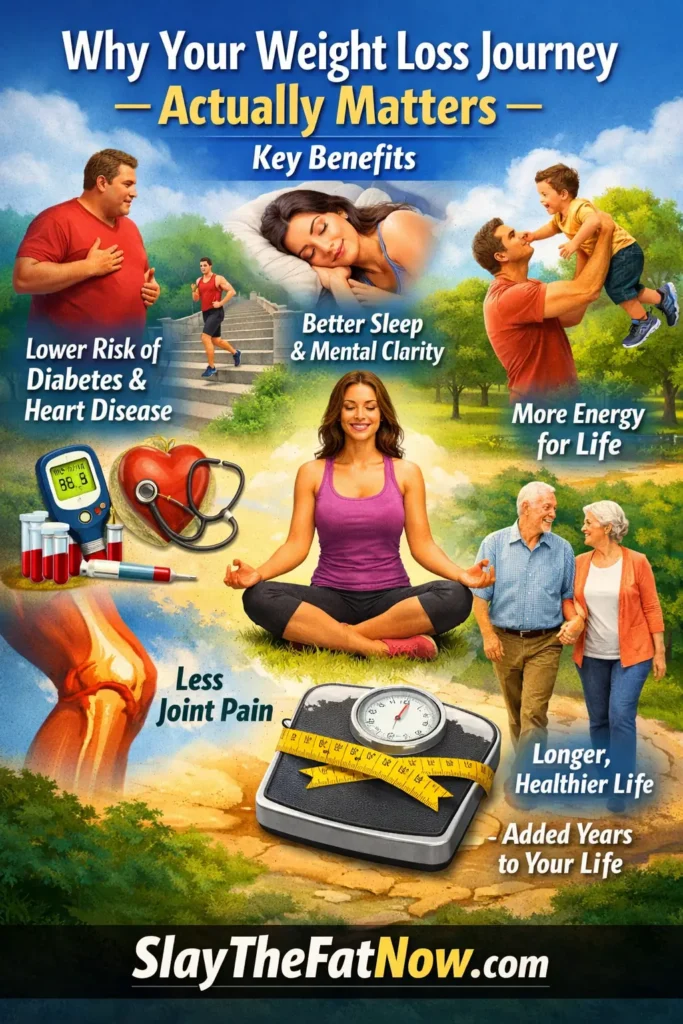
Losing even 5–10% of your body weight has been shown to dramatically reduce the risk of type 2 diabetes, heart disease, sleep apnea, and joint pain. You sleep better. You think more clearly. You have more energy for the people and things you love.
Here’s what changes when you commit to a real weight loss plan:
Your health risk drops fast. Blood pressure, blood sugar, and cholesterol levels often improve within weeks of meaningful weight loss — before you’ve even reached your goal.
Your mental health improves. Exercise and proper nutrition directly impact mood-regulating brain chemicals. Many people report significantly less anxiety and depression within 60–90 days of consistent lifestyle changes.
Your energy comes back. Carrying excess body fat is exhausting — literally. Reducing it lifts a physical and metabolic burden that affects every hour of your day.
Your joints thank you. Every pound of body weight puts approximately four pounds of pressure on your knees. Losing 20 pounds relieves 80 pounds of pressure from your joints.
You add years to your life. Research published in leading medical journals consistently links obesity to reduced life expectancy — and weight loss to the reversal of many of those risks.
This is why Cordova weight loss isn’t a vanity project. It’s one of the most important investments you can make in yourself.
The Data Tells a Sobering Story — But Also a Hopeful One
Let’s look at where America stands right now.
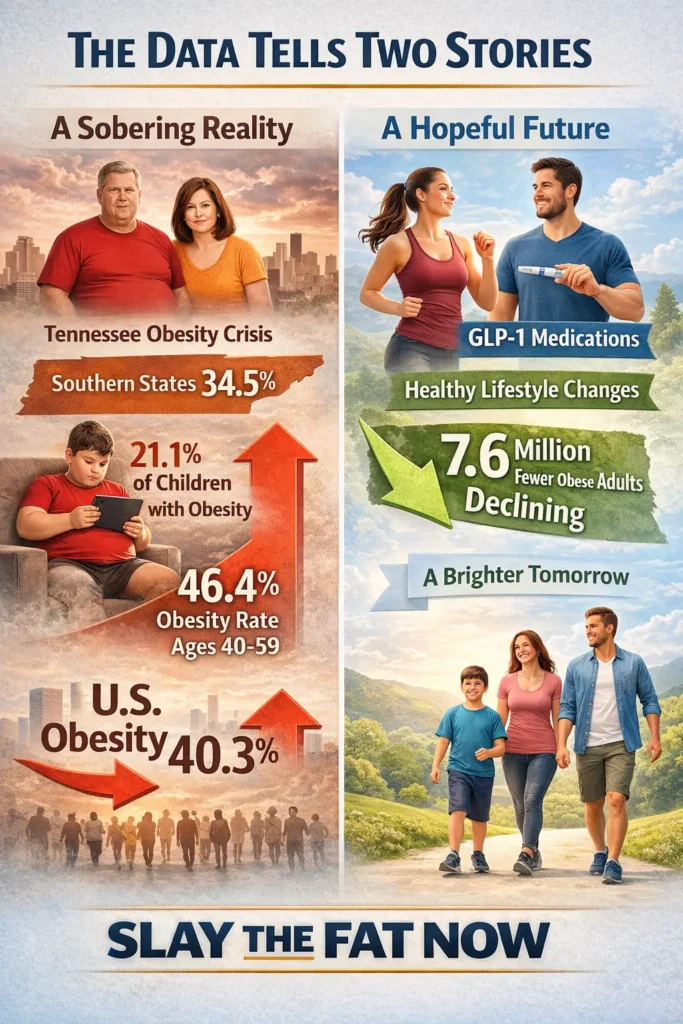
According to the CDC’s most recent data, 40.3% of U.S. adults have obesity, with 9.7% classified as severely obese. Middle-aged adults — those between 40 and 59 — carry the highest burden, with an obesity prevalence of 46.4%.
In Tennessee specifically, the numbers are among the highest in the nation. The South as a region has an obesity prevalence of 34.5%, one of the two highest regional rates in the country.
For children, the picture is equally concerning. The CDC reports that 21.1% of children and teens ages 2 to 19 have obesity — more than triple the rate seen in the mid-1970s.
But here’s the hopeful part: the tide is beginning to turn.
Gallup’s 2025 National Health and Well-Being Index found that after peaking at 39.9% in 2022, the U.S. adult obesity rate declined to 37.0% in 2025 — representing approximately 7.6 million fewer obese adults in just three years. Much of this decline is being driven by increased access to GLP-1 medications like semaglutide and tirzepatide, along with growing public awareness about sustainable lifestyle interventions.
The tools exist. The science is there. What people need is the right guide.
A Real-World Example: What a Successful Weight Loss Journey Looks Like
Meet Marcus. He’s 44, lives in Cordova, TN, works a desk job, and has two kids. In January 2025, he weighed 247 pounds. His doctor warned him about pre-diabetes and high blood pressure.
He’d tried dieting before. Lost weight, gained it back — twice.
This time, he did something different. He booked a consultation with a certified weight loss coach, got a complete metabolic panel done, and built a plan around three pillars:
1. Nutrition redesigned, not just restricted. Instead of counting every calorie, Marcus shifted to a whole-food, moderate-protein diet. He cut ultra-processed foods, not entire food groups. He didn’t starve — he learned to eat strategically.
2. Exercise that actually fit his life. Three 45-minute strength sessions per week, plus 8,000–10,000 steps daily. Nothing extreme. Nothing that required five hours at the gym.
3. Accountability and coaching. He checked in weekly with his coach, tracked his habits (not just his weight), and had someone to call when motivation dipped.
By August 2025, Marcus had lost 51 pounds. His blood sugar normalized. His blood pressure dropped to a healthy range. His doctor took him off one of his medications.
More importantly — he kept it off. Because the habits were built to last.
This isn’t a fantasy. This is what structured, supported, science-based weight loss looks like. And it’s available to you.

Insights From a Weight Loss Expert: What We See Every Day
As a weight loss coaching practice working with clients across the United States, here is what we consistently observe — and what the most successful clients have in common.
The biggest mistake people make is starting with tactics, not strategy. They pick a diet — keto, intermittent fasting, vegan — without ever assessing whether that approach matches their biology, their lifestyle, or their relationship with food. The best diet is the one you can maintain for life. That looks different for everyone.
Most people underestimate the role of sleep and stress. Cortisol — the stress hormone — is one of the most potent drivers of abdominal fat storage. People who work on sleep quality and stress management often see the scale move in ways that diet and exercise alone couldn’t achieve.
Progress isn’t always linear. The scale will stall. That doesn’t mean the process is broken. Clients who understand this and stay consistent through plateaus are the ones who reach their goals.
Accountability changes everything. Research consistently shows that people who have regular check-ins with a coach lose significantly more weight and maintain it longer than those who try to go it alone.
Medication isn’t cheating — but it’s not a silver bullet either. GLP-1 medications like Semaglutide and Tirzepatide are powerful tools when used within a comprehensive lifestyle program. But patients who rely on medication without building sustainable habits often regain weight when they stop. The lifestyle is still the foundation.

The Honest Reality: What Weight Loss Is — and Isn’t
Let’s break some myths, because your trust matters more than telling you what you want to hear.
Myth 1: “I just need more willpower.” False. Obesity is recognized by the American Medical Association, the CDC, and the World Health Organization as a chronic disease influenced by genetics, hormones, environment, and behavior. Blaming willpower alone ignores the biology.
Myth 2: “Extreme diets get results faster.” Sometimes in the short term. But rapid weight loss through extreme restriction leads to muscle loss, metabolic adaptation, nutritional deficiencies, and almost always — rebound weight gain. The research is unambiguous on this.
Myth 3: “Once I hit my goal weight, I’m done.” Weight maintenance is an ongoing practice, not a finish line. The habits that get you there need to continue in some form — or the weight returns. This is why building a lifestyle, not just following a plan, is everything.
Myth 4: “Supplements and detox teas will speed things up.” The supplement industry generates billions of dollars annually by exploiting people’s desire for shortcuts. The vast majority of weight loss supplements have no meaningful clinical evidence behind them. Save your money.
The risk of doing nothing: Untreated obesity increases your risk for type 2 diabetes, heart disease, stroke, certain cancers, sleep apnea, and depression — and reduces your life expectancy. The cost of inaction is always higher than the cost of change.

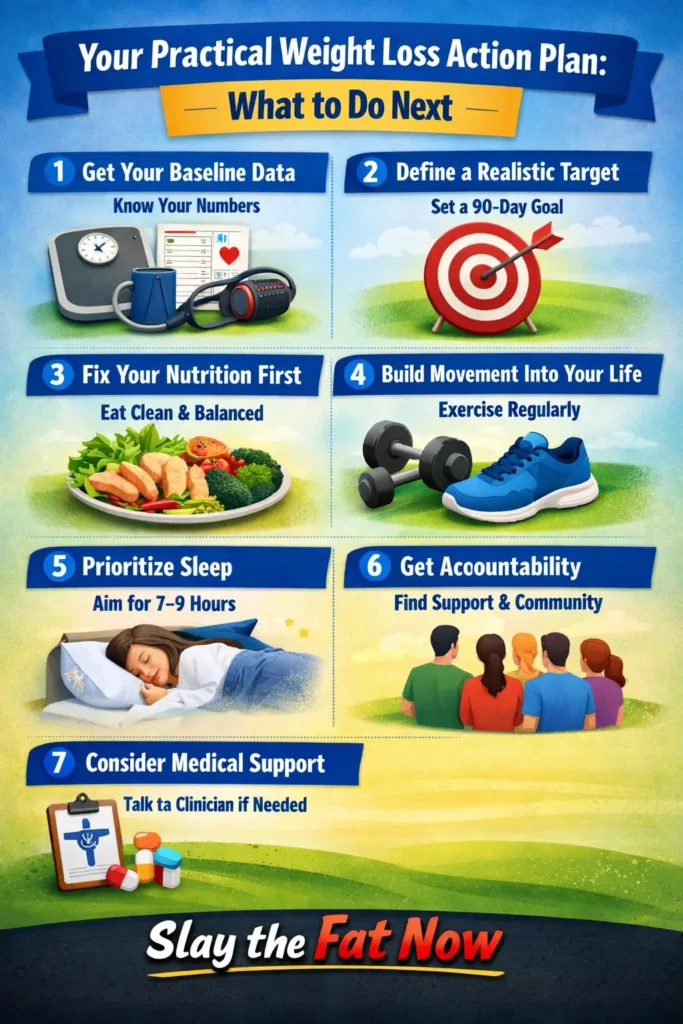
Your Practical Weight Loss Action Plan: What to Do Next
Here is a clear, actionable framework based on what actually works — regardless of where you’re starting from.
Step 1: Get your baseline data. Before changing anything, know your numbers. Your current weight, BMI, waist circumference, resting heart rate, blood pressure, and — ideally — a basic metabolic panel from your doctor. You can’t manage what you don’t measure.
Step 2: Define a realistic target. A safe and sustainable rate of fat loss is 0.5 to 1.5 pounds per week. Set a 90-day goal, not a 10-day goal. Sustainable > dramatic.
Step 3: Fix your nutrition first. You cannot outrun a bad diet. Focus on building meals around lean protein, vegetables, whole grains, and healthy fats. Limit ultra-processed foods, sugary beverages, and alcohol — not because they’re morally wrong, but because they undermine your goals.
Step 4: Build movement into your life. Aim for 150 minutes of moderate exercise per week, as recommended by the CDC and WHO. Strength training at least twice a week preserves muscle mass during fat loss — this is critical for long-term metabolic health.
Step 5: Prioritize sleep. Aim for 7–9 hours per night. Sleep deprivation elevates ghrelin (your hunger hormone) and suppresses leptin (your fullness hormone) — a recipe for overeating.
Step 6: Get accountability. Join a program. Work with a coach. Find a community. The data is clear: people who have structured support lose more weight and keep it off longer.
Step 7: Consider medical support if appropriate. If you have a BMI of 30 or above and haven’t had success with lifestyle changes alone, speak with a clinician about whether GLP-1 medications or other medical interventions are appropriate for you. These are legitimate, science-backed tools — not shortcuts.
Do’s:
- Track your habits, not just your weight
- Celebrate non-scale victories (energy, sleep, strength)
- Build flexible, sustainable eating patterns
- Work with qualified professionals
Don’ts:
- Don’t cut below 1,200 calories without medical supervision
- Don’t skip strength training
- Don’t compare your journey to someone else’s
- Don’t rely on supplements or detox products

Comparing Your Weight Loss Options in 2026
| Approach | Best For | Speed | Sustainability | Cost |
|---|---|---|---|---|
| Lifestyle coaching | Everyone, especially beginners | Moderate | Very High | Low–Moderate |
| Structured diet program | Those who need structure | Moderate | Moderate | Low–Moderate |
| Medical weight loss (GLP-1) | BMI 30+, clinical candidates | Fast | Moderate (with habits) | Moderate–High |
| Bariatric surgery | Severe obesity (BMI 40+) | Very Fast | High (with compliance) | High |
| DIY/self-guided | Motivated self-starters | Variable | Low | Very Low |
| Crash dieting | Nobody | Fast short-term | Very Low | Low |
The right option depends on your starting point, your health status, and your lifestyle. A qualified weight loss coach can help you identify which path — or which combination — makes the most sense for you.
For most people, lifestyle coaching paired with a structured nutrition and exercise plan is the most accessible, sustainable, and cost-effective starting point.

15 Frequently Asked Questions About Cordova Weight Loss
1. What is the most effective weight loss method in Cordova, TN? The most effective approach combines personalized nutrition, consistent exercise, behavioral coaching, and — for eligible patients — medically supervised support. There is no single “best” method; the right plan depends on your individual health profile and lifestyle.
2. How much weight can I realistically lose in 90 days? With a structured, sustainable program, most people can safely lose 12–25 pounds in 90 days. Faster loss is possible with medical support, but sustainability requires building lasting habits alongside any rapid results.
3. Are GLP-1 medications like Semaglutide safe for weight loss? When prescribed and monitored by a qualified healthcare provider, GLP-1 medications have a strong clinical safety record. In December 2025, the WHO issued its first global guideline endorsing these medications as part of comprehensive obesity care for eligible adults.
4. What is a healthy rate of weight loss per week? Most clinical guidelines recommend 0.5 to 1.5 pounds per week as a safe and sustainable target. Losing weight faster than this often results in muscle loss, nutrient deficiencies, and eventual rebound.
5. Do I need a gym membership to lose weight? No. Walking, bodyweight training, and home workouts can be highly effective. What matters is consistency and progressive challenge — not the equipment or location.
6. How does stress affect weight gain? Chronic stress elevates cortisol, which promotes fat storage — particularly around the abdomen. Managing stress through sleep, mindfulness, and exercise is a critical and often overlooked component of any weight loss plan.
7. Is intermittent fasting effective for weight loss? Intermittent fasting can be effective for some people as a tool to reduce overall calorie intake. However, it is not superior to other dietary approaches when total calories are equal. The best eating pattern is the one you can sustain long-term.
8. What should I eat to lose weight fast but safely? Focus on lean proteins (chicken, fish, eggs, legumes), non-starchy vegetables, whole grains, and healthy fats. Limit ultra-processed foods, added sugars, and alcohol. Avoid extreme calorie restriction, which can backfire metabolically.
9. How does sleep affect weight loss? Poor sleep disrupts hunger-regulating hormones, increases cravings for high-calorie foods, and reduces the energy available for exercise. Prioritizing 7–9 hours of quality sleep per night is a non-negotiable part of any serious fat loss plan.
10. Can I lose weight without exercising? Technically yes — weight loss is primarily driven by a calorie deficit. But exercise — especially strength training — preserves muscle mass, improves metabolic rate, supports mental health, and dramatically improves long-term weight maintenance outcomes.
11. What is BMI and does it matter? BMI (Body Mass Index) is a screening tool that measures weight relative to height. A BMI of 25–29.9 is classified as overweight; 30 or above is obesity. BMI isn’t a perfect measure of health, but it’s a useful starting point for clinical assessment.
12. How do I know if I need medical weight loss support? If you have a BMI of 30 or above, or a BMI of 27 or above with a weight-related condition such as type 2 diabetes or hypertension, you may be a candidate for medically supervised weight loss. Speak with your doctor or a certified weight loss clinician.
13. What is the role of a weight loss coach? A weight loss coach provides personalized guidance, accountability, habit-building support, and behavioral strategies that make it easier to stay consistent. Research consistently shows that coached individuals achieve better and more lasting results than those who go it alone.
14. Are weight loss supplements worth buying? For the vast majority of products on the market, no. Most supplements lack meaningful clinical evidence and are not regulated by the FDA for efficacy. The exceptions are certain micronutrient deficiencies that, when corrected, can support overall metabolic health — but these should be guided by a clinician.
15. How do I maintain weight loss after reaching my goal? Maintenance requires continuing the core habits that produced your results: consistent movement, balanced nutrition, adequate sleep, and ongoing accountability. Many people benefit from a maintenance check-in with their coach on a monthly or quarterly basis to stay on track.
Ready to Finally Lose the Weight? Here’s How to Start
If you’ve read this far, something has shifted. You’re not looking for another quick fix. You’re looking for real change.
At Slay the Fat Now, Benjamin Sley and the coaching team have helped people across the United States transform their bodies and their lives — not through extremes, but through science-backed, personalized, sustainable programs.
Whether you’re just starting out or you’ve been struggling for years, the right support makes all the difference.
Here’s your next step:
👉 Book your free consultation at SlaytheFatNow.com — No pressure. No gimmicks. Just a real conversation about your goals and how to get there.
You’ve waited long enough. The best time to start was years ago. The second best time is today.
This article was written by Benjamin Sley, certified weight loss coach and founder of SlaytheFatNow.com, drawing on verified data from the CDC, Gallup, Trust for America’s Health, and clinical research published by the WHO and NHANES. Information is intended for educational purposes and does not substitute for personalized medical advice. Always consult a qualified healthcare provider before beginning any new weight loss program.
