 Skip to content
The Liquid Calories Myth: What Your Drink Is Really Doing to Your Weight (And What No One Tells You)
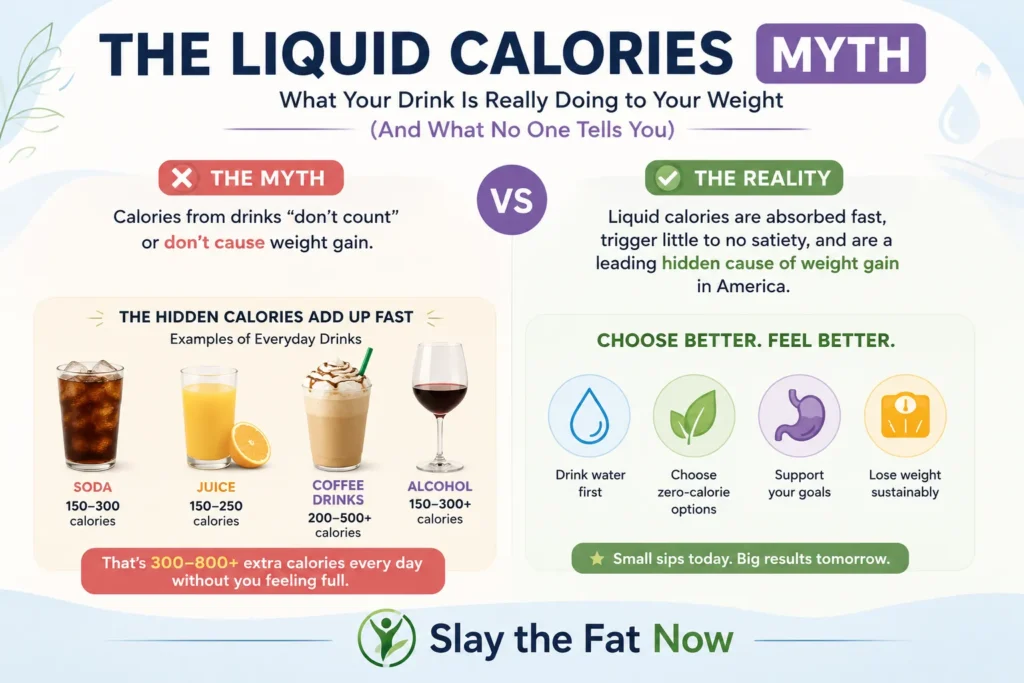
The liquid calories myth is the false belief that calories from drinks “don’t count” or don’t cause weight gain. In reality, liquid calories are absorbed fast, trigger little to no satiety, and are a leading hidden cause of weight gain in America. Beverages like soda, juice, coffee drinks, and alcohol can add 300–800+ calories daily without you feeling full.
😣 You’re Doing Everything Right So Why Isn’t the Scale Moving?
You cut the bread. You skipped dessert. You’re hitting the gym three times a week.
But the weight? It’s not budging.
Here’s what most people don’t hear: it might be what you’re drinking.
Every morning, millions of Americans pour themselves a large orange juice, a flavored latte, or a “healthy” smoothie and they genuinely believe they’re making good choices. After all, it’s not food, right?
Wrong. And that single misunderstanding is costing people months sometimes years of weight loss progress.
If you’ve been frustrated, confused, or ready to give up, keep reading. What you’re about to learn could be the missing piece that changes everything.
📖 Overview: What Is the Liquid Calories Myth?
The liquid calories myth refers to the widespread belief that calories consumed through beverages are somehow less “real,” less fattening, or less impactful than the same number of calories eaten as solid food.
This myth is baked into our culture. We say things like “it’s just a drink” or “I barely ate anything today.” But we forget to count the two cans of soda, the venti caramel macchiato, the sports drink after the gym, or the glass of wine after dinner.
The science is clear: a calorie is a calorie, regardless of whether you chew it or sip it. But here’s what makes liquid calories even more dangerous your body processes them differently, and your brain doesn’t register them the same way.
This article breaks down everything you need to know about the liquid calories myth, backed by real data, expert insights, and practical steps you can use today.
💡 Why This Matters: Key Benefits of Understanding Liquid Calories
Understanding the truth about liquid calories isn’t just interesting it’s transformational for your weight loss journey.
Here’s why this matters for you:
1. You’ll finally understand why your diet “isn’t working.” Most people underestimate their liquid calorie intake by 30–50%. Fixing this alone can create a 300–500 calorie daily deficit enough to lose 1+ pound per week without changing anything else.
2. You’ll make smarter choices at the grocery store, coffee shop, and restaurant. Once you know which drinks are secretly loaded with sugar and calories, you stop falling into the traps set by clever marketing.
3. You protect your long-term metabolic health. Sugary drinks are directly linked to insulin resistance, fatty liver disease, and Type 2 diabetes conditions that make weight loss harder and harder over time.
4. You break the cycle of cravings. Liquid sugar spikes your blood glucose fast, then crashes it leaving you hungry again within an hour. Understanding this cycle is the first step to breaking it.
📊 Data + Facts: What the Research Actually Says
Let’s look at the numbers because this is where the liquid calories myth gets demolished.
🔴 The Average American Drinks 400+ Liquid Calories Per Day According to data from the CDC’s National Health and Nutrition Examination Survey (NHANES), beverages account for approximately 21% of total daily calorie intake for adults in the United States. That’s roughly 400–500 calories per day just from drinks.
🔴 Sugary Drinks Are the #1 Source of Added Sugar in the American Diet The Dietary Guidelines for Americans (2020–2025) identify sugar-sweetened beverages as the top contributor of added sugars in the U.S. diet, exceeding candy, cakes, and desserts combined.
🔴 Liquid Calories Don’t Reduce Hunger Like Solid Food A landmark study published in the American Journal of Clinical Nutrition found that people who drank 450 calories worth of soda did not reduce their food intake at the next meal while those who ate 450 calories of solid food consumed significantly less. The brain simply doesn’t register liquid calories the same way.
🔴 One Extra Sugary Drink Per Day = 15 lbs Gained Per Year A 20 oz. bottle of regular Coca-Cola has 240 calories. Drinking one per day without changing anything else adds up to 87,600 extra calories per year, which translates to roughly 25 pounds of fat gain.
🔴 Alcohol Is a Double Threat Alcohol has 7 calories per gram (almost as much as fat at 9 cal/g). A single glass of wine = ~130 calories. A margarita = 300–500 calories. And alcohol lowers your inhibitions making you more likely to eat more.
🔴 “Healthy” Drinks Are Deceiving Millions
- Naked Green Machine Juice (15.2 oz): 270 calories, 53g sugar
- Starbucks Venti White Chocolate Mocha: 580 calories
- Vitamin Water (20 oz): 125 calories, 32g sugar
- Tropicana Orange Juice (12 oz): 168 calories, 32g sugar
These aren’t junk food. But they carry the caloric load of a full meal.
🧪 Real Example: What a Typical “Healthy” Day Actually Looks Like
Meet Tom, a 38-year-old office worker in Chicago who’s been trying to lose weight for six months with no success. He thinks he eats around 1,800 calories per day.
Here’s what Tom drinks in a typical day:
| Drink | Calories |
|---|---|
| Morning OJ (12 oz) | 168 |
| Starbucks Latte (Grande, 2% milk) | 190 |
| Vitamin Water at lunch | 125 |
| Afternoon Gatorade after gym | 140 |
| Glass of red wine at dinner | 130 |
| Total Liquid Calories | 753 |
Tom doesn’t count any of these. He thinks he’s eating clean. But he’s consuming 753 hidden calories every single day just from drinks.
At his calorie target of 1,800 (for maintenance), his actual intake is closer to 2,550 calories. That’s a surplus of 750 calories per day, or about 1.5 lbs of fat gained per week.
Tom isn’t failing because of lack of willpower. He’s failing because of a myth. Once he switched to water, black coffee, and one small glass of wine on weekends only, he lost 11 lbs in 6 weeks without changing his food at all.
Tom’s story isn’t unique it’s the norm.
🏋️ From the Coach’s Desk: What I See Every Day (Authority Builder)
As a weight loss coach, I work with clients across the United States who come to me frustrated, defeated, and confused. They’ve tried everything. Keto. Intermittent fasting. Counting macros.
And in almost every single case, when I audit their drink habits, I find the same problem.
Here are the most common liquid calorie mistakes I see:
Mistake #1: Treating juice as a health food. Juice is fruit without the fiber. That fiber is what slows digestion, prevents blood sugar spikes, and keeps you full. Remove it, and you’re essentially drinking sugar water no matter what the label says.
Mistake #2: Forgetting about coffee drinks. A plain black coffee has 5 calories. A flavored, sweetened coffee drink from a café can have 400–600. Most people mentally file these under “coffee” and don’t count them.
Mistake #3: Rewarding workouts with sports drinks. Unless you’re a competitive athlete doing 90+ minutes of intense cardio, you don’t need Gatorade or Powerade. A 30-minute gym session burns about 250 calories. One Gatorade puts 140 of them right back.
Mistake #4: Underestimating alcohol. Alcohol doesn’t just bring calories it brings cortisol spikes, disrupted sleep, and lower fat-burning capacity for 24–48 hours after drinking. The impact is far bigger than the calorie counts alone.
Mistake #5: Drinking “diet” versions and eating more. Research shows that artificial sweeteners can trigger cravings and compensatory eating. Diet drinks aren’t a free pass.
At Slay the Fat Now, we’ve seen clients break 6-month plateaus in under 3 weeks simply by getting serious about what they drink.
⚖️ The Reality: Honest Truths About Liquid Calories
Let’s cut through the noise. Here’s what’s actually true no sugarcoating.
Truth #1: Not all liquid calories are equal. Protein shakes made with whole food ingredients can support satiety better than soda. A green smoothie with fiber-rich vegetables is nutritionally different from a juice cleanse. Context matters.
Truth #2: You don’t have to cut everything. Total elimination isn’t realistic for most people. The goal is awareness and reduction, not perfection. Cutting from 700 liquid calories per day to 150 is a massive win.
Truth #3: Water is the only truly “free” drink. Black coffee, plain tea, and sparkling water are extremely low-calorie options. Everything else requires tracking.
Truth #4: The beverage industry is not on your side. Drinks are marketed with words like “natural,” “organic,” “cold-pressed,” and “fortified” none of which mean low-calorie. Read the nutrition label every time.
Truth #5: This is fixable. Unlike genetics or hormones, your drink habits are 100% within your control. This is one of the fastest and most effective levers in weight loss.
✅ Practical Advice: What To Do Right Now
Here’s a simple, actionable framework to eliminate the liquid calories myth from your life:
DO:
- ✅ Drink at least 8–10 glasses of plain water daily
- ✅ Choose black coffee or tea (unsweetened)
- ✅ Track every drink in your calorie app for at least 2 weeks
- ✅ Read labels on every bottled beverage before buying
- ✅ Swap one high-calorie drink per day with sparkling water + lemon
- ✅ Use a protein shake (low-sugar) as a structured meal replacement, not a treat
- ✅ Give yourself 1 “flex drink” per week so deprivation doesn’t derail you
DON’T:
- ❌ Don’t trust health halos “organic” juice is still sugar
- ❌ Don’t drink calories before meals (reduces satiety regulation)
- ❌ Don’t assume diet drinks are harmless
- ❌ Don’t use alcohol as a stress-coping tool it stalls fat loss for days
- ❌ Don’t buy “smoothies” from fast-food chains most have 600–1,000 calories
For personalized guidance, explore our Weight Loss Coaching Program at Slay the Fat Now built around real behavior change, not gimmicks.
🆚 Comparison: Which Drinks Help vs. Hurt Your Weight Loss?
| Drink | Calories | Satiety Effect | Verdict |
|---|---|---|---|
| Water (still or sparkling) | 0 | Neutral | ✅ Best choice |
| Black coffee | 5 | Mild appetite suppression | ✅ Great |
| Unsweetened green tea | 2 | Mild metabolic boost | ✅ Great |
| Diet soda | 0–5 | May trigger cravings | ⚠️ Use sparingly |
| Regular soda (12 oz) | 140–180 | No satiety | ❌ Avoid |
| Orange juice (12 oz) | 168 | Low satiety | ❌ Avoid daily |
| Starbucks Frappuccino | 380–510 | Low satiety | ❌ Avoid |
| Sports drink (Gatorade) | 140 | No satiety | ❌ Avoid unless athlete |
| Protein shake (low sugar) | 120–180 | High satiety | ✅ Structured use |
| Whole milk (8 oz) | 150 | Moderate satiety | ⚠️ Portion control |
| Alcohol (glass of wine) | 130–200 | No satiety + suppresses fat burn | ❌ Limit strictly |
| Green smoothie (homemade) | 150–250 | Moderate satiety if fiber-rich | ⚠️ Track carefully |
The pattern is clear: the more processed, sweetened, and refined a drink is, the more likely it’s silently destroying your calorie deficit.
❓ FAQs: 15 Questions About the Liquid Calories Myth
1. Do liquid calories count the same as food calories?
Yes. A calorie is a unit of energy regardless of its form. However, liquid calories are processed faster and trigger less satiety than solid food, making them easier to overconsume.
2. Can drinking juice make you gain weight?
Absolutely. Fruit juice is high in fructose and lacks the fiber of whole fruit. Even 100% pure juice consumed daily can contribute to significant calorie surplus and weight gain.
3. Is it true that smoothies are healthier than juice?
Whole-food smoothies that retain fiber are nutritionally better than juice. But store-bought smoothies often have 400–700 calories which can still derail weight loss if untracked.
4. Does diet soda cause weight gain?
Diet soda has nearly zero calories, but some research suggests artificial sweeteners may increase cravings and appetite, leading to compensatory eating. It’s not a weight-loss tool.
5. How many calories are in a typical Starbucks order?
It varies widely. A plain Americano is ~15 calories. A Venti White Chocolate Mocha is 580 calories. Always check the Starbucks nutrition calculator before ordering.
6. Does alcohol stop weight loss?
Yes, significantly. Alcohol temporarily shuts down fat oxidation as your body prioritizes metabolizing the alcohol. It also disrupts sleep and increases cortisol both of which promote fat storage.
7. Are sports drinks bad for weight loss?
For most people yes. Sports drinks like Gatorade are designed for endurance athletes. Unless you’re exercising intensely for 90+ minutes, you’re taking in more sugar than you burned.
8. What is the best drink for weight loss?
Water. Full stop. Followed closely by unsweetened black coffee and green tea, which have mild appetite-suppressing and metabolic effects.
9. How many liquid calories should I consume per day?
Ideally, aim for under 100 calories from beverages per day (excluding intentional meal replacements like protein shakes). This keeps the focus on nutrient-dense food.
10. Does coffee with cream and sugar count as liquid calories?
Yes. One tablespoon of cream adds ~50 calories; one teaspoon of sugar adds ~16. A heavily doctored cup of coffee can become a 200-calorie beverage quickly.
11. Is coconut water good for weight loss?
It’s lower in calories than juice (~45 cal per 8 oz) and contains electrolytes, but it still has natural sugars. Drink it occasionally, not daily.
12. What’s the biggest source of hidden liquid calories in the American diet?
Sugary sodas, sweetened coffees, and fruit juices are the top three. Combined, they’re the single largest contributor to untracked calorie intake in the U.S.
13. Can drinking water help with weight loss?
Yes in multiple ways. Water increases feelings of fullness, boosts metabolism slightly, and replaces high-calorie beverages. Drinking water before meals can reduce food intake.
14. How do I track liquid calories accurately?
Use an app like MyFitnessPal or Cronometer. Log every drink, including coffee additions, alcohol, and packaged beverages. Check the serving size on the label carefully most bottles contain multiple servings.
15. Is the liquid calories myth why most diets fail?
It’s a major contributing factor. Studies show most dieters underestimate their daily intake significantly, and liquid calories are the most commonly forgotten. Addressing this alone can restart stalled weight loss.
🚀 Ready to Finally Break the Plateau?
If you’ve been spinning your wheels with weight loss and you suspect your drinks might be the culprit you’re probably right.
The liquid calories myth isn’t just an interesting piece of trivia. It’s the silent killer of thousands of weight loss journeys every day across America.
But now you know the truth. And knowledge without action is just information.
Here’s your next step:
Work directly with Benjamin Sley and the team at Slay the Fat Now where we don’t guess, we audit. We look at everything: what you eat, what you drink, how you sleep, and how your body responds.
👉 Book Your Free Weight Loss Consultation No pressure. Just clarity.
📞 Or reach out directly via the contact page to get personalized support from a coach who’s helped hundreds of Americans break through exactly where you’re stuck right now.
