 Skip to content
Mediterranean Diet Weight Loss: 9 Proven Reasons It Works in 2025
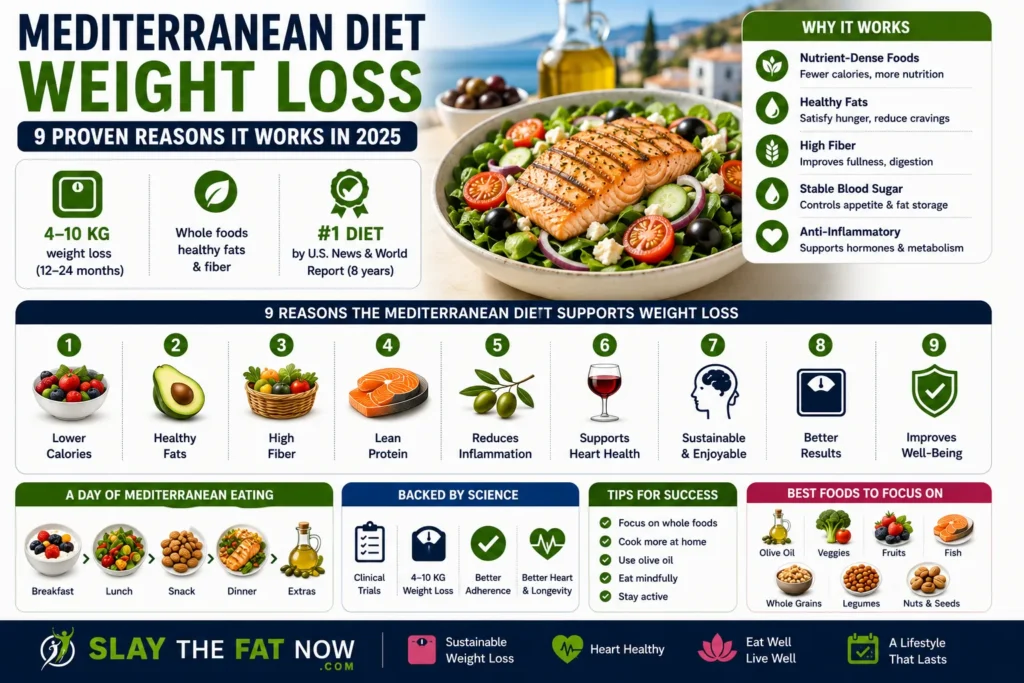
Mediterranean diet weight loss works because it creates a moderate, sustainable calorie deficit through whole foods, healthy fats, and fiber without strict restriction. Clinical trials show 4 to 10 kg of weight loss over 12 to 24 months, plus better long-term adherence than low-fat diets. It’s also rated the #1 overall diet by U.S. News & World Report for 8 straight years.
The Mistake That Sends Most Diets Straight to the Trash
Here’s a scene I’ve watched play out more times than I can count: someone starts a strict, low-fat or ultra-low-carb plan on a Monday, white-knuckles through two weeks of bland chicken breast and rice cakes, and quits by week three because it feels like punishment. They lose 5 pounds, regain 8, and conclude that they just “can’t stick to anything.”
The problem usually isn’t willpower. It’s that most popular diets are built around restriction, and restriction has an expiration date. The body and the brain eventually rebels against deprivation.
This is exactly where Mediterranean diet weight loss approaches the problem differently. It isn’t a deprivation plan. It’s an eating pattern people in Mediterranean countries have followed for generations, built around olive oil, vegetables, fish, and whole grains foods you actually want to eat. And the research backing it for weight loss is some of the strongest in all of nutrition science.
What Is Mediterranean Diet Weight Loss, Really?
Mediterranean diet weight loss refers to losing fat by following the traditional eating pattern of countries like Greece, Italy, and Spain high in vegetables, fruits, legumes, whole grains, fish, and extra-virgin olive oil, moderate in poultry and dairy, and low in red meat, refined sugar, and ultra-processed food. Unlike crash diets, it isn’t built around a strict calorie target or a banned-foods list; it works by naturally improving the quality and satiety of what you eat, which tends to bring calorie intake down without forcing it.
In this guide, you’ll learn the real data behind Mediterranean diet weight loss, how it compares to other major diets, what makes it especially effective for women, and a practical week-one plan to get started without falling for the marketing fluff that surrounds most “best diet” claims.
Key Benefits of the Mediterranean Diet for Weight Loss
- Sustainable results, not just fast ones. Because nothing is fully off-limits, adherence rates stay far higher long-term than restrictive diets and adherence is the single biggest predictor of weight loss success.
- Built-in appetite control. Healthy fats, fiber, and protein from fish, legumes, and vegetables keep you fuller longer, which naturally lowers calorie intake without conscious restriction.
- Heart and metabolic health alongside the scale. Beyond weight, it improves cholesterol, blood pressure, and insulin sensitivity outcomes that matter as much as the number on the scale.
- Less mental burden. No macro spreadsheets or forbidden-food anxiety. Most people find it easier to eat out, travel, and socialize while following this pattern.
- Strong evidence specifically for women. Research on the Mediterranean diet for women, particularly postmenopausal women with metabolic syndrome, links it to both weight loss and better preservation of bone density a combination most weight loss diets don’t address.
Mediterranean Diet Weight Loss: The Data and Research
This isn’t a wellness trend it’s one of the most studied dietary patterns in modern nutrition science. Here’s what the evidence actually shows:
- In a landmark 2-year trial published in the New England Journal of Medicine, participants following a calorie-restricted Mediterranean diet lost an average of 4.4 kg, compared to 2.9 kg on a low-fat diet with adherence rates above 84% at two years.
- A systematic review in The American Journal of Medicine of five randomized controlled trials found the Mediterranean diet produced 4.1 to 10.1 kg of weight loss at 12+ months, significantly outperforming low-fat diets (2.9 to 5.0 kg).
- The Mediterranean diet has been ranked the #1 overall diet by U.S. News & World Report for 8 consecutive years, scoring 4.8 out of 5 for nutritional completeness, long-term sustainability, and evidence-based effectiveness.
- A 2025 study covered by Medical News Today found a low-calorie Mediterranean diet combined with physical activity supported both weight loss and bone density preservation in older women with metabolic syndrome addressing a common concern about dieting and bone health.
- The large-scale PREDIMED-Plus trial, following nearly 5,000 participants, found that combining the Mediterranean diet with calorie control and exercise reduced type 2 diabetes risk by 31% while also producing greater weight and waistline reduction than the Mediterranean diet alone.
One honest caveat worth noting: in U.S. News’ 2025 category-specific rankings, Weight Watchers edged out the Mediterranean diet specifically in the “best for weight loss” category (4.3 vs. its overall 4.8 score), largely because WW offers more structure for rapid early results. The Mediterranean diet still topped categories like easiest-to-follow, gut health, and mental health which matters because the easiest diet to follow is usually the one you’ll still be on a year later.
A Real-World Example: Mediterranean Diet Weight Loss in Practice
Consider “Janet,” a composite of clients I’ve worked with a 52-year-old who’d tried keto, intermittent fasting, and two separate meal-delivery programs, losing weight each time only to regain it within months. She came in skeptical, certain that “eating normal food” couldn’t possibly produce real results.
We didn’t start with rules. We started with swaps: olive oil instead of butter, salmon or beans instead of red meat three nights a week, fruit instead of packaged desserts, and a daily vegetable-forward lunch instead of a sandwich on white bread. No calorie counting in week one just better building blocks.
By week four, she’d lost 6 pounds without feeling like she was dieting. By month four, she was down 18 pounds, her energy was noticeably more stable through the afternoon, and the part that mattered most to her she wasn’t white-knuckling restaurant menus anymore. That’s the practical promise of Mediterranean diet weight loss: results that come from addition and substitution, not constant subtraction.
Expert Insight: What Actually Makes This Diet Work Long-Term
After years of watching clients try and abandon diet after diet, a few patterns stand out specifically with the Mediterranean approach:
- People who succeed treat olive oil as the primary fat, not an addition. Swapping butter and processed oils for extra-virgin olive oil is one of the highest-leverage changes in the entire pattern.
- People who succeed eat fish at least twice a week, not “when they remember.” Omega-3-rich fish is one of the most consistently cited components in trials showing cardiometabolic benefit.
- People who fail try to follow it as a strict checklist instead of a flexible pattern. The Mediterranean diet was never meant to be measured to the gram it’s meant to shift the ratio of whole foods to processed foods over time.
- The biggest long-term predictor isn’t perfection in week one it’s whether someone is still mostly following the pattern a year later. This diet wins on adherence, and adherence is what actually moves the scale over time.
If there’s one thing I wish more people understood before starting: Mediterranean diet weight loss is slower than a crash diet by design and that’s exactly why it tends to stay lost.
| Want a Mediterranean-style meal plan built for your calorie target? Skip the guesswork. Our free Mediterranean diet starter plan gives you a week of meals, swaps, and a shopping list tailored to your weight loss goal. |
Reality Check: Where the Mediterranean Diet Falls Short
No diet is perfect, and the Mediterranean diet deserves an honest look at its limits too.
- It’s not the fastest option. If your goal is rapid short-term weight loss for an event, more aggressive plans like a structured calorie deficit or a commercial point-based system may move the scale faster just with less staying power.
- “Mediterranean-style” restaurant and packaged foods are often not Mediterranean at all. Olive-oil branding doesn’t mean a product fits the pattern many are still calorie-dense and processed.
- Portion size still matters. Olive oil, nuts, and cheese are healthy, but they’re calorie-dense. Without any portion awareness, it’s possible to eat a “clean” Mediterranean diet and still gain weight.
- It requires some cooking. This pattern leans on fresh vegetables, legumes, and fish rather than pre-packaged convenience foods, which means more kitchen time than some other approaches.
The honest takeaway: Mediterranean diet weight loss is one of the best-supported, most sustainable approaches in nutrition science but it still requires a sensible calorie deficit and a degree of consistency. It isn’t a loophole; it’s a better-designed framework.
Practical Advice: How to Start Mediterranean Diet Weight Loss This Week
What to Do
- Swap your primary cooking fat to extra-virgin olive oil for everything except high-heat searing.
- Build half your plate with vegetables at lunch and dinner this is the single highest-impact habit in the entire pattern.
- Eat fish (salmon, sardines, mackerel) at least twice a week; lean on legumes and poultry the rest of the week.
- Replace refined grains (white bread, white pasta) with whole grains like farro, brown rice, or whole-wheat pasta.
- Keep a rough calorie awareness even on a Mediterranean pattern healthy fats are still calorie-dense, so portion them, don’t eliminate them.
What to Avoid
- Don’t assume “Mediterranean-inspired” packaged products at the grocery store are automatically diet-friendly check the label.
- Don’t treat nuts, cheese, and olive oil as unlimited just because they’re “healthy fats” a tablespoon of olive oil is roughly 120 calories.
- Don’t expect keto-speed results in week one. Judge this diet on its 3-month and 12-month numbers, not its first 7 days.
Mediterranean Diet vs. Other Popular Weight Loss Diets
This is the question most people actually want answered: is the Mediterranean diet really the best diet for 2025 weight loss, or do other approaches work better? The honest answer depends on your priorities.
| Factor | Mediterranean Diet | Weight Watchers | Keto / Low-Carb |
| U.S. News overall score | 4.8 / 5 (#1, 8 years running) | 4.6 / 5 | Not top-ranked overall |
| Best for | Sustainable, long-term fat loss + heart health | Fast, structured early weight loss | Rapid initial water-weight loss |
| 12-24 month weight loss | 4.1 – 10.1 kg in trials | Comparable with consistent use | Similar to Mediterranean long-term |
| Adherence at 2 years | 84.6% in NEJM trial | Moderate, app-dependent | Often lower past 6 months |
| Food restriction level | Low nothing fully banned | Low point-based flexibility | High carbs largely eliminated |
| Extra health benefits | Heart, brain, diabetes, gut health | Weight-focused, less disease-specific data | Mixed cardiovascular evidence |
If your top priority is the fastest possible weight loss with built-in structure and accountability, a points-based plan like Weight Watchers narrowly edged out the Mediterranean diet in 2025’s weight-loss-specific category. If your priority is the best overall combination of weight loss, heart health, mental health, and long-term sustainability, the Mediterranean diet remains the strongest all-around choice which is exactly why it has topped the overall rankings for 8 years running.
For most women specifically, especially those managing metabolic syndrome, perimenopause, or bone health concerns alongside weight goals, the research edge tilts further toward the Mediterranean pattern, since few other diets are studied as thoroughly for those combined outcomes.
FAQs: Mediterranean Diet Weight Loss
Does the Mediterranean diet actually work for weight loss?
Yes. Multiple randomized controlled trials, including a 2-year NEJM study, show consistent weight loss of 4 to 10 kg over 12 to 24 months, with notably higher adherence than low-fat diets.
How much weight can I lose on the Mediterranean diet in a month?
Most people following a calorie-aware version of the Mediterranean diet lose roughly 4 to 8 pounds in the first month, primarily from reduced processed food and refined carbohydrate intake.
Is the Mediterranean diet good for women specifically?
Yes, research shows particular benefits for women, including support for bone density alongside weight loss in postmenopausal women with metabolic syndrome a combination not well addressed by many other diets.
What is the best diet for 2025 weight loss?
The Mediterranean diet was ranked the #1 overall diet by U.S. News & World Report for the 8th consecutive year in 2025, though Weight Watchers ranked slightly higher specifically in the weight-loss category.
Do I need to count calories on the Mediterranean diet?
Not strictly, but some portion awareness helps, since olive oil, nuts, and cheese are calorie-dense. Many people lose weight on the pattern naturally, while others benefit from light calorie tracking in the first few weeks.
What foods should I avoid on the Mediterranean diet?
Limit red and processed meat, refined sugar, white bread and pasta, and heavily processed snack foods. Nothing is fully banned, but these should be occasional rather than daily.
Can I drink alcohol on the Mediterranean diet?
Moderate red wine (about one glass a day for women) is traditionally part of the pattern, but it’s optional and not necessary for weight loss results.
Is the Mediterranean diet better than keto for weight loss?
Research shows similar weight loss outcomes between the two in head-to-head trials, but the Mediterranean diet generally shows better long-term adherence and additional heart-health benefits.
How long does it take to see results on the Mediterranean diet?
Most people notice initial changes in energy and digestion within 1 to 2 weeks, with measurable weight loss typically visible by week 3 to 4.
Is olive oil really necessary for the Mediterranean diet to work?
It’s a core component. Studies, including the original PREDIMED trial, found extra-virgin olive oil specifically tied to the diet’s cardiovascular and metabolic benefits not just “healthy fat” in general.
Can the Mediterranean diet help with belly fat?
Yes, several trials show reductions in waist circumference alongside overall weight loss, particularly when combined with regular physical activity.
Is the Mediterranean diet hard to follow long-term?
It’s considered one of the easiest diets to sustain long-term, ranked #1 for “easiest to follow” by U.S. News, largely because no major food groups are eliminated.
What’s a simple way to start the Mediterranean diet this week?
Start with three swaps: olive oil instead of butter, fish twice a week instead of red meat, and whole grains instead of refined ones. Build from there.
Does the Mediterranean diet work without exercise?
It produces weight loss on its own, but research like the PREDIMED-Plus trial shows combining it with regular physical activity significantly improves both weight loss and metabolic outcomes.
Is the Mediterranean diet safe for people with diabetes?
Yes, it’s rated the #1 diet for diabetes management by U.S. News & World Report, and the PREDIMED-Plus trial specifically found it reduced type 2 diabetes risk by 31% when combined with calorie control.
Your Next Step
So does Mediterranean diet weight loss actually deliver? The research says yes not as a quick fix, but as one of the most consistently sustainable, well-studied paths to losing weight and keeping it off.
You don’t need a complicated overhaul this week. You need three smart swaps and a plan you can actually follow past January.
Related reading on Slay The Fat Now:
• How to Calculate Your TDEE Accurately
• Best Healthy Fats for Weight Loss
• High-Protein Meal Plans for Weight Loss
