 Skip to content
Intermittent Fasting for Women Weight Loss: 7 Proven Strategies That Actually Work in 2026
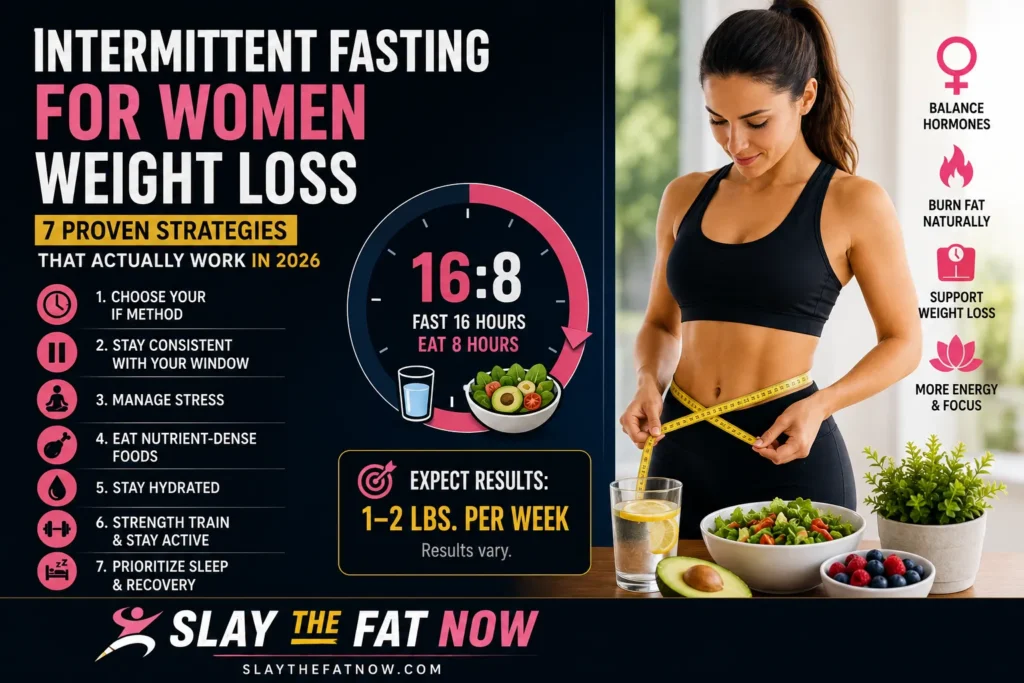
Intermittent fasting for women weight loss works by restricting the eating window typically 16 hours fasted, 8 hours eating to lower insulin, burn stored fat, and reduce overall calorie intake. Most women lose 1–2 lbs. per week on a properly structured IF plan. However, results vary based on hormones, stress levels, and the specific protocol used.
The Mistake Most Women Make (And Why It Stalls Their Results)
You’ve probably tried cutting calories, skipping dinner, or following some 30-day detox plan only to lose 5 pounds and gain 8 back. Sound familiar?
Here’s what nobody tells you: most mainstream diet advice was designed around male biology. Intermittent fasting for women weight loss is a completely different game and if you follow the standard “skip breakfast and eat between noon and 8 PM” advice blindly, you could be sabotaging your hormones without even knowing it.
The good news? Once you understand how intermittent fasting for women weight loss actually works with your body not against it the results can be genuinely life changing.
What Is Intermittent Fasting for Women? A Plain-English Overview
Intermittent fasting (IF) is not a diet in the traditional sense. It’s a pattern of eating specifically, cycling between periods of eating and fasting. It doesn’t tell you what to eat, only when to eat.
For women specifically, the most popular and well-researched protocol is the 16:8 method, where you fast for 16 hours and eat within an 8-hour window. Other common approaches include:
- 5:2 Method: Eat normally 5 days a week; restrict to 500 calories on 2 non-consecutive days
- 14:10 Method: 14 hours fasting, 10-hour eating window (gentler often better for women)
- OMAD (One Meal a Day): 23:1 ratio aggressive and generally not recommended for women
- Alternate Day Fasting (ADF): Full fast every other day
In this guide, you’ll learn which protocols deliver the best 16:8 fasting women results, how IF interacts with female hormones, what the real science says, and how to implement it practically starting tomorrow.
Key Benefits of Intermittent Fasting for Women Weight Loss
Why is IF worth your time over the dozens of other weight loss approaches? Here’s what makes it different:
1. It Addresses the Root Cause: Insulin
High insulin levels are the #1 reason most women can’t burn stubborn fat especially around the belly and thighs. When you eat constantly (including “healthy snacks”), insulin stays elevated and your body never shifts into fat-burning mode. Fasting brings insulin down, unlocking your fat stores for energy.
2. It Simplifies Your Life
No calorie counting. No meal prepping six times a day. No complicated macros. You simply eat within your window and stop. Women who’ve struggled with food obsession often find IF liberating rather than restrictive.
3. Preserves Muscle While Burning Fat
Unlike extreme calorie cutting, IF triggers growth hormone release during the fasted state which helps protect lean muscle mass while your body burns fat for fuel. This means you’ll look toned, not just “skinny fat.”
4. Anti-Inflammatory and Metabolic Improvements
Research shows IF reduces markers of chronic inflammation, improves insulin sensitivity, lowers triglycerides, and can improve blood pressure all critical for women approaching perimenopause and menopause.
5. Mental Clarity and Energy
Many women report a notable increase in morning focus and mental sharpness during the fasted state partly due to ketone production, which the brain uses as a premium fuel source.
What the Science Actually Says: Data & Facts
4–8%Average body weight loss in studies on IF over 8–24 weeks
3–7%Reduction in waist circumference reported in trials
~500Calories fewer per day women naturally consume on 16:8 without tracking
20–30%Increase in metabolic rate during short-term fasting (up to 48 hrs)
A 2020 review published in the New England Journal of Medicine confirmed that intermittent fasting produces meaningful improvements in metabolic health, body composition, and reduced inflammation markers with evidence growing particularly for the 16:8 protocol.
A 2022 study published in PubMed/NIH found that women following 16:8 intermittent fasting for 12 weeks lost significantly more body fat than control groups without intentional calorie restriction.
The CDC reports that over 41% of American women are currently classified as obese, making evidence-backed, sustainable strategies like IF more important than ever.
Importantly, a 2023 study specifically on premenopausal women found that the 14:10 protocol (gentler than 16:8) produced similar fat loss results with fewer hormonal side effects suggesting the “optimal” window may differ by hormonal status.
Real Example: What 90 Days of 16:8 Fasting Actually Looks Like
Let’s follow Sarah a 38-year-old mom of two in Dallas, Texas. She’s 167 lbs, works a desk job, exercises twice a week, and has struggled to lose the same 20 lbs for four years.
Week 1–2: Sarah shifts her eating window to 11 AM–7 PM. She skips her usual 7 AM bowl of cereal and has black coffee instead. She feels hungry until about Day 5, then the hunger normalizes as her ghrelin (hunger hormone) adjusts. She loses 3 lbs mostly water and glycogen.
Week 3–6: Real fat loss begins. Sarah is eating the same types of foods but slightly less overall without counting anything. She notices her energy is more stable throughout the day. She drops another 5 lbs.
Week 7–12: Sarah has lost 12 lbs. total. Her jeans fit again. She’s not perfect she breaks her fast occasionally on weekends but she’s consistent enough that the results keep building. She also notices her skin is clearer and her afternoon energy crashes are gone.
This scenario is realistic and representative of what 16:8 fasting women results look like in practice not dramatic overnight transformation, but steady, manageable, sustainable fat loss.
Ready to Start Your Intermittent Fasting Journey?
Get our free beginner’s IF meal plan + schedule designed specifically for women. No calorie counting required.Get My Free Plan →
Expert Insight: What Actually Separates Women Who Get Results from Those Who Don’t
After years of studying fat loss patterns, a few things consistently separate the women who get lasting results from those who quit by Week 3:
They Start with 14:10, Not 16:8
Jumping straight to 16 hours of fasting is like running a marathon without training. A 14-hour fast (e.g., 8 PM to 10 AM) is still deeply effective and far easier to sustain. Once that becomes your normal, extending to 16 hours is effortless.
They Protect Their Sleep Window
The easiest way to “fast” is to include 7–8 hours of sleep in your fasting window. If you stop eating at 8 PM and sleep by 10 PM, you’ve already fasted for 10 hours before you even wake up. The last 4–6 hours are the only real “challenge.”
They Eat Protein First
Women who prioritize protein 30–40g per meal during their eating window preserve muscle, stay fuller longer, and see far better body composition results than those who break their fast with carb-heavy meals.
They Don’t Compensate
The biggest mistake: breaking a 16-hour fast with a 1,500-calorie meal “because you earned it.” The calories you eat in your window still matter. IF is a tool for naturally reducing intake not a license to overeat.
Reality Check: Myths, Risks & Things You Need to Hear
✖ Myth: “IF works the same for women as for men”
Women are more sensitive to caloric restriction and fasting due to kisspeptin neurons which regulate reproductive hormones. Aggressive fasting (20+ hours) can disrupt luteinizing hormone (LH) and follicle-stimulating hormone (FSH), disrupting menstrual cycles in some women.
✔ Fact
Women generally do best with modified IF shorter fasting windows, cycle-synced fasting, and strategic break days around their menstrual cycle.
✖ Myth: “Skipping breakfast will wreck your metabolism”
This is food industry mythology. There is no evidence that skipping breakfast slows metabolism in healthy adults. Short-term fasting (up to 24–48 hours) actually increases metabolic rate due to norepinephrine release.
✔ Fact
What matters is total daily caloric balance and food quality not when the first meal of the day is eaten.
✖ Myth: “IF and hormones don’t mix it’s dangerous for women”
This concern is valid but often exaggerated. The research showing hormonal disruption is primarily from aggressive calorie restriction (below 1,000 kcal) combined with very long fasts not moderate 14:10 or 16:8 windows with adequate nutrition.
✔ Fact
Women with PCOS, thyroid issues, or irregular cycles should consult their doctor before starting IF. For most healthy women, a moderate protocol is safe and beneficial.
Who Should NOT Do Intermittent Fasting:
- Pregnant or breastfeeding women
- Women with a history of eating disorders
- Those with Type 1 diabetes or on insulin medication
- Women who are severely underweight
- Anyone with adrenal fatigue or chronic stress (cortisol is already elevated fasting adds more)
Practical Intermittent Fasting for Women: Step-by-Step Guide
Step 1: Choose Your Protocol
Start with 14:10 if you’re new to fasting. Move to 16:8 after 2–3 weeks once you’re comfortable. Don’t start with OMAD or extended fasts they offer diminishing returns and more hormonal risk.
Step 2: Set Your Eating Window
Choose a window that fits your lifestyle. Common choices for women:
- 10 AM – 6 PM (works well for early risers and those with evening family commitments)
- 11 AM – 7 PM (the most popular; suits 9-to-5 schedules)
- 12 PM – 8 PM (good for social dinners but harder if you exercise in the morning)
Step 3: Break Your Fast Strategically
Your first meal sets the tone. Aim for:
- 30–40g of protein (eggs, Greek yogurt, chicken, cottage cheese)
- Healthy fats (avocado, olive oil, nuts)
- Fiber-rich vegetables
- Minimal refined carbs in your first meal
Step 4: What’s Allowed During the Fast?
Fasting-Safe Drinks: Water, sparkling water, black coffee, plain green or herbal tea. These do NOT break your fast.
Breaks the Fast: Bulletproof coffee (with butter/MCT), bone broth (small amounts debated), any food with calories, milk or cream in coffee, BCAAs.
Step 5: Sync With Your Cycle (Gamechanger)
Your body’s insulin sensitivity, energy, and hunger levels shift dramatically across your monthly cycle:
- Days 1–14 (Follicular Phase): Higher estrogen, better insulin sensitivity, ideal for strict fasting + exercise
- Days 15–28 (Luteal Phase): Progesterone rises, hunger increases, cortisol more reactive consider 12:12 or 14:10 instead of strict 16:8
This cycle-synced approach to IF and hormones is one of the most powerful and underused tools in women’s fat loss.
Intermittent Fasting vs. Other Popular Women’s Diets: Side-by-Side Comparison
| Approach | Avg. Weight Loss (12 Weeks) | Hormonal Safety | Ease / Sustainability | Best For |
|---|---|---|---|---|
| 16:8 IF | 8–12 lbs | Good (monitor cycle) | ⭐⭐⭐⭐ | Most women; busy schedules |
| 14:10 IF | 6–10 lbs | Excellent | ⭐⭐⭐⭐⭐ | Beginners; hormonal sensitivity |
| Keto Diet | 10–15 lbs (incl. water) | Moderate (thyroid risk) | ⭐⭐⭐ | Insulin resistance; quick start |
| Calorie Counting | 6–10 lbs | Excellent | ⭐⭐ | Data-driven types |
| 5:2 Method | 6–8 lbs | Moderate | ⭐⭐⭐ | Women who prefer flexibility |
| OMAD | 10–18 lbs | Poor (not recommended) | ⭐ | Not recommended for women |
Note: Weight loss figures are estimates based on published research averages and assume no extreme calorie compensation. Individual results vary based on starting weight, activity level, and dietary quality.
Frequently Asked Questions: Intermittent Fasting for Women Weight Loss
1. Does intermittent fasting for women weight loss actually work?
Yes the research is solid. Multiple controlled trials show women lose 4–8% of body weight over 8–24 weeks on IF protocols, with improvements in waist circumference, insulin sensitivity, and blood lipids. It works best when you choose the right protocol for your hormonal profile.
2. What are typical 16:8 fasting women results after 30 days?
Most women report losing 3–7 lbs in the first month on 16:8 some of which is water and glycogen. Real fat loss accelerates in weeks 3–6. By day 30, improved energy, reduced bloating, and better mental clarity are commonly reported alongside physical changes.
3. Can intermittent fasting affect my menstrual cycle?
It can especially if you fast aggressively (20+ hours) or severely restrict calories. Mild protocols like 14:10 or 16:8 rarely disrupt cycles in healthy women. If you notice irregular periods after starting IF, shorten your fasting window or add a break day mid-cycle.
4. How does IF and hormones interact in women?
Intermittent fasting lowers insulin and increases human growth hormone (HGH), both of which support fat burning. However, it also raises cortisol slightly during the fasted state. For women under high stress, this cortisol bump can worsen hormonal imbalances making stress management a critical companion to IF.
5. What’s the best intermittent fasting schedule for women?
For most women, 16:8 (eating between 11 AM–7 PM or 12 PM–8 PM) is optimal. Beginners should start with 14:10. Women who are highly active, perimenopausal, or have hormonal sensitivities often do better with 12:12 or 14:10 and shouldn’t push to 20+ hours.
6. Can I exercise while intermittent fasting?
Yes and many women find fasted morning workouts incredibly effective for fat burning. However, if you’re lifting weights for muscle retention, consider having your workout close to your eating window so you can consume protein shortly after. Intense exercise (HIIT, heavy lifting) during extended fasts can be harder to recover from.
7. Does black coffee break intermittent fasting?
No. Plain black coffee no sugar, no milk, no cream does not break a fast. It actually enhances fat burning by increasing norepinephrine and may suppress hunger. Just don’t add anything caloric to it during your fasting window.
8. How do I deal with hunger during fasting?
Hunger during fasting is largely driven by the hormone ghrelin, which peaks at your habitual meal times and then drops after 20–30 minutes if you don’t eat. After 5–10 days, your body adjusts and hunger becomes much more manageable. Drinking water, black coffee, or herbal tea helps bridge the gap.
9. Is intermittent fasting safe for women over 40?
Yes, in fact, many women over 40 find IF particularly effective because declining estrogen increases insulin resistance and belly fat accumulation. The key is using a gentler protocol (14:10) and ensuring adequate protein and resistance training to preserve muscle mass.
10. What should I eat to break my fast for weight loss?
Break your fast with protein first eggs, Greek yogurt, a protein shake, or cottage cheese. This stabilizes blood sugar, reduces hunger signals, and protects muscle. Avoid starting with refined carbs or sugary foods, which spike insulin immediately after a fasted state.
11. Can intermittent fasting help with PCOS-related weight gain?
Yes, PCOS is largely driven by insulin resistance, and IF is one of the most effective dietary tools for improving insulin sensitivity. Multiple small studies have shown that women with PCOS experience improvements in insulin levels, testosterone, and weight with IF protocols. Always consult your doctor first.
12. Will intermittent fasting slow my metabolism?
Not in the short or medium term. Studies show metabolic rate actually increases slightly during the first 48 hours of fasting. Metabolic adaptation (the “starvation mode” myth) requires sustained, severe calorie restriction over many weeks not a daily 14–16 hour eating pause.
13. Can I do intermittent fasting while breastfeeding?
No this is not recommended. Breastfeeding requires significantly higher caloric intake to support milk production and infant development. Any form of calorie restriction or extended fasting is not appropriate during this period. Wait until after weaning before starting IF.
14. How long does it take to see results with intermittent fasting for women?
Most women notice reduced bloating and water retention within the first 1–2 weeks. Meaningful fat loss (1–2 lbs of actual fat per week) typically shows up by Week 3–4. Body composition changes (tone, waist reduction) become visible around Week 6–8 for most women who remain consistent.
15. Can I do intermittent fasting on weekends?
You don’t have to, but consistency helps. Many women follow IF strictly Monday through Friday and eat more flexibly on weekends. This “5-day IF” approach still delivers solid results. The key is not using weekends as a full compensation cycle for the week’s deficit.
Stop Guessing. Start Losing.
Join thousands of women who’ve used our proven IF + nutrition framework to finally shed the weight without starving, counting calories, or giving up the foods they love. Start My Transformation →
