 Skip to content
How to Stop Emotional Eating: 7 Proven Strategies That Actually Work
By SlayTheFatNow Team
To stop emotional eating, you need to identify your personal binge eating triggers, create a pause between the urge and the action, and replace food with healthier coping habits. The most effective emotional eating solutions combine self-awareness, stress management, and structured eating not just willpower.
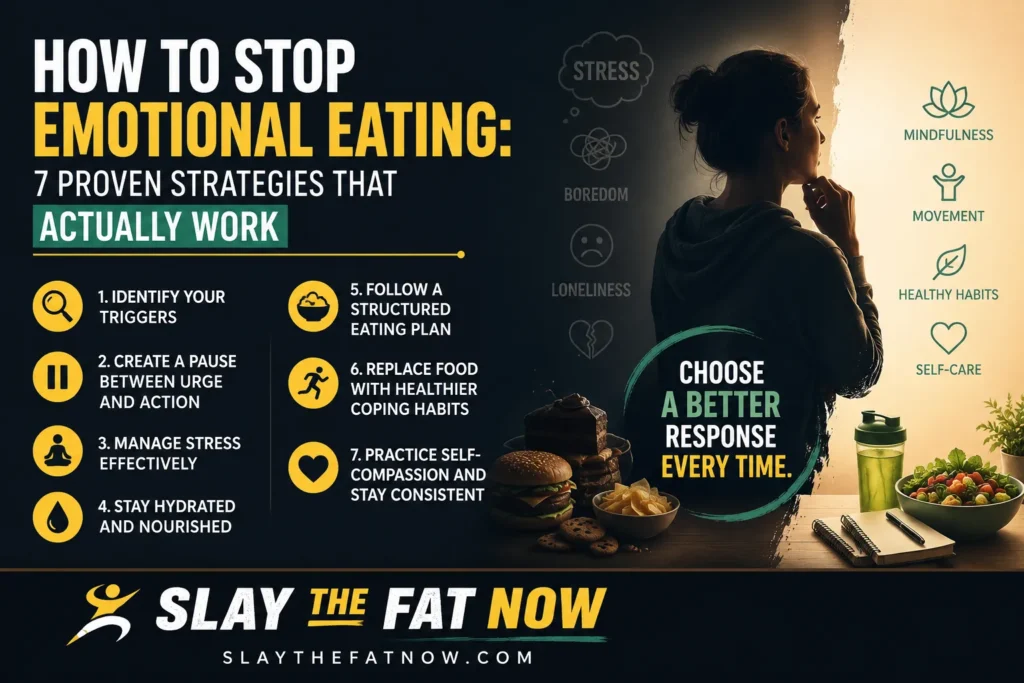
You’re Not Weak You’re Wired This Way
You’ve had a stressful day. You’re not even hungry. But fifteen minutes later you’re standing in front of the fridge, halfway through a bag of chips or a pint of ice cream, wondering how you got there.
Sound familiar? You’re not broken, and you definitely don’t lack discipline. Emotional eating is one of the most misunderstood patterns in weight loss and it’s the #1 hidden reason most diets fail in America.
Here’s the uncomfortable truth nobody tells you: most “diet problems” aren’t about the food at all. They’re about what happens in your brain before the food ever reaches your mouth.
This article will show you exactly how to stop emotional eating for good with science-backed strategies that go beyond “just eat less and move more.”
What Is Emotional Eating (And Why It’s So Hard to Stop)?
Emotional eating is when you use food to manage feelings not hunger. Stress, boredom, loneliness, anxiety, and even happiness can all trigger the urge to eat. Unlike physical hunger, emotional hunger comes on fast, craves specific comfort foods, and often leads to guilt afterward.
Learning how to stop emotional eating isn’t just about putting down the fork. It requires rewiring the emotional patterns that drive the behavior in the first place. In this guide you’ll learn:
- The real binge eating triggers (most people never identify these)
- 7 proven emotional eating solutions that work long-term
- What to do in the moment when a craving hits
- How to build habits that make emotional eating less likely
- Common myths that keep people stuck in the cycle
Why Breaking the Emotional Eating Cycle Changes Everything
This isn’t just about losing a few pounds. Breaking free from emotional eating impacts your entire life:
⚖️ Sustainable Weight Loss
Stop yo-yo dieting and start making real, lasting progress by addressing the root cause.
🧠 Mental Clarity
Fewer food-related mood swings means more energy, focus, and emotional stability daily.
💰 Save Money
Stress eating especially on takeout and junk food can cost hundreds of dollars per month.
❤️ Better Relationships
Emotional regulation improves communication, patience, and connection with the people you love.
🎯 Confidence
Breaking a cycle you felt powerless over is one of the most empowering things you can do.
😴 Better Sleep
Late-night emotional eating disrupts sleep. Fix the trigger, and your rest improves too.
The Numbers Behind Emotional Eating in the USA
This is not a small or rare problem. Here’s how widespread emotional eating is and why understanding binge eating triggers matters more than ever:
38% of US adults report overeating due to stress regularly
27% eat to manage emotions, according to the APA Stress Survey
2.8M mericans affected by binge eating disorder (BED)
49% of dieters who fail cite emotional eating as the primary reason
According to the American Psychological Association’s Stress in America report, food is one of the top three coping mechanisms Americans turn to under stress ahead of alcohol and even social media. And the National Institute of Mental Health recognizes Binge Eating Disorder as the most common eating disorder in the United States.
The data tells a clear story: emotional eating isn’t a willpower problem. It’s a coping mechanism problem one that requires targeted emotional eating solutions, not stricter diets.
A Real-Life Scenario: How It Happens and How to Break It
📖 Case Study
Sarah’s Story: 40 lbs Lost After Identifying Her Triggers
Sarah, 34, from Nashville, had tried every diet keto, intermittent fasting, calorie counting. She’d lose 10 pounds, then regain 15. She’d never connected her weight gain to the 9 PM ritual she’d developed: come home from a demanding nursing job, pour a glass of wine, and finish off whatever snacks were in the pantry.
When Sarah started tracking her emotional eating triggers not calories, just feelings and circumstances before eating she noticed a pattern within one week. She was almost always tired, resentful, and overstimulated from patient care. Food wasn’t hunger; it was decompression.
Her solution wasn’t a new diet. She replaced the first 20 minutes after work with a 15-minute walk and a 5-minute journaling session. She kept herbal tea and cut fruit where the snacks used to be. Within six weeks, her evening bingeing dropped by 80%. In eight months, she lost 40 pounds without counting a single calorie.
The change wasn’t the food. It was the trigger management.
Ready to Finally Break the Cycle?
Get our free 7-Day Emotional Eating Reset Plan a step-by-step guide tailored for busy Americans who want real results without obsessing over food.🔥 Get My Free Reset Plan
What Actually Works: Expert Insight on How to Stop Emotional Eating
After years of working with people on weight loss and behavioral change, certain patterns emerge that no one talks about enough.
The biggest mistake people make is trying to stop eating emotionally by using more restriction. Restriction creates scarcity, scarcity creates obsession, and obsession creates binges. The path out is through awareness not control. Behavioral nutrition principle consistently supported in cognitive behavioral therapy (CBT) research
The 4 Patterns That Keep People Stuck in Emotional Eating
1. The Reward Mindset: Using food as the only reward after stress, hard work, or discomfort. The brain learns that food = relief, making it harder to choose anything else.
2. The Restriction Rebound: Eating too little during the day raises cortisol, drops blood sugar, and weakens decision-making making emotional eating almost inevitable by evening.
3. The “I’ll Start Monday” Loop: One emotional eating episode triggers shame, which triggers more eating. Breaking the guilt cycle is as important as breaking the eating pattern.
4. Environment Blindness: Most people never change their physical environment the snack drawer, the office vending machine, the late-night TV-and-snacks ritual. The environment drives behavior more than motivation does.
Reality Check: Myths About Emotional Eating That Keep You Stuck
❌ Myth: “I just need more willpower.”
Willpower is a limited resource that depletes throughout the day. Emotional eating is driven by the limbic brain the same area that controls fear and survival. You cannot “will” your way past it consistently. You need systems, not strength.
❌ Myth: “If I could just stop buying junk food, I’d be fine.”
If the underlying emotional need isn’t met, people find a way to satisfy it often driving to a store at 10 PM or eating “healthy” foods in unhealthy volumes. The food is never really the problem.
❌ Myth: “Emotional eating means I have an eating disorder.”
Occasional emotional eating is normal and universal. The problem arises when it becomes the primary coping mechanism, happens frequently, causes guilt, and interferes with your health or weight goals.
❌ Myth: “I eat emotionally because I’m weak or broken.”
Emotional eating is a learned behavior, often developed in childhood. It is 100% possible to unlearn it but self-blame makes it harder, not easier. Treat yourself with the same patience you’d give a friend.
7 Proven Strategies to Stop Emotional Eating for Good
These aren’t vague tips. These are the specific emotional eating solutions that make a measurable difference:
- Identify Your Binge Eating Triggers With a Food-Mood JournalFor 7 days, note what you ate, what time it was, your hunger level (1–10), and how you felt before eating. Most people identify 2–3 recurring binge eating triggers within the first week. Common ones: fatigue, loneliness, boredom after work, conflict, and social anxiety. You cannot change what you cannot see.
- Create a 10-Minute “Pause Protocol” Before Emotional Eating When a craving strike and you’re not physically hungry, set a 10-minute timer. Drink a glass of water, take a short walk, or do a few deep breaths. This disrupts the automatic reward loop and activates the prefrontal cortex the rational part of your brain. Many cravings pass entirely within 10 minutes.
- Build a “Comfort Menu” That Isn’t Food Write out 5–10 non-food activities that genuinely soothe you a walk, calling a friend, a hot shower, a short meditation, 10 minutes of music. Post this list where emotional eating usually happens (fridge, desk, nightstand). When the urge comes, you have a plan ready. Improvising in the moment almost never works.
- Eat Enough During the Day Especially Protein Skipping meals or under-eating is one of the top binge eating triggers. When blood sugar crashes and cortisol rises, willpower drops and cravings soar. Aim for 25–30g of protein at each meal. It reduces ghrelin (the hunger hormone) and stabilizes blood sugar more effectively than any other macronutrient. See our breakdown of high-protein meals for weight loss for practical ideas.
- Redesign Your Physical Environment Remove the most triggering foods from easy reach. Put fruit on the counter. Move snacks to opaque containers in hard-to-reach places. The Stanford Persuasion Lab calls this “environmental design” and studies consistently show it changes behavior more reliably than motivation. You don’t have to be perfect; you just have to make the better choice easier.
- Address Stress at the Source Not with Food Stress is the single biggest binge eating trigger in the USA. Regular exercise (even 20 minutes of walking) reduces cortisol more effectively than almost any other intervention. Sleep deprivation below 7 hours dramatically increases hunger hormones and emotional reactivity. Tackling sleep and movement isn’t optional for people who struggle with stress eating; it’s foundational.
- Practice Self-Compassion After a Slip Research from the University of Texas shows that self-compassion not self-criticism predicts faster recovery from dietary slips. When you eat emotionally, don’t spiral. Acknowledge it, ask “what triggered this?”, note it in your journal, and move on immediately. One emotional eating episode doesn’t undo your progress. The guilt-binge loop is optional you can exit it any time.
✅ DO These Things
- Keep a food-mood journal
- Eat adequate protein at every meal
- Build a non-food comfort menu
- Sleep 7–9 hours per night
- Exercise regularly, even lightly
- Practice the 10-minute pause
- Be kind to yourself after slips
❌ AVOID These Things
- Skipping meals or over-restricting
- Keeping trigger foods in sight
- Eating in front of screens habitually
- Using guilt as motivation
- Relying on willpower alone
- Rewarding yourself only with food
- Trying to “white-knuckle” cravings
Comparing Emotional Eating Solutions: Which Approach Is Right for You?
There’s no single path out of emotional eating. Here’s an honest comparison of the most popular strategies to help you decide where to start:
| Approach | Best For | Time to See Results | Effort Level | Effectiveness |
|---|---|---|---|---|
| Food-Mood Journal | Everyone start here | 1–2 weeks | Low | High |
| Cognitive Behavioral Therapy (CBT) | Severe or longstanding patterns | 6–12 weeks | High | Very High |
| Mindfulness & Meditation | Stress-driven eaters | 4–8 weeks | Medium | High |
| Strict Elimination Diet | Food addiction overlap | 2–4 weeks | Very High | Moderate |
| Willpower Only | Short-term, low-stress periods | 1 week | Very High | Low (unsustainable) |
| Environment Redesign | Home / pantry emotional eaters | Immediate | Low | High (passive) |
| Structured Eating Plan | Meal-skippers & restriction rebounders | 1–3 weeks | Medium | High |
The recommendation: Don’t pick just one. Start with the journal + environment redesign (low effort, high impact), then layer in structured eating and a non-food comfort menu. Add CBT or professional support if patterns persist after 6–8 weeks of self-directed work.
For a complete, structured approach to weight loss that integrates all of these principles, visit our complete weight loss guide for beginners.
Frequently Asked Questions About How to Stop Emotional Eating
1. What is the difference between emotional eating and physical hunger?
Physical hunger builds gradually, can be satisfied by almost any food, and stops when you’re full. Emotional hunger comes on suddenly, craves specific comfort foods (usually high-sugar or high-fat), often leads to mindless eating, and doesn’t go away with fullness it goes away when the emotion is addressed.
2. What are the most common binge eating triggers?
The most common binge eating triggers are stress, fatigue, loneliness, boredom, anxiety, and negative emotions like shame or frustration. Situational triggers such as watching TV, coming home from work, or being alone at night are also very common. Identifying yours through a food-mood journal is the essential first step.
3. Can emotional eating cause weight gain?
Yes. Emotional eating typically involves high-calorie, high-sugar, or high-fat foods consumed in excess of physical need. Over time, this creates a consistent caloric surplus that leads to weight gain. Beyond calories, the hormonal disruption from chronic stress eating (elevated cortisol, disrupted insulin) further promotes fat storage, especially around the belly.
4. How long does it take to stop emotional eating?
With consistent effort and the right strategies, most people notice meaningful improvement within 4–8 weeks. Complete elimination of the pattern can take several months, especially if it’s deeply ingrained. There is no overnight fix, but every week you practice new coping skills, the old pattern weakens.
5. Is emotional eating the same as binge eating disorder?
Not exactly. Emotional eating is a behavior pattern that many people engage in occasionally. Binge Eating Disorder (BED) is a clinical condition involving repeated episodes of eating large amounts in a short time, feeling out of control during the episode, and experiencing significant distress afterward. If you suspect BED, seeking professional support is strongly recommended.
6. What should I do in the moment when I feel like emotionally eating?
Use the 10-minute pause: drink water, move your body for a few minutes, and consult your non-food comfort menu. Ask yourself: “Am I physically hungry right now? What emotion am I actually feeling?” If the urge passes after 10 minutes, it was emotional. If it doesn’t, eat something nutritious and satisfying.
7. Can therapy help with emotional eating?
Absolutely and it’s often the most effective long-term solution for severe cases. Cognitive Behavioral Therapy (CBT), Dialectical Behavior Therapy (DBT), and Acceptance and Commitment Therapy (ACT) all have strong evidence for treating emotional eating. A licensed therapist or registered dietitian specializing in eating behavior can accelerate progress significantly.
8. Does stress cause emotional eating?
Yes. Chronic stress raises cortisol, which increases appetite and cravings for calorie-dense foods. The brain’s reward system is activated by sugary and fatty foods, creating a temporary reduction in stress hormones which reinforces the eating behavior. Managing the stress at its source (sleep, exercise, boundaries) is one of the most powerful emotional eating solutions.
9. Can poor sleep make emotional eating worse?
Yes dramatically. Sleep deprivation increases ghrelin (hunger hormone), decreases leptin (satiety hormone), and impairs the prefrontal cortex that governs decision-making. Studies show that just one night of poor sleep increases caloric intake by 300–500 calories the next day, predominantly from comfort foods. Protecting your sleep is genuinely non-negotiable.
10. What foods help reduce emotional eating urges?
Foods that stabilize blood sugar and support serotonin production can reduce the intensity of emotional eating urges. These include lean protein (chicken, eggs, Greek yogurt), complex carbohydrates (oats, sweet potatoes), magnesium-rich foods (leafy greens, dark chocolate), and omega-3 rich foods (salmon, flaxseed). Avoiding ultra-processed foods that spike and crash blood sugar is equally important.
11. How do I stop eating out of boredom?
Boredom eating is one of the most common binge eating triggers. The key is identifying when you eat out of boredom (often mid-afternoon or late evening) and scheduling a specific activity in that time slot. Physical movement works especially well even a 10-minute walk. Also, drink water first: dehydration is frequently mistaken for hunger.
12. Can mindful eating stop emotional eating?
Mindful eating paying full attention to the experience of eating without distraction is one of the most effective emotional eating solutions backed by research. It helps you distinguish physical from emotional hunger, slows eating, and reduces automatic or unconscious consumption. It takes practice, but even 5 minutes of mindful eating per meal creates measurable change.
13. Is it normal to eat when you’re happy or celebrating?
Yes, completely normal. Using food to celebrate or connect socially is a cultural universal. The issue arises when food becomes the only way you regulate any emotion positive or negative. Eating cake at a birthday party is not emotional eating. Eating cake alone at midnight to numb anxiety is. Context and frequency matter.
14. Does exercise help with emotional eating?
Yes and it’s one of the most underused emotional eating solutions. Exercise reduces cortisol, raises endorphins, improves mood, and provides an alternative outlet for stress and negative emotions. Even low-intensity movement like walking has meaningful effects. Many people find that establishing a consistent exercise habit gradually reduces the intensity of emotional eating cravings.
15. How do I stop feeling guilty after emotional eating?
Guilt is counterproductive it triggers more emotional eating, not less. After a slip, practice self-compassion: acknowledge what happened without judgment, identify the trigger, note it in your journal, and return to your plan immediately. Research consistently shows that self-compassion leads to better long-term outcomes than self-criticism. One episode is not a failure; only giving up is.
Take the First Step Today Your Future Self Will Thank You
You’ve just learned what most people spend years trying to figure out. Now it’s time to put it into practice. Explore our full library of weight loss tools, meal plans, and mindset guides designed specifically to help you break emotional eating for good.🚀 Start My Transformation at SlayTheFatNow.com
Sources & References
- American Psychological Association — Stress in America™ Survey. apa.org
- National Institute of Mental Health — Eating Disorders. nimh.nih.gov
