 Skip to content
7 Shocking Truths About Weight Loss vs Fat Loss That Will Transform Your Body
What is the difference between weight loss vs fat loss?
Weight loss means your total body weight goes down including water, muscle, and fat. Fat loss means you’re specifically losing stored body fat while preserving muscle. Fat loss is almost always the better goal. You can lose weight and still look “skinny fat,” but losing fat reshapes your body completely. Focus on fat loss, not fat loss not weight loss guessing games.
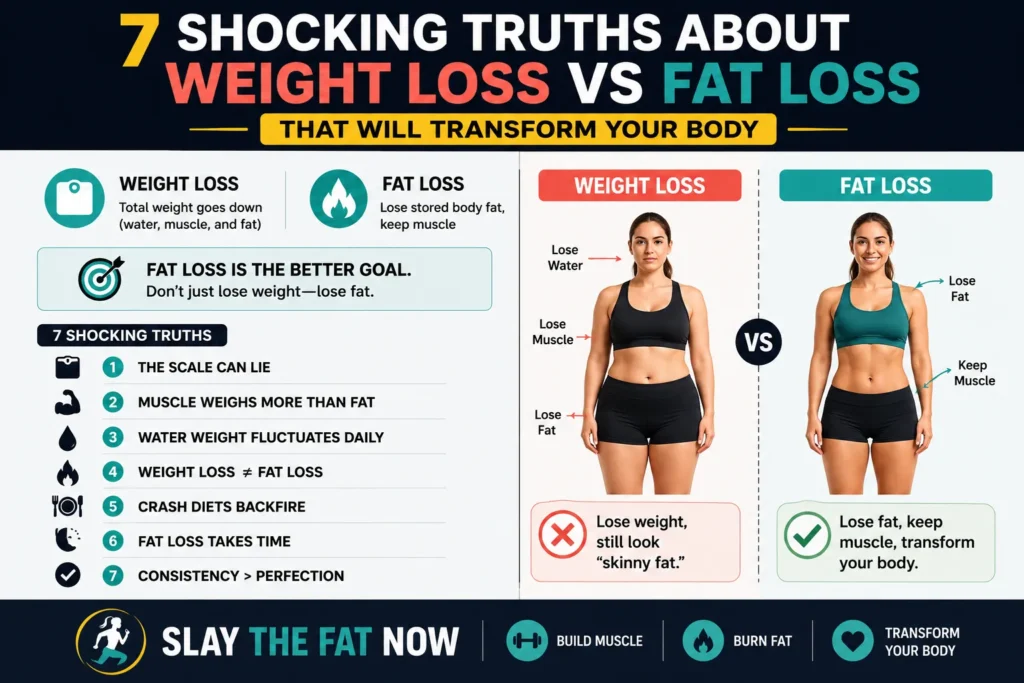
You’ve Been Chasing the Wrong Number Your Whole Life
You step on the scale. It reads 3 pounds less than last week. You feel incredible until you look in the mirror and nothing has changed.
Sound familiar?
Here’s what no one tells you: the scale doesn’t know the difference between fat, water, and muscle. It just adds them all up and spits out a number. And millions of Americans are obsessing over that number every single morning while unknowingly losing muscle and holding onto fat.
That’s not a weight loss win. That’s a body composition disaster hiding behind a smaller number.
The difference between weight loss vs fat loss isn’t just semantic. It’s the reason some people go from 180 to 160 pounds and still have a soft belly while others drop just 10 pounds and look completely transformed. If you’ve ever followed a diet, lost weight, and still felt disappointed in how you looked, this article is going to change how you think about your body forever.
What You’ll Learn in This Article
In this guide, you’ll understand:
- Why weight loss vs fat loss are completely different goals
- What fat loss not weight loss actually means for your results
- How to lose fat keep muscle at the same time
- The science behind body composition and why the scale lies
- A complete, actionable plan to target fat not just bodyweight
Why Weight Loss vs Fat Loss Actually Matters
The Scale Is Not Your Friend
Your body weight at any given moment is made up of:
- Body fat
- Muscle mass
- Bone density
- Water (which fluctuates 2–5 lbs daily)
- Organ tissue
- Food in your digestive system
When you “lose weight,” you’re losing some combination of all of these. Crash diets, extreme calorie restriction, and excessive cardio tend to strip away muscle and water first because fat is your body’s survival reserve. Your body holds onto fat when it feels threatened.
Fat loss, on the other hand, is a targeted process. It means creating the right hormonal environment, getting enough protein, training with resistance, and staying in a moderate calorie deficit so your body burns stored fat specifically.
The result? You can gain a pound of muscle and lose a pound of fat and weigh exactly the same but look dramatically leaner. That’s why so many people at SlayTheFatNow.com focus on body decomposition instead of just dieting.
Weight Loss vs Fat Loss: The Simple Breakdown
| Weight Loss | Fat Loss | |
|---|---|---|
| Goal | Lower the number on the scale | Reduce body fat percentage |
| Method | Any calorie deficit | Strategic deficit + protein + resistance training |
| Risk | Muscle loss, metabolic slowdown | Minimal when done correctly |
| Result | Smaller but same shape | Leaner, firmer, reshaped body |
| Long-term | Often regained (yo-yo) | Sustainable with maintained muscle |
Key Benefits of Targeting Fat Loss (Not Just Weight)
1. You Preserve Metabolic Rate
Muscle tissue burns calories even at rest. Lose muscle chasing weight loss and your metabolism tanks which is why most dieters regain weight within 12 months. Fat loss that preserves muscle keeps your metabolism high.
2. You Actually Look Different
Two people can weigh 160 pounds. One has 30% body fat. The other has 18%. They look like completely different people. Fat loss is what changes how you look, not just what the scale says.
3. You Improve Health Markers
Losing body fat especially visceral fat (the dangerous fat around your organs) dramatically improves insulin sensitivity, blood pressure, cholesterol, and inflammation markers. Weight loss alone doesn’t guarantee these benefits if you’re also losing muscle.
4. Long-Term Sustainability
Diets built around weight loss often led to restriction, bingeing, and yo-yo cycles. Fat loss built on proper nutrition and strength training creates a lifestyle you can maintain.
The Data and Research Don’t Lie
The research on weight loss vs fat loss is clear and consistent:
- According to the National Institutes of Health, approximately 80% of people who lose weight regain it within 5 years largely because they lost muscle mass and experienced metabolic adaptation.
- A landmark study published in the Journal of the American Medical Association found that calorie restriction without resistance training caused participants to lose significant lean mass, while those who combined dieting with strength training preserved muscle and lost more fat.
- The CDC reports that over 42% of American adults are obese, yet the U.S. diet industry generates over $70 billion per year suggesting that traditional “weight loss” approaches simply aren’t working at scale.
- Research from Harvard Medical School confirms that building muscle through resistance training is one of the most effective ways to improve long-term body composition and metabolic health.
- A 2020 study in Obesity Reviews found that high-protein diets (1.2–1.6g per kg of bodyweight) significantly improved fat loss while protecting lean muscle during calorie restriction.
The bottom line? The science supports fat loss not weight loss as the superior approach every single time.
Real-World Example: Meet Sarah
Sarah, a 38-year-old teacher from Ohio, came to the SlayTheFatNow program after losing 22 pounds on a popular low-calorie diet and still hating how she looked.
She was lighter but flabby. Her arms had no definition. Her belly looked softer than before. She was tired all the time.
When she shifted her focus from weight loss to fat loss, everything changed:
- She started eating 140g of protein per day
- She added 3 days of strength training per week
- She stopped doing 2-hour cardio sessions and switched to 30-minute targeted workouts
- Her calorie deficit went from 1,000 calories/day to a more sustainable 300–400 calories/day
Over 16 weeks, Sarah gained 4 pounds on the scale but lost 3 inches from her waist and dropped from 31% body fat to 24%. She looked better than she had in her 20s, wearing two sizes smaller while weighing more than she did at the end of her previous diet.
That’s the power of targeting fat loss, not weight loss.
Expert Insight: What Actually Works (And What Doesn’t)
After years of working with real people trying to transform their bodies, certain patterns emerge clearly.
What works:
- High protein intake. 0.7–1g of protein per pound of bodyweight is the single most powerful fat loss tool. Protein preserves muscle, increases satiety, and has the highest thermic effect of any macronutrient (you burn more calories just digesting it).
- Progressive resistance training. Three to four days per week of compound movements (squats, deadlifts, presses, rows) signals your body to keep muscle while releasing fat.
- Moderate, not extreme, calorie deficits. A 300–500 calorie daily deficit is sustainable. Anything beyond that increases cortisol, which accelerates muscle breakdown and fat storage.
- Sleep and stress management. Cortisol from chronic stress and sleep deprivation directly increases belly fat storage. No diet can fix a broken lifestyle.
- Consistency over perfection. The best fat loss plan is the one you actually follow for 6–12 months.
What doesn’t work:
- Extreme calorie restriction below 1,200 calories/day (for women) or 1,500 (for men) without medical supervision
- Doing only cardio with no resistance training
- Ignoring protein and eating mostly carbs and low-fat foods
- Weighing yourself daily and letting it dictate your mood
- Skipping meals to “save” calories
Reality Check: Myths That Are Keeping You Stuck
Myth 1: “Cardio is the best way to lose fat”
Cardio burns calories during the workout but it doesn’t rebuild your metabolism. Strength training builds muscle that burns calories around the clock. A combination is ideal, but resistance training comes first.
Myth 2: “The scale is the best way to track progress”
The scale measures total mass. It tells you nothing about body composition. Use body measurements, progress photos, how your clothes fit, and body fat percentage tests instead.
Myth 3: “Eating fat makes you fat”
Dietary fat is essential for hormone production including testosterone and estrogen, which regulate fat burning and muscle building. Eliminating fat from your diet can tank your hormones and stall fat loss entirely.
Myth 4: “You need to lose weight before you start lifting”
This is backward. Lifting weights accelerates fat loss, protects muscle, and reshapes your body faster than any diet alone. Start lifting now, regardless of your current weight. Here’s a beginner strength training guide on SlayTheFatNow to get you started.
Myth 5: “Eating less is always better”
Eating too little puts your body in a starvation response. It slows metabolism, increases muscle catabolism, and often leads to binging. More protein + moderate deficit beats extreme restriction every time.
Practical Steps to Lose Fat and Keep Muscle
Follow this evidence-based approach to shift your focus from weight loss to fat loss immediately:
Step 1: Calculate Your Maintenance Calories
Use a TDEE (Total Daily Energy Expenditure) calculator. Eat 300–500 calories below this number. Nothing more extreme.
Step 2: Set Your Protein Target
Aim for 0.7–1 gram of protein per pound of bodyweight daily. For a 160-pound person, that’s 112–160g of protein. Spread it across 3–4 meals.
Step 3: Start Lifting Weights (3–4x Per Week)
Focus on compound movements: squats, deadlifts, bench press, rows, overhead press. These recruit the most muscle fiber and produce the greatest metabolic response.
Step 4: Add Cardio Strategically
20–30 minutes of moderate-intensity cardio 2–3 times per week is plenty. Walking is underrated it burns fat without increasing cortisol like intense cardio can.
Step 5: Track Body Composition, Not Just Weight
Measure your waist, hips, arms, and chest every 2–4 weeks. Take monthly progress photos in the same lighting. Get a DEXA scan or use an InBody scale to measure body fat percentage every 6–8 weeks.
Step 6: Sleep 7–9 Hours Per Night
This isn’t optional. Growth hormone (which drives fat burning and muscle repair) is released primarily during deep sleep. Chronic sleep deprivation increases ghrelin (hunger hormone) and cortisol, making fat loss nearly impossible. Learn more about sleep and fat loss at SlayTheFatNow.
Step 7: Be Patient with the Process
Body recomposition losing fat while maintaining or gaining muscle is slower than crash dieting. But the results are permanent. Expect 0.5–1% body fat loss per month as a healthy, sustainable rate.
Comparing the Two Approaches Side by Side
Traditional Weight Loss Diet
- Extreme calorie restriction (800–1,200 cal/day)
- No specific protein targets
- Mostly cardio or no exercise
- Scale-focused
- Results: rapid initial loss, significant muscle loss, metabolic slowdown, rebound likely
Strategic Fat Loss Program
- Moderate deficit (300–500 cal/day below TDEE)
- High protein (0.7–1g per lb bodyweight)
- Resistance training 3–4x/week + moderate cardio
- Body composition-focused
- Results: slower but sustainable, preserves muscle, reshapes body, metabolism maintained
The verdict: If you’ve tried traditional dieting and ended up lighter but still unhappy with your body, it’s because you were targeting the wrong thing. Shift to fat loss not weight loss, and everything changes.
For a deeper look at the best fat loss approaches proven to work, the NIH’s research on body composition and the Mayo Clinic’s nutrition resources are excellent starting points.
Frequently Asked Questions
1. What is the main difference between weight loss vs fat loss?
Weight loss refers to a reduction in total body mass, including water, muscle, and fat. Fat loss specifically targets stored body fat while preserving lean muscle making it the superior and more meaningful goal for body transformation.
2. Can you lose fat without losing weight?
Yes. This is called body recomposition. You can simultaneously build muscle and lose fat, which means the scale stays the same or even goes up while your body becomes leaner and more defined.
3. Why is fat loss better than weight loss?
Fat loss preserves metabolic rate, reshapes the body, improves health markers, and produces lasting results. Weight loss without attention to fat loss often leads to muscle loss, metabolic slowdown, and weight regain.
4. How do I know if I’m losing fat or muscle?
Track your body fat percentage (via DEXA scan or InBody scale), body measurements, and strength levels in the gym. If you’re losing inches but strength is holding or increasing, you’re likely losing fat, not muscle.
5. What is fat loss not weight loss?
“Fat loss not weight loss” is a mindset shift prioritizing the reduction of body fat percentage over simply lowering the number on the scale. It focuses on body composition rather than total bodyweight.
6. How fast can I lose fat without losing muscle?
A safe and sustainable rate is 0.5–1% of body fat per month, or roughly 0.5–1 pound of fat per week. Faster rates almost always involve muscle loss.
7. Does cardio cause muscle loss?
Excessive cardio combined with low protein intake and insufficient calories can cause muscle loss. Moderate cardio (2–3x per week) combined with strength training and high protein does not.
8. How much protein do I need for fat loss?
Aim for 0.7–1 gram of protein per pound of bodyweight daily. This protects muscle mass during a calorie deficit and keeps you feeling full longer.
9. Can I lose fat and gain muscle at the same time?
Yes, especially if you are a beginner, have significant fat to lose, or are returning to training after a break. This is body recomposition. It requires adequate protein, resistance training, and a modest calorie deficit.
10. Why did I lose weight but still look fat?
If you lost weight through dieting alone without strength training, you likely lost muscle alongside fat. This leaves the body composition unchanged or even worse despite the lower scale number. This is called “skinny fat.”
11. What foods help with fat loss?
Lean proteins (chicken, fish, eggs, Greek yogurt), vegetables, legumes, and whole grains. Foods that are high in protein and fiber promote satiety and preserve muscle during a deficit.
12. Is losing 2 pounds a week healthy?
Two pounds per week is at the high end of safe fat loss and risks muscle loss without very high protein intake and resistance training. One pound per week is a safer, more sustainable target for most people.
13. How does sleep affect fat loss?
Poor sleep increases cortisol (which drives fat storage, especially belly fat), raises hunger hormones like ghrelin, and decreases growth hormone (which burns fat and builds muscle). Seven to nine hours of sleep per night is non-negotiable for fat loss.
14. Is intermittent fasting good for fat loss?
Intermittent fasting can be an effective tool for creating a calorie deficit, but it is not magic. Its benefits come from eating fewer calories overall. It should be paired with adequate protein and resistance training.
15. What is the best exercise for fat loss?
The most effective combination is resistance training (3–4x per week) plus moderate cardio (2–3x per week) plus daily walking. Resistance training builds muscle that boosts metabolism; cardio increases calorie burn; walking reduces cortisol and adds low-impact activity.
Take the Next Step Stop Losing Weight, Start Losing Fat
You now understand why the number on the scale has been misleading you. You know the difference between weight loss vs fat loss. You know that the goal is fat loss not weight loss and you know exactly what to do about it.
The next move is yours.
At SlayTheFatNow.com, you’ll find everything you need to start your real fat loss journey today not a crash diet, not another quick fix, but a proven system built around body composition, performance, and sustainable results.
Start your fat loss transformation at SlayTheFatNow.com →
Your body is capable of incredible change. The only difference is knowing what you’re actually targeting.
References:
