 Skip to content
7 Proven Secrets to Sustainable Weight Loss (That Actually Stick)
By SlayTheFatNow Team
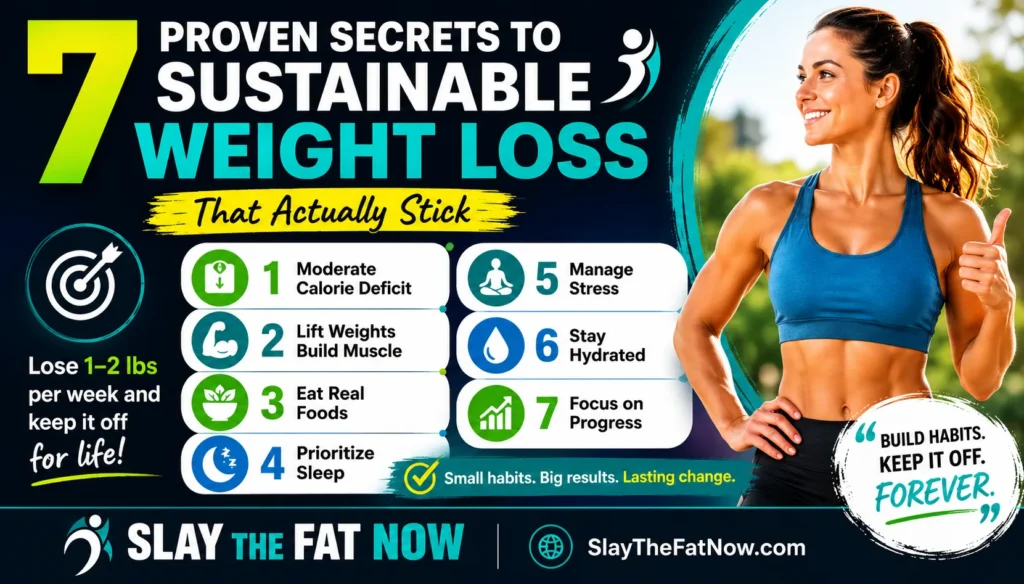
Sustainable weight loss means losing 1–2 pounds per week through a moderate calorie deficit, strength training, and habits you can actually maintain long-term. It’s not about crash diets it’s about building a lifestyle that keeps the fat off permanently without destroying your metabolism or mental health.
You’ve Already Tried. Why Isn’t It Working?
Here’s a scenario that plays out millions of times a year: You commit hard to a new diet. The first two weeks feel incredible the scale drops fast and your motivation is through the roof. Then week three hits. Progress stalls. Life gets busy. One bad day turns into one bad week, and suddenly you’re back where you started maybe heavier.
Sound familiar? You’re not weak. You’re not broken. You were just handed the wrong strategy.
The diet industry made $76 billion in the U.S. in 2023 and it stays profitable because most approaches are designed to produce short-term results, not sustainable weight loss. The second you stop “dieting,” the weight comes back. Every time.
This guide is different. We’re going to break down exactly how to lose weight and keep it off using real science, real examples, and practical steps you can start today.
What Sustainable Weight Loss Actually Means
Sustainable weight loss isn’t a number on the scale. It’s a state of living where your body naturally maintains a healthy weight because of the habits and choices that surround your daily life. It means the fat stays off after six months, after a year, after a decade.
By the time you finish this guide, you’ll understand:
- Why most diets fail and what the research says about it
- The difference between fast weight loss and long-term fat loss
- 7 evidence-backed strategies that actually work
- What to avoid (this list is just as important)
- How to compare the most popular approaches and pick the right one
Why Long-Term Fat Loss Changes Everything
Getting lean and staying lean isn’t just about aesthetics though there’s absolutely nothing wrong with wanting that. The real rewards of sustainable weight loss go much deeper:
- Better metabolic health: Reducing even 5–10% of body weight can dramatically lower blood sugar, blood pressure, and triglycerides.
- More energy: When your body runs on consistent fuel not boom-and-bust dieting your energy stabilizes throughout the day.
- Reduced disease risk: Long-term fat loss lowers your risk of type 2 diabetes, heart disease, and certain cancers.
- Mental health benefits: Sustainable habits reduce anxiety around food and build genuine confidence.
- Economic savings: Fewer medical bills, less money wasted on fad diets, supplements, and programs that don’t deliver.
- Joint health: Every pound of fat you lose reduces pressure on your knees by roughly 4 pounds.
And the biggest benefit? You never have to diet again because sustainable eating is your normal.
If you’re also looking for strategies to accelerate fat loss safely, check out our deep-dive on effective fat loss strategies for beginners.
The Science Behind Sustainable Weight Loss (Real Numbers)
95% of dieters regain weight within 1–5 years on standard diets
1–2 lbs per week is the CDC-recommended safe rate of fat loss
500–750 daily calorie deficit needed for 1–1.5 lb/week loss
5–10% body weight loss that produces significant health improvements
Research from the National Institute of Diabetes and Digestive and Kidney Diseases (NIDDK) confirms that losing weight too fast triggers your body’s starvation response slowing your metabolism and increasing hunger hormones like ghrelin. This is the biological reason yo-yo dieting is so common.
The CDC’s guidelines on healthy weight loss are clear: gradual, steady loss of 1–2 pounds per week is the gold standard for keeping weight off long-term. Anything faster and you’re likely losing muscle not just fat.
A landmark study published in the New England Journal of Medicine found that people who achieved long-term fat loss shared four key behaviors: regular physical activity, consistent self-monitoring, eating breakfast daily, and maintaining similar eating patterns on weekdays and weekends.
A Real-World Example: From 240 to 185 and Staying There
📖 Case Study
Take Marcus, a 38-year-old IT manager from Texas. He’d done keto twice, tried intermittent fasting for three months, and lost 25 pounds on a meal-replacement program only to gain back 30 within a year each time.
When he came to us, we didn’t put him on a diet. We started with three simple changes:
- A 400-calorie daily deficit (not 1,000) using foods he already liked
- Three 30-minute strength training sessions per week
- 7,000 steps per day tracked on his phone
Marcus lost 55 pounds over 14 months about 1 pound per week. Two years later, he’s maintained within 5 pounds of his goal weight. He didn’t follow a “diet.” He built a lifestyle.
The secret? He never felt deprived. The deficit was small enough that hunger wasn’t unbearable. Strength training preserved his muscle. And the habits were simple enough to survive vacations, holidays, and stressful work weeks.
Ready to Build Your Sustainable Fat Loss Plan?
Get a free personalized breakdown of your calorie targets, macro split, and workout structure built for long-term results, not quick fixes.
7 Evidence-Based Secrets to Sustainable Weight Loss
After working through patterns in hundreds of real transformation journeys, these are the strategies that consistently produce long-term fat loss not just short-term wins.
1. Build a Moderate Calorie Deficit Not a Massive One
A 500–750 calorie daily deficit hits the sweet spot. You lose fat fast enough to stay motivated, but slowly enough that your body doesn’t fight back. Apps like MyFitnessPal or Cronometer can help you track without obsessing.
2. Prioritize Protein at Every Meal
Protein is the single most important macronutrient for sustainable weight loss. It keeps you full, preserves lean muscle during a deficit, and has the highest thermic effect of any food (your body burns more calories digesting protein). Aim for 0.7–1 gram of protein per pound of bodyweight daily.
3. Strength Train at Least 2–3 Times Per Week
Cardio burns calories. Strength training changes your body composition meaning you carry more muscle and less fat at the same weight. More muscle = higher resting metabolism = easier long-term fat loss. This is non-negotiable if you want results that last.
4. Improve Sleep Quality (Seriously)
Poor sleep directly raises ghrelin (hunger hormone) and crashes leptin (satiety hormone). In plain terms: you’ll be hungrier, have worse willpower, and crave more junk food when you’re sleep-deprived. Aim for 7–9 hours of quality sleep per night this is a fat loss lever most people completely ignore.
5. Manage Stress Proactively
Chronic stress chronically elevates cortisol a hormone that promotes fat storage, especially around the belly. Exercise, meditation, journaling, or even just a 20-minute walk can bring cortisol back down. This isn’t soft advice; it’s biochemistry.
6. Focus on Food Volume, Not Just Calories
Eating large volumes of low-calorie, high-fiber foods (vegetables, fruits, legumes, broth-based soups) keeps you physically full on fewer calories. This approach called “volumetrics” is one of the most effective and underutilized tools for controlling hunger without suffering.
7. Track Progress But Not Just the Scale
The scale lies. Water retention, hormonal fluctuations, and muscle gain can mask fat loss for weeks at a time. Track your weight weekly (same time, same conditions), but also track measurements, progress photos, how clothes fit, and energy levels. The full picture tells the real story.
The Reality Check: Myths That Are Keeping You Stuck
“The diet that works is the one you can follow for life not the one that’s fastest.”
❌ Myth: Carbs make you fat.
Reality: Excess calories make you fat. Carbs are your body’s preferred energy source. Eliminating them is neither necessary nor sustainable for most people.
❌ Myth: You need to do hours of cardio to lose weight.
Reality: You can create your entire calorie deficit through diet. Cardio is a tool not a requirement and strength training delivers more long-term metabolic benefit.
❌ Myth: Eating after 8 PM causes weight gain.
Reality: Total daily calorie intake determines fat gain not timing. Late-night eating is a problem because people tend to eat more at that time, not because of the clock.
❌ Myth: Supplements are the missing piece.
Reality: No supplement replaces a calorie deficit and consistent training. Most fat burners are minimally effective at best and harmful at worst.
❌ Myth: If you slip up, you’ve failed.
Reality: The ability to recover quickly from setbacks is the #1 predictor of long-term success. One bad day doesn’t derail a good plan. Quitting does.
Practical Steps to Start Your Sustainable Weight Loss Journey Today
Do This:
- Calculate your TDEE (Total Daily Energy Expenditure) and subtract 500 calories
- Hit 0.7–1g of protein per pound of bodyweight daily
- Strength train 2–3 times per week, focusing on compound movements
- Walk 7,000–10,000 steps per day (this alone can burn 300–500 extra calories)
- Eat mostly whole, minimally processed foods 80% of the time
- Sleep 7–9 hours. Treat it like a training session.
- Weigh yourself weekly, same time, same conditions
- Allow one “flexible” meal per week without guilt
Avoid This:
- Cutting calories below 1,200 (women) or 1,500 (men) this backfires
- Relying on willpower alone environment design beats willpower every time
- Skipping meals to “save calories” this increases binge risk
- Weighing yourself every day and reacting emotionally
- Eliminating entire food groups without medical reason
- Starting with an extreme plan you can only sustain for 2 weeks
Comparing Popular Weight Loss Approaches for Long-Term Results
| Approach | Short-Term Loss | Sustainable? | Muscle Preservation | Best For |
|---|---|---|---|---|
| Calorie Deficit + Protein Focus | Moderate | ✓ Yes | ✓ High | Most people flexible & evidence-backed |
| Keto Diet | Fast (mostly water) | ✗ Hard | Moderate | People with insulin resistance; short-term |
| Intermittent Fasting | Moderate | ✓ For some | Moderate | People who prefer skipping breakfast |
| Very Low Calorie Diet (VLCD) | Fast | ✗ No | ✗ Low | Medically supervised situations only |
| Mediterranean Diet | Slow & steady | ✓ Very Yes | High | Long-term health + gradual fat loss |
| Meal Replacement Plans | Fast | ✗ No | ✗ Low | Short-term jump-start only |
The verdict: A moderate calorie deficit combined with high protein and strength training outperforms every other approach for sustainable weight loss. It’s flexible, preserves muscle, and adapts to real life.
Frequently Asked Questions About Sustainable Weight Loss
1. What is sustainable weight loss?
Sustainable weight loss is the process of losing body fat gradually (typically 1–2 pounds per week) using habits diet, exercise, sleep, stress management that you can realistically maintain for life. The goal is permanent fat loss, not temporary scale drops.
2. How fast is sustainable weight loss?
The CDC recommends 1–2 pounds per week as the safe, sustainable rate. That translates to 500–750 calories below your maintenance needs daily. Faster than this often means losing muscle and triggering metabolic adaptation.
3. How do I lose weight and keep it off?
The research is consistent: the people who keep weight off long-term exercise regularly (especially strength training), monitor their food intake, eat consistent meals, and recover quickly from setbacks instead of quitting. There’s no magic it’s habits stacked consistently over time.
4. Is intermittent fasting good for long-term fat loss?
Intermittent fasting (IF) is a tool that helps some people eat less without counting calories. But research shows it produces similar results to regular calorie restriction when total intake is matched. It’s great if it fits your lifestyle not essential if it doesn’t.
5. How much protein do I need for sustainable fat loss?
Aim for 0.7–1 gram per pound of bodyweight daily (roughly 120–200g for most adults). This preserves muscle during a calorie deficit, keeps hunger lower, and boosts metabolism via the thermic effect of food.
6. Can you lose weight without exercising?
Yes, weight loss is primarily driven by a calorie deficit, which can be created through diet alone. But exercise (especially strength training) dramatically improves body composition, preserves muscle, supports metabolic health, and makes keeping the weight off much easier long-term.
7. Why do I keep gaining weight back after dieting?
Rapid weight loss slows your metabolism and raises hunger hormones a process called metabolic adaptation. When the restrictive diet ends, you eat the way you used to but burn fewer calories, leading to regain. The fix is slower loss and habits you can sustain permanently.
8. What’s the best diet for sustainable weight loss?
The best diet is the one you can follow consistently for years. Generally, approaches that are high in protein, include whole foods, allow flexibility, and create a moderate calorie deficit outperform extreme or rigid diets in long-term studies.
9. How does sleep affect weight loss?
Poor sleep raises ghrelin (hunger) and lowers leptin (fullness), making you eat 300–500 more calories per day on average. It also increases cortisol, promotes fat storage, and kills workout performance. Getting 7–9 hours of quality sleep is a legitimate fat loss strategy.
10. Is it possible to lose belly fat specifically?
You cannot spot-reduce fat the body determines where fat is lost based on genetics and hormones. However, a calorie deficit combined with strength training and stress management (to lower cortisol) is the most effective approach for reducing abdominal fat over time.
11. How many calories should I eat for sustainable weight loss?
Calculate your Total Daily Energy Expenditure (TDEE) using an online calculator, then subtract 500 calories. This creates approximately 1 pound of fat loss per week. Never drop below 1,200 calories (women) or 1,500 calories (men) without medical supervision.
12. Do fat burner supplements work?
Most fat burner supplements have minimal evidence behind them and are not regulated by the FDA. Some contain stimulants that can raise heart rate and blood pressure. The calorie deficit and training remain far more effective and free of side effects.
13. How do I stay motivated during sustainable weight loss?
Motivation fluctuates systems don’t. Build a routine that runs on habit, not emotion. Track non-scale victories (energy, strength, measurements), find a community, schedule workouts like appointments, and remember that slow progress is still progress.
14. Is keto good for long-term fat loss?
Keto can be effective short-term, especially for people with insulin resistance. Long-term, adherence rates are low most people find it too restrictive to maintain for years. When total calories are matched, keto doesn’t outperform other approaches in fat loss studies.
15. What role does stress play in weight gain?
Chronic stress elevates cortisol, which promotes fat storage (especially visceral belly fat), drives cravings for high-calorie comfort foods, disrupts sleep, and reduces motivation to exercise. Managing stress is a legitimate and often overlooked lever in sustainable weight loss.
Stop Starting Over. Start Building a Plan That Lasts.
Join thousands of people across the U.S. who are achieving real, lasting fat loss with SlayTheFatNow. No fads. No extremes. Just a proven system that works with your life.
Sources & References
- Centers for Disease Control and Prevention. Losing Weight. cdc.gov
- National Institute of Diabetes and Digestive and Kidney Diseases. Factors Affecting Weight & Health. niddk.nih.gov
© 2024 SlayTheFatNow.com · All rights reserved · This article is for informational purposes only and does not constitute medical advice.
