 Skip to content
How to Meal Prep for Weight Loss: A 7-Step Beginner System That Actually Sticks
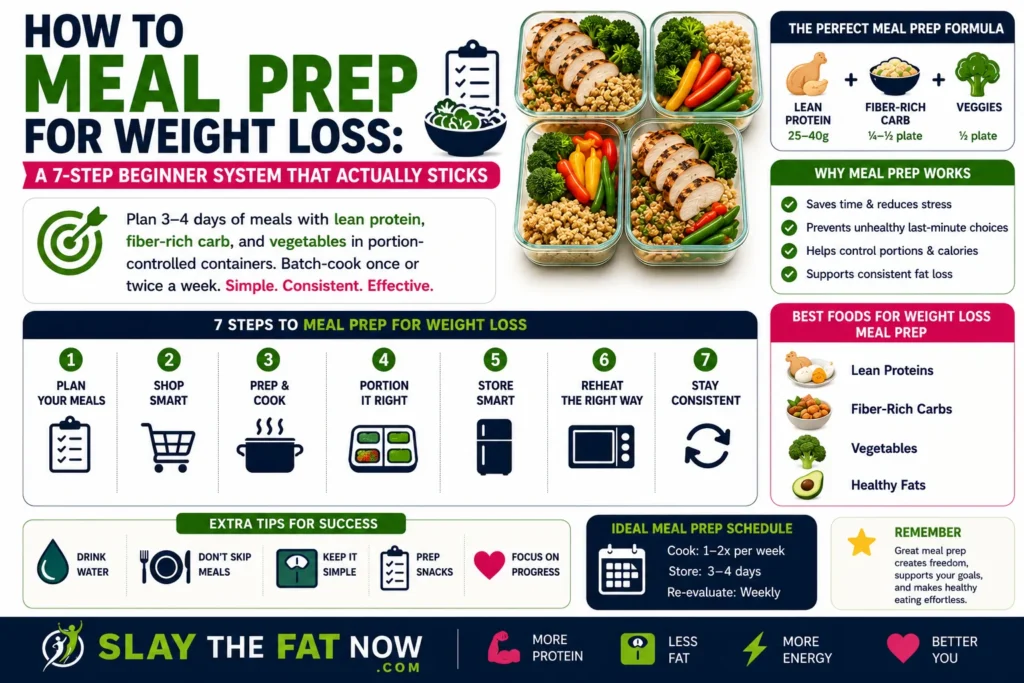
To meal prep for weight loss, plan 3-4 days of meals around a lean protein, a fiber-rich carb, and vegetables in portion-controlled containers, then batch-cook once or twice a week. This removes daily decision-making, controls portions automatically, and keeps calorie intake consistent the three biggest predictors of whether a weight loss plan survives a busy week.
The Mistake That Sinks Most Beginner Meal Prep Plans
Here’s the mistake almost everyone makes the first time they try meal prep for weight loss: they open Pinterest, copy a beautiful seven-container grid, cook for four hours on Sunday, and quit by Wednesday.
It’s not a discipline problem. It’s a design problem. Most beginner meal prep plans are built for influencers with empty schedules, not for someone working a real job, raising kids, or just trying to get through a Tuesday without ordering takeout out of exhaustion.
The actual goal isn’t a perfect grid of matching containers. It’s removing just enough daily decision-making that eating well stops requiring willpower.
What Meal Prep for Weight Loss Actually Means
Meal prep for weight loss means preparing some or all of your meals in advance usually once or twice a week so that healthy, portion-appropriate food is the easiest option available when you’re hungry, tired, or short on time.
It’s not one rigid method. Some people batch-cook full meals. Others prep components (cooked grains, chopped vegetables, grilled protein) and assemble meals daily. Both work. What matters is that the system fits your week, not someone else’s.
By the end of this guide, you’ll know exactly how to build a beginner meal prep routine for fat loss, how much food to prep, what mistakes derail most people in week one, and how to keep the habit going past the two-week mark which is where most plans quietly die.
Key Benefits of Meal Prepping for Weight Loss
- Time. Cooking five lunches at once is faster than cooking one lunch five separate times. Most people save 3-5 hours a week once they have a routine.
- Money. Buying ingredients in bulk for planned meals cuts grocery waste and slashes the temptation spend on delivery apps, which is often where a “healthy” food budget actually leaks.
- Portion control without tracking everything. When your container is built around a sensible portion, you stop needing to weigh and log every bite to stay roughly on target.
- Fewer impulsive decisions. Decision fatigue is real. By 7 p.m. on a hard day, a pre-made meal in the fridge beats a 20-minute mental negotiation about what to order.
- Consistency, which compounds. A meal eaten at home from your own kitchen tends to vary far less in calories than the same “healthy-sounding” meal ordered out, where portion sizes and added oils or sauces are invisible to you.
What the Research Actually Says About Meal Prep and Weight Loss
This isn’t just kitchen folklore. The data backs it up.
CDC data show the prevalence of obesity among U.S. adults was 40.3% during August 2021–August 2023, with obesity highest among adults ages 40-59 at 46.4%. This is the exact population juggling careers, family schedules, and constant time pressure exactly the group beginner meal prep is built for.
On the mechanism side, a large cross-sectional study of more than 40,000 participants found that meal planning, meaning planning ahead the foods that will be eaten for the next few days, was associated with better adherence to nutritional guidelines and improved diet quality. That’s the core promise of meal prep in plain terms: deciding what you’ll eat before you’re hungry leads to better choices than deciding in the moment.
Adherence research backs this up from a different angle. Researchers studying dietary weight loss interventions note that behavioral strategies like self-monitoring and meal planning help promote adherence and increase the success of weight loss efforts. Adherence, not any single “perfect” diet, is consistently the variable that determines whether weight loss happens at all.
Controlled feeding research tells a similar story about consistency. Researchers note that adherence to any dietary regimen and managing energy balance are central to successful weight loss, and that approaches promoting better adherence with less deprivation and more meal satisfaction can support clinical weight management efforts. Meal prep is, functionally, a low-cost way to build that kind of structure into a normal week without hiring a chef or a dietitian.
A Realistic Beginner Meal Prep Week (Illustrative Example)
To make this concrete, here’s what a beginner meal prep for weight loss week could realistically look like for someone working a 9-to-5 with no cooking background. This is an illustrative scenario, not a documented case study.
Sunday, 90 minutes:
- Roast two sheet pans: one with chicken thighs and broccoli, one with sweet potato and bell peppers
- Cook a large batch of brown rice
- Hard-boil six eggs for grab-and-go breakfasts
- Wash and portion fruit into snack bags
Result: Five lunches and five dinners built from the same base ingredients, recombined differently each day so it doesn’t feel like eating the same meal twice (chicken + rice + broccoli one day, chicken + sweet potato + peppers the next).
Wednesday, 20 minutes:
A quick top-up: grill a second batch of protein, chop more vegetables, because most people run out of fresh-tasting food by day four.
That’s it. No spiralizer, no scale obsession, no seven identical containers. Two structured cooking sessions instead of fourteen separate decisions about what to eat.
Expert Insight: What Actually Separates People Who Stick With It
After watching beginners try and abandon meal prep over and over, a few patterns show up again and again.
- The people who stick with it batch-cook components, not finished dishes. Cooked protein, cooked grain, raw or roasted vegetables stored separately and combined fresh each day. This avoids the “soggy reheated everything” problem that kills motivation by Thursday.
- The people who stick with it prep for 80% of meals, not 100%. Trying to meal prep every single meal, including weekends, is what causes burnout. Leaving Friday dinner and Saturday flexible keeps the system sustainable.
- The people who stick with it build in variety from day one. Two or three different protein and vegetable combinations on rotation, not one meal eaten five days straight. Boredom, not hunger, is what actually ends most meal prep attempts.
- The people who stick with it accept imperfect prep over no prep. A rough batch of grilled chicken and frozen vegetables beats an elaborate Pinterest recipe that’s too time-consuming to repeat weekly.
Reality Check: What Meal Prep Won’t Fix
Meal prep is a tool, not a guarantee. A few things worth being honest about:
- It won’t outrun a large calorie surplus. If portions are too large or sauces and oils are heavy-handed, a prepped meal can carry just as many calories as takeout. Meal prep controls consistency, not automatically quantity those have to be set intentionally.
- It doesn’t replace protein and fiber priorities. A week of beige carbs in a container isn’t a weight loss meal prep plan; it’s just food in Tupperware. Protein in particular plays an important role in promoting satiety during weight loss and helping to prevent loss of fat-free mass, which is part of why protein-forward meals tend to outperform low-protein ones for sustained fat loss.
- It can feel monotonous if done wrong. Eating the identical meal five days running is a fast track to abandoning the habit. Built-in variety (see Expert Insight above) isn’t optional it’s what makes the system last past week two.
- Results vary by starting point. Someone with 80 pounds to lose and someone with 15 pounds to lose will see different timelines on the scale, even doing everything right. Meal prep supports the process; it isn’t a guaranteed number on a schedule.
Practical Advice: How to Start Meal Prepping This Week
Do this:
- Pick two proteins, two carbs, and three vegetables for the week that’s it for planning
- Cook in bulk using simple methods: sheet pan roasting, slow cooker, or one big pot
- Portion into containers based on hand-size estimates (palm of protein, fist of carbs, two fists of vegetables) rather than obsessing over exact grams when starting out
- Store in the fridge for 3-4 days max; freeze the rest
- Keep one “emergency” prepped meal in the freezer for the day everything goes wrong
Avoid this:
- Don’t prep seven days of food in one go if you’re brand new start with three or four days
- Don’t drown vegetables in oil or heavy sauces; flavor with herbs, spices, vinegar, or citrus instead
- Don’t skip breakfast prep; mornings are usually when decision fatigue is highest
- Don’t aim for “perfect” recipes that take 90 minutes per dish; aim for repeatable
For a deeper breakdown of how metabolism and food choices interact as you age, this guide on metabolism after 40 is a useful companion read, especially for anyone over 40 trying to fine-tune portions.
Comparison: Which Meal Prep Style Fits You
| Style | Best For | Time Investment | Downside |
| Full-meal batch cooking | People who want zero daily decisions | High upfront (2-3 hrs), low daily | Can feel repetitive without variety planning |
| Component prepping | People who like some daily flexibility | Medium upfront, 10 min daily assembly | Requires slightly more daily effort |
| Hybrid (prep 3-4 days, fresh-cook rest) | Beginners and busy professionals | Low-to-medium | Needs a backup plan for off days |
| Freezer meal prep | People who travel or have unpredictable schedules | High upfront, very low ongoing | Less control over fresh vegetable intake |
For most beginners trying to lose weight without obsessing over food, the hybrid approach is the easiest entry point prep most of the week, leave room for spontaneity.
If cravings tend to derail your week despite having food prepped, it’s worth reading this practical guide to reducing cravings naturally, since prep alone doesn’t solve every trigger.
Want a plan built around your actual schedule? If you’d rather have a structured plan instead of figuring this out alone, request a free consult with Slay The Fat Now and get a meal and coaching plan tailored to your week.
Frequently Asked Questions
Is meal prepping good for weight loss?
Yes. Meal prepping supports weight loss primarily by improving portion consistency and reducing the number of impulsive, in-the-moment food decisions, both of which are linked to better dietary adherence over time.
How many days should beginners meal prep for?
Start with three to four days instead of a full week. It’s easier to stay motivated, and the food stays fresher, especially for vegetables and proteins that don’t hold up well past day four.
What should a weight loss meal prep container include?
A simple formula works well: a palm-sized portion of lean protein, a fist-sized portion of complex carbs, and two fists of non-starchy vegetables, with healthy fat added in moderation.
How long does prepped food last in the fridge?
Most cooked proteins, grains, and vegetables stay fresh and safe for three to four days refrigerated. Anything you won’t eat within that window should be frozen instead.
Can I meal prep without a microwave?
Yes. Many prepped meals can be eaten cold (grain bowls, salads) or reheated briefly in a skillet or toaster oven if a microwave isn’t available.
Do I need special containers to meal prep?
No. Any clean, sealable containers work. Glass containers hold up better over time and don’t absorb odors or stains the way some plastics do, but they aren’t required to start.
What’s the best protein for weight loss meal prep?
Lean options like chicken breast or thighs, turkey, white fish, eggs, tofu, and legumes are easy to batch-cook and reheat well without drying out or becoming rubbery.
How do I avoid getting bored with the same meals?
Rotate two or three different sauces, spice blends, or vegetable combinations across the same base proteins and carbs so meals don’t feel repetitive by midweek.
Is meal prep more expensive than eating out?
Generally no. Buying ingredients in bulk for planned meals is typically far cheaper per meal than ordering delivery or eating out, even accounting for grocery waste.
Can meal prepping help with emotional eating?
It can reduce some triggers tied to convenience and decision fatigue, but it isn’t a complete solution for emotional eating, which often has separate underlying causes worth addressing directly.
Should I count calories while meal prepping?
It’s optional. Portion-based meal prep using hand-size guides gives reasonable consistency without tracking, though calorie counting can add precision for people who want more exact control.
What’s the biggest mistake beginners make with meal prep?
Trying to prep every single meal perfectly in week one. Starting smaller a few days, simple recipes and building the habit gradually leads to far better long-term consistency.
Can I meal prep on a tight budget?
Yes. Beans, eggs, frozen vegetables, rice, and chicken thighs are some of the most budget-friendly weight-loss-friendly staples, and buying them in bulk lowers cost per meal further.
How much food should I prep for one week?
For most adults, that’s roughly 10-14 main meals (lunches and dinners), plus breakfast and snack components, scaled to your typical appetite and activity level.
Does meal prepping work for weight loss after 40?
Yes, and it can matter even more, since metabolic and lifestyle changes after 40 often make consistent portions and planned protein intake more important for maintaining a healthy weight.
Your Next Step
Meal prep isn’t about perfect containers or Pinterest-worthy photos. It’s about making the healthy choice the easy choice on a Tuesday night when you’re tired and the takeout app is one tap away.
Start small: pick three days, two proteins, two carbs, three vegetables. Build from there.
If you want a meal and coaching plan built specifically around your schedule instead of a generic template, reach out to Slay The Fat Now for a free consult and get a system that actually fits your life not someone else’s.
More Resources
Sources
- CDC/NCHS Data Brief No. 508 (2024) —Obesity and Severe Obesity Prevalence in Adults
- Prepackaged Foods to Promote Weight Loss, ClinicalTrials.gov
