 Skip to content
Metabolism After 40: The Complete Truth (And Exactly What to Do About It)
By Benjamin Sley | Weight Loss Coach | SlayTheFatNow.com
What happens to your metabolism after 40?
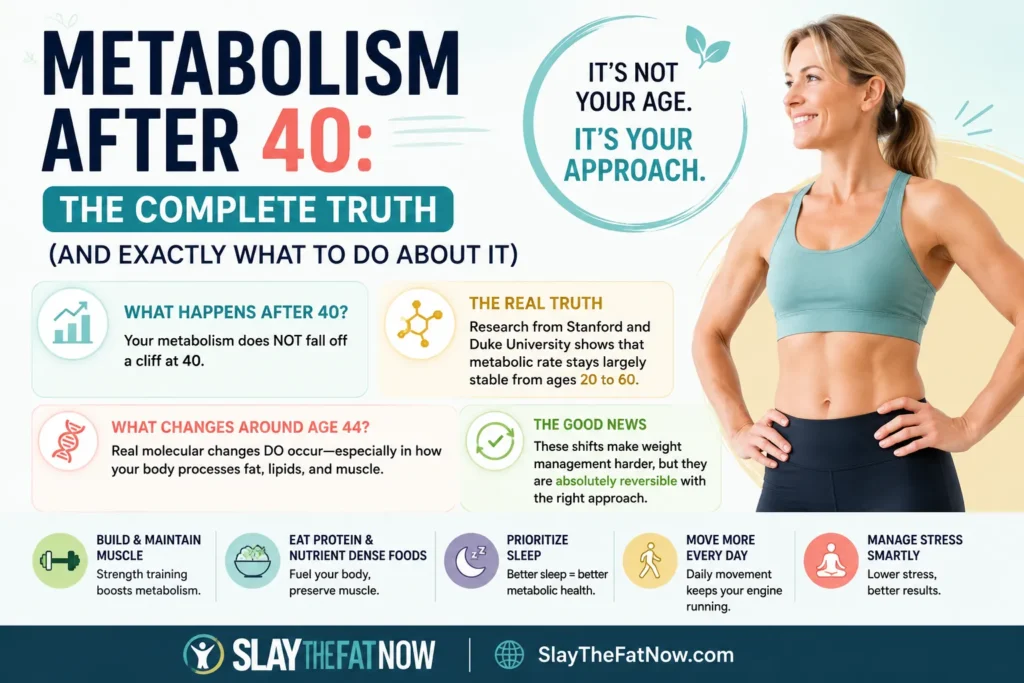
Your metabolism does NOT fall off a cliff at 40. Research from Stanford and Duke University shows that metabolic rate stays largely stable from ages 20 to 60. However, real molecular changes DO occur around age 44 especially in how your body processes fat, lipids, and muscle. These shifts make weight management harder, but they are absolutely reversible with the right approach.
The Lie You’ve Been Told About Turning 40
You’re standing in front of the mirror, and you’re doing the math.
Same calories. Same schedule. Maybe even the same gym membership you’ve had since your 30s. But somehow, the jeans are tighter. The belly is softer. The energy is lower. And someone maybe a doctor, maybe a friend, maybe the internet told you: “It’s just your metabolism slowing down. It happens after 40.”
So you believed it. You stopped fighting. You started calling it “just age.”
Here’s the uncomfortable truth: that explanation is only half right and the half that matters most has nothing to do with your metabolism slowing down.
The real story is more nuanced, more empowering, and frankly, more actionable than anyone has told you. And that’s exactly what this article is going to give you.
What Is Metabolism, Really?
Before we talk about what changes, let’s get clear on what metabolism actually is because most people get this wrong.
Metabolism is not a switch. It’s not a furnace that burns bright when you’re young and flickers out at 40. It’s the sum total of every chemical process your body runs to keep you alive converting food into energy, repairing cells, pumping blood, building muscle, eliminating waste.
The number that matters most for weight is your Total Daily Energy Expenditure (TDEE) how many calories your body burns in a 24-hour period across everything you do, including rest.
And this number? It’s far more stable across your adult life than you’ve been told.
Understanding metabolism after 40 starts with separating myth from biology. Let’s do that now.
The Key Facts: What the Science Actually Says
Fact #1: Your Metabolism Is More Stable Than You Think
A landmark study published in the journal Science, analyzing data from 6,421 people across 29 countries, found that metabolic rate stays remarkably stable from age 20 all the way to age 60. Not 30. Not 40. Sixty.
Researchers from Duke University used the gold-standard “doubly labeled water” method to measure actual calorie burn in real people, going about their real lives. The conclusion was clear: your metabolic engine is not the villain behind your weight gain in your 40s.
Fact #2: Something Real DOES Shift Around Age 44
Here’s where it gets interesting and important.
A 2024 study published in Nature Aging by Stanford Medicine scientists analyzed over 135,000 different molecules and microbes in 108 volunteers aged 25 to 75. They found that 81% of all molecules studied showed non-linear fluctuations meaning dramatic changes at specific ages, not gradual decline.
The two biggest shift points? Age 44 and age 60.
Around age 44, the body undergoes significant changes in:
- Lipid metabolism (how your body processes fats and cholesterol)
- Muscle-related molecules (affecting strength, repair, and tone)
- Alcohol metabolism (you process alcohol more slowly)
- Cardiovascular markers (LDL and triglyceride shifts)
- Skin structure and collagen
These changes don’t mean your metabolism has “stopped.” They mean your body is processing food and building tissue differently. That’s a crucial distinction because it means the solution is different too.
Fact #3: The Weight Gain Is Real, But the Cause Isn’t What You Think
Research published in the Journal of Clinical Investigation (Mayo Clinic) found that between ages 40 and 66, the average American adult gains 0.3 to 0.5 kg per year steadily and quietly. Body fat increases by roughly 1% per year starting in your 40s, even when total body weight stays the same.
Why? Because muscle mass is quietly decreasing. And muscle burns more calories than fat. So even with a “stable” metabolism, your body composition is shifting and that shift costs you.
This is not a death sentence. It’s a clear diagnosis. And clear diagnoses have clear treatments.
Why This Matters for You Right Now
If you’re in your 40s, 50s, or approaching 60, here’s what’s actually at stake:
Your hormones are shifting. Estrogen drops during perimenopause, triggering up to a 10–20% increase in fat release but that fat isn’t going away. It’s redistributing. Testosterone in men declines gradually, reducing muscle-building capacity. Both sexes see a drop in DHEA, a hormone linked to metabolic regulation.
Your muscle is quietly disappearing. Without active intervention, adults lose 3–8% of muscle mass per decade after 30. After 60, that rate can accelerate. Muscle is your metabolic currency. Every pound of it burns calories around the clock, even at rest.
Your liver is changing. Liver mass and blood volume decrease with age by as much as 20–40% in older adults. This affects how your body processes glucose, stores fat, and detoxifies. An aging liver that’s also carrying excess fat is a recipe for insulin resistance.
Your stress is different. Your 40s are statistically one of the most stressful periods of life career pressure, family demands, financial obligations. Cortisol, the stress hormone, promotes belly fat storage and breaks down muscle. It’s not just “feeling stressed.” It has a biochemical cost.
Understanding these mechanisms is the first step. Taking action is the second.
A Real Example: What a 44-Year-Old’s Transformation Actually Looks Like
Meet “Mark” a 44-year-old marketing manager in Chicago. He came to our program carrying 38 extra pounds, mostly around the belly. He was eating roughly what he ate at 34. He was doing 30-minute cardio sessions, three times a week. And he was gaining weight anyway.
Sound familiar?
Here’s what changed when he took a targeted approach:
Step 1 Protein first. We shifted his diet to prioritize 1g of protein per pound of target body weight. This protected existing muscle, kept him satiated, and boosted his thermic effect of food (the calories burned just from digesting).
Step 2 Strength training replaced cardio. Two days of resistance training replaced two of his cardio sessions. Within eight weeks, his resting metabolic rate increased measurably because muscle was coming back.
Step 3 Sleep became non-negotiable. Below 7 hours of sleep, cortisol rises and testosterone drops. Mark went from 5.5 hours to 7.5 hours within a month using basic sleep hygiene. Fat loss accelerated.
Step 4 Caloric adjustment, not starvation. We reduced his intake by only 300–400 calories per day, targeting fat stores without triggering the metabolic adaptation that comes from aggressive restriction.
Result: 22 pounds lost in 14 weeks. Visible muscle definition returned. Energy improved dramatically.
The metabolism wasn’t broken. The strategy was.
Expert Insight: What I See Working With Clients After 40
After years of coaching men and women through weight loss in their 40s, 50s, and 60s, I’ve noticed consistent patterns in what holds people back and what breaks them through.
The most common mistakes I see:
- Eating too little for too long. Aggressive caloric restriction triggers your body to protect itself by slowing activity and holding fat. This is called metabolic adaptation and it’s the reason crash diets always fail.
- Cardio-only fitness plans. Running and cycling are great for heart health, but they do almost nothing to preserve or build muscle. Without muscle, fat loss plateaus fast.
- Ignoring sleep. Sleep is where your body releases growth hormone, repairs muscle tissue, and regulates hunger hormones (ghrelin and leptin). Shortchanging sleep is shortchanging your results.
- Blaming age as an excuse. This is the most dangerous mistake. It becomes a story that stops people from trying. And it’s not accurate. The science is clear: your body is still highly responsive to the right inputs at 40, 50, and beyond.
- Going it alone. Weight loss after 40 requires a personalized strategy not a generic plan designed for a 25-year-old. Hormonal shifts, lifestyle constraints, and body composition challenges are unique at this stage of life.
The clients who succeed are not those with the best genetics or the most time. They’re the ones who stop guessing and start following a strategy built for their actual biology.
The Hard Truth: What Makes Weight Loss After 40 Genuinely Harder
I believe in honesty. So let me be clear about what’s real.
Yes, it is harder. Not because your metabolism “broke,” but because:
- You have less margin for error. A 25-year-old can recover from a bad diet week quickly. A 45-year-old may carry those consequences longer.
- Hormonal shifts create genuine headwinds especially for women during perimenopause and post-menopause.
- Recovery takes longer. Your body needs more time to repair after exercise.
- Life is busier. Stress is higher. Sleep is often worse.
But harder is not impossible. And in many ways, people over 40 have advantages younger people don’t: greater self-discipline, clearer motivation, more life experience, and better decision-making.
The approach just has to be smarter. Not harder. Smarter.
Practical Action Plan: How to Boost Your Metabolism After 40
Here is what actually works, backed by research and real-world results:
✅ DO These Things
1. Build and preserve muscle. Strength training 2–3 times per week is non-negotiable. Focus on compound movements: squats, deadlifts, rows, presses. Muscle is the engine of your metabolism.
2. Eat enough protein. Aim for 0.7–1g of protein per pound of bodyweight. Protein has the highest thermic effect of any macronutrient your body burns more calories just digesting it. It also protects muscle during a caloric deficit. Learn more about high-protein meal planning for fat loss on SlayTheFatNow.com.
3. Prioritize sleep. 7–9 hours per night. Non-negotiable. Sleep deprivation directly impairs fat loss, raises cortisol, and suppresses testosterone. It’s not a luxury it’s a metabolic tool.
4. Manage stress actively. Chronic stress equals chronic cortisol. Cortisol drives belly fat storage and muscle breakdown. Meditation, time in nature, boundaries at work this is part of your fat-loss strategy now.
5. Eat in a moderate caloric deficit. 300–500 calories below maintenance. Not 1,000. Not 1,500. Enough to lose fat without triggering protective metabolic adaptation.
6. Monitor your lipids and hormones. Given the Stanford findings on lipid metabolism shifting in your 40s, get a full blood panel. Know your LDL, triglycerides, testosterone (men), estradiol (women), and thyroid function. Knowledge is power.
7. Time your carbohydrates. Consume most of your carbs around your workouts, when insulin sensitivity is highest. This supports muscle recovery and reduces fat storage. Check out our carb-cycling guide for people over 40.
❌ STOP These Things
- Stop doing only cardio. Add resistance training.
- Stop skipping meals and then overeating later.
- Stop blaming your metabolism without addressing your muscle mass.
- Stop treating alcohol as harmless. After 40, your body metabolizes it more slowly the Stanford study confirmed this directly.
- Stop following plans designed for people half your age.
Strategy Comparison: What Works Best After 40?
| Approach | Best For | Realistic Results | Long-Term Sustainable? |
|---|---|---|---|
| Keto Diet Only | Short-term fat loss | 5–10 lbs in 4–6 weeks | Moderate hard to maintain |
| Cardio Only | Heart health | Minimal fat loss without diet | Yes, but plateaus quickly |
| Caloric Restriction Only | Initial weight loss | 5–8 lbs, then stalls | No triggers adaptation |
| Strength Training + Protein | Body recomposition | 1–2 lbs/week of fat, muscle preserved | Yes sustainable and effective |
| Comprehensive Coaching Program | Full transformation | 15–40 lbs in 12–16 weeks | Yes with accountability |
The data is clear: the combination of strength training, high protein intake, moderate caloric deficit, and proper sleep outperforms every other single approach for people over 40. It’s not a trick. It’s just biology working in your favor when you give it the right inputs.
Want a personalized plan built around your exact body, lifestyle, and goals? Start with a free consultation at SlayTheFatNow.com and let’s build your roadmap together.
Frequently Asked Questions About Metabolism After 40
1. Does metabolism really slow down after 40?
Not dramatically. Major research from Duke University and Stanford shows that metabolic rate stays largely stable from ages 20 to 60. However, significant molecular changes especially in fat and lipid processing do occur around age 44, which can make weight management harder without proper strategy.
2. Why am I gaining weight in my 40s if my metabolism hasn’t slowed?
The most common causes are muscle loss (which reduces calorie burn), hormonal shifts (cortisol, estrogen, testosterone), lifestyle changes (less movement, poorer sleep, higher stress), and shifts in how your body processes fat and carbohydrates.
3. Can you speed up your metabolism after 40?
Yes. Building muscle through resistance training is the most effective way to raise resting metabolic rate. Eating adequate protein, improving sleep, reducing stress, and avoiding extreme caloric restriction also help protect and boost metabolism.
4. What foods boost metabolism after 40?
Lean protein (chicken, fish, Greek yogurt, eggs), fiber-rich vegetables, green tea, and foods rich in omega-3 fatty acids (salmon, flaxseed, walnuts) all support metabolic health. Protein has the highest thermic effect meaning your body burns more calories digesting it.
5. Does menopause destroy your metabolism?
No. Menopause causes hormonal shifts especially a decline in estrogen that can lead to fat redistribution (more belly fat) and some muscle loss. But the metabolic rate itself is not destroyed. With the right nutrition and exercise strategy, women in and after menopause absolutely can lose fat and build muscle.
6. How many calories should I eat to lose weight after 40?
This varies by individual, but a general starting point is a 300–500 calorie deficit below your Total Daily Energy Expenditure. Eating too little is often as harmful as eating too much it triggers muscle loss and metabolic adaptation. Use a TDEE calculator and consult a coach for a personalized number.
7. Is intermittent fasting good for metabolism after 40?
Intermittent fasting (IF) can be a useful tool for some people after 40, particularly for controlling caloric intake. However, it must be combined with adequate protein and resistance training to prevent muscle loss. IF is not a magic bullet it’s one strategy among many.
8. What is the best exercise for metabolism after 40?
Resistance/strength training is the most metabolically impactful exercise for people over 40, because it builds and preserves muscle mass. Combining it with moderate cardio for cardiovascular health creates an optimal plan.
9. Does sleep really affect metabolism after 40?
Absolutely. Sleep deprivation raises cortisol, suppresses growth hormone, disrupts leptin and ghrelin (hunger hormones), and impairs insulin sensitivity. Studies show that even partial sleep restriction can significantly reduce fat loss, even in a caloric deficit.
10. Why is belly fat so hard to lose after 40?
Belly fat (visceral fat) is particularly responsive to cortisol, insulin, and hormonal changes all of which shift in your 40s. Visceral fat is also metabolically active in a harmful way, increasing inflammation and insulin resistance. Reducing stress, improving sleep, and building muscle are the most effective approaches to losing belly fat after 40.
11. How long does it take to see results when trying to lose weight after 40?
Most people see measurable results within 4–6 weeks of following a structured plan combining nutrition, resistance training, and lifestyle adjustments. Visible body composition changes typically appear within 8–12 weeks. Consistency matters more than intensity.
12. Does testosterone affect metabolism in men after 40?
Yes. Testosterone plays a key role in muscle maintenance, fat distribution, and energy levels. Testosterone levels decline gradually in men after 30. Low testosterone can make weight loss harder. A blood test can reveal whether hormone optimization is appropriate as part of your plan.
13. Are there supplements that boost metabolism after 40?
Some evidence supports the use of creatine (for muscle preservation), magnesium (for sleep and hormone function), vitamin D (linked to metabolic health), and omega-3 fatty acids (anti-inflammatory, supports fat metabolism). No supplement replaces diet, training, and sleep. Always consult a doctor before starting any supplement.
14. What is the #1 mistake people make when trying to lose weight after 40?
Doing too much cardio and eating too little simultaneously. This combination creates a caloric deficit that the body resists by breaking down muscle for fuel, slowing activity, and triggering hunger. The result is a stalled metabolism and increased fat storage. Building muscle while eating adequate protein is the correct approach.
15. Can a 50-year-old or 60-year-old also use these strategies?
Absolutely. The same principles building muscle, eating enough protein, sleeping well, managing at 50, 60, and beyond. The pace of results may be slightly slower, and recovery may take longer, but the body remains highly responsive to the right inputs at any age. Many of our most remarkable client transformations have come from people in their 50s and 60s.
Ready to Stop Guessing and Start Transforming?
You now know the truth about metabolism after 40. It’s not hopeless. It’s not inevitable. It’s biology and biology responds to the right strategy.
But knowing is only step one. Doing is where the transformation happens.
At SlayTheFatNow.com, we build personalized fat-loss programs specifically for people over 40 built around your hormones, your schedule, your goals, and your real life. No cookie-cutter plans. No starvation diets. No giving up.
Here’s what to do next:
👉 Book your free strategy call at SlayTheFatNow.com available this week, limited spots.
In 30 minutes, we’ll identify exactly what’s holding you back, show you what a realistic transformation looks like for your specific body, and give you a clear path forward.
Your 40s aren’t the beginning of the end. For hundreds of our clients, they’ve been the beginning of the best shape of their lives.
Let’s build that for you.
Sources & Further Reading
- Pontzer, H. et al. “Daily Energy Expenditure Through the Human Life Course.” Science, 2021. Read the study
- Jensen, M.D. “Metabolic changes in aging humans: current evidence and therapeutic strategies.” Journal of Clinical Investigation, 2022. Read at NIH/PubMed
- Harvard Health Publishing. “Surprising findings about metabolism and age.” Read at Harvard Health
Benjamin Sley is a certified weight loss coach and founder of SlayTheFatNow.com. He specializes in helping men and women over 40 lose fat, build muscle, and reclaim their energy through science-based, personalized coaching programs. All information in this article is educational and should not replace personalized medical advice.
