 Skip to content
Sugar and Weight Gain: 7 Truths That Melt Belly Fat Fast
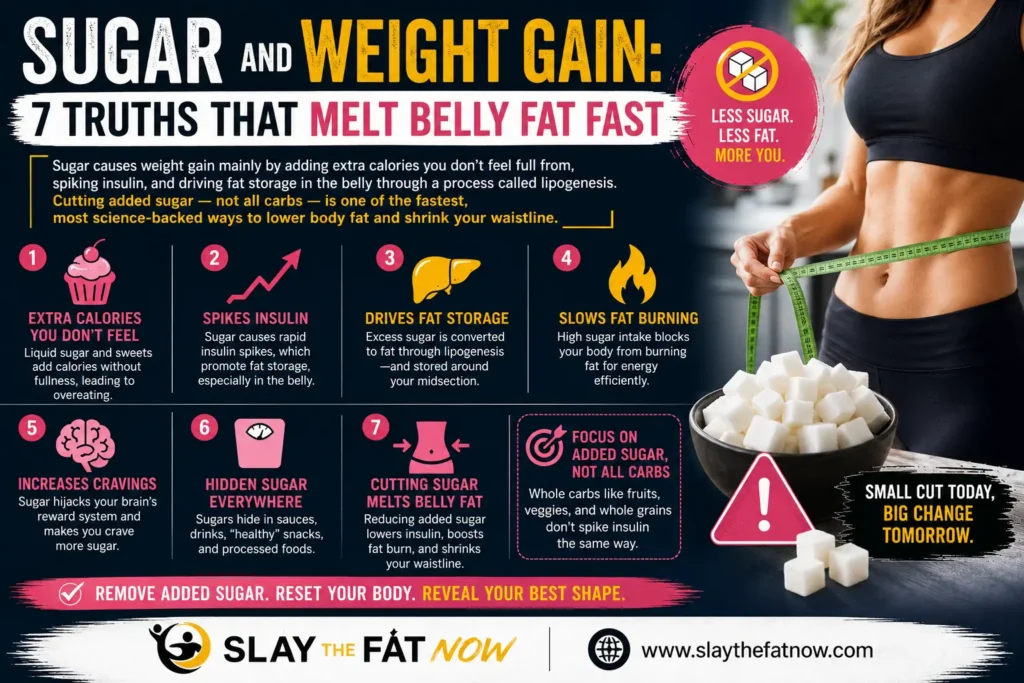
Sugar causes weight gain mainly by adding extra calories you don’t feel full from, spiking insulin, and driving fat storage in the belly through a process called lipogenesis. Cutting added sugar not all carbs is one of the fastest, most science-backed ways to lower body fat and shrink your waistline.
The Diet Soda Trap Nobody Warns You About
You switched to “diet.” You cut the candy bowl at work. You started reading labels. And the scale still won’t move.
Here’s the part that stings: you might be eating “healthy” and still pouring sugar into your body all day without realizing it. Granola bars. Flavored yogurt. Salad dressing. Pasta sauce. Sugar hides in foods marketed as clean eating, and most people never connect the dots between their stubborn belly fat and what’s actually in their pantry.
This isn’t a willpower problem. It’s an information problem. Once you understand exactly how sugar and weight gain are connected, the fix becomes a lot more obvious and a lot less miserable than you think.
What’s Really Going On: Sugar and Weight Gain Explained
Let’s keep this simple, because most explanations make it more complicated than it needs to be.
When you eat added sugar, two things happen at once:
- You get extra calories with almost no fullness signal. Liquid sugar (soda, juice, sweetened coffee) is the worst offender your body doesn’t register it as food, so you don’t eat less later to compensate.
- Your insulin spikes, then crashes. That crash is what triggers cravings an hour or two later, which leads to more snacking, which leads to more sugar.
This is the core mechanism behind sugar and weight gain, and it’s why cutting sugar tends to produce faster, more noticeable results than just “eating less” in a vague sense. You’re not just cutting calories you’re breaking a hormonal cycle that keeps you hungry.
In this article, you’ll learn what the research actually says, whether sugar specifically targets belly fat, a realistic example of what cutting sugar looks like in real life, the mistakes that stall most people’s progress, and a step-by-step plan you can start today.
Why This Actually Matters (Beyond the Number on the Scale)
People assume cutting sugar is about vanity. It’s not or at least, it’s not only that. Here’s what’s actually at stake:
- Energy crashes disappear. The 3pm slump most people blame on “being busy” is often a sugar crash in disguise.
- Cravings get quieter. Sugar is one of the few foods that creates a measurable craving-and-crash loop. Cutting it resets your baseline hunger.
- Visceral fat the dangerous kind shrinks first. Belly fat isn’t just cosmetic. It’s linked to heart disease and type 2 diabetes risk, which means this is a health issue dressed up as a weight issue.
- Results show up faster than most diets. Because sugar affects both calorie intake and insulin response, cutting it tends to produce visible change in weeks, not months.
If you’ve been wondering whether this is worth the effort compared to counting macros or doing more cardio, the honest answer is: for most people, it’s the highest-leverage change available.
What the Data Actually Shows
This is where a lot of articles get vague. Let’s not do that.
A 30-year longitudinal study following adults from the CARDIA cohort found that higher added sugar intake was directly associated with weight gain and a greater risk of developing obesity over time, supporting U.S. Dietary Guidelines recommendations to limit added sugar. That’s not a short-term fad-diet result that’s three decades of real-world data.
On sugary drinks specifically, a large systematic review and meta-analysis covering nearly half a million adults and children found that each additional daily serving of sugar-sweetened beverages was associated with measurably higher body weight in adults and higher BMI in children.
And on belly fat specifically answering “does sugar cause belly fat” directly Framingham Heart Study researchers who scanned over 1,000 adults found that people who drank at least one sugary beverage daily had significantly more visceral (belly) fat accumulation over six years compared to non-drinkers, while diet soda showed no such association. Researchers pointed to fructose specifically, noting it’s metabolized primarily in the liver and converted to fat, which may explain why sugary drinks (but not diet versions) were linked to insulin resistance and fat accumulation.
On the federal side, the CDC confirms that most Americans consume more added sugar than recommended, and that excess intake contributes to weight gain, obesity, type 2 diabetes, and heart disease. The current Dietary Guidelines for Americans recommend keeping added sugar under 10% of total daily calories and researchers using NHANES data classify “high sugar consumers” as anyone exceeding 15% of calories from added sugar, which is one and a half times the recommended limit.
A Realistic Example: What Cutting Sugar Actually Looks Like
Let’s make this concrete instead of abstract.
Picture someone call her Maria, 34, a nurse working 12-hour shifts. Her “healthy” day looked like this: flavored oat milk latte on the way to work, a granola bar at lunch because there’s no time to cook, a “light” yogurt for an afternoon snack, and a glass of wine to unwind at night. Nothing in that day looks like a junk-food binge. But added up, she was consuming close to 90 grams of added sugar daily almost double the recommended limit for most adults.
Maria didn’t go keto or cut carbs entirely. She made four swaps: black coffee with a splash of milk instead of the flavored latte, a handful of almonds instead of the granola bar, plain Greek yogurt with berries instead of the flavored version, and she kept the wine but dropped the nightly habit to twice a week.
Within three weeks, her energy crashes stopped. By week six, her waist measurement had dropped over an inch without changing her exercise routine at all. That’s the how to cut sugar approach that actually sticks: small swaps, not total deprivation.
What Years of Doing This Reveals
After working with people trying to lose weight for years, a few patterns show up again and again patterns that don’t get talked about enough.
First, people underestimate liquid sugar by a wide margin. Solid food gets scrutinized; drinks don’t. A daily sweetened coffee or two sodas can add 300–500 “invisible” calories that never show up in someone’s mental food log.
Second, “natural” sugar gets a free pass it doesn’t deserve. Honey, agave, and coconut sugar are metabolized almost identically to table sugar. They’re marginally better in micronutrients, not in their effect on insulin or fat storage.
Third, the people who succeed long-term don’t go to zero. The ones who try to eliminate sugar completely tend to rebound hard within a few months. The ones who set a sustainable ceiling say, staying under the recommended daily limit most days keep the results.
Fourth, sleep and stress sabotage sugar goals more than willpower does. Poor sleep increases cravings for high-sugar foods specifically, not just more food in general. Fixing sleep often fixes half the sugar battle without a single dietary change.
Reality Check: What Most People Get Wrong
Time to break a few myths, even the ones you might not want to hear.
Myth: Sugar is uniquely “toxic” and different from all other calories. Reality: Sugar’s biggest problem isn’t that it’s poison it’s that it’s easy to overconsume and doesn’t trigger fullness the way protein or fiber does. Context and quantity matter more than demonization.
Myth: Cutting sugar alone will get you to your goal weight. Reality: It’s a powerful lever, not a magic one. If your overall calorie intake stays too high from other sources, cutting sugar helps but won’t fully solve the problem on its own.
Myth: Fruit is basically the same as candy because “it’s sugar too.” Reality: Whole fruit comes packaged with fiber, water, and micronutrients that slow absorption and support fullness. The research consistently treats added/refined sugar and whole fruit as different categories with different metabolic effects.
Myth: You have to quit sugar completely to see results. Reality: Most of the research showing harm focuses on habitual high intake not occasional treats. An all-or-nothing mindset is usually what causes people to quit the whole effort within a month.
Practical Advice: What to Do (and What to Avoid)
Here’s the actionable part what to actually change starting this week.
Do this:
- Read labels for “added sugars” specifically, not just “sugars” (which includes natural sugar in dairy or fruit).
- Swap one sugary drink per day first it’s the single highest-leverage change.
- Add protein and fiber to meals; both slow sugar absorption and reduce cravings.
- Aim to keep added sugar under 10% of daily calories the federal benchmark backed by the Dietary Guidelines.
- Plan ahead for the 3–4pm energy dip with a protein-based snack instead of letting a vending machine decide for you.
Avoid this:
- Don’t try to eliminate sugar 100% overnight it backfires for most people within weeks.
- Don’t assume “sugar-free” or “no sugar added” labels mean low-calorie; check the full nutrition panel.
- Don’t replace sugar with excessive artificial sweeteners as a long-term crutch it can keep cravings for sweetness alive.
- Don’t skip meals to “save calories” for sugar later it usually backfires into overeating.
If you want a done-for-you version of this, our step-by-step sugar detox guide walks through a 14-day reset built around exactly these principles.
Comparing Your Options: Which Approach Actually Fits You?
| Approach | Best for | Tradeoff |
|---|---|---|
| Gradual swap method (what Maria did) | People with limited time/energy for big changes | Slower results, but far more sustainable |
| Full sugar detox (7–14 days) | People who want a fast reset and clear head | Harder short-term; cravings spike in days 2–4 before easing |
| Tracking added sugar grams daily | Detail-oriented people who like data | Requires consistent label-reading; can feel tedious |
| Low-carb/keto approach | People who also want to cut refined carbs broadly | More restrictive overall; not necessary just to address sugar specifically |
For most people starting out, the gradual swap method has the best track record for actually sticking past the first month which matters more than any approach that looks good on paper but gets abandoned by week three.
Frequently Asked Questions
Does sugar cause belly fat specifically, or just weight gain in general?
Research using imaging studies found that sugary drink consumption was linked to increased visceral (belly) fat specifically, independent of overall weight gain, likely because fructose is processed in the liver and converted to fat there.
How much added sugar is too much per day?
The Dietary Guidelines for Americans recommend keeping added sugar under 10% of total daily calories roughly 50 grams on a 2,000-calorie diet, though less is generally better for weight loss goals.
Can I lose belly fat without cutting sugar completely?
Yes. Most successful long-term results come from reducing sugar to a sustainable level rather than eliminating it entirely, paired with adequate protein and overall calorie awareness.
Is natural sugar like honey better than refined sugar for weight loss?
Not meaningfully. Honey and agave are metabolized very similarly to table sugar in terms of insulin response and fat storage, despite marketing that suggests otherwise.
How long does it take to see results after cutting sugar?
Many people notice reduced bloating and steadier energy within 1–2 weeks, with visible waistline changes often appearing between weeks 4–6, depending on starting point and consistency.
Does fruit count as the “bad” sugar I should cut?
No. Whole fruit contains fiber and water that slow sugar absorption and support fullness, and is treated differently from added/refined sugar in most major studies on weight gain.
Why do I crave sugar so badly in the afternoon?
This is usually a blood sugar crash following an earlier spike, often made worse by poor sleep or skipped meals not a sign of weak willpower.
Does diet soda cause weight gain the same way regular soda does?
Studies have generally not found the same visceral fat association with diet soda that they have with sugar-sweetened beverages, though it’s best used as a transitional tool rather than a permanent staple.
What’s the fastest way to cut sugar without feeling deprived?
Swap one high-sugar item at a time instead of overhauling your whole diet at once this is the approach most likely to actually stick past the first few weeks.
Does cutting sugar help with belly fat more than cutting fat from your diet?
For visceral fat specifically, current research points more strongly toward sugar and refined carbs as drivers than dietary fat, though total calorie balance still matters.
Is it normal to have intense cravings in the first few days of cutting sugar?
Yes, this is common and typically peaks around days 2–4 before easing significantly by the end of the first week.
Can stress make sugar cravings worse even if my diet hasn’t changed?
Yes. Elevated cortisol from chronic stress is linked to increased cravings for high-sugar, high-fat foods specifically, independent of actual hunger.
Do artificial sweeteners help or hurt weight loss goals?
They can help short-term by reducing calorie intake, but relying on them long-term may keep sweet cravings active rather than retraining your palate.
Should I cut sugar gradually or all at once?
Gradual reduction tends to produce better long-term adherence for most people, though some prefer a short, structured detox to break the habit loop quickly.
How does sugar intake compare to exercise for losing belly fat?
Diet particularly sugar and overall calorie intake tends to have a larger direct effect on belly fat than exercise alone, though combining both produces the best outcomes.
Your Next Step
Sugar isn’t the enemy but the invisible, everyday sugar hiding in “healthy” foods probably is working against you more than you realize. The good news: you don’t need to overhaul your entire diet overnight. You need one swap this week, then another next week.
If you want a structured plan instead of figuring it out alone, our free 7-day sugar reset lays out exactly what to eat, what to skip, and what to expect day by day built specifically for people who don’t have hours to spend meal-prepping.
Start your first swap today.
Pick one sugary drink or snack you have daily, replace it tomorrow morning, and notice how you feel by Friday. That’s how real, lasting change actually starts.
1. CDC — Get the Facts: Added Sugars
