 Skip to content
How to Eat Out and Lose Weight: 9 Rules That Actually Work in 2026
To eat out and lose weight, order protein and vegetables first, ask for sauces and dressings on the side, skip the bread basket, and assume your meal has 20–30% more calories than it looks like. Pair this with portion awareness, not restriction, and restaurant meals can fit into steady, sustainable fat loss.
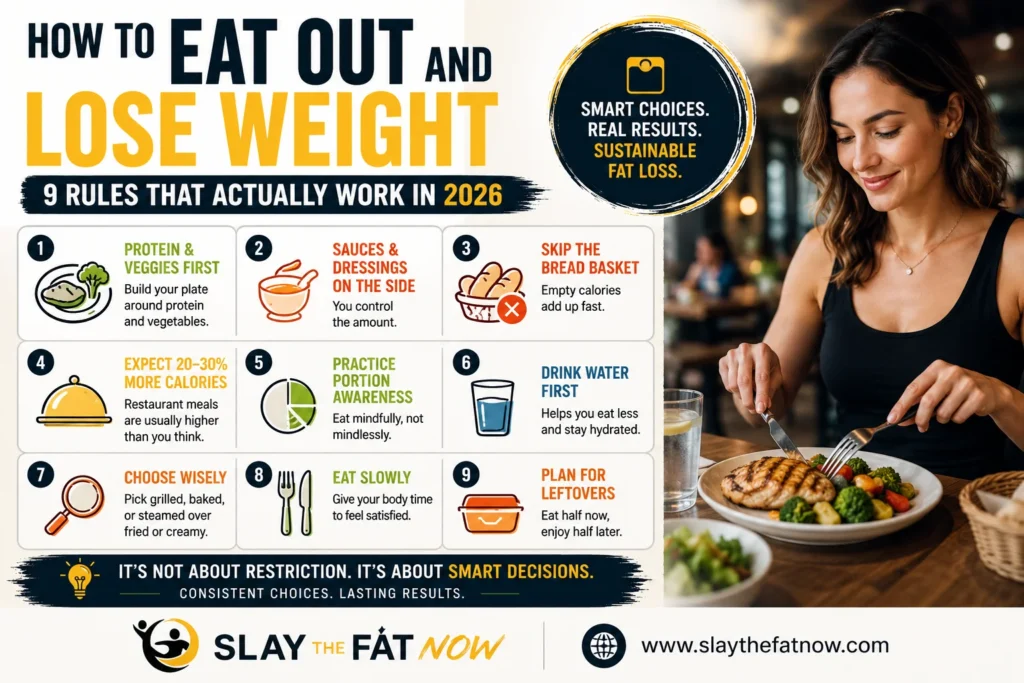
How to Eat Out and Lose Weight Without Giving Up Your Social Life
You order the “healthy-sounding” salad. Grilled chicken, mixed greens, a light vinaigrette. You feel good about your choice. Then the scale doesn’t move for two weeks.
This happens constantly, and it’s almost never about willpower. It’s about a number you never saw: that salad likely had 700+ calories of dressing, cheese, and candied nuts hiding under a few leaves.
I’ve coached clients who swore off restaurants entirely because they assumed eating out and losing weight were mutually exclusive. They’re not. The problem isn’t restaurants it’s going in without a plan.
This guide breaks down exactly how to eat out and lose weight using real strategy, not deprivation. You’ll learn what actually drives the calorie gap between home food and restaurant food, how to order at any type of restaurant, and the mistakes that quietly add hundreds of calories to meals that look perfectly healthy.
What “Eating Out on a Diet” Actually Means (Overview)
Eating out on a diet doesn’t mean ordering the smallest, saddest item on the menu. It means understanding three things before you sit down: what restaurants tend to hide in their food, how your brain reacts to plated meals, and which simple swaps protect your progress without making the meal feel like punishment.
Here’s what most people get wrong: they think the fix is willpower at the table. The real fix happens before you ever look at the menu in how you think about the meal, what you’ve eaten earlier that day, and which two or three questions you ask your server.
By the end of this article, you’ll have a complete system for restaurant food weight loss what to order, what to avoid, how to handle social pressure, and how to stop dreading dinner out.
Key Benefits of Learning to Eat Out Strategically
Why This Skill Matters More Than People Think
1. You stop avoiding your social life. Diets that ban restaurants entirely tend to collapse the first time there’s a birthday dinner, work lunch, or date night. Learning to navigate menus means your weight loss plan survives real life.
2. You close the calorie gap you can’t see. Restaurant meals are consistently denser in calories than home-cooked equivalents, often without tasting “extra” rich. Knowing this changes how you order, not just how much you eat.
3. You save the mental energy diets usually drain. Once you have a system protein first, sauce on the side, skip the extras ordering becomes automatic. No more standing at a menu for ten minutes feeling anxious.
4. You build a sustainable habit instead of an exception. If “eating healthy” only happens at home, you’ve built a fragile system. If it works at a steakhouse, a food court, and a friend’s birthday dinner, it’s an actual skill.
5. You protect long-term progress, not just this week’s number. People who can eat out without spiraling tend to keep weight off longer, because the behavior isn’t contingent on perfect conditions.
Data and Facts: What the Research Says About Restaurant Eating
This is where most diet advice gets vague. The actual research on restaurant food weight loss is specific, and some of it is uncomfortable.
The calorie gap is real and large. A large-scale Tufts University study analyzing 364 meals across 123 restaurants in Boston, San Francisco, and Little Rock found that 92% of popular restaurant meals exceeded recommended calorie levels for an average meal, with American, Chinese, and Italian dinner entrees averaging nearly 1,500 calories each before drinks, appetizers, or dessert.
You’re probably underestimating by hundreds of calories. A Harvard-affiliated study published in BMJ surveyed nearly 3,400 people at fast-food restaurants and found adults underestimated their meal’s calorie content by an average of 175 calories, while teens underestimated theirs by 259 calories on average. A quarter of all participants underestimated their meal by 500 calories or more.
“Healthy” labeling backfires more often than it helps. Cornell University research found that people eating at restaurants marketed as “healthy” tended to underestimate calorie content by around 35%, and chose side items containing up to 131% more calories than they would at a restaurant without a health claim. This is sometimes called the health halo effect and it’s exactly why that salad surprised you.
Calorie menu labels help, but only a little. One of the largest studies on menu labeling, published in 2020 and covering more than 5,500 diners, found that people given calorie counts ordered about 45 fewer calories on average roughly a 3% reduction at dinner. Helpful, but nowhere near enough to offset a 1,500-calorie entree on its own.
You don’t have to eat out less to lose weight you have to eat out smarter. A controlled intervention study on mindful restaurant eating found that participants who learned specific in-restaurant strategies reduced their daily caloric intae by about 297 calories and lost an average of 1.7 kg (about 3.7 lbs) over six weeks without significantly reducing how often they ate out. This is the most important finding in this entire section: frequency of eating out didn’t have to drop for weight loss to happen.
Real Example: A Realistic Week of Eating Out and Still Losing Weight
Meet “Marcus” a composite based on a pattern I’ve coached repeatedly.
Marcus traveled for work three days a week and ate out for nearly every lunch and dinner. He’d tried meal prepping but it didn’t survive hotel stays and client dinners. He assumed weight loss was off the table until his schedule changed.
Here’s what shifted when he applied a system instead of restriction:
- Monday lunch (client meeting, steakhouse): Ordered a 6 oz sirloin, double vegetables instead of fries, sauce on the side
- Tuesday dinner (hotel room service): Skipped the bread basket automatically, asked for dressing on the side on the Caesar salad
- Wednesday (fast casual, rushed): Chose a protein bowl instead of a burrito same restaurant, smarter order
- Thursday (team dinner, Italian): Ate a normal portion of pasta but split a dessert instead of ordering his own
- Result after 10 weeks: Down 9 lbs, while eating out 11–13 times per week
Marcus didn’t eat out less. He ordered differently, almost every single time, using the same handful of rules.
Expert Insight: What Actually Separates Success From Failure at Restaurants
A few patterns show up again and again with clients who successfully combine restaurant eating with how to eat out and lose weight goals.
The bread basket and drink are the real damage, not the entree. People obsess over whether to get the chicken or the steak, then drink 300 calories of soda or cocktails and eat half a basket of bread before the food even arrives. Controlling the entree matters less if the “free” stuff before it goes unchecked.
Ordering first, before anyone else at the table, dramatically improves choices. This sounds small, but it works. When you order after everyone else has chosen indulgent options, social pressure pulls your order in the same direction. Order early, order intentionally.
“Diet items” on the menu are often a trap. Some menus mark certain dishes as “lighter” or “fit” options that, due to hidden sauces or large portions, end up similar in calories to regular dishes. Don’t trust the label ask how the dish is prepared.
The health halo is the single biggest blind spot. Clients consistently underestimate “healthy-sounding” meals the most exactly what the Cornell research found. A salad with crispy chicken, candied nuts, dried fruit, and a creamy dressing can out-calorie a burger.
People who succeed long-term use the same 3–4 rules everywhere, not a new plan per restaurant. The clients who stop stressing about restaurants are the ones who built one repeatable system (protein first, sauce on the side, skip the extras, stop at satisfied) and apply it at every type of restaurant, instead of overthinking each new menu.
Reality Check: Myths That Quietly Sabotage Restaurant Eating
Myth: “Salads are always the safe choice.” Reality: Many restaurant salads carry 600–1,000+ calories once dressing, cheese, croutons, and add-ons are included. Order dressing on the side and ask what’s actually in it.
Myth: “If I eat out, I’ve already ruined the day.” Reality: One meal, even an indulgent one, rarely undoes a week of consistent choices. The all-or-nothing mindset causes far more damage than the meal itself.
Myth: “Calorie counts on menus mean I don’t need to think about it.” Reality: Research shows calorie labeling only modestly reduces what people order, around 3% on average. It helps, but it’s not a substitute for an ordering strategy.
Myth: “Eating out less is the only way to lose weight.” Reality: A controlled study found people reduced daily intake by nearly 300 calories and lost weight without significantly changing how often they ate out the strategy mattered more than the frequency.
Myth: “I can just exercise off a big restaurant meal.” Reality: A typical 1,500-calorie restaurant entree can take well over an hour of vigorous exercise to “burn off.” Managing intake at the table is far more efficient than trying to outwork it later.
Practical Advice: How to Order at Any Restaurant This Week
Do This:
- Decide your order before you’re hungry. Look at the menu online beforehand if possible decisions made on a full stomach are dramatically better than decisions made starving.
- Order protein and vegetables as the anchor of the meal. Build the rest of the order around that, not the other way around.
- Ask for sauces, dressings, and gravies on the side. This single habit alone can cut several hundred calories without changing what you’re eating.
- Skip the bread basket and chips automatically. Not “I’ll just have one” decide before they hit the table.
- Round up your calorie estimate by 20–30%. Restaurant portions and added fats are inconsistent, even when calorie counts are posted.
- Order water or unsweetened tea as your default drink. Liquid calories add up fast and don’t add fullness.
- Box up half before you start eating, if portions are large. Out of sight reduces mindless finishing.
Avoid This:
- Don’t trust “healthy,” “light,” or “fit” menu labels at face value ask how it’s actually prepared
- Don’t order last at the table if you’re prone to social influence order early and stick with it
- Don’t skip meals earlier in the day to “save calories” for a restaurant meal it backfires into overeating
- Don’t treat every restaurant meal as a cheat that mindset creates an all-or-nothing spiral
- Don’t assume fast casual is automatically lighter than sit-down bowls and wraps can carry 800+ calories easily
Comparison: Strategies for Different Eating-Out Situations
| Situation | Best Strategy | Difficulty | Social Friction |
|---|---|---|---|
| Work lunch / client meeting | Protein + veg anchor, sauce on side, skip bread | Easy | Low |
| Date night / special occasion | Eat normally, split dessert, don’t restrict beforehand | Medium | Low |
| Fast casual (rushed) | Choose bowls over wraps/burritos, ask for light sauce | Easy | None |
| Group dinner / family style | Order first, control your own plate portion before passing dishes | Medium | Medium |
| Travel / hotel dining | Pre-decide meals when possible, default to grilled options | Medium | Low |
For most people, the protein-and-vegetable anchor strategy works across nearly every situation above it’s the single rule worth mastering first if you’re serious about learning how to eat out and lose weight without overhauling your whole life.
Frequently Asked Questions
Can you really lose weight while still eating out regularly?
Yes, research on mindful restaurant eating strategies shows people can reduce daily intake by close to 300 calories and lose weight without significantly cutting back on how often they eat out.
What should I order at a restaurant to lose weight?
Start with a protein and vegetable as the base of your order, ask for sauces and dressings on the side, and skip bread or chips that come before the meal.
Are restaurant salads actually healthy for weight loss?
Not always. Many restaurant salads carry 600–1,000+ calories once dressing, cheese, candied nuts, and croutons are added, often rivaling a burger in total calories.
How many calories are in an average restaurant meal?
Studies on full-service restaurants found average dinner entrees in American, Chinese, and Italian cuisine reaching nearly 1,500 calories each, not including drinks or sides.
Why do “healthy” restaurants sometimes lead to overeating?
Research from Cornell University found people underestimate calories at restaurants labeled “healthy” by around 35% on average, and tend to add higher-calorie sides than they would elsewhere.
Do calorie counts on menus actually help people eat less?
Slightly. One large study found diners given calorie information ordered about 45 fewer calories on average, a modest but real reduction.
Is fast food worse than sit-down restaurants for weight loss? Not necessarily sit-down and full-service restaurant meals often carry just as many, or more, calories than fast food, particularly with bread, appetizers, and creamy sauces included.
How do I handle eating out with friends or family without feeling restricted?
Order early before social pressure builds, choose your protein-and-vegetable anchor, and allow yourself normal portions rather than treating the meal as forbidden.
Should I skip eating earlier in the day before a big dinner out?
No. Skipping meals to “save up” calories typically backfires into extreme hunger and overeating once food arrives. Eat normally throughout the day instead.
What’s the single biggest mistake people make when eating out on a diet?
Trusting “healthy-sounding” menu items without asking how they’re prepared this is consistently where the largest hidden calories show up.
Can I still drink alcohol while trying to lose weight and eat out?
Occasionally, yes, but alcohol adds calories without adding fullness, so it’s worth factoring into your overall intake for the day rather than ignoring it.
How much should I assume restaurant calories are underestimated by?
Research shows people commonly underestimate restaurant meals by 175–259 calories on average, with about a quarter of people underestimating by 500 calories or more, so rounding up your estimate is wise.
Is it better to order an appetizer-sized portion instead of a full entree?
Often, yes. Appetizer or “starter” portions can be an easy way to control calorie intake without feeling restricted, especially at restaurants known for large entree sizes.
Does eating out more often always lead to weight gain?
Not automatically. The data shows the strategy used while eating out matters more than the raw frequency of restaurant visits for weight outcomes.
What’s a simple rule I can use at literally any restaurant? Anchor your order around a protein and a vegetable, request sauces on the side, and skip bread or chips before the meal this single combination is the core habit behind learning how to eat out and lose weight at almost any cuisine.
Final Thoughts: Your Next Step
How to eat out and lose weight isn’t about white-knuckling your way through every menu or giving up your social life. It’s about a handful of repeatable decisions: protein first, sauce on the side, skip the extras, and round your estimate up.
You don’t need to stop living your life to lose weight. You need a system that works wherever you eat.
Sources:
Tufts University Energy Metabolism Laboratory restaurant meal study,
Harvard Pilgrim Health Care Institute/BMJ fast-food calorie estimation study,
Cornell University Food and Brand Lab “healthy” restaurant research,
Journal of Policy Analysis and Management menu labeling study,
