 Skip to content
7 Powerful Weight Loss Habits That Stick (And Actually Work in 2026)
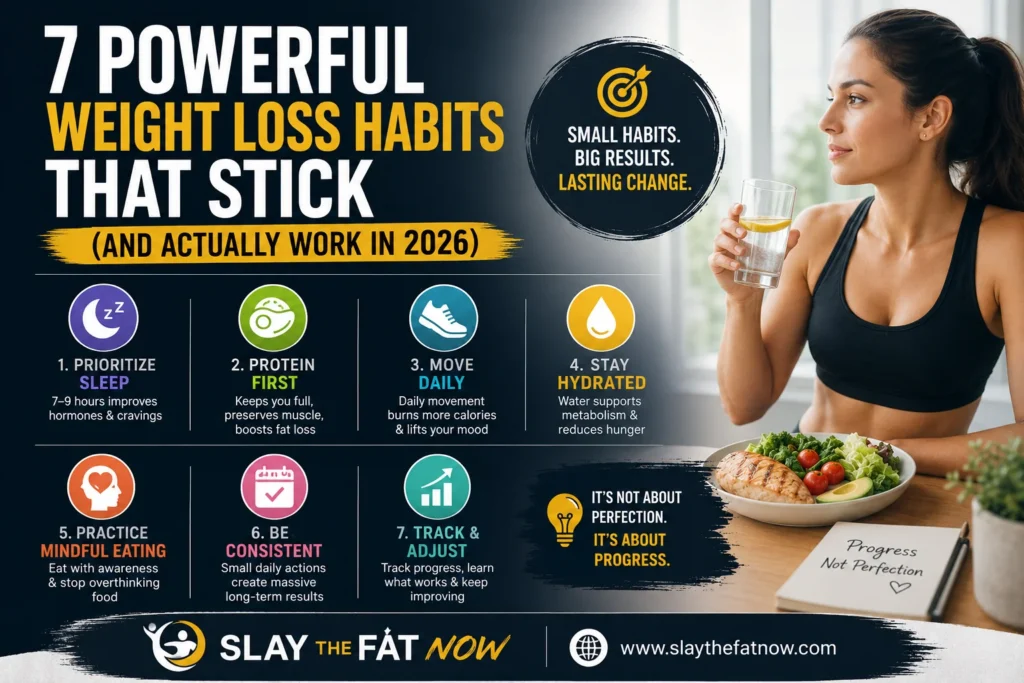
The best weight loss habits that stick are small, repeatable daily actions not crash diets or extreme workouts. Science shows that when you focus on building healthy habits like consistent sleep, protein-first meals, daily movement, and mindful eating, fat loss becomes automatic over time rather than a constant struggle.
You’ve Tried Everything So Why Isn’t It Working?
Here’s the painful truth most weight loss programs don’t want to tell you: your diet isn’t failing you your habits are.
You cut calories. You started running. You gave up bread for three weeks. And then life happened. A bad week at work, a birthday dinner, a rainy morning and suddenly you’re back to square one, wondering why you have zero willpower.
But willpower has nothing to do with it. People who maintain their weight loss long-term aren’t more disciplined than you. They’ve just built better systems. They’ve built weight loss habits that stick the kind that run on autopilot, even when motivation is nowhere to be found.
This article is going to show you exactly how to do that.
What Are Weight Loss Habits That Stick And Why Do They Work?
When most people think about losing weight, they jump straight to restrictions: eat less, move more, suffer more. That approach works for about two to four weeks and then it collapses under the weight of real life.
True weight loss habits that stick work differently. Instead of relying on motivation or willpower, they integrate into your existing routine so seamlessly that skipping them actually feels weird. You don’t have to decide to do them every morning. They just happen.
This is the core idea behind the atomic habits weight loss framework, popularized by James Clear in his bestselling book Atomic Habits. Small behaviors, repeated consistently, compound into dramatic results. A 1% improvement every day doesn’t feel like much but over a year, it makes you 37 times better.
In this guide, you’ll discover the 7 most effective habits for sustainable fat loss, the real science behind them, expert insight on what actually separates people who succeed from those who don’t, and a clear comparison of approaches so you can pick the right starting point for you.
Why Building Healthy Habits Beats Every Diet You’ve Ever Tried
Diets are temporary. Habits are permanent. Here’s what consistently building healthy habits around weight loss actually delivers:
- Sustained fat loss without rebound: Research consistently shows that behavioral habit-based approaches have lower dropout rates and better long-term weight maintenance than calorie-restriction diets alone.
- Less mental exhaustion: When a behavior becomes automatic, your brain stops burning glucose on decisions. This is called decision fatigue reduction and it means you have more mental energy for everything else in your life.
- Improved metabolic health: Habits like regular sleep, strength training, and fiber-rich eating improve insulin sensitivity, reduce inflammation, and lower your risk of type 2 diabetes benefits that go far beyond the number on the scale.
- Better relationship with food: Habit-based weight loss teaches you to eat in response to hunger, not stress, boredom, or habit a transformation that most diets never achieve.
- Compounding results: Each habit you build makes the next one easier. Sleep better → you have more energy to exercise. Exercise more → you naturally crave healthier food. It’s a positive spiral.
What the Research Actually Says About Weight Loss and Habits
📊 Key Statistics on Weight Loss Habits:
- According to the Centers for Disease Control and Prevention (CDC), even a modest 5–10% reduction in body weight through sustained habits significantly reduces the risk of cardiovascular disease, type 2 diabetes, and certain cancers.
- A study published in the European Journal of Social Psychology found that forming a habit takes anywhere from 18 to 254 days with an average of 66 days. This busts the common myth that 21 days is enough.
- The National Weight Control Registry (NWCR), which tracks over 10,000 individuals who lost at least 30 lbs and kept it off for a year or more, found that 78% of successful maintainers eat breakfast daily, 90% exercise an average of one hour per day, and 75% weigh themselves at least once a week.
- Harvard research shows that people who sleep fewer than 6 hours per night are 30% more likely to become obese than those sleeping 7–9 hours making sleep one of the most underrated weight loss habits.
The data is clear: weight loss isn’t about finding the perfect diet. It’s about building the right systems consistently over time.
What “Atomic Habits Weight Loss” Looks Like in Real Life
Meet Sarah. She’s 38, works full-time, has two kids, and has tried every diet under the sun keto, intermittent fasting, juice cleanses, you name it. Each time, she lost 10–15 pounds, then gained it all back within six months.
What changed? She stopped focusing on the diet and started focusing on the habit loop.
Here’s exactly what her week looked like after applying the atomic habits weight loss approach:
- Cue: Every morning, her coffee maker beeps at 7 AM.
- Routine: While coffee brews, she does 10 minutes of walking on her treadmill (not a full workout just 10 minutes).
- Reward: She gets to drink her coffee guilt-free while scrolling her phone.
That’s it. In week one, 10 minutes of movement. By month two, she was doing 30 minutes most mornings not because she forced herself, but because the habit had already formed and her body craved the movement.
She also started “habit stacking” pairing a new behavior with an existing one. After dinner (existing habit), she went for a 15-minute walk (new habit). After grocery shopping (existing habit), she prepped two days of meals (new habit).
In six months, she lost 22 pounds and 18 months later, she hasn’t gained a single pound back. She never “went on a diet” once.
🔥 Ready to Build Habits That Actually Burn Fat?
Get our free 7-Day Habit Jumpstart Plan zero restriction, zero overwhelm. Just one small daily action that compounds into real results.Get My Free Plan →
What Actually Works: Expert Patterns from Years of Watching People Succeed and Fail
After observing hundreds of weight loss journeys, a pattern becomes impossible to ignore. The people who succeed long-term share almost none of the same “diets.” But they share nearly all of the same habits.
The 7 Weight Loss Habits That Stick Proven Over Time
1. Eat Protein First at Every Meal
Protein is the most filling macronutrient. When you eat it first, you naturally eat less of everything else. Aim for 25–40 grams of protein per meal eggs, Greek yogurt, chicken, fish, cottage cheese, or a quality protein shake. This single habit reduces total daily calorie intake without any tracking or restriction.
2. Move for 10 Minutes After Every Meal
You don’t need a gym membership to start. A 10-minute walk after meals improves blood sugar regulation, boosts digestion, and burns real calories. Over three meals a day, that’s 30 minutes of movement you didn’t have to schedule or “find time” for.
3. Sleep 7–9 Hours Every Night (Non-Negotiable)
Sleep deprivation disrupts ghrelin and leptin the two hormones that regulate hunger and fullness. When you’re sleep-deprived, your body produces more hunger hormones and fewer satiety signals. You don’t just feel tired; you feel hungry, specifically craving high-calorie junk food. Fix your sleep, and half your cravings disappear. Check out our detailed breakdown on how sleep affects weight loss.
4. Drink Water Before Every Meal
Studies show that drinking 16 oz (about two glasses) of water before meals reduces calorie intake by 13% and increases fat burning. It’s possibly the easiest habit on this list and one of the most consistently overlooked.
5. Never Skip Breakfast But Make It Count
NWCR data confirms that 78% of long-term weight maintainers eat breakfast daily. Not a sugary cereal or a muffin a high-protein, fiber-rich breakfast that keeps you full until lunch. Think: eggs with vegetables, Greek yogurt with berries, or a smoothie with protein powder and spinach.
6. Track Your Weight Weekly (Not Daily)
Daily weigh-ins cause anxiety because your weight fluctuates by 2–4 pounds every day due to water, food volume, and hormones. Weekly tracking gives you the real trend data you need to make intelligent adjustments. Every Sunday morning, after using the restroom, before breakfast: that’s your number for the week.
7. Build a “Default Meal” System
Decision fatigue is one of the biggest silent killers of weight loss. When you’re tired, stressed, or busy, you choose whatever is easiest and “easiest” usually means fast food or takeout. The solution: 3–5 default meals you know how to make in under 15 minutes, always have ingredients for, and actually enjoy. When in doubt, you fall back on your defaults. This is the system, not the diet.
Reality Check: What Nobody Tells You About Building Weight Loss Habits
⚠️ Honest Truths Most Programs Skip:
Myth #1: “You need motivation to build habits.” You don’t. In fact, waiting for motivation is why most people fail. Habits work precisely because they don’t require motivation they run automatically. Start when you’re NOT motivated. That’s how you know it’s becoming a real habit.
Myth #2: “Slip-ups mean you’ve failed.” Missing a habit one day has zero statistical impact on your outcome. Missing it two days in a row starts to break the chain. The rule is simple: never miss twice. One missed day is a blip. Two in a row is the start of a relapse.
Myth #3: “More habits are better.” The most common habit-building mistake is starting too many habits at once. Your brain can only absorb so much change. Start with one. Stack a second only after the first is automatic (usually 4–6 weeks). Trying to overhaul your entire life in January is why 80% of New Year’s resolutions are dead by February.
Myth #4: “The scale is the only measure of progress.” Water retention, muscle gain, hormonal cycles, and food volume can all mask fat loss on the scale for weeks at a time. Track multiple signals: photos, waist measurements, how your clothes fit, energy levels, and sleep quality. The scale is one data point not the whole story.
How to Start Building Healthy Habits for Weight Loss This Week
The 5-Step Starter System
- Choose ONE habit to start with. Pick from the 7 above. Don’t add a second habit until the first feels effortless.
- Make it tiny. So small it feels almost embarrassing. “Walk for 10 minutes” instead of “work out for an hour.” Tiny habits get done. Heroic ones don’t.
- Attach it to an existing trigger. “After I pour my morning coffee, I will ____.” This is habit stacking, and it’s the fastest path to automaticity.
- Remove friction. Sleep in your workout clothes. Keep a water bottle on your desk. Prep a bag of nuts for your car. The easier the cue, the more likely the behavior.
- Track it visibly. A simple checkmark on a calendar creates a “don’t break the chain” effect that’s surprisingly motivating. Use the free habit tracker at SlayTheFatNow to get started today.
What to Avoid
- Don’t set goals like “lose 30 pounds.” Set process goals: “eat protein at breakfast 5 days this week.”
- Don’t rely on external accountability alone (e.g., a diet buddy). Build internal identity: “I’m someone who prioritizes their health.”
- Don’t change your diet and exercise and sleep all at once. Overwhelm leads to abandonment.
Weight Loss Habits vs. Traditional Dieting: Which Approach Wins?
| Factor | Traditional Dieting | Habit-Based Weight Loss |
|---|---|---|
| Time to see results | Fast (2–4 weeks) | Moderate (6–12 weeks) |
| Sustainability | Low (most rebound within 1 year) | High (compounds over time) |
| Mental effort required | High (constant decisions) | Low once habits are formed |
| Flexibility | Low (strict rules) | High (adaptable) |
| Long-term results | Poor (95% regain weight) | Strong (habit maintenance) |
| Effect on metabolism | Often slows metabolism | Preserves or improves metabolism |
| Relationship with food | Often worsens it | Improves it over time |
| Best for | Short-term events | Permanent transformation |
The verdict is clear: if you want to lose weight and actually keep it off, building healthy habits is not just one option it’s the only option backed by long-term data.
Frequently Asked Questions About Weight Loss Habits That Stick
How long does it take for weight loss habits to stick?
Research from University College London found that on average, a new behavior becomes automatic in about 66 days not the popular “21-day rule.” Complex habits like exercise can take up to 254 days. The key is consistency, not speed.
What is the single most important weight loss habit to start with?
Most behavioral experts point to sleep as the foundational habit, because it regulates hunger hormones, energy, and willpower. Fix your sleep first, and every other habit becomes easier to implement.
Can I lose weight just by changing habits without dieting?
Yes and research supports it. Studies show that habit-based interventions (without explicit calorie counting) produce comparable or superior results to traditional dieting, with far lower dropout rates and better long-term maintenance.
What does “atomic habits weight loss” mean?
It refers to the approach from James Clear’s book Atomic Habits building weight loss through tiny, 1% improvements each day rather than dramatic overhauls. The idea is that small habits compound into massive results over time, just like compound interest.
How many weight loss habits should I build at once?
Start with exactly one. After it becomes automatic (typically 4–8 weeks), add a second. Most people who fail at building habits do so because they try to change everything at once.
Are morning habits better for weight loss than evening habits?
Morning habits tend to stick better because they’re less disrupted by the events of the day. However, the best time is whatever time you’ll actually do it consistently. Consistency beats timing every time.
What role does protein play in weight loss habits?
Protein is the most important macro for weight loss because it’s the most satiating (reduces hunger), requires the most energy to digest (increases calorie burn), and preserves muscle mass during fat loss. Making “protein first” a habit is one of the highest-leverage changes you can make.
How does tracking weight weekly help with weight loss habits?
Weekly tracking provides trend data without the daily noise of normal weight fluctuation. It helps you spot real progress (or real stalls) and make smarter adjustments to your habits without the anxiety that daily weigh-ins create for most people.
Is exercise a habit I need to build for weight loss?
Movement matters but you don’t need intense daily workouts to lose weight. Walking after meals, taking stairs, and building in “movement snacks” throughout the day can create a meaningful calorie deficit without a gym membership. Start there, and add structured exercise once the habit is established.
How do I stay consistent with weight loss habits when I’m busy?
Reduce friction and make your habits tiny. A 5-minute habit on a busy day beats a 60-minute habit you skip entirely. The goal is maintaining the chain showing up consistently in a smaller way beats skipping entirely every time.
What are the most common reasons weight loss habits fail?
The top three reasons are: starting too many habits at once, relying on motivation instead of systems, and setting outcome goals (lose 20 lbs) instead of process goals (walk after dinner). Most failures are systems failures, not willpower failures.
Does drinking water really help with weight loss?
Yes and the evidence is solid. Drinking water before meals has been shown to reduce calorie intake by up to 13%, while staying well-hydrated supports metabolism, reduces water retention, and is often mistaken for hunger. It’s one of the easiest high-return habits you can build.
How do I handle cravings when building weight loss habits?
Cravings are usually the result of three things: dehydration, insufficient protein at the last meal, or habitual eating patterns (eating at certain times or situations). Address the root cause: drink water first, make sure your meals include enough protein, and identify your craving “triggers” to build alternative habit responses.
What is habit stacking and how does it help with weight loss?
Habit stacking is a technique where you link a new habit to an existing one using the formula: “After I [existing habit], I will [new habit].” For example: “After I pour my coffee, I will drink a glass of water.” It’s one of the most effective habit formation strategies because it anchors the new behavior to an already-established routine.
How is building healthy habits different from following a weight loss program?
Weight loss programs give you a plan to follow temporarily. Building healthy habits rewires how you live permanently. Programs end. Habits don’t. The most effective approach combines the structure of a good program with the long-term sustainability of genuine habit formation which is exactly what SlayTheFatNow is built around.
💪 You’ve Got the Knowledge Now Build the Habit
The gap between knowing and doing is where most people stay stuck. Don’t let that be you. Start with one habit from this list today, and let our free tools help you track, stay consistent, and actually see results.Start My Transformation →
Sources:
Centers for Disease Control and Prevention — Healthy Weight: Losing Weight
Harvard T.H. Chan School of Public Health — Sleep and Obesity
