 Skip to content
7 Proven Strategies to Set Realistic Weight Loss Goals That Actually Stick
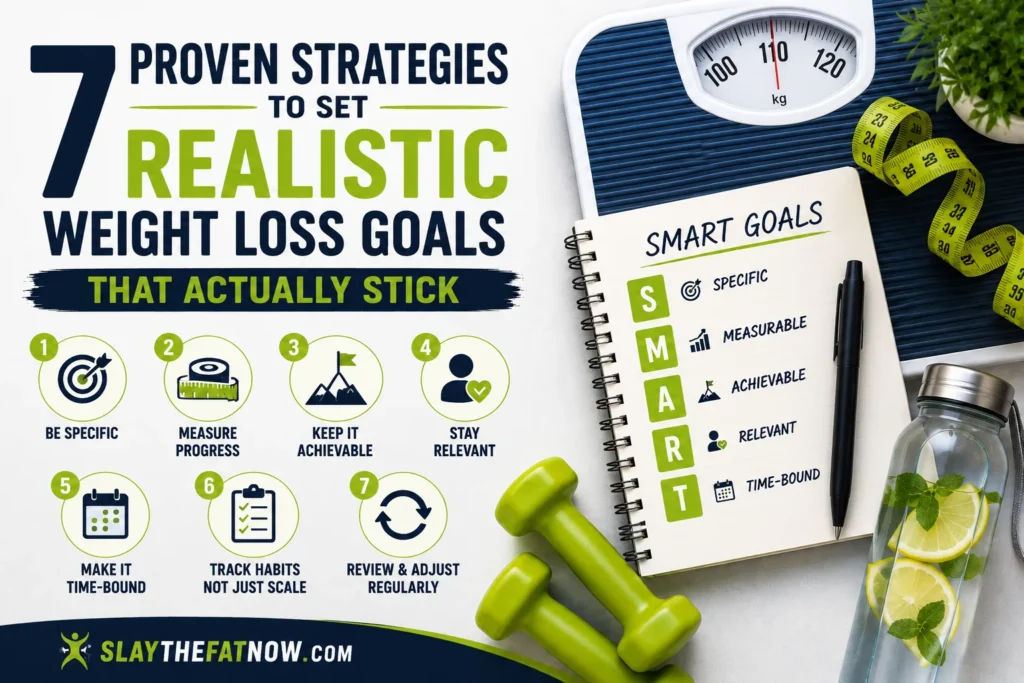
Realistic weight loss goals target 1–2 pounds per week the rate the CDC and most clinical guidelines consider both safe and sustainable. Using SMART goals (Specific, Measurable, Achievable, Relevant, Time-bound), tracking behavior instead of just the scale, and adjusting every 4–6 weeks keeps you losing fat without burning out.
The One Mistake That Kills Most Weight Loss Journeys Before They Start
You’ve been there. New year, fresh motivation, you set a goal to lose 30 pounds in two months. The first week goes great. By week three, life happens, the scale barely moves, and you feel like a failure even though you were doing everything right.
Here’s the hard truth: the goal itself was the problem. Most people don’t fail because they lack willpower. They fail because they set unrealistic weight loss goals that were never designed to succeed.
When your expectations don’t match reality, your brain reads any progress as failure. You quit. And the cycle starts over.
This guide is here to fix that. You’re going to learn exactly how to set realistic weight loss goals that motivate you every single day not just the first week.
What Are Realistic Weight Loss Goals? (And Why They Matter)
Realistic weight loss goals are targets that are grounded in biology, behavioral science, and your actual lifestyle not magazine covers or before-and-after ads. They’re the kind of goals a doctor would approve of and that your body can actually sustain.
In this article, you’ll learn:
- How to use SMART goals for weight loss the right way
- What rate of loss is genuinely healthy
- How to structure short-term and long-term goals
- Common myths that sabotage even the most motivated people
- A practical step-by-step framework you can start today
For more on the mental side of your journey, read our guide on the psychology of weight loss.
Why Setting Realistic Weight Loss Goals Is the Single Most Important Step
You might be thinking: “Aren’t ambitious goals more motivating?” Research says otherwise.
- Sustained motivation: Small wins stack up, and each one releases dopamine.
- Better adherence: You’re more likely to stick to a plan that feels manageable.
- Preserved muscle mass: Slow, steady loss mostly comes from fat.
- Metabolic protection: Crash diets tank your resting metabolic rate. Realistic goals don’t.
- Long-term results: The vast majority of people who lose weight slowly keep it off.
What the Science Actually Says About Healthy Weight Loss Rates
The CDC recommends losing 1–2 pounds per week as a safe and sustainable rate. That’s backed by decades of clinical research showing this pace is achievable through a moderate calorie deficit of 500–1,000 calories per day without extreme restriction.
A landmark study published in the American Journal of Clinical Nutrition (NCBI) found that participants who lost weight at a gradual pace were significantly more likely to maintain their loss at the 12-month mark compared to those who pursued rapid weight loss programs.
- Even a 5–10% reduction in body weight can dramatically reduce risk of type 2 diabetes and heart disease.
- The average person who sticks to a 500-calorie daily deficit loses roughly 4 pounds per month about 48 pounds per year.
- Approximately 80% of people who lose weight regain it within 5 years primarily because of unsustainable methods.
Real-World Example: How Sarah Lost 40 Pounds in 10 Months Without Burning Out
Sarah, a 38-year-old teacher from Ohio, had tried every crash diet in the book. She’d lose 8 pounds fast, then gain 12 back. Her issue wasn’t discipline it was her goals.
She set one simple realistic goal: lose 1 pound per week by eating 400 fewer calories per day and walking 30 minutes every day. That’s it.
She didn’t give up pizza. She didn’t join a gym. She tracked her meals in an app and weighed herself every Friday morning.
By month three, she was down 12 pounds. By month six, 24 pounds. By month ten, she’d hit 40 pounds lost and she didn’t feel like she was on a diet.
Ready to Build a Plan That Actually Works?
Stop guessing. Get a proven system built around your lifestyle, your goals, and your biology.
Start Your Weight Loss Journey Today → slaythefatnow.com
7 Proven Strategies to Set Realistic Weight Loss Goals (That Work Long-Term)
1. Use the SMART Goals Framework for Weight Loss
SMART goals weight loss isn’t just a buzzword it’s the most field-tested goal-setting system in behavioral health.
- Specific: “Lose weight” → “Lose 8 pounds in 8 weeks”
- Measurable: Track the number on the scale, body measurements, or clothing size
- Achievable: Is 1 pound/week realistic for your schedule and calorie needs? Yes.
- Relevant: Why does this matter to you? Write it down.
- Time-bound: Set a clear end date and a review checkpoint
2. Set Behavior Goals, Not Just Outcome Goals
You can’t fully control how fast your body loses weight. But you can control what you eat and how much you move. Set process-based goals alongside your outcome goal.
This is critical for building a healthy relationship with food that lasts beyond the diet phase.
3. Break Your Big Goal Into Milestones
If you want to lose 50 pounds, break that into ten 5-pound milestones. Celebrate each one. Your brain needs frequent wins to stay engaged.
4. Reassess Every 4–6 Weeks
Your metabolism adapts. What worked in month one may plateau by month three. Schedule regular check-ins to adjust your calorie target, activity level, or approach.
5. Separate Weight Loss From Self-Worth
Your weight is data, not a verdict on your worth as a person. This connects directly to healthy body image and weight loss.
6. Plan for Plateaus Before They Happen
Every weight loss journey hits a wall. Plateaus are physiological, not personal. Plan for them by deciding in advance how you’ll respond.
7. Track More Than the Scale
Body weight fluctuates daily by 1–4 pounds due to water, food volume, hormones, and sodium. Track waist circumference, energy levels, sleep quality, and how your clothes fit.
Myth-Busting: 5 Common Lies About Weight Loss Goals
❌ Myth: You need to lose weight fast to stay motivated.
✅ Reality: Fast loss feels good for two weeks, then crashes. Slow loss builds a track record your brain actually trusts.
❌ Myth: If you’re not losing 5+ pounds a week, something is wrong.
✅ Reality: Losing 5 pounds a week means you’re in a 17,500-calorie deficit for the week physically impossible without severe starvation.
❌ Myth: Plateaus mean your metabolism is broken.
✅ Reality: Plateaus mean your body has adapted to your current calorie level. Adjust the input, and the output changes.
❌ Myth: You either follow the plan perfectly or you’ve failed.
✅ Reality: This all-or-nothing mindset is the #1 reason people quit. Progress beats perfection every time.
❌ Myth: Your goal weight has to be your ideal body weight from a chart.
✅ Reality: Health outcomes improve measurably with even a 5–10% reduction in starting weight.
Realistic vs. Unrealistic Weight Loss Goals: A Side-by-Side Comparison
| Factor | Realistic Goal | Unrealistic Goal |
| Weekly loss target | 1–2 lbs/week | 5–10 lbs/week |
| Calorie deficit | 500–750 cal/day | 1,500–2,000+ cal/day |
| Sustainability | Months to years | Days to weeks |
| Muscle preservation | High | Low |
| Metabolic impact | Minimal slowdown | Significant slowdown |
| Long-term success rate | High | Very low |
| How you feel daily | Energized | Fatigued, irritable |
| Motivation trend | Builds over time | Crashes fast |
How to Set Realistic Weight Loss Goals: Your Step-by-Step Action Plan
- Calculate your TDEE (Total Daily Energy Expenditure) using a free online calculator.
- Subtract 500 calories from your TDEE to create a 1-pound-per-week deficit.
- Set a 90-day outcome goal (e.g., lose 12 pounds in 12 weeks).
- Write 3 weekly behavior goals: one nutrition, one exercise, one sleep or stress goal.
- Schedule a weekly weigh-in same day, same time, same conditions.
- Log your food for at least the first 4 weeks.
- Set a 4-week review date. Are you losing 1 pound/week on average? Adjust if needed.
- Build in flexibility. Plan for one meal out per week without guilt.
“The goal is not perfection. The goal is consistency over months and consistency only happens when the plan fits your real life.”
Frequently Asked Questions About Realistic Weight Loss Goals
What is a realistic weight loss goal per week?
The CDC and most clinical guidelines recommend 1–2 pounds per week as a realistic and sustainable rate. This pace is achievable through a moderate calorie deficit of 500–1,000 calories daily and does not require extreme restriction.
How do I set SMART goals for weight loss?
SMART goals for weight loss should be Specific (lose 10 lbs), Measurable (track weekly), Achievable (1–2 lbs/week), Relevant (tied to a health or lifestyle reason), and Time-bound (in 8–10 weeks). Write them down and review every 4 weeks.
Is losing 10 pounds in a month realistic?
Losing 10 pounds in a month is aggressive but not impossible for some people particularly those with a higher starting weight. For most people, 4–8 pounds per month is more sustainable and comes predominantly from fat.
What is a healthy weight loss goal for 3 months?
A healthy weight loss goal for 3 months is 12–24 pounds, which aligns with a rate of 1–2 pounds per week. This range is supported by research and achievable without extreme dieting.
Why do I keep failing to reach my weight loss goals?
The most common reason is setting goals that are too aggressive, too vague, or disconnected from your real life. Switching from outcome goals to behavior goals is one of the most effective resets you can make.
How much weight can I realistically lose in 6 months?
With a consistent 1–2 pound/week deficit, you can realistically lose 24–48 pounds in 6 months. Results vary by starting weight, adherence, and metabolism.
Should I set a goal weight or a goal size?
Both have value. A goal weight is measurable and specific. A goal size reflects body composition changes that the scale doesn’t show. Using both gives you the clearest picture.
What happens if I don’t reach my weight loss goal on time?
Extend the timeline don’t abandon the goal. Progress that’s slower than expected is still progress. Reassess your calorie intake, activity level, and sleep quality, make one adjustment, and keep going.
How many calories should I cut to lose 1 pound per week?
One pound of fat equals approximately 3,500 calories. Cutting 500 calories per day creates a weekly deficit of 3,500 calories, equating to roughly 1 pound of fat loss per week.
Is it normal to plateau during weight loss?
Yes weight loss plateaus are a normal physiological response. As you lose weight, your body requires fewer calories. Most plateaus can be broken by recalculating your TDEE or increasing activity.
How does stress affect weight loss goals?
Chronic stress elevates cortisol, which promotes fat storage and can increase appetite. Managing stress through sleep, movement, and mindfulness directly supports your weight loss goals.
Can I lose weight without exercising?
Yes. Weight loss is primarily driven by a calorie deficit, achievable through diet alone. However, exercise preserves muscle mass, boosts metabolism, and significantly improves long-term weight maintenance.
How do I stay motivated when the scale isn’t moving?
Track non-scale victories: energy levels, sleep quality, how clothes fit, strength improvements, and mood. A plateau on the scale does not mean your body isn’t changing.
What is the best app to track weight loss goals?
MyFitnessPal, Cronometer, and Lose It are three of the most popular and research-backed tracking apps. The best one is the one you’ll actually use consistently.
At what point should I adjust my weight loss goal?
If you’ve been consistently following your plan for 4 weeks and losing less than 0.5 pounds per week on average, it’s time to adjust. Either slightly reduce your calorie intake, increase your activity, or both.
You’ve Got the Knowledge Now Take the First Step
Setting realistic weight loss goals is how every lasting transformation begins. Start with one SMART goal this week and build from there.
Get Your Free Weight Loss Game Plan → slaythefatnow.com/start-here
