 Skip to content
Sleep and Weight Loss: 7 Proven Ways Better Sleep Burns Fat Faster
By the SlayTheFatNow Team
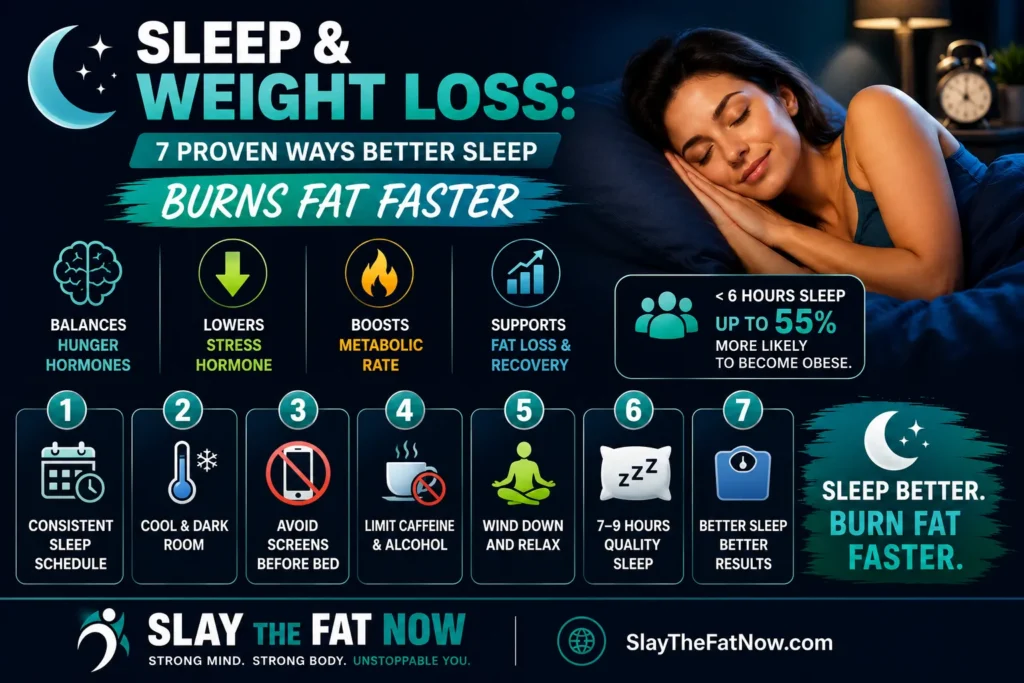
Yes sleep and weight loss are deeply connected. Getting 7–9 hours of quality sleep regulate hunger hormones (ghrelin and leptin), reduces cortisol-driven fat storage, and boosts your metabolic rate. Adults who sleep fewer than 6 hours per night are up to 55% more likely to become obese. Better sleep is one of the most overlooked fat-loss tools available.
You’re Eating Clean, Exercising Hard So Why Aren’t You Losing Weight?
You’ve cut the carbs. You’re hitting the gym four times a week. You downloaded the calorie-tracking app and actually use it. And yet the scale doesn’t move.
Here’s what most diet programs won’t tell you: if you’re sleeping 5–6 hours a night, you’re fighting your own biology. Poor sleep doesn’t just make you tired it chemically hijacks your hunger, slows your metabolism, and tells your body to store fat instead of burning it.
The relationship between sleep and weight loss is one of the most scientifically robust and most ignored areas of metabolic health. This article breaks down exactly what’s happening in your body when you shortchange your sleep, and what you can do about it starting tonight.
What Is the Sleep–Weight Connection? An Overview
Sleep isn’t downtime. It’s when your body repairs muscle, balances hormones, consolidates energy use, and resets your appetite signals. Disrupting that cycle for even a few nights throws off a cascade of metabolic processes that make fat loss significantly harder.
The link between lack of sleep and weight gain works through several mechanisms simultaneously hormones, cravings, energy expenditure, and even the decisions you make the next day. Understanding these mechanisms puts you in control.
In this guide, you’ll learn:
- The exact hormones that sleep deprivation disrupts
- How many hours of sleep are optimal for fat loss
- Real-world strategies to immediately improve sleep quality
- The comparison between good vs. poor sleep on weight outcomes
- Answers to the 15 most-searched questions on this topic
7 Key Benefits of Sleep for Weight Loss
1. Sleep Balances Your Hunger Hormones
Two hormones govern appetite: leptin (signals fullness) and ghrelin (signals hunger). A single night of poor sleep raises ghrelin by up to 28% and drops leptin significantly leaving you genuinely, biochemically hungry the next day, even if you’ve eaten enough calories. This is not a willpower problem. It’s a hormone problem caused by sleep deprivation.
2. Reduces Cortisol and Stress-Driven Fat Storage
Chronic sleep deprivation keeps cortisol elevated. Cortisol, your primary stress hormone, signals the body to store visceral fat the deep belly fat that wraps around organs and raises your risk of cardiovascular disease. More sleep = lower cortisol = less belly fat accumulation.
3. Boosts Human Growth Hormone (HGH)
The majority of your daily HGH is released during deep slow-wave sleep. HGH drives fat metabolism and muscle preservation. Cut sleep short and you cut HGH production making it harder to build lean muscle and easier to gain fat.
4. Improves Insulin Sensitivity
Even four days of sleep restriction can reduce insulin sensitivity by up to 30%. Poor insulin sensitivity means your body doesn’t efficiently move glucose into cells for energy instead storing it as fat. For anyone managing blood sugar or trying to lose weight, this is critical.
5. Controls Late-Night Cravings
Sleep loss activates the endocannabinoid system the same neural pathway that causes munchies. Research from the University of Chicago found that sleep-deprived people consumed 300+ extra calories per day, overwhelmingly from high-fat snack foods. That’s an extra 2,100 calories per week just from being tired.
6. Preserves Lean Muscle During Fat Loss
A landmark study found that dieters who slept 8.5 hours lost 55% of their weight as fat, while those sleeping 5.5 hours lost only 25% as fat the rest came from muscle. Less muscle means a slower metabolism. Sleep protects your metabolic engine.
7. Increases Resting Metabolic Rate
Your body burns calories even at rest. Sleep deprivation reduces resting energy expenditure meaning you burn fewer calories doing nothing. Combine that with increased appetite and reduced motivation to exercise, and the weight loss math becomes brutal.
The Science: Sleep and Weight Loss Data You Can’t Ignore
55% Higher obesity risk in adults sleeping under 6 hours (Harvard Health)
300+ Extra calories consumed daily when sleep-deprived (Univ. of Chicago)
30% Drop in insulin sensitivity after 4 nights of poor sleep
28% Increase in hunger hormone ghrelin after one bad night
According to the CDC, more than 1 in 3 American adults do not regularly get the recommended amount of sleep. This isn’t just a fatigue problem it’s a metabolic crisis affecting millions of weight loss efforts.
A landmark study published in the New England Journal of Medicine confirmed that sleep duration is one of the strongest independent predictors of weight gain over time separate from diet and exercise. Separate. Meaning even people who diet and work out but don’t sleep well are at a significant disadvantage.
The National Sleep Foundation recommends 7–9 hours for adults aged 18–64, and 7–8 hours for those 65+. Getting consistently less than 7 hours is where metabolic damage begins to accumulate.
A Real-World Scenario: What Poor Sleep Actually Looks Like
“I was doing everything right meal prepping, tracking macros, going to the gym. But I was also working late, sleeping 5 hours, and wondering why I wasn’t losing weight. A common pattern we see in the SlayTheFatNow community
Meet a composite of someone we’ll call Sarah. She’s 34, works a demanding desk job, started a calorie deficit three months ago, and exercises five times a week. She dropped 6 lbs in the first month, then completely stalled.
After tracking her habits more carefully, the pattern emerged: Sarah was averaging 5.5 hours of sleep due to late-night screen time and early morning alarms. Her hunger on low-sleep days was noticeably worse. She’d hit the vending machine at 3pm and raid the pantry after dinner behaviors that felt out of control, but were entirely driven by ghrelin spikes from poor sleep.
The intervention was simple: a hard 10:30pm bedtime, a wind-down routine, and blackout curtains. Within three weeks, Sarah’s late-night cravings dropped dramatically. By week six, she’d lost another 5 lbs without changing her diet or training at all.
Sleep was the missing variable.
Ready to Finally Break Your Weight Loss Plateau?
Get our free 7-day fat loss jumpstart guide built around sleep, nutrition, and metabolic reset strategies that actually work.Get the Free Guide →
Expert Insight: What Years of Seeing Fat Loss Results Teaches You
After working with thousands of people on their weight loss journeys, one pattern stands out above everything else: the people who consistently sleep 7.5–9 hours lose weight faster, keep it off longer, and experience far fewer plateaus than chronic short sleepers even when their diets are less strict.
Here are the patterns that separate successful losers from those who struggle:
- They protect their sleep schedule like a workout. They don’t skip workouts casually, and they don’t let random Netflix binges push their bedtime back two hours.
- They treat tired days as a nutrition risk. If they slept poorly, they plan their food more carefully that day because they know cravings will spike.
- They address sleep quality, not just quantity. 9 hours of fragmented sleep isn’t the same as 7.5 hours of deep, uninterrupted sleep. They optimize both.
- They don’t train intensely on very low sleep. Overtraining on poor sleep elevates cortisol further the opposite of what you want for fat loss.
Want to understand how your training fits into this? Check out our breakdown of the most effective fat-burning workouts and how to schedule them around recovery.
Reality Check: Common Sleep and Weight Loss Myths Busted
❌ Myth“I can catch up on sleep on weekends.”
✅ Reality“Social jet lag” from irregular schedules disrupts circadian rhythm and worsens metabolic markers even if total hours are the same.
❌ Myth“Sleeping more means burning fewer calories.”
✅ RealityBetter sleep raises your resting metabolic rate and prevents the hormonal disruptions that cause overeating you net burn more.
❌ Myth“Only diet and exercise matter for weight loss.”
✅ RealitySleep is the third pillar. Without it, your diet and exercise efforts work at 50–60% efficiency due to hormonal and metabolic impairment.
❌ Myth“Melatonin supplements fix your sleep.”
✅ RealityMelatonin helps with sleep timing (jet lag), not sleep quality. Addressing light exposure, stress, and sleep hygiene is more effective for fat loss benefits.
7 Practical Steps to Use Sleep as a Weight Loss Tool
🔑 The Sleep Optimization Protocol for Fat Loss
Step 1: Set a Non-Negotiable Bedtime
Pick a bedtime that allows 7.5–9 hours before your alarm. Treat it like a gym appointment. Consistency of sleep timing matters as much as duration a stable schedule keeps your circadian clock optimized.
Step 2: Eliminate Blue Light 60–90 Minutes Before Bed
Screens suppress melatonin production by up to 50%. Use blue-light-blocking glasses, enable Night Mode on all devices, or simply switch to a book, journal, or audio content in the final hour.
Step 3: Keep Your Room Cold, Dark, and Quiet
The optimal sleep temperature is 65–68°F (18–20°C). Even small amounts of ambient light disrupt sleep architecture. Blackout curtains and a white noise machine are among the highest-ROI sleep investments you can make.
Step 4: Stop Eating 2–3 Hours Before Bed
Late-night eating raises core body temperature and can suppress growth hormone release during early sleep. It also tends to add calories that undercut your deficit. Closing your eating window earlier aligns with both circadian biology and caloric control.
Step 5: Limit Alcohol
Alcohol makes you fall asleep faster but destroys sleep quality suppressing REM sleep and causing fragmented awakenings in the second half of the night. Even one drink significantly reduces slow-wave sleep, where HGH release peaks.
Step 6: Build a Wind-Down Ritual
Your nervous system needs a signal that it’s time to downshift. A 20–30 minute routine of light stretching, reading, or meditation can meaningfully reduce sleep onset time and improve sleep quality.
Step 7: Track Your Sleep
You can’t optimize what you don’t measure. A basic fitness tracker or sleep-tracking ring gives you data on sleep stages, HRV, and consistency that you can use to make targeted improvements.
Sleep and Weight Loss: Good Sleep vs. Poor Sleep Side by Side
| Factor | 7–9 Hours Quality Sleep | Less Than 6 Hours Poor Sleep |
|---|---|---|
| Hunger hormones | Leptin high, Ghrelin balanced | Ghrelin up 28%, Leptin drops |
| Cortisol levels | Normalized, anti-inflammatory | Elevated, fat-storing mode |
| HGH production | Peak release during deep sleep | Significantly suppressed |
| Insulin sensitivity | Normal glucose regulation | Up to 30% reduced |
| Daily calorie intake | On-target with plan | 300–500 extra calories consumed |
| Fat vs. muscle loss | 55% weight lost as fat | Only 25% lost as fat |
| Workout performance | Full strength and endurance | Reduced output, higher injury risk |
| Decision-making | Better food choices | Impulsive, high-calorie choices |
The data is unambiguous. When it comes to does sleep help you lose weight, the answer is a resounding yes and lack of sleep is actively pushing you in the wrong direction.
Frequently Asked Questions: Sleep and Weight Loss
1. Does sleep help you lose weight?
Yes. Quality sleep regulates hunger hormones, boosts fat-burning hormones like HGH, lowers cortisol, and improves insulin sensitivity all of which make fat loss easier and more efficient. It’s not optional if you’re serious about results.
2. Can lack of sleep cause weight gain?
Absolutely. Sleep deprivation raises ghrelin (hunger hormone), drops leptin (fullness hormone), elevates cortisol (fat-storing hormone), and triggers cravings for high-calorie foods. People who sleep less than 6 hours are up to 55% more likely to be obese.
3. How many hours of sleep do I need to lose weight?
The sweet spot for metabolic health and fat loss is 7–9 hours per night for most adults. Consistently getting 7.5 hours appears to be the minimum threshold where most metabolic benefits are preserved.
4. Does sleeping more burn more calories?
Not directly your body burns fewer calories per hour during sleep than during activity. However, better sleep raises your resting metabolic rate and prevents the hormonal disruptions that lead to overeating, resulting in a net calorie advantage.
5. What time should I go to sleep for weight loss?
Consistency matters more than a specific time. However, sleeping between 10pm–11pm aligns with natural cortisol rhythms and maximizes slow-wave sleep (when HGH peaks). Aim to be asleep by 10:30pm if possible.
6. Can naps help with weight loss?
Short naps (20–30 minutes) can reduce cortisol and improve afternoon decision-making, indirectly supporting better food choices. But they don’t replace the metabolic benefits of a full night’s sleep.
7. Does poor sleep affect belly fat specifically?
Yes. Elevated cortisol from poor sleep specifically promotes visceral fat accumulation the dangerous belly fat around organs. Studies consistently show that short sleepers carry significantly more abdominal fat than those sleeping 7+ hours.
8. How quickly can improving sleep affect weight loss?
Hunger hormones can normalize within 2–3 days of better sleep. Cortisol levels begin to drop within a week. Most people notice reduced cravings and improved energy within 1–2 weeks of consistent sleep improvement.
9. Does exercise help you sleep better and does that help weight loss?
Yes it’s a positive cycle. Regular aerobic exercise improves sleep quality and duration. Better sleep enhances workout performance and recovery. This loop accelerates fat loss significantly over time.
10. Is it harder to lose weight on night shift?
Yes. Night shift work disrupts circadian rhythm, which independently increases obesity and metabolic syndrome risk. Night shift workers need to be especially strategic about sleep timing, meal timing, and light exposure to mitigate these effects.
11. Does melatonin help with weight loss?
Melatonin can help regulate sleep timing (useful for jet lag or shift work) and has some preliminary evidence for improving insulin sensitivity. But it’s not a fat-loss supplement. The sleep quality it enables is the real benefit.
12. What foods improve sleep for weight loss?
Foods rich in magnesium (leafy greens, pumpkin seeds), tryptophan (turkey, eggs), and complex carbohydrates (oatmeal, sweet potato) support serotonin and melatonin production. Avoid heavy meals, sugar, and alcohol within 2–3 hours of bedtime.
13. Can sleep apnea prevent weight loss?
Yes and this is underdiagnosed. Sleeps apnea fragments sleep architecture, destroys HGH release, and elevates cortisol chronically. It also creates a vicious cycle since excess weight worsens apnea. If you snore heavily or wake unrested, get a sleep study done.
14. Is it normal to weigh less in the morning?
Yes. Your lightest weight of the day is typically in the morning after hours without eating or drinking, and after expelling water through breathing and sweat. This is why morning is the best time to weigh yourself for consistent tracking.
15. What’s the single most impactful sleep change for weight loss?
Setting a consistent, non-negotiable bedtime. Sleep consistency going to bed and waking at the same time daily appears to be more important than any single sleep hygiene tip, as it stabilizes your circadian rhythm and hormone cycles.
Stop Leaving Fat Loss Results on the Table
Join thousands of Americans who are using the sleep-first fat loss approach at SlayTheFatNow. Get personalized strategies, meal plans, and accountability coaching.Start Your Transformation →
Sources & References
- CDC – Adult Sleep Deprivation Statistics: cdc.gov/sleep
- Spiegel, K. et al. (2004). Sleep curtailment in healthy young men is associated with decreased leptin levels. Sleep. academic.oup.com/sleep
