 Skip to content
7 Proven Reasons You’re Not Losing Weight in a Calorie Deficit (And How to Fix It Fast)
If you’re not losing weight in a calorie deficit, you’re likely eating more than you think, underestimating calories, or experiencing metabolic adaptation. Other common causes include water retention, poor sleep, stress hormones, or medical issues like hypothyroidism. Fix your tracking, reduce stress, and reassess your deficit real fat loss will follow.
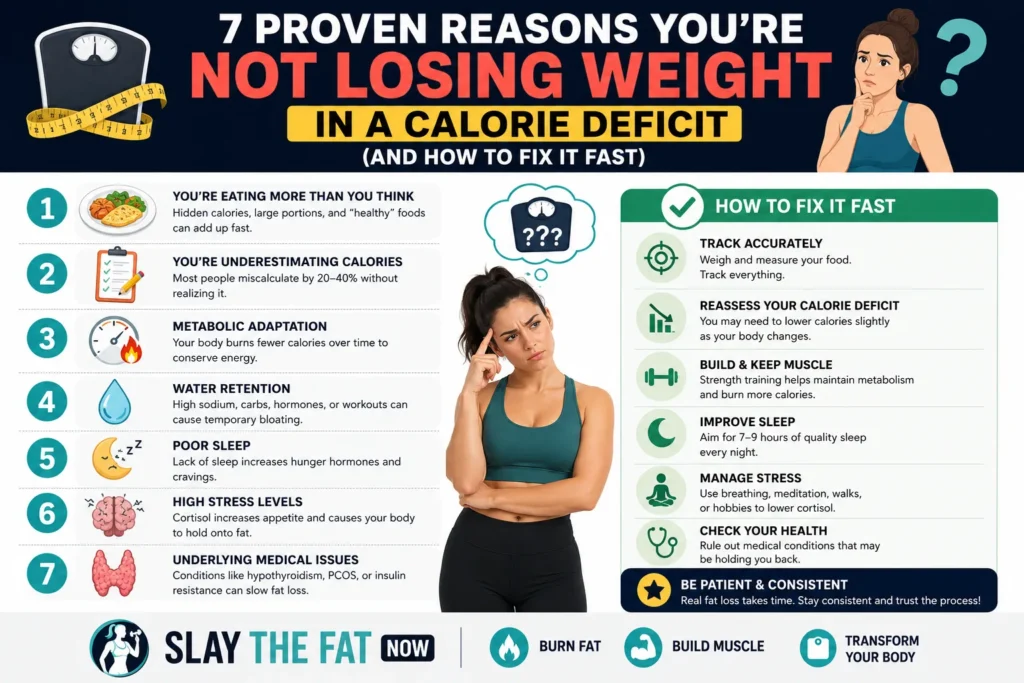
You’re Doing Everything “Right” So Why Isn’t the Scale Moving?
You’ve been counting calories for weeks. You’re eating less. You’re exercising. You’ve said no to pizza three times this week.
And yet nothing.
The scale hasn’t budged. Maybe it even went up.
This is one of the most frustrating experiences in any weight loss journey, and it happens to millions of Americans every single year. You’re not broken. You’re not cursed. But something is off and it’s probably not what you think.
If your calorie deficit is not working, there are real, fixable reasons why. This article will walk you through all of them, clearly and honestly, so you can stop spinning your wheels and start seeing results.
What Does “Calorie Deficit Not Working” Actually Mean?
A calorie deficit means consuming fewer calories than your body burns. In theory, this should always lead to fat loss. In practice, a lot of people find that not losing weight in a calorie deficit is surprisingly common and deeply confusing.
Here’s what you’ll learn in this article:
- The top 7 reasons your calorie deficit isn’t producing fat loss
- How to identify which reason applies to you
- Practical, tested fixes you can apply this week
- What the science actually says about metabolism and weight loss
- How to get back on track without starting over
Whether you’ve been at this for 2 weeks or 6 months, the answers you need are here.
Why This Matters More Than You Think
Getting your calorie deficit right isn’t just about aesthetics. Carrying excess weight is directly linked to type 2 diabetes, heart disease, sleep apnea, joint problems, and reduced quality of life. According to the CDC, nearly 42% of American adults are obese.
The cost of staying stuck isn’t just emotional. It’s physical. It compounds over years.
On the flip side, when you identify the real reason your deficit isn’t working and fix it, fat loss follows. Energy improves. Sleep gets better. Confidence climbs. The downstream effects of losing even 5–10% of your body weight are significant and measurable.
This isn’t about perfection. It’s about understanding your body well enough to stop sabotaging progress you deserve.
The Data: Why “Eat Less, Move More” Isn’t Always Simple
Research consistently shows that people underestimate their calorie intake by 20–50%. A landmark study published in the New England Journal of Medicine found that even trained dietitians underreported their food intake by an average of 223 calories per day.
A study from the National Institutes of Health on metabolic adaptation found that the body actively reduces its energy expenditure when calories drop sometimes by 300–500 calories per day. This is called adaptive thermogenesis, and it’s one of the most common reasons people find their calorie deficit not working after initial success.
Other data points worth knowing:
- Sleep deprivation increases ghrelin (hunger hormone) by up to 24% (University of Chicago study)
- Stress hormones (cortisol) promote fat storage, especially around the abdomen
- Water retention from sodium, inflammation, or hormonal cycles can mask fat loss for 1–3 weeks
- Up to 5% of adults with unexplained weight gain may have undiagnosed hypothyroidism
The bottom line: your biology is fighting back. That doesn’t mean you lose it means you need to fight smarter.
Real Example: Why Sarah Couldn’t Lose Weight Despite Eating 1,400 Calories
Sarah, a 34-year-old teacher from Ohio, came to us after four months of dieting with zero results. She was eating 1,400 calories a day, walking 10,000 steps, and doing yoga three times a week.
After a deeper look at her situation, we found three problems:
- Her food log was inaccurate. She wasn’t measuring she was estimating. Her “tablespoon” of peanut butter was closer to three tablespoons. That alone added 300+ uncounted calories daily.
- She was sleeping 5 hours a night. Her cortisol was chronically elevated, and her hunger hormones were dysregulated.
- Her calories had been at 1,400 for four months. Her metabolism had adapted. She needed a diet break followed by a recalibrated deficit.
Once she started weighing food, sleeping 7–8 hours, and cycling her calories, she lost 11 pounds in six weeks.
The science was real. The fix was simple. She just needed to know what to look for.
The 7 Real Reasons You’re Not Losing Weight in a Calorie Deficit
Reason 1: You’re Eating More Than You Think
This is the #1 culprit. Studies show people underestimate their intake by hundreds of calories daily. Cooking oils, dressings, drinks, bites while cooking, and “healthy” foods all add up fast.
Fix: Use a food scale and log everything even drinks and condiments for at least 2 weeks. Apps like Chronometer or MyFitnessPal help, but only if your portions are accurate.
Reason 2: Your Calorie Deficit Is Not Working Because of Metabolic Adaptation
When you eat less, your body burns less. This is called metabolic adaptation or adaptive thermogenesis. Your body reduces NEAT (non-exercise activity thermogenesis) you fidget less, move less unconsciously, and burn fewer calories even at rest.
Fix: Take a 1–2 week diet break at maintenance calories. This can partially reset your metabolism. Then recalculate your TDEE (Total Daily Energy Expenditure) and create a modest 300–500 calorie deficit instead of a steep one.
For help calculating your maintenance calories and building a smarter deficit, visit SlayTheFatNow.com for tools and guides designed specifically for this.
Reason 3: You’re Retaining Water
Water retention is the silent killer of motivation. It can mask weeks of real fat loss. Causes include:
- High sodium intake
- Starting a new exercise program (muscles retain water to repair)
- Hormonal fluctuations (especially in women)
- Inflammation from processed foods or alcohol
Fix: Drink more water (paradoxically, this helps your body release retained water), reduce sodium, and track weight trends over 2–4 weeks not day to day.
Reason 4: You’re Under Too Much Stress
Chronic stress raises cortisol, which signals your body to store fat particularly visceral fat around the abdomen. Cortisol also increases appetite and cravings for high-calorie foods. If you’re stressed at work, under financial pressure, or sleep-deprived, your hormones are working against fat loss even when your calories are low.
Fix: Prioritize stress management as seriously as your diet. Techniques that work: 10 minutes of daily breathwork, walking in nature, reducing caffeine after noon, and protecting sleep time. Check out stress and weight loss strategies on SlayTheFatNow.com for a deeper breakdown.
Reason 5: Poor Sleep Is Sabotaging Fat Loss
Sleep isn’t a luxury. It’s a fat-loss requirement. Sleeping fewer than 7 hours per night:
- Raises ghrelin (hunger hormone)
- Lowers leptin (satiety hormone)
- Increases cravings for high-calorie, high-carb foods
- Reduces insulin sensitivity
- Impairs muscle recovery and NEAT
Fix: Make 7–9 hours of sleep non-negotiable. Keep a consistent sleep schedule, limit screens an hour before bed, and keep your room cool and dark.
Reason 6: You Have an Underlying Medical Condition
If everything else checks out tracking is accurate, sleep is good, stress is managed and you’re still not losing weight in a calorie deficit, consider getting bloodwork done. Common culprits include:
- Hypothyroidism — slows metabolism significantly
- Polycystic Ovary Syndrome (PCOS) — causes insulin resistance and weight gain
- Insulin resistance — impairs fat burning even at a caloric deficit
- Cushing’s syndrome — causes excess cortisol production
Fix: Talk to your doctor. Request a full thyroid panel (TSH, T3, T4), fasting insulin, and blood glucose test. Don’t suffer through ineffective dieting when a medical condition may be the root cause.
Reason 7: You’re Losing Fat But Gaining Muscle
If you’re new to strength training or returning after a break, your body may be losing fat while simultaneously building muscle. Since muscle is denser than fat, the scale may stay flat or even go up even as your body composition improves significantly.
Fix: Don’t rely solely on the scale. Track measurements (waist, hips, arms), progress photos every 2–4 weeks, and how your clothes fit. These are often more accurate indicators of body recomposition than weight alone.
Expert Insight: What Actually Works When the Deficit Fails
After working with hundreds of weight loss cases, here’s what separates the people who break plateaus from those who keep spinning their wheels:
They audit before they add. When progress stalls, the instinct is to eat less or exercise more. But the smarter move is to audit what you’re already doing. Measure everything for 7 days before making changes.
They think in trends, not days. Weight fluctuates 2–5 pounds daily due to water, digestion, hormones, and sodium. Weekly averages not daily weigh-ins reveal real trends.
They protect muscle. Going too low in calories speeds up muscle loss. Muscle drives metabolism. Losing muscle slows fat loss over time. A moderate deficit with adequate protein (0.7–1g per pound of body weight) protects your most metabolically active tissue.
They cycle their calories. Alternating between deficit days and maintenance days (or higher-carb days) prevents metabolic adaptation better than a constant deficit.
They get comfortable with slow. Real, sustainable fat loss is 0.5–1 pound per week. If you expect faster results, you’ll constantly feel like it’s not working even when it is.
Reality Check: Hard Truths About Calorie Deficits
Let’s be honest about some things the fitness industry won’t always tell you:
- There is no “magic” deficit size. What works at 1,800 calories for one person may not work at 1,800 for another. TDEE calculators are estimates, not guarantees.
- Cardio alone won’t fix a broken diet. An extra 30 minutes on the treadmill burns roughly 250–300 calories the equivalent of two tablespoons of peanut butter and a banana.
- “Eating clean” doesn’t automatically mean a deficit. Avocado, nuts, olive oil, and whole grains are nutritious and calorie dense. Clean eating without tracking can still lead to a surplus.
- Weight loss plateaus are normal. Almost everyone hits one. It doesn’t mean failure. It means your body adapted. Adapt back.
- You can’t out-exercise stress and poor sleep. Hormones override willpower. Fix the foundations first.
Practical Steps to Get Your Calorie Deficit Working Again
Here’s a step-by-step action plan:
- Audit your food log for 7 days — use a digital scale, not measuring cups, for all solid foods
- Recalculate your TDEE — using an online calculator, then subtract 300–500 calories (not 1,000+)
- Check your protein intake — aim for at least 0.7g per pound of body weight daily
- Improve sleep to 7–9 hours — this single change can restart fat loss within 2–3 weeks
- Reduce sodium for 5–7 days to flush excess water retention
- Take a 10–14 day diet break at maintenance if you’ve been in a deficit for more than 12 weeks
- Get bloodwork done if nothing else explains the stall
- Track body measurements and photos, not just the scale
- Be patient for 4 full weeks before concluding something isn’t working
For a complete guide on breaking through weight loss plateaus, read this in-depth plateau guide on SlayTheFatNow.com.
Calorie Deficit Approaches: Which One Is Right for You?
| Approach | Best For | Risk |
|---|---|---|
| Standard deficit (300–500 cal/day) | Most people, sustainable results | Slow (0.5–1 lb/week) |
| Aggressive deficit (700–1,000 cal/day) | Short-term rapid loss | Muscle loss, metabolic adaptation |
| Calorie cycling | People who’ve plateaued | Requires planning |
| Intermittent fasting + deficit | People who struggle with constant tracking | Not suitable for everyone |
| High-protein deficit | Active individuals, muscle preservation | Must track macros carefully |
The right approach depends on your lifestyle, history, and goals. For personalized guidance, explore the weight loss resources at SlayTheFatNow.com to find your best-fit strategy.
Frequently Asked Questions
1. Why am I not losing weight in a calorie deficit?
The most common reasons include inaccurate calorie tracking, metabolic adaptation, water retention, poor sleep, high stress levels, or an underlying medical condition like hypothyroidism. Audit your intake and lifestyle before assuming the method doesn’t work.
2. Can you be in a calorie deficit and not lose weight?
Yes, at least temporarily. Water retention, muscle gain, and metabolic adaptation can all mask fat loss on the scale for weeks. Use body measurements and photos alongside scale weight to get a clearer picture.
3. How long does it take for a calorie deficit to work?
Most people begin to see measurable scale movement within 2–4 weeks when tracking is accurate. However, week-to-week fluctuations are normal. Track a 4-week average before drawing conclusions.
4. What is metabolic adaptation and is it real?
Yes. Metabolic adaptation (also called adaptive thermogenesis) is a scientifically documented process where your body reduces its calorie burn in response to a prolonged deficit. It can reduce your TDEE by 200–500 calories and is a leading reason for plateaus.
5. How many calories should I eat in a deficit to lose weight?
A deficit of 300–500 calories below your TDEE is considered safe and effective for most people. This typically produces 0.5–1 lb of fat loss per week. Larger deficits may accelerate initial loss but increase the risk of muscle loss and metabolic adaptation.
6. Why did I stop losing weight after the first two weeks?
The rapid loss in the first 1–2 weeks is often water weight (from glycogen depletion). When that stops, actual fat loss begins but it’s slower. This is normal, not a sign of failure.
7. Does stress really stop weight loss?
Yes. Elevated cortisol promotes fat storage, increases appetite, and disrupts sleep all of which undermine fat loss even in a calorie deficit. Managing stress is a non-negotiable part of an effective weight loss plan.
8. Is 1,200 calories too low for a calorie deficit?
For most women, 1,200 calories is the bare minimum considered safe. For men, it’s usually 1,500 calories. Going below these thresholds without medical supervision risks muscle loss, nutrient deficiencies, and severe metabolic adaptation.
9. Can hormones stop weight loss?
Yes. PCOS, hypothyroidism, elevated insulin, and high cortisol all interfere with fat metabolism. If you suspect a hormonal issue, consult a physician and request comprehensive bloodwork.
10. How do I know if I’m in a real calorie deficit?
Track every calorie using a food scale for at least 7 days. Estimates and eyeballing are notoriously inaccurate. Compare your intake to a TDEE calculator to confirm a real deficit exists.
11. Does eating too little stop weight loss?
Ironically, yes in some cases. Severely restricting calories triggers strong metabolic adaptation and muscle loss, which reduces your calorie burn. A moderate deficit is more effective long-term than extreme restriction.
12. Why is my weight loss calorie deficit not working after months?
Prolonged deficits cause metabolic adaptation. Take a 1–2-week break at maintenance calories, then return to your deficit. This approach known as a “diet break” has scientific support for resetting metabolism and improving long-term results.
13. Should I eat back exercise calories?
It depends on your setup. If you calculated your deficit using an activity-adjusted TDEE, don’t eat back exercise calories. If you used a sedentary TDEE, eating back 50% of workout calories is a reasonable approach.
14. What foods cause water retention and mask weight loss?
High-sodium foods (processed meats, canned soups, fast food), refined carbohydrates, and alcohol are common culprits. Reducing sodium intake for 5–7 days often leads to a visible drop on the scale.
15. When should I see a doctor about not losing weight?
See a doctor if you’ve been in an accurately tracked calorie deficit for 6+ weeks with zero progress, if you experience unexplained fatigue, hair loss, cold intolerance, or other symptoms alongside weight gain, or if you suspect PCOS, thyroid issues, or insulin resistance.
Take the Next Step Start Losing Weight the Right Way
If you’ve made it this far, you now understand more about why not losing weight in a calorie deficit happens than most people ever learn. You know the reasons. You know the fixes. The only step left is applying them.
Don’t keep guessing. Don’t keep cutting calories blindly. Build a plan that accounts for your metabolism, your hormones, and your actual lifestyle.
Visit SlayTheFatNow.com for free guides, calorie tools, and a step-by-step fat loss system built for real people not fitness influencers.
You’ve already done the hard part by educating yourself. Now let’s put that knowledge to work.
Sources:
