 Skip to content
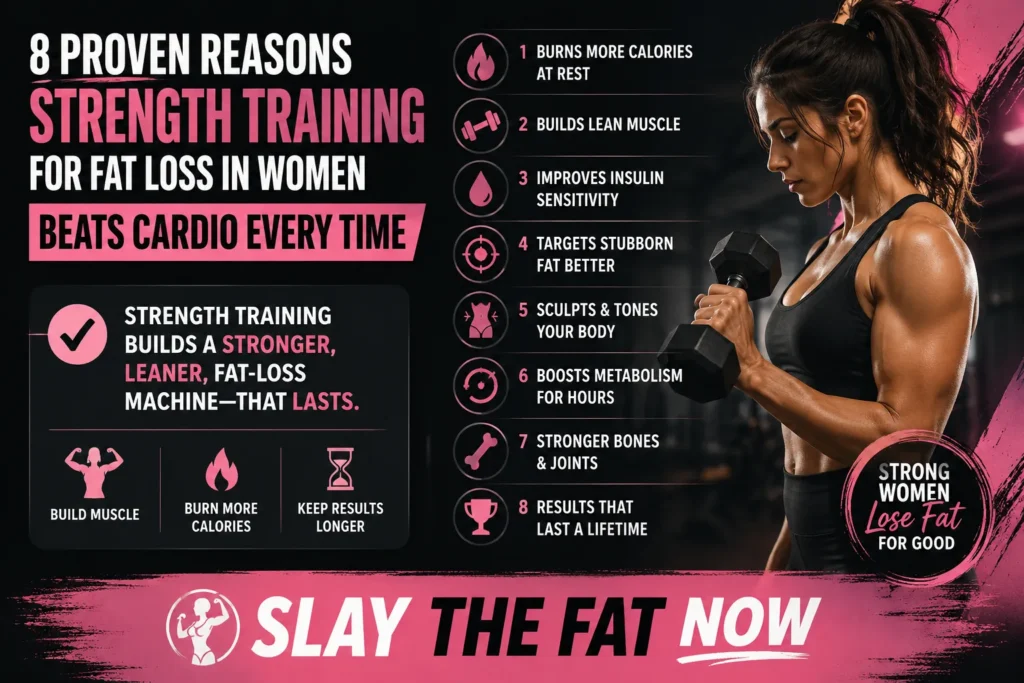
8 Proven Reasons Strength Training for Fat Loss in Women Beats Cardio Every Time
Is strength training effective for fat loss in women?
Yes, strength training for fat loss in women is one of the most effective approaches available. Unlike cardio, resistance training builds muscle that burns calories around the clock, improves insulin sensitivity, and reshapes the body permanently. Women who lift weights lose more fat, maintain more muscle, and keep results far longer than those who rely on cardio alone.
You’ve Been Doing All the Cardio and Your Body Hasn’t Changed
You’ve been on the treadmill five days a week. You’ve done the spin classes, the Zumba, the hour-long elliptical sessions. You sweat, you push, you show up and your body looks almost exactly the same as it did six months ago.
Sound familiar?
Here’s the uncomfortable truth: endless cardio is one of the least effective strategies for transforming a woman’s body. It burns calories in the moment, yes. But it doesn’t build the metabolic foundation that keeps fat off long-term. It doesn’t reshape your arms, your waist, or your legs. And in many women, chronic cardio actually increases cortisol, breaks down muscle, and makes fat loss harder over time.
What actually works? Strength training for fat loss in women. And the data behind it is overwhelming.
If you’ve been avoiding the weights section because you’re afraid of getting “bulky,” or because you don’t know where to start, this article will change your approach entirely.
What You’ll Learn in This Guide
This article covers everything you need to know about strength training for fat loss in women, including:
- Why resistance training fat loss results outlast cardio results
- How weight lifting for weight loss women works differently than it does for men
- The 8 science-backed benefits of lifting weights for female fat loss
- A clear, beginner-friendly plan to start today
- The most common mistakes women make with strength training and how to avoid them
Why Strength Training for Fat Loss in Women Works So Well
The Muscle-Metabolism Connection
Muscle tissue is metabolically expensive. Your body burns calories maintaining it 24 hours a day even while you sleep. Every pound of muscle you add increases your Resting Metabolic Rate (RMR) by approximately 6–10 calories per day. That might not sound dramatic but add 5–8 pounds of lean muscle over a year of consistent training, and you’ve permanently increased your daily calorie burn by 50–80 calories without changing anything else.
More importantly, the afterburn effect (Excess Post-Exercise Oxygen Consumption, or EPOC) from strength training is significantly higher than from cardio. After an intense lifting session, your body continues burning elevated calories for 24–48 hours during the muscle repair process. 45-minute cardio session burns calories during the workout. 45-minute strength session burns calories during the workout AND for the next two days.
Why Women Respond Particularly Well to Resistance Training
Women have lower baseline testosterone than men, which means they don’t build large, bulky muscle easily. What they do build is lean, dense, defined muscle tissue that dramatically changes body shape without adding significant scale weight.
This is why the goal of resistance training fat loss for women isn’t to get bigger. It’s to get tighter, leaner, and more defined while the scale stays similar or drops slowly, and body fat percentage falls significantly.
8 Key Benefits of Strength Training for Fat Loss in Women
1. Burns Fat While Preserving Muscle
Traditional dieting and cardio cause women to lose both fat and muscle. Strength training, especially when combined with adequate protein, preserves lean muscle during a calorie deficit so the weight you lose comes almost entirely from fat.
2. Reshapes Your Body, Not Just Shrinks It
Cardio makes you a smaller version of your current shape. Lifting weights rebuilds the structure of your body lifting the glutes, defining the shoulders, tightening the arms, narrowing the waist. Two women can weigh the same but look entirely different based on muscle distribution.
3. Improves Insulin Sensitivity for Lasting Fat Loss
Muscle is the primary tissue responsible for glucose uptake from the bloodstream. The more muscle you have, the better your body regulates blood sugar dramatically reducing fat storage and carbohydrate tolerance issues. This is especially important for women with PCOS or a history of yo-yo dieting.
4. Elevates Metabolism Long-Term
Unlike crash dieting or excessive cardio which slow metabolism through muscle loss strength training does the opposite. It permanently raises your resting metabolic rate, making it easier to maintain fat loss without extreme restriction.
5. Reduces Cortisol Belly Fat Over Time
Moderate, progressive strength training actually reduces cortisol over time unlike chronic cardio, which can raise it. Lower cortisol means less visceral belly fat accumulation.
6. Improves Bone Density
Women lose bone density progressively after age 30, accelerating sharply at menopause. Resistance training is the most effective non-pharmaceutical intervention for building and maintaining bone density reducing osteoporosis risk significantly.
7. Enhances Mental Health and Confidence
Research consistently shows that weightlifting for weight loss in women produces significant improvements in self-esteem, body image, and mood independent of how much weight is lost on the scale. Feeling physically capable and strong has profound psychological benefits.
8. Produces Sustainable Results
Because strength training changes body composition rather than just bodyweight, results are far more durable. Women who stop cardio regain fat quickly. Women who stop lifting but maintain moderate activity retain much of their muscle and metabolic advantage for months.
What the Research Actually Says
The science behind strength training for fat loss in women is clear and consistent:
- A landmark study in Obesity found that women who combined resistance training with a calorie deficit lost significantly more body fat and retained significantly more muscle than women who did cardio alone even though both groups consumed the same number of calories.
- Research published in the Journal of Strength and Conditioning Research found that the EPOC (afterburn) from heavy resistance training was 21% higher than steady-state cardio over the 24 hours post-workout.
- The American College of Sports Medicine (ACSM) recommends resistance training 2–3 days per week for adults seeking fat loss, citing its superior impact on body composition versus cardiovascular exercise alone.
- Harvard Medical School research found that 20 minutes of daily weight training was associated with less age-related abdominal fat gain than 20 minutes of aerobic activity in a long-term study of over 10,000 men and women.
- A 2021 meta-analysis in Sports Medicine confirmed that resistance training alone without any dietary intervention reduced total body fat percentage in women by an average of 1.4% over 8–12 weeks.
- The CDC’s physical activity guidelines now explicitly include muscle-strengthening activities as essential components of a healthy weight management plan not just optional addition.
The evidence is not subtle. Resistance training fat loss results are real, measurable, and consistently superior to cardio for long-term body transformation in women.
Real Example: How Priya Went From Cardio Addict to Fat-Loss Success Story
Priya, a 36-year-old accountant from Chicago, had been doing cardio 5 days a week for three years. She ran. She cycled. She attended every group fitness class her gym offered.
At 154 pounds and 5’4″, she hated how she looked. Soft arms. A belly she couldn’t shift. Legs that felt thick despite all the miles she logged.
A friend convinced her to try a structured strength training for fat loss program instead. She was terrified of the weights section and convinced she’d “get huge.”
What happened instead:
- She reduced cardio to two 20-minute sessions per week
- She started lifting weights 3 days per week using compound movements
- She increased protein to 130g per day
- She ate more calories than before 1,850 vs her previous 1,500
After 10 weeks, the scale had moved only 6 pounds. But Priya had lost 3 inches from her waist, 2 inches from her hips, and her arms and shoulders had visible definition for the first time in her adult life. Her body fat dropped from 33% to 27%.
She didn’t shrink. She transformed. That’s what weight lifting for weight loss women actually looks like.
Expert Insight: What Women Keep Getting Wrong About Lifting
After working with hundreds of women on fat loss, the same mistakes appear over and over when it comes to strength training:
Mistake 1: Going Too Light to “Tone” “Toning” is a myth. Muscle either grows or it shrinks. Using 5-pound dumbbells for 20 reps creates very little stimulus for muscle development. Women need to progressively challenge their muscles with weights that feel difficult in the 8–12 rep range. If you can do 15 reps easily, the weight is too light.
Mistake 2: Only Training Legs and Glutes Upper body training is critical for metabolism and body composition. Shoulder, back, and arm development creates the visual appearance of a smaller waist through contrast one of the fastest ways to change how your body looks without losing weight.
Mistake 3: Not Eating Enough Protein Lifting without adequate protein is like building a house without cement. Muscles are made of protein. Without 0.7–1g per pound of bodyweight daily, your body cannot repair and build muscle tissue effectively and your fat loss results will stall.
Mistake 4: Expecting Fast Scale Movement When you start lifting, muscle tissue retains water during the repair process. The scale often goes up or stays flat for 2–4 weeks while fat is being lost and muscle is being built. This terrifies women and causes them to quit right before the results appear.
Mistake 5: Inconsistent Programming Random workouts don’t produce results. Progressive overload consistently adding more weight, reps, or difficulty over time is the engine of body transformation. Following a structured program for 8–12 weeks beats doing random exercises every time.
Reality Check: The Truth About Strength Training for Women
“I’ll Get Bulky”
This is the single most common fear women have about lifting and it is physiologically unfounded. Women produce roughly 15–20 times less testosterone than men. The men you’ve seen with huge muscles train for years with very specific nutrition designed to maximize muscle growth. You will not accidentally stumble into that outcome by doing 3 sessions a week.
“It Takes Forever to See Results”
Body composition changes are visible within 4–6 weeks for most women not on the scale, but in measurements, how clothes fit, and how the body looks and feels. Full transformation takes 3–6 months. That’s not “forever” that’s faster than most people expect when they stick to a real program.
“Cardio Burns More Calories”
Per session, yes, a 60-minute run burns more calories than a 45-minute lifting session. But strength training’s calorie burns over 24–48 hours through EPOC often equalizes or exceeds this gap. And muscle built through lifting burns additional calories daily for years. The math favors lifting over time.
“Machines Are Safer Than Free Weights for Beginners”
Machines isolate muscles and reduce stabilizer development. Free weights (dumbbells, barbells, kettlebells) recruit more muscle fibers, produce greater hormonal response, and build functional strength. Beginners benefit from learning proper form with free weights from the start not developing machine-dependent movement patterns they’ll have to unlearn later.
Your Beginner Strength Training for Fat Loss Plan (3 Days Per Week)
You don’t need a complex program to start. You need consistency, progressive overload, and the right movements. Here is a simple, effective starting framework:
Day 1 — Lower Body Focus
- Goblet Squat: 3 sets × 10 reps
- Romanian Deadlift (dumbbells): 3 sets × 10 reps
- Reverse Lunge: 3 sets × 10 reps each leg
- Glute Bridge: 3 sets × 15 reps
- Plank Hold: 3 × 30–45 seconds
Day 2 — Upper Body Focus
- Dumbbell Bench Press or Push-Ups: 3 sets × 10–12 reps
- Dumbbell Bent-Over Row: 3 sets × 10 reps
- Overhead Dumbbell Press: 3 sets × 10 reps
- Lat Pulldown or Assisted Pull-Up: 3 sets × 10 reps
- Tricep Dips or Pushdowns: 3 sets × 12 reps
Day 3 — Full Body / Compound Focus
- Barbell or Dumbbell Deadlift: 3 sets × 8 reps
- Dumbbell Squat to Press: 3 sets × 10 reps
- Single-Leg Romanian Deadlift: 3 sets × 8 reps each side
- Renegade Row: 3 sets × 8 reps each side
- Farmer’s Carry: 3 × 30 meters
Rest 60–90 seconds between sets. Add weight every 1–2 weeks when the current weight feels manageable for all reps.
Pair this with 100–140g of protein daily, a 300–400 calorie daily deficit, and 2–3 light cardio sessions (walking counts), and you have a complete fat loss system.
Strength Training vs Cardio for Female Fat Loss: A Direct Comparison
| Cardio Only | Strength Training + Cardio | |
|---|---|---|
| Calorie burn per session | Higher | Moderate |
| 24-hr calorie burn (EPOC) | Low | High |
| Muscle preservation | Low | High |
| Body shape change | Minimal | Significant |
| Metabolic rate impact | Neutral to negative | Positive (long-term) |
| Hormonal effect (cortisol) | Raises (if excessive) | Lowers (with moderation) |
| Bone density | Moderate benefit | Strong benefit |
| Sustainability | Results reverse quickly | Results persist longer |
| Best for | Cardiovascular health | Fat loss + body recomposition |
The decision is not between strength training or cardio it’s about making strength training the foundation and using cardio as a supporting tool. For fat loss, resistance training belongs at the center of every woman’s fitness plan.
Frequently Asked Questions
Is strength training good for fat loss in women?
Yes, strength training is one of the most effective fat loss tools available to women. It builds muscle that raises resting metabolic rate, creates an afterburn effect that lasts 24–48 hours, improves insulin sensitivity, and reshapes the body in ways cardio simply cannot.
How many days per week should women do strength training for fat loss?
Three to four days per week is the optimal range for most women. This provides enough stimulus to build and maintain muscle while allowing adequate recovery. Beginners should start with 3 days and gradually increase as fitness improves.
Will lifting weights make women bulky?
No. Women lack the testosterone levels needed to build large, bulky muscle. Strength training produces lean, defined, firm muscle tissue that reshapes the body without adding significant size. The “bulky” fear is one of the most persistent myths in women’s fitness.
What is the best strength training program for fat loss in women?
The best program includes compound movements (squats, deadlifts, presses, rows), progressive overload, 3–4 sessions per week, and adequate protein intake. Beginners should follow a structured full-body program for at least 8–12 weeks before advancing.
How long before women see fat loss results from strength training?
Most women notice visible changes in body shape within 4–6 weeks. Significant fat loss and body decomposition results are typically visible after 8–12 weeks of consistent training with proper nutrition. Scale weight may not reflect these changes measurements and photos tell the full story.
Should women do cardio while strength training for fat loss?
Yes, moderate cardio (2–3 sessions of 20–30 minutes per week, including walking) complements strength training. It adds calorie burn without raising cortisol excessively. Cardio should support, not replace, resistance training in a fat loss plan.
What should women eat when strength training for fat loss?
Prioritize protein (0.7–1g per pound of bodyweight), moderate carbohydrates timed around workouts, and healthy fats. Eat in a modest calorie deficit (300–500 calories below maintenance). Do not undereat insufficient calories impair muscle development and fat loss simultaneously.
Can women over 40 benefit from strength training for fat loss?
Absolutely women over 40 benefits more than younger women in many ways. Strength training counteracts age-related muscle loss (sarcopenia), improves bone density, corrects hormonal fat distribution patterns, and restores metabolic rate that typically declines with age.
Is resistance training different from strength training?
The terms are often used interchangeably. Resistance training refers to any exercise that works muscles against resistance including machines, free weights, bands, and bodyweight. Strength training typically implies progressive overload with the goal of building strength and muscle. Both produce fat loss benefits.
How much weight should women lift for fat loss?
Choose weights that feel challenging by the last 2–3 reps of each set, typically in the 8–12 rep range. If you can complete all reps easily, increase the weight. Progressive overload gradually increasing resistance over time is the key driver of results.
Can strength training replace cardio for fat loss?
For body composition, yes strength training alone produces meaningful fat loss without any cardio. Adding moderate cardio accelerates results. But women who lift consistently without doing cardio still transform their bodies far more effectively than women who do only cardio.
What are the best strength training exercises for women’s fat loss?
The most effective exercises are compound movements: squats, deadlifts (conventional and Romanian), lunges, hip thrusts, bench press, rows, overhead press, and pull-ups or lat pulldowns. These recruit multiple large muscle groups simultaneously for maximum metabolic impact.
Does strength training help with belly fat in women?
Yes, indirectly. You cannot spot-reduce fat, but reducing overall body fat percentage through strength training consistently reduces belly fat. The insulin sensitivity improvements and cortisol reduction from lifting also specifically target visceral (belly) fat accumulation.
How do I track fat loss from strength training if the scale doesn’t move?
Use body measurements (waist, hips, arms, thighs), progress photos every 2–4 weeks, how your clothes fit, and body fat percentage testing (DEXA scan, InBody, or skinfold calipers). These tell the true story of body recomposition that the scale misses.
Is bodyweight training as effective as lifting weights for fat loss?
Bodyweight training is beneficial and better than no training. However, free weights and barbells allow for progressive overload far more easily the key driver of muscle growth and long-term fat loss. As fitness improves, bodyweight training becomes insufficient stimulus for continued progress.
Stop Running in Circles. Start Lifting for Real Change.
The research is clear. The results speak for themselves. Strength training for fat loss in women is not just effective it’s the most transformative approach you can take for your body, your metabolism, your hormones, and your long-term health.
You don’t need to spend hours on the treadmill. You don’t need to fear the weights section. You need a plan, a little protein, and the willingness to show up three times a week and push.
Get your personalized strength training fat loss plan at SlayTheFatNow.com →
Your body is ready to change. Give it the right signal.
References:
