 Skip to content
7 Proven Ways to Lose Weight Without Exercise
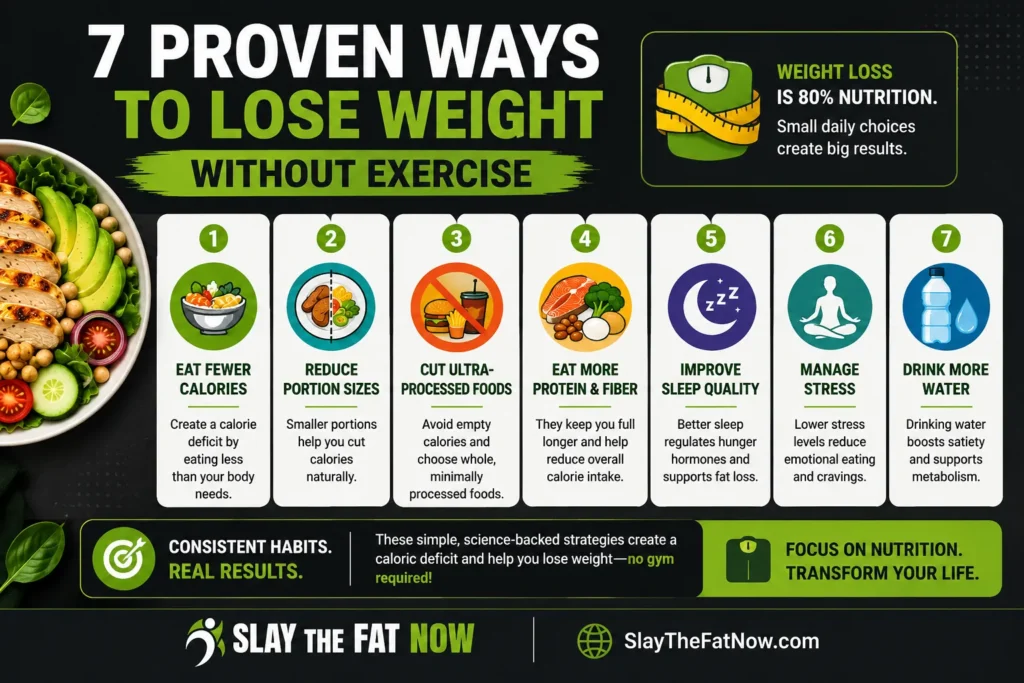
You can lose weight without exercise by eating fewer calories than your body burns through diet-only methods: reducing portion sizes, cutting ultra-processed foods, increasing protein and fiber intake, improving sleep quality, managing stress, and drinking more water. These strategies alone can create a consistent caloric deficit that leads to sustainable fat loss.
Here’s a truth most fitness influencers don’t want you to hear: you do not need to exercise to lose weight.
You’ve probably tried it the hard way dragging yourself to the gym, doing 45-minute cardio sessions five days a week, and still watching the scale barely budge. You’re exhausted, frustrated, and ready to give up. Sound familiar?
The mistake millions of Americans make is believing that working out is the cornerstone of weight loss. It isn’t. Diet is responsible for roughly 80% of your results. Exercise matters for health, but for pure fat loss, what you eat and how you eat it is the game-changer.
In this guide, you’ll learn exactly how to lose weight without exercise using strategies backed by science, not fads. Whether you’re dealing with bad knees, a packed schedule, or simply hate the gym, this is for you.
What “Weight Loss Without Exercise” Actually Means
Weight loss happens when your body is in a caloric deficit meaning you consume fewer calories than you burn. Your body burns calories all day just to exist: breathing, digesting food, pumping your heart. This is your Basal Metabolic Rate (BMR), and for most adults, it accounts for 60–75% of total daily energy expenditure.
Exercise can add to that burn, but it’s not the only lever. By eating smarter, sleeping better, and making a few lifestyle adjustments, you can create a meaningful deficit without ever stepping foot in a gym.
Want to understand your starting point? Check out our free calorie calculator to estimate your daily burn.
Why Diet-Only Weight Loss Is Underrated
- 1. Sustainable for most people. You can maintain dietary changes far longer than grueling workout routines. Habits that stick are habits that work.
- 2. No injury risk. Millions of Americans avoid exercise due to joint pain, chronic conditions, or disability. Diet-based strategies are inclusive by default.
- 3. Faster initial results. Cutting 500 calories from your diet is far easier than burning 500 calories through exercise (which takes 45–60 minutes of moderate cardio).
- 4. Time-efficient. Planning meals doesn’t require a commute to the gym, locker rooms, or recovery days.
- 5. Addresses the root cause. Most weight gain is driven by food choices, not inactivity. Fixing diet tackles the problem at its source.
The Science: What the Data Says About Weight Loss Without Working Out
80% of weight loss outcomes are attributed to diet, not exercise (Harvard T.H. Chan School of Public Health)
42% of American adults are obese as of 2024, despite gym membership rates near all-time highs (CDC)
500 calories/day deficit needed to lose approximately 1 lb. per week through diet alone
56% more weight lost by those who focused on diet vs. exercise-only groups in a 2018 NIH study
A landmark study published in the New England Journal of Medicine found that caloric restriction alone produced weight loss comparable to and in some cases greater than exercise-based interventions over a 2-year period.
The CDC’s obesity data consistently shows that Americans who exercise regularly but eat poorly still struggle with weight. Meanwhile, people who make dietary changes alone see meaningful, lasting results.
How Sarah Lost 23 Pounds in 4 Months No Gym Required
Sarah, a 38-year-old office manager from Ohio, had a herniated disc that made most forms of exercise painful. She’d gained 35 pounds over three years and felt stuck. Her doctor cleared her for light walking but said nothing strenuous.
Instead of fighting her body, Sarah focused entirely on her diet: she swapped her 600-calorie morning Starbucks order for black coffee and a boiled egg. She replaced fast food lunches with prepped chicken and vegetables. She stopped eating after 8 PM. She drank 80 oz of water daily.
Result: 23 lbs lost in 4 months. No gym. No cardio. Just consistent, intentional eating. Her back pain also reduced, which she attributes partly to the lower body weight reducing spinal pressure.
Sarah’s story isn’t a miracle it’s basic energy math applied consistently. You can do the same.
Ready to Start Losing Weight Without the Gym?
Get our free 7-day diet-only weight loss meal plan designed for busy Americans who don’t have time for the gym but are ready for real results.Download Your Free Meal Plan
7 Proven Ways to Lose Weight Without Exercise
1. Create a Caloric Deficit Through Portion Control
This is the non-negotiable foundation. Weight loss without working out starts and ends with calories. You don’t need to count every calorie obsessively, but you do need awareness.
Start by reducing your portions by 20%. Use smaller plates. Never eat directly from a bag or box. Pause halfway through a meal for 5 minutes research shows this simple pause reduces total intake by up to 15%.
Pro tip: The average American underestimates their calorie intake by 40%. Take one week to log everything you eat in an app like MyFitnessPal. The awareness alone will change your behavior.
2. Prioritize Protein at Every Meal
Protein is your greatest diet-only weapon. It’s the most satiating macronutrient meaning it keeps you full longer, reduces cravings, and requires more energy to digest (known as the thermic effect of food).
Aim for 0.7–1 gram of protein per pound of bodyweight daily. Think: eggs, chicken breast, Greek yogurt, cottage cheese, lentils, tuna.
3. Cut Ultra-Processed Foods First
Ultra-processed foods (chips, cookies, sugary drinks, fast food) are engineered to override your fullness signals. A 2019 NIH clinical trial found that people eating ultra-processed diets consumed an average of 500 more calories per day than those eating whole foods even when both groups had equal access to food.
You don’t need to eat perfectly. Just move the junk out of your immediate environment. If it’s not in your kitchen, you won’t eat it at 10 PM.
4. Increase Fiber Intake
Fiber slows digestion, stabilizes blood sugar, and makes you feel full on fewer calories. The average American gets just 15 grams of fiber per day. The recommended target is 25–38 grams.
Add these fiber powerhouses to your daily meals: lentils (15g per cup), avocado (10g each), chia seeds (10g per 2 tbsp), black beans (15g per cup), broccoli (5g per cup). Small additions, big impact.
5. Optimize Your Sleep
This one surprises people. Poor sleep is one of the biggest hidden drivers of weight gain. When you sleep less than 7 hours, your body produces more ghrelin (the hunger hormone) and less leptin (the fullness hormone). The result: you eat more the next day often 300–400 additional calories without realizing it.
Prioritize 7–9 hours of quality sleep. This is diet-adjacent advice that directly impacts your ability to lose weight without exercise. It’s not optional.
6. Manage Stress and Cortisol
Chronic stress elevates cortisol, a hormone that promotes fat storage particularly around your abdomen. Stress also triggers emotional eating and cravings for calorie-dense comfort foods.
You don’t need to eliminate stress (impossible). But building in 10 minutes of daily stress reduction whether that’s journaling, deep breathing, or a short walk can measurably reduce cortisol and its impact on weight.
7. Drink More Water Strategically
Drinking 16 oz of water 30 minutes before meals reduces calorie intake by an average of 13% per meal, according to a study in the journal Obesity. Water also temporarily boosts metabolism by 24–30% for 1–1.5 hours after drinking.
Replace sugary drinks entirely. A single can of regular soda is 150 calories. Two per day = 300 calories = 31 pounds of stored fat over a year if nothing else changes.
Expert Insight: What Actually Works for Long-Term Diet-Only Weight Loss
After analyzing thousands of weight loss journeys, a clear pattern emerges: the people who succeed without exercise are not the most disciplined they’re the most strategic about their environment.
They don’t white-knuckle through cravings. They restructure their kitchens so bad choices are hard and good ones are easy. They meal prep on Sunday so there’s no decision fatigue at 7 PM on Tuesday. They have a go-to breakfast that requires zero thought.
Three behaviors separate those who succeed from those who quit:
- ✓They track, even imperfectly. Awareness beats perfection every time.
- ✓They build consistent anchor habits same breakfast, same lunch, varied dinners.
- ✓They plan for failure. What will you eat when you’re tired, stressed, or traveling? Having a plan prevents derailment.
Reality Check: Common Myths About Losing Weight Without Working Out
❌ Myth “You need to eat less than 1,200 calories to lose weight fast.”
✅ Truth Severe restriction slows metabolism and causes muscle loss. A moderate deficit of 500–750 cal/day is far more effective long-term.
❌ Myth “Carbs are the enemy and must be eliminated.”
✅ Truth Total calorie balance matters most. Whole-food carbs (oats, sweet potato, legumes) are filling and nutritious not fattening.
❌ Myth “Weight loss supplements can replace dietary changes.”
✅ Truth No supplement produces meaningful weight loss without a caloric deficit. Most are expensive and unproven. Diet comes first, always.
❌ Myth “Losing weight without exercise means you’ll lose muscle.”
✅ Truth Adequate protein intake (0.7–1g/lb bodyweight) preserves muscle during weight loss even without resistance training.
Comparing Weight Loss Approaches: Diet Only vs. Exercise Only vs. Both
| Factor | Diet Only | Exercise Only | Diet + Exercise |
|---|---|---|---|
| Fat Loss Speed | Fast | Slow | Fastest |
| Sustainable Long-Term | High | Low (injury/burnout) | High (when balanced) |
| Accessible to Everyone | Yes | No | Limited |
| Cardiovascular Health | Moderate | High | Highest |
| Muscle Preservation | Moderate (with protein) | Good | Best |
| Time Required | Minimal | Significant | Most |
| Beginner Friendly | Yes | Moderate | Moderate |
The data is clear: diet-only weight loss is a legitimate, effective strategy especially as a starting point. For overall health, adding light movement eventually is ideal, but it is not a prerequisite for losing weight.
Frequently Asked Questions
1. Can you really lose weight without exercise?
Yes, absolutely. Weight loss is primarily determined by the caloric balance between what you eat and what your body burns at rest. By eating fewer calories than your BMR requires, your body burns stored fat for energy no exercise required.
2. How much weight can you lose in a month without exercising?
With a consistent caloric deficit of 500–750 calories per day through diet alone, most people lose 4–6 pounds per month. Results vary based on starting weight, metabolism, age, and how strictly dietary changes are maintained.
3. What is the fastest way to lose weight without working out?
The fastest approach combines cutting ultra-processed foods, increasing protein, reducing refined carbohydrates, eliminating liquid calories (soda, alcohol, juice), and improving sleep. Together, these create a substantial daily deficit without any exercise.
4. Is diet alone enough for significant weight loss?
Yes. Research consistently shows that diet is responsible for 80% or more of weight loss outcomes. Exercise accelerates and maintains results but is not required for significant fat loss to occur especially in the first 3–6 months.
5. Will I lose muscle if I diet without exercising?
Some muscle loss is possible during any weight loss phase, but it’s minimized by eating adequate protein (0.7–1g per pound of body weight). Without resistance exercise, you won’t build new muscle, but high protein intake largely preserves existing muscle mass.
6. What foods help you lose weight without exercise?
Focus on high-protein foods (chicken, eggs, fish, Greek yogurt), high-fiber foods (lentils, vegetables, chia seeds), and whole foods in general. Avoid ultra-processed snacks, sugary drinks, and refined carbohydrates that spike hunger without providing satiety.
7. How many calories should I eat to lose weight without exercise?
Calculate your Basal Metabolic Rate (BMR) using your height, weight, and age, then subtract 500–750 calories from that number. This typically falls between 1,400–1,800 calories per day for most American adults, depending on body size and age.
8. Does intermittent fasting work for weight loss without exercise?
Yes, intermittent fasting is an effective diet-only strategy. By restricting your eating window (e.g., 16:8 method eating within 8 hours), most people naturally consume fewer calories, which creates a deficit. It works best when you still eat nutritious, whole foods during your eating window.
9. Can drinking water help you lose weight without exercise?
Strategically, yes. Drinking 16 oz of water before each meal reduces calorie intake by up to 13%. Replacing high-calorie beverages (soda, juice, alcohol) with water can eliminate hundreds of calories from your daily intake effortlessly.
10. Is it possible to lose belly fat without exercising?
You cannot spot-reduce fat from specific areas, but overall fat loss through a caloric deficit will reduce belly fat over time. Reducing refined carbs, sugar, and alcohol specifically tends to reduce abdominal fat more noticeably than other approaches.
11. How does sleep affect weight loss without exercise?
Sleep is critical. Less than 7 hours per night increases hunger hormones (ghrelin) and decreases fullness hormones (leptin), causing you to eat 300–400 extra calories the following day on average. Prioritizing 7–9 hours of sleep is one of the most underrated diet-only weight loss tools.
12. Can stress cause weight gain even if you eat the same amount?
Yes. Elevated cortisol from chronic stress increases fat storage, particularly in the abdominal area, and directly triggers cravings for calorie-dense comfort foods. Managing stress is a legitimate and underutilized tool for weight control without changing exercise habits.
13. What is the best diet plan for weight loss without exercise?
There’s no single “best” plan, but diets that emphasize whole foods, adequate protein, high fiber, and calorie awareness consistently produce results. Mediterranean-style eating, high-protein diets, and low-processed-food approaches all work well choose the one that fits your lifestyle and you can maintain long-term.
14. Are weight loss pills effective without exercise?
Most over-the-counter weight loss supplements have limited evidence of effectiveness and can carry side effects. FDA-approved medications (like semaglutide) do produce results but require a doctor’s supervision and address weight as a medical condition. Diet-based changes are safer, more accessible, and more sustainable for most people.
15. How long does it take to see results from diet-only weight loss?
Most people notice changes within 2–3 weeks of consistent dietary changes. The first week often shows a faster drop due to water weight loss as carbohydrate stores deplete. True fat loss becomes visible and measurable around weeks 3–4, with consistent results following after that.
Stop Waiting for the “Perfect Time” to Start
You don’t need the gym. You don’t need to be perfect. You just need a starting point. Our community at SlayTheFatNow has helped thousands of real people lose weight through diet alone and we’re ready to help you next.Start Your Journey Today
Sources:
New England Journal of Medicine — Caloric Restriction Study
NIH Ultra-Processed Food Study — Cell Metabolism
This article is for informational purposes only and does not constitute medical advice. Consult a qualified healthcare provider before making significant changes to your diet.
