 Skip to content
Scale Not Moving? 9 Real Reasons Your Weight Loss Has Stalled (And What To Track Instead)
When the scale is not moving during weight loss, it’s usually water retention, glycogen storage, hormonal shifts, or metabolic adaptation not a lack of fat loss. The scale measures total body weight, not body fat, so it can stay flat for weeks even while you’re genuinely losing fat. Non-scale victories like measurements and how clothes fit often reveal progress first.
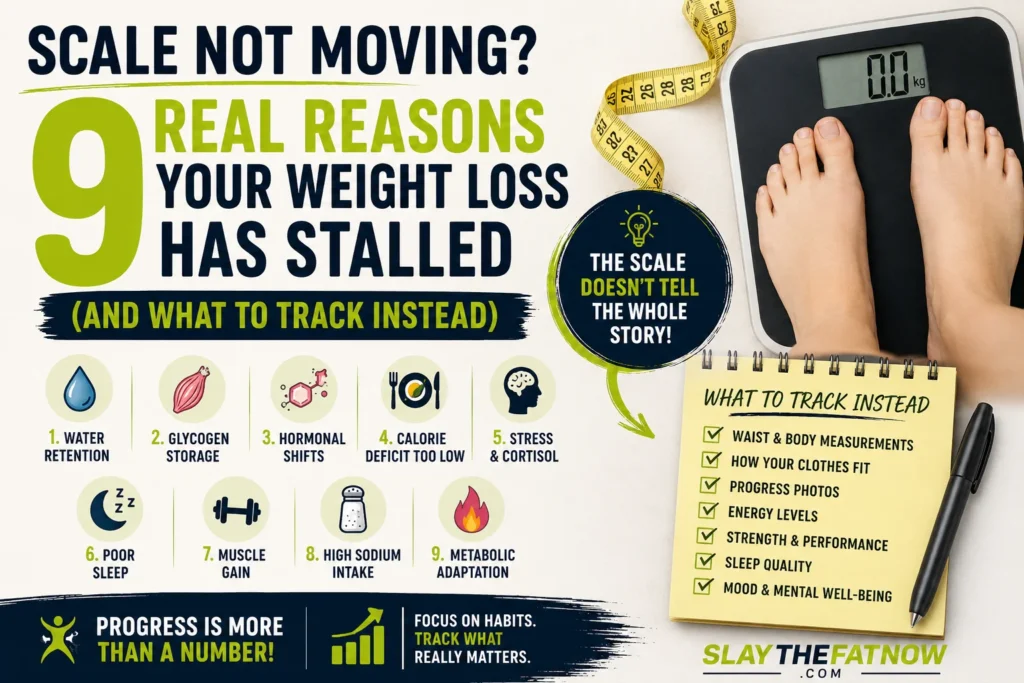
The Number That Lies to You Every Morning
You’ve eaten clean for two weeks. You’ve hit your workouts. You stepped on the scale this morning expecting a reward and it showed the exact same number it showed ten days ago.
So you do what almost everyone does next: you assume you’re doing something wrong. Maybe you cut calories further. Maybe you add another workout. Maybe you just feel like giving up, because if the scale isn’t moving, what’s the point?
Here’s the uncomfortable truth: the scale not moving doesn’t mean you’ve failed. It often means the scale is the wrong tool for the question you’re actually asking. Your body weight and your body fat are not the same number, and conflating them is the single biggest reason people quit programs that were actually working.
What It Really Means When the Scale Is Not Moving
A stalled scale during active weight loss usually reflects what’s happening underneath the surface, not a lack of progress. A bathroom scale measures total mass fat, muscle, water, glycogen, and even the food currently in your digestive tract all at once. It cannot isolate fat loss from everything else your body is doing.
In this article, you’ll learn:
- The real physiological reasons the scale stalls even during genuine fat loss
- What the research says about water retention, glycogen, and metabolic adaptation
- A realistic week-by-week example of how this plays out
- The non-scale victories that are often more reliable than the number itself
- Exactly what to do and what not to do when this happens to you
Why Understanding This Matters More Than You Think
Getting this right isn’t just about feeling better on a Tuesday morning. It changes what you actually do next:
- Time: Misreading a stall as failure leads people to quit programs days or weeks before results would have shown up on the scale.
- Money: Switching diets or buying new supplements every time the scale stalls wastes money chasing a problem that often doesn’t exist.
- Health: Overcorrecting with extreme calorie cuts in response to a stall can backfire, slowing metabolism further and increasing the risk of binge cycles.
- Confidence: Understanding that the scale not moving is biologically normal protects your motivation for the months that actually matter.
The Research Behind a Stalled Scale
This isn’t just anecdotal. Government and peer-reviewed research backs up nearly everything happening when your scale stops moving:
- NIH researcher Kevin Hall’s modeling work shows most weight loss interventions reach a plateau around six months, even when people stay consistent with diet and exercise.
- A peer-reviewed study of 71 adults with obesity on low-energy diets found measurable metabolic adaptation after just eight weeks meaning resting metabolic rate dropped beyond what body composition changes alone would predict.
- NIH-funded research into “Biggest Loser” competition participants found resting energy expenditure had dropped roughly 500 kcal/day more than expected based on their new body composition, and this metabolic slowing persisted for years afterward.
- Mayo Clinic explains that early rapid weight loss comes largely from glycogen and fluid stores, not fat, which is why initial scale drops are often faster than later, fat-driven losses.
- Research on body recomposition shows people new to strength training can simultaneously lose fat and gain muscle, producing little to no scale movement despite real physical change.
Sources: NIH/NIDDK, PMC peer-reviewed studies, Mayo Clinic full citations in the FAQ section below.
Put simply: a flat scale during a calorie deficit is one of the most well-documented, expected patterns in weight loss research. It’s not a sign that something is broken.
A Real Example: What a Stall Actually Looks Like Week by Week
Consider “James,” a composite scenario reflecting a pattern seen constantly among people frustrated by a stalled scale. He started a calorie deficit and lost 6 pounds in two weeks mostly water and glycogen, even though it felt like pure fat loss.
- Week 3–4: The scale flattened completely. He hadn’t changed anything, but panic set in and he nearly switched diets entirely.
- Week 5: Instead of quitting, he started tracking waist measurements and progress photos alongside the scale.
- Week 6: The scale still hadn’t moved, but his waist was down half an inch and his work pants fit looser.
- Week 8: The scale finally dropped 3 pounds in a single week a delayed reflection of fat loss that had been happening the entire time, just masked by water retention and stress from a demanding work month.
The lesson: when the scale is not moving, the body is often catching up to changes that already happened, not failing to make them.
Expert Insight: What Years of Stalled Scales Have Taught Us
After years of watching people respond to a stalled scale, a clear pattern emerges: the people who keep progressing are the ones who stop treating the scale as the only scoreboard. The people who quit are the ones who let one flat week override weeks of consistent behavior.
1. Water retention swings are bigger than people expect
A single salty meal, a hard workout, travel, or alcohol can shift body water by several pounds within 24 to 48 hours. None of that reflects fat gain, yet it’s often misread as “the diet stopped working.”
2. Stress and sleep matter as much as food
Elevated cortisol from poor sleep or chronic stress drives water retention and can mask fat loss on the scale for days at a time, independent of what you’re eating.
3. The people who stick with it track more than one metric
Successful clients almost always have a second or third data point measurements, photos, how clothes fit, strength in the gym so one flat scale reading never tells the whole story alone.
Reality Check: Myths About a Scale Not Moving
Myth: “If the scale isn’t moving, I’m not in a deficit.”
Reality: You can be in a genuine calorie deficit and still see zero scale movement for one to two weeks due to water retention completely masking fat loss underneath.
Myth: “I should cut calories further the moment the scale stalls.”
Reality: Cutting too aggressively in response to a short stall often backfires, increasing stress hormones, hunger, and the odds of bingeing without speeding up actual fat loss.
Myth: “Body recomposition isn’t real progress if the scale doesn’t move.”
Reality: Simultaneously losing fat and gaining muscle is one of the most beneficial outcomes possible, even though it’s the scenario most likely to leave the scale completely flat.
Myth: “A weight loss plateau means I’ve hit my body’s true limit.”
Reality: Plateaus around the six-month mark are largely driven by metabolic adaptation, not a fixed biological ceiling they typically respond to adjusted calories, activity, or simply more time.
Practical Advice: What To Do When the Scale Is Not Moving
Do this:
- Switch to weekly averages. Weigh in most days, but judge progress by the 7-day average instead of any single number.
- Track at least one non-scale metric. Waist measurement, progress photos, or how a specific pair of pants fits are far more stable indicators of fat loss.
- Give it two to four weeks before reacting. Most short stalls resolve on their own once water retention catches up to actual fat loss.
- Check sleep and stress first. Before touching your diet, rule out poor sleep or high stress as the cause of a stalled scale.
- Reassess calories only after a genuine multi-week plateau. If the average truly hasn’t moved in 3–4 weeks with consistent tracking, a modest calorie or activity adjustment may be warranted.
Avoid this:
- Drastically cutting calories the same week the scale stalls.
- Weighing yourself multiple times a day and reacting to each number.
- Abandoning a plan that’s working just because the scale hasn’t caught up yet.
- Ignoring strength, energy, and how clothes fit in favor of the scale alone.
Comparison: Which Tracking Method Tells the Truth Fastest?
| Method | Reacts To | Best Used | Reliability During a Stall |
|---|---|---|---|
| Daily scale weight | Water, food, hormones, fat | Spotting daily noise patterns | Low alone |
| Weekly scale average | True weight trend | Tracking real progress over time | High |
| Waist/hip measurements | Fat distribution changes | Confirming fat loss during a stall | High |
| Progress photos | Visible body composition | Long-term motivation | Medium–High |
| Strength/performance logs | Muscle and recomposition | Spotting recomp during a stall | Medium–High |
The most reliable approach combines a weekly scale average with at least one physical measurement. If you want a structured way to track all of these together, our 1:1 coaching program is built specifically around interpreting stalls like these correctly.
Frequently Asked Questions About a Scale Not Moving
Why is the scale not moving even though I’m eating less?
Water retention, glycogen storage, and hormonal fluctuations can completely mask fat loss for one to two weeks, even while you remain in a genuine calorie deficit.
Can you lose fat without the scale moving at all?
Yes. This is common during body recomposition, where you lose fat and gain muscle at similar rates, leaving total body weight largely unchanged for weeks.
How long is normal for the scale to stay the same during a diet?
A stall of one to three weeks is common and usually resolves on its own. Plateaus lasting four or more weeks with consistent tracking may warrant a calorie or activity adjustment.
Does water retention really affect the scale that much?
Yes. Sodium intake, carbohydrate intake, stress, hormones, and intense workouts can each shift body water by several pounds within a day or two.
What is a weight loss plateau caused by?
Plateaus, often appearing around the six-month mark of a diet, are largely driven by metabolic adaptation, where the body’s energy expenditure drops as weight decreases.
Should I weigh myself daily or weekly?
Daily weighing can be useful for spotting patterns, but the number that matters most is your weekly average, since single-day readings are too noisy to judge progress accurately.
What are non-scale victories?
Non-scale victories are signs of progress that don’t show up on a bathroom scale, such as looser clothing, smaller waist measurements, more energy, and improved strength.
Why did I gain weight after eating healthy all week?
This is almost always water retention from sodium, carbohydrates, hormonal cycles, or post-workout inflammation rather than actual fat gain, and it typically resolves within days.
Does stress really stall weight loss?
Yes. Elevated cortisol from chronic stress or poor sleep increases water retention and can blunt fat loss progress on the scale even when your diet hasn’t changed.
How do I know if I’m in a body recomposition phase?
Signs include a flat or barely-moving scale combined with looser clothing, visible muscle definition, and strength improvements in the gym especially common for beginners who are new to strength training.
Should I cut more calories if the scale stops moving?
Not immediately. Give it two to four weeks of consistent tracking first, since most short stalls resolve naturally as water retention catches up to real fat loss.
Can muscle gain explain why the scale isn’t moving?
Yes. Gaining muscle while losing fat at a similar rate can keep total body weight nearly unchanged, even though your body composition is genuinely improving.
What should I track instead of just the scale?
Track your weekly weight average alongside waist or hip measurements, progress photos, and strength or energy levels for a more complete and accurate picture.
Is it normal to plateau around the six-month mark of a diet?
Yes. Research modeling weight loss interventions shows most plateaus occur around six months, largely due to the body’s metabolic rate adjusting downward as weight decreases.
Will the scale eventually reflect my progress if I stay consistent?
In most cases, yes. Once water retention and glycogen shifts stabilize, the scale typically catches up to reflect the fat loss that was already happening underneath.
Your Next Step
The scale not moving isn’t proof that your effort failed. In most cases, it’s proof that your body is doing exactly what bodies do under a calorie deficit holding water, adjusting hormones, and slowly catching up to the real change happening underneath.
Give it a few more weeks. Track something besides the number. The progress is very likely already there.
Ready to track progress the right way? Explore the full weight loss program on Slay The Fat Now for your next step.
Sources :
peer-reviewed study on metabolic adaptation in low-energy diets (PMC);
