 Skip to content
How Much Protein Do Women Need to Lose Weight? The Ultimate 5-Step Guide
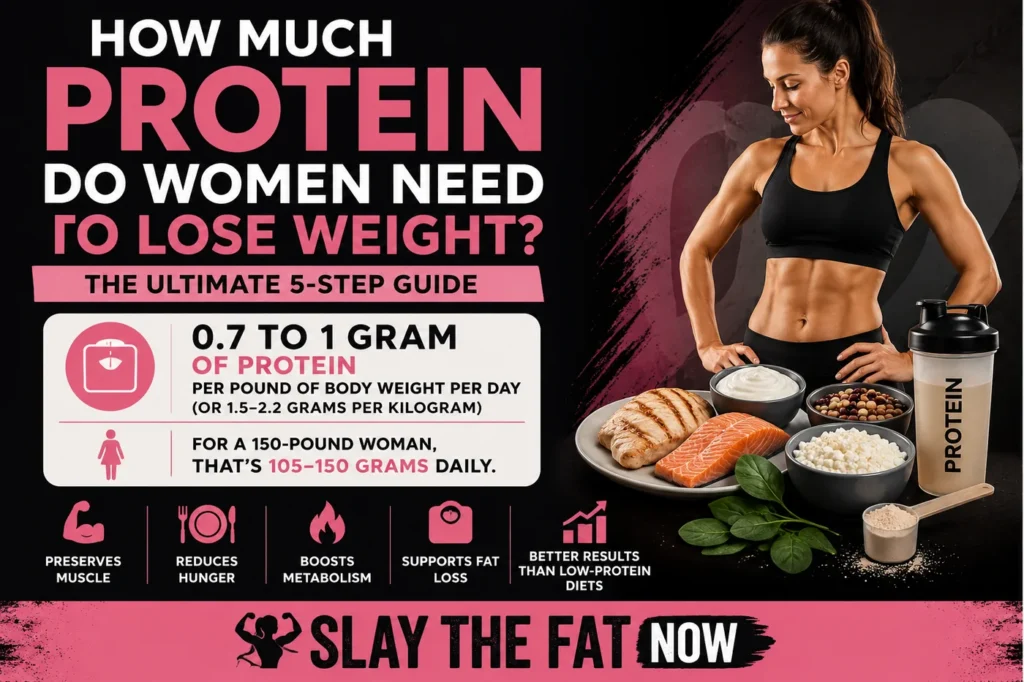
Women trying to lose weight should aim for 0.7 to 1 gram of protein per pound of body weight per day (or 1.5–2.2 grams per kilogram). For a 150-pound woman, that’s 105–150 grams daily. Higher protein intake preserves muscle, reduces hunger, boosts metabolism, and dramatically improves fat loss results compared to low-protein diets.
Most Women Are Eating Half the Protein They Actually Need
If you’ve been eating at a calorie deficit, doing your workouts, and still watching the scale refuse to move your protein intake might be the missing piece.
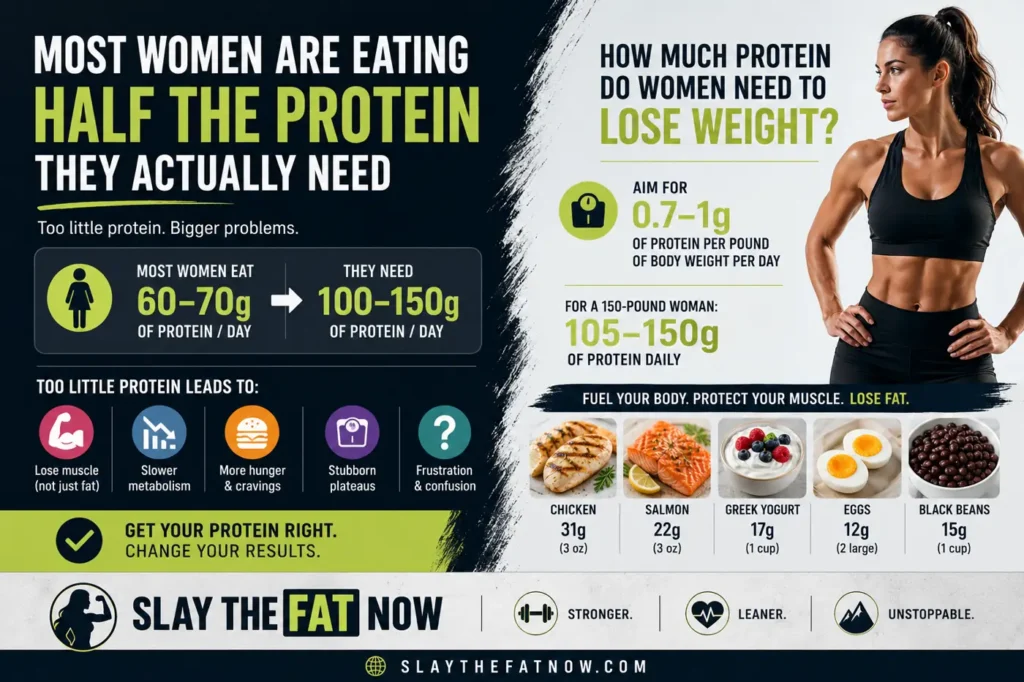
Here’s the uncomfortable truth: most American women eat around 60–70 grams of protein per day. The research says they need closer to 100–150 grams to lose fat effectively, preserve muscle, and keep hunger under control.
The result of too little protein? You lose muscle along with fat. Your metabolism slows. You feel constantly hungry. You fight cravings all day. And when you finally hit a plateau, you have no idea why because you’re technically “eating less.”
Understanding how much protein to lose weight as a woman isn’t complicated. But it will change everything once you get it right.
What This Guide Covers
This article gives you the complete picture on protein intake for fat loss in women with real numbers, practical food guides, and a step-by-step approach you can use starting today.
You’ll learn:
- The exact daily protein target for women trying to lose weight
- Why protein matters more than most women realize
- How a high-protein diet for weight loss actually works in the body
- Real-world meal planning examples with numbers
- Common protein mistakes and how to fix them
- 15 answers to the most-searched questions on this topic
No outdated RDA numbers. No one-size-fits-all nonsense. Just what the current science supports and what actually works.
Why Protein Is the Most Important Macronutrient for Women Losing Weight
Protein is not just for athletes and bodybuilders. For women in a calorie deficit, it is the single most important macronutrient and here’s why.
It preserves lean muscle mass. When you cut calories, your body burns both fat and muscle for energy. Higher protein intake signals your body to protect muscle tissue, so a greater proportion of weight lost comes from fat not hard-earned lean mass.
It burns more calories through digestion. The thermic effect of protein is 20–30%, compared to 5–10% for carbohydrates and 0–3% for fats. That means your body burns significantly more calories just digesting protein than it does processing other foods.
It crushes hunger. Protein reduces ghrelin (the hunger hormone) and increases satiety hormones like peptide YY and GLP-1. Women who eat adequate protein report dramatically lower appetite, fewer cravings, and less tendency to overeat at meals.
It stabilizes blood sugar. High-protein meals produce smaller, slower insulin spikes compared to high-carb meals reducing the blood sugar crashes that trigger cravings for sugar and processed foods.
It supports long-term weight maintenance. Research shows that women who maintain higher protein intakes after weight loss are significantly less likely to regain the weight over the following 1–2 years.
The bottom line: if your protein is too low, everything else in your plan becomes harder.
What the Science Says About Protein Intake for Fat Loss in Women
The research on protein and fat loss is among the most robust in all of nutrition science.
The current USDA Dietary Guidelines recommend 0.36 grams of protein per pound of body weight per day (the RDA). But this number is the minimum to prevent deficiency not the optimal amount for fat loss or body composition.
Studies consistently show that women trying to lose weight need substantially more:
- A 2015 meta-analysis published in the American Journal of Clinical Nutrition found that protein intakes of 1.2–1.6 grams per kilogram of body weight significantly improved body composition outcomes during caloric restriction compared to the RDA.
- Research from the NIH confirms that high-protein diets (25–35% of total calories from protein) reduce total calorie intake by reducing appetite even without conscious restriction.
- A landmark study from Purdue University found that women on a high-protein diet lost more fat and preserved more lean mass than women on a standard-protein diet, even at the same calorie level.
- Women over 40 need even more protein. After 40, muscle protein synthesis (the process of building and repairing muscle) becomes less efficient. Research published in the Journal of Nutrition found that older women require up to 25% more protein per meal to achieve the same muscle-building response as younger women.
The evidence is overwhelming: the standard protein recommendation is not enough for women who want to lose fat, preserve muscle, and maintain results long-term.
Real Example: What Happened When Lisa Doubled Her Protein
Lisa, a 38-year-old marketing manager from Colorado, had been stuck at the same weight for three months despite eating 1,500 calories per day and exercising four times per week.
After tracking her food carefully, we found she was averaging just 58 grams of protein daily mostly from small portions of chicken, some yogurt, and occasional eggs. Most of her calories were coming from complex carbohydrates and healthy fats.
The change: we kept her calorie target the same but restructured her meals to hit 130 grams of protein per day. She added a protein shake in the morning, doubled the protein portions at lunch and dinner, and replaced afternoon crackers with Greek yogurt and almonds.
The results over 10 weeks:
- Lost 14 pounds of body fat
- Maintained nearly all of her lean muscle mass
- Reported significantly less hunger and fewer evening cravings
- No changes to her exercise routine or calorie target
Same calories. Same workouts. Completely different outcome just by getting her protein right.
Expert Insight: The Protein Mistakes That Keep Women Stuck
After reviewing hundreds of nutrition logs and fat loss journeys, these are the protein mistakes that show up over and over again for women:
Mistake 1: Treating protein as optional. Most women plan their meals around carbohydrates and vegetables, then add a small amount of protein as an afterthought. The approach needs to flip: build every meal around a high-quality protein source first.
Mistake 2: Relying on incomplete protein sources. Plant proteins (except soy and quinoa) are incomplete they lack one or more essential amino acids. Women who eat mostly plant protein need to combine sources strategically or supplement to ensure adequate leucine content for muscle protein synthesis.
Mistake 3: Front-loading protein at dinner. Research shows your body can only use roughly 30–40 grams of protein per meal efficiently for muscle synthesis. Women who eat 10g at breakfast, 15g at lunch, and 80g at dinner are not getting the same benefit as those who distribute it evenly across meals.
Mistake 4: Not adjusting for body weight. A 120-pound woman and a 200-pound woman have very different protein needs. Use your body weight (or goal body weight if you’re significantly above it) to calculate your actual number not a generic gram count.
Mistake 5: Stopping protein optimization after initial weight loss. The maintenance phase is when protein matters most. Women who drop their protein intake after reaching their goal weight are significantly more likely to regain fat over the following year.
For more fat loss nutrition strategies tailored to women, visit SlayTheFatNow.com.
Reality Check: What a High-Protein Diet Won’t Do
Let’s be clear about what protein can and cannot accomplish.
Protein alone won’t cause weight loss. Protein is a tool within a calorie deficit not a magic macro. You still need to eat fewer calories than you burn. Eating 200 grams of protein per day at a calorie surplus will not produce fat loss.
More protein is not always better. Beyond approximately 1.2 grams per pound of body weight, additional protein provides diminishing returns for fat loss and muscle preservation. Eating 250 grams of protein at 130 pounds is unnecessary and just adds calories.
High protein does not damage healthy kidneys. This myth persists despite decades of evidence showing that high-protein diets are safe for women with normal kidney function. The concern applies only to individuals with pre-existing kidney disease.
Protein shakes are supplements, not requirements. You can absolutely hit 120–150 grams of protein daily from whole foods alone. Shakes are convenient but not necessary. The source matters less than the total daily amount.
A high-protein diet is not the same as keto or low-carb. You can eat adequate protein while also eating carbohydrates and fats. Most women see the best results on a balanced macro approach where protein is simply prioritized not where everything else is eliminated.
5 Practical Steps to Hit Your Protein Target Every Day
Step 1: Calculate Your Personal Protein Target
Use this formula: body weight in pounds × 0.7 to 1.0 = daily protein grams
- 130 lbs → 91–130g per day
- 150 lbs → 105–150g per day
- 170 lbs → 119–170g per day
- 190 lbs → 133–190g per day
If you’re significantly overweight, use your goal body weight in the calculation to avoid an unreasonably high target.
Step 2: Anchor Every Meal Around a Protein Source
Plan meals by choosing the protein first:
- Breakfast: 3 eggs + 1 cup Greek yogurt = ~35g protein
- Lunch: 5 oz grilled chicken + side salad = ~40g protein
- Dinner: 5 oz salmon + vegetables = ~35g protein
- Snack: 1 cup cottage cheese = ~25g protein
That’s 135 grams without trying very hard.
Step 3: Know Your Best Protein Sources
Animal proteins (complete, high bioavailability): Chicken breast (31g/100g), canned tuna (25g/100g), Greek yogurt (17g/170g), eggs (6g each), cottage cheese (25g/cup), turkey breast (29g/100g), salmon (25g/100g)
Plant proteins (pair strategically): Edamame (17g/cup), lentils (18g/cup cooked), black beans (15g/cup cooked), tofu (10g/half cup), tempeh (15g/half cup), quinoa (8g/cup cooked)
Step 4: Distribute Protein Across Meals
Aim for 25–40 grams per meal, 3–4 times per day. This maximizes muscle protein synthesis throughout the day and keeps hunger hormones stable.
Step 5: Use Tracking Tools to Confirm Your Numbers
Apps like MyFitnessPal, Cronometer, or Carb Manager make protein tracking easy. Track for at least 2 weeks to build an intuitive sense of your intake. After that, most women can eyeball their protein accurately.
For a complete high-protein meal plan built for women’s fat loss, check out the nutrition resources at SlayTheFatNow.com.
Comparing Protein Intake Strategies for Women’s Weight Loss
| Approach | Daily Protein | Fat Loss Result | Hunger Control | Best For |
|---|---|---|---|---|
| USDA RDA (0.36g/lb) | ~55–65g | Poor | Low | Sedentary maintenance only |
| Moderate protein (0.5g/lb) | ~75–100g | Fair | Moderate | Beginners, lower activity |
| Optimal range (0.7–1g/lb) | ~105–150g | Excellent | High | Active women, fat loss focus |
| High protein (1–1.2g/lb) | ~150–180g | Excellent | Very High | Women over 40, strength training |
| Excessive (>1.5g/lb) | 200g+ | No added benefit | Very High | Not necessary, excess calories |
The sweet spot for most women trying to lose weight is 0.7–1 gram per pound of body weight. Women over 40 or those doing consistent strength training benefit from the higher end of that range.
For age-specific protein guidance, read the women over 40 fat loss guide on SlayTheFatNow.com.
Frequently Asked Questions
How much protein should a woman eat per day to lose weight?
Women aiming to lose weight should consume 0.7 to 1 gram of protein per pound of body weight daily. For a 150-pound woman, that’s 105–150 grams per day. This is significantly higher than the standard RDA but is consistently supported by fat loss and body composition research.
Can too much protein stop weight loss?
Protein itself does not stop weight loss. However, eating too much protein alongside high carbohydrate and fat intake will create a calorie surplus and prevent fat loss. Protein is a tool within a calorie deficit not a replacement for overall calorie management.
What is a high-protein diet for weight loss?
A high-protein diet for weight loss typically means deriving 25–35% of total daily calories from protein, or approximately 0.7–1.2 grams per pound of body weight. It emphasizes protein-rich foods at every meal, reduces hunger through hormonal effects, and preserves lean muscle during fat loss.
Does protein help women lose belly fat specifically?
Protein does not target belly fat directly, but it supports the overall fat loss process and helps preserve muscle, which prevents metabolic slowdown. Higher protein diets reduce visceral fat accumulation over time, particularly when combined with strength training and adequate sleep.
How much protein per meal should women eat?
Research supports 25–40 grams of protein per meal as the optimal range for muscle protein synthesis and satiety. Eating much more than 40 grams in a single sitting provides diminishing returns for muscle-building, though excess is not harmful for healthy women.
What are the best high-protein foods for women trying to lose weight?
The top high-protein foods for women include chicken breast, Greek yogurt, cottage cheese, eggs, canned tuna, salmon, turkey breast, edamame, lentils, and protein powder. Prioritizing lean animal proteins ensures high bioavailability and complete amino acid profiles.
Does protein intake for fat loss change for women over 40?
Yes. After 40, muscle protein synthesis efficiency declines. Women over 40 benefit from consuming protein at the higher end of the range (0.9–1.2 grams per pound) and ensuring each meal contains at least 30–35 grams of protein to trigger adequate muscle protein synthesis.
Can I hit my protein target from plant sources alone?
Yes, but it requires more planning. Plant proteins are often incomplete and less bioavailable than animal proteins. Women eating plant-based diets should focus on soy (edamame, tofu, tempeh), legumes, quinoa, and consider a plant-based protein supplement to consistently hit their target.
Will eating more protein make women bulky?
No. Protein supports muscle preservation and modest muscle development, but women do not have the testosterone levels needed to build large muscles without years of dedicated, progressive strength training. Adequate protein combined with exercise produces a leaner, firmer appearance not bulk.
Should women track protein or just eat more protein-rich foods?
Tracking for at least 2–4 weeks is strongly recommended to calibrate your eye for portion sizes and confirm you’re actually hitting your target. Most women are surprised to find they’re falling far short of their protein goal when they first begin tracking accurately.
Is a protein shake necessary for women to lose weight?
Protein shakes are convenient but not required. Women who can hit 100–150 grams of protein from whole foods daily do not need shakes. However, shakes are a practical tool for women who struggle to reach their target through food alone or who need a fast, portable protein source.
What happens if women don’t eat enough protein while dieting?
Insufficient protein during a calorie deficit accelerates muscle loss, slows metabolism, reduces satiety, increases cravings, and impairs workout recovery. Women who undereat protein often lose weight initially but then plateau quickly and regain weight rapidly once the diet ends.
How does protein intake affect women’s hormones?
Adequate protein intake supports balanced levels of satiety hormones (leptin, peptide YY), reduces ghrelin (hunger hormone), and helps regulate insulin. Protein also supports thyroid hormone production and cortisol management both of which directly impact fat storage and fat loss in women.
Is it safe to eat 150 grams of protein per day as a woman?
Yes, for women with healthy kidneys. Research consistently shows high-protein diets (even up to 2.2 grams per kilogram of body weight) are safe for healthy individuals. If you have kidney disease or a related condition, consult your doctor before increasing protein significantly.
What’s the easiest way for women to add more protein to their diet?
The easiest changes: swap regular yogurt for Greek yogurt (+10g), add eggs to breakfast (+6g each), double your meat or fish portion at dinner (+25–30g), replace afternoon snacks with cottage cheese (+25g), and add a protein shake on workout days (+25–30g). Small swaps compound quickly.
You’re One Macro Away From Better Results
You now have everything you need to understand how much protein to lose weight as a woman and exactly how to put it into practice.
The good news: you don’t need to change your calorie target, your workout plan, or your lifestyle dramatically. You just need to restructure what you’re already eating so that protein is the priority at every single meal.
Do that consistently for four weeks and the difference will be undeniable in the mirror, on the scale, and in how you feel every single day.
Visit SlayTheFatNow.com for free protein calculators, high-protein meal plans built for women, and a step-by-step fat loss system that finally makes the numbers work in your favor.
Your metabolism is not broken. Your protein is just too low. Fix that first.
Sources:
