 Skip to content
Menopause Weight Gain: 8 Proven Ways to Stop It Before It Takes Over
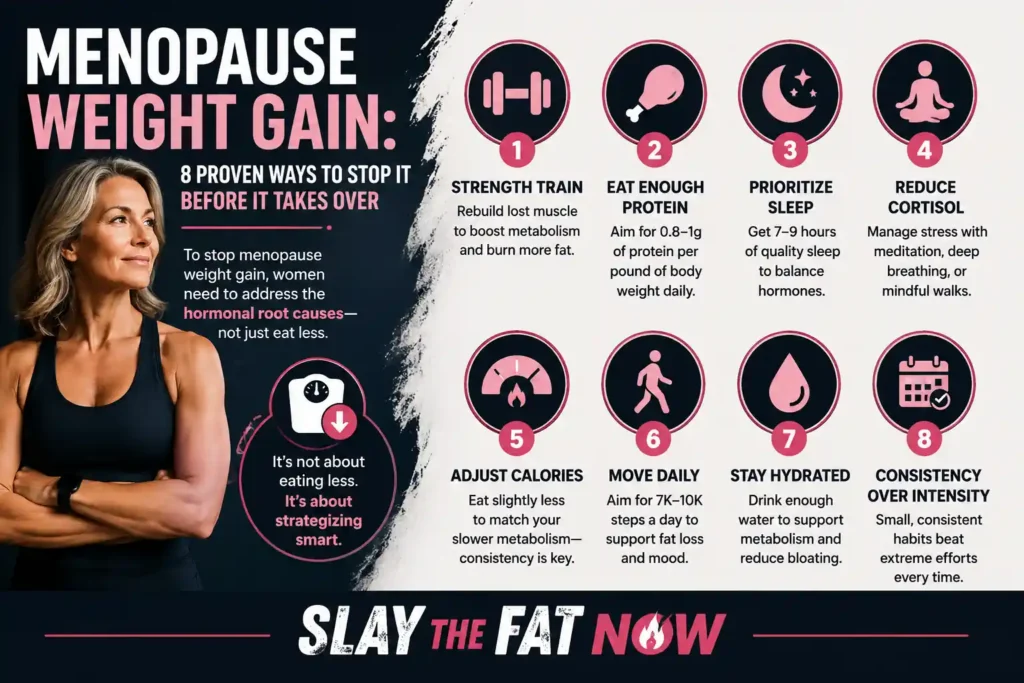
To stop menopause weight gain, women need to address the hormonal root causes not just eat less. Key strategies include strength training to rebuild lost muscle, increasing daily protein to 0.8–1g per pound of body weight, prioritizing 7–9 hours of sleep, reducing cortisol through stress management, and adjusting calorie intake for a slower metabolism. Consistency beats intensity at this stage.
You’re Not Imagining It Your Body Really Did Change Overnight
You haven’t changed what you eat. You haven’t stopped exercising. But over the past year or two, your waist has expanded, your energy has crashed, and the scale has crept up 10, 15, sometimes 20 pounds mostly in your midsection.
You’ve tried cutting calories. You’ve tried more cardio. Nothing works the way it used to.
Here’s what no one told you: menopause weight gain is not a willpower problem. It is a hormonal, metabolic, and physiological shift that changes the rules of fat loss entirely. What worked in your 30s will not work the same way in your 40s and 50s.
The good news? Once you understand what’s actually happening in your body, stopping and reversing menopause weight gain becomes entirely possible.
Understanding Menopause Weight Gain and How to Stop It
Menopause weight gain affects the vast majority of women, typically beginning in perimenopause (the transition years before menopause, usually starting in the mid-40s) and continuing through the menopause transition itself.
It isn’t a single cause. It’s a combination of declining estrogen, rising cortisol, muscle loss, sleep disruption, and metabolic slowdown all hitting at the same time.
This guide will explain exactly what’s happening and give you a clear, evidence-based roadmap to fight back.
Here’s what you’ll learn:
- The biological reasons menopause causes weight gain (especially belly fat)
- Why standard diet advice fails women in this phase of life
- The 8 most effective strategies for weight loss during menopause
- What to do specifically about perimenopause belly fat
- Common mistakes women make that accelerate the problem
- 15 science-based answers to the most common questions
Why Stopping Menopause Weight Gain Matters Beyond the Scale
This is bigger than how your jeans fit.
Postmenopausal abdominal fat particularly visceral fat (the deep fat around organs) dramatically increases the risk of serious health conditions. These include cardiovascular disease, type 2 diabetes, insulin resistance, metabolic syndrome, sleep apnea, and certain hormone-sensitive cancers.
According to the American Heart Association, heart disease risk in women increases sharply after menopause, and abdominal obesity is a primary driver of that elevated risk.
Stopping menopause weight gain matters because:
- It directly reduces your cardiovascular disease risk
- It improves insulin sensitivity and blood sugar regulation
- It reduces systemic inflammation a root cause of dozens of chronic conditions
- It supports bone density and joint health
- It restores energy, mood, and cognitive clarity that menopause often disrupts
- It gives you control over your health trajectory in the most pivotal decade of your life
This is not vanity. This is survival.
The Data: What Science Tells Us About Menopause and Weight Gain
The research on menopausal weight gain is extensive and deeply clarifying.
According to the NIH’s National Institute on Aging, women gain an average of 1.5 pounds per year during the perimenopause transition, and most women gain 10–15 pounds total between the start of perimenopause and two years post-menopause.
Key research findings:
- Estrogen decline drives fat redistribution. Estrogen directs fat to the hips and thighs in premenopausal women. When estrogen drops, fat migrates to the abdomen. A 2012 study in the journal Menopause confirmed visceral fat increases by 49% during the menopausal transition regardless of changes in total body weight.
- Muscle mass drops sharply. Women lose 3–8% of muscle mass per decade after 30, and this accelerates during and after menopause due to hormonal changes. Less muscle means a significantly lower resting metabolic rate meaning the same calorie intake that maintained weight at 38 causes weight gain at 48.
- Cortisol and sleep disruption compound the problem. Menopause-related hot flashes, night sweats, and anxiety disrupt sleep, which raises cortisol. High cortisol directly promotes visceral fat storage creating a vicious cycle where poor sleep causes more belly fat, which causes more health stress, which causes more sleep disruption.
- Calorie needs decline. Research from the Mayo Clinic estimates that postmenopausal women burn 200–400 fewer calories per day than they did at peak metabolic efficiency in their 30s. Eating the same amount without adjustment leads to consistent, gradual weight gain.
- Insulin resistance increases. Estrogen plays a protective role in insulin sensitivity. As estrogen declines, insulin resistance often increases making the body more prone to storing calories as fat rather than burning them.
Understanding these mechanisms is the key to reversing them.
Real Example: How Carol Stopped Gaining Weight at 52 and Lost 19 Pounds
Carol, a 52-year-old teacher from North Carolina, had gained 22 pounds over three years. She had gone through menopause at 50 and was eating roughly the same diet she’d maintained for two decades. Nothing else had changed.
Her doctor told her weight gain during menopause was “normal.” She accepted it until she developed prediabetes at her annual physical.
Carol’s approach, built around the strategies in this article, involved five key changes:
First, she started strength training three times per week. Within six weeks, her resting energy expenditure had measurably increased and her body composition began shifting.
Second, she raised her daily protein intake from 65 grams to 130 grams. Hunger became dramatically more manageable.
Third, she reduced her calorie target by 250 calories (not 700+ as she had tried before), reflecting her lower metabolic rate post-menopause.
Fourth, she addressed her sleep. A white noise machine, cooler bedroom temperature, and a consistent bedtime reversed her chronic 5-hour nights to a consistent 7.5 hours.
Fifth, she cut evening alcohol entirely her one glass of wine per night had been adding 150+ empty calories and disrupting her sleep quality.
Over 18 weeks, Carol lost 19 pounds, reversed her prediabetes markers, and reported feeling better than she had in five years. Menopause had changed the rules but it hadn’t ended the game.
Expert Insight: Why Women Struggle So Long Before Getting Real Results
The pattern in women navigating menopausal weight gain is almost always the same and understanding it can save you months of wasted effort.
They try harder at what already isn’t working. More cardio. Fewer calories. More restriction. These approaches worked at 35. They not only fail at 50 they make things worse. Excessive cardio without strength training accelerates muscle loss. Severe calorie restriction triggers metabolic adaptation in a body that’s already metabolically slower. The harder you fight the wrong way, the harder your body fights back.
They underestimate how different this phase of life actually is. Menopause is not just “getting older.” It is a distinct physiological transition with specific hormonal drivers that require specific solutions. Women who treat it as a standard diet problem consistently underperform. Women who address the hormonal and metabolic changes specifically get results.
They skip strength training because they fear “bulk.” This is perhaps the most expensive mistake menopausal women make. Strength training rebuilds the muscle mass being lost to hormonal changes, elevates resting metabolism, improves insulin sensitivity, strengthens bones (critical for post-menopausal osteoporosis risk), and reduces visceral fat more effectively than any amount of cardio.
They address diet but ignore sleep and stress. Cortisol and sleep are not soft lifestyle factors at menopause they are primary hormonal drivers of belly fat accumulation. Fixing diet without fixing sleep and stress is like bailing water out of a leaking boat.
For more guidance built specifically for this phase, explore the menopause weight loss resources at SlayTheFatNow.com.
Reality Check: The Hard Truths About Weight Loss During Menopause
It will be slower than it was before. A woman who lost 10 pounds in 6 weeks at 32 may need 12–16 weeks to achieve the same result at 52. That is not failure that is biology. Adjust your expectations to match your biology, not your memories.
Hormone replacement therapy (HRT) is not a weight loss treatment. HRT can reduce some menopausal symptoms (hot flashes, mood changes) and may reduce the rate of fat redistribution but it is not a primary fat loss intervention. Women who start HRT hoping to automatically lose weight are typically disappointed. Diet, exercise, and lifestyle remain the foundation.
You cannot outrun your hormones with cardio alone. This is the most important reality check in this entire article. Cardiovascular exercise is healthy and important. But without the muscle-rebuilding signal of strength training, cardio during menopause progressively worsens the muscle loss problem that’s driving the metabolic slowdown.
Perimenopause belly fat is the last fat to go. Visceral abdominal fat is metabolically stubborn especially in the context of declining estrogen. It is usually the last fat to respond and the first to return with lifestyle backsliding. Patience and consistency are non-negotiable.
Supplements alone do nothing meaningful. Black cohosh, evening primrose oil, and dozens of “menopause weight loss” supplements have minimal to no clinical evidence for fat loss. They are not substitutes for the foundational interventions.
8 Proven Ways to Stop Menopause Weight Gain
Strategy 1: Start Strength Training This Is Non-Negotiable
Three sessions per week of progressive resistance training is the single most impactful intervention for menopausal weight gain. It rebuilds metabolically active muscle, improves insulin sensitivity, strengthens bones, reduces visceral fat, and elevates resting metabolic rate. Start with bodyweight or light dumbbells if you’re new to it the load matters less than the consistency.
Strategy 2: Recalculate Your Calorie Needs for Your Current Metabolism
Your TDEE (Total Daily Energy Expenditure) at 50 is significantly lower than it was at 35. Recalculate it using your current age, weight, and activity level. A deficit of 250–400 calories below your current TDEE not the TDEE you had a decade ago is the appropriate starting point.
Strategy 3: Dramatically Increase Protein Intake
Women in menopause need 0.8–1.2 grams of protein per pound of body weight daily more than younger women. Protein preserves muscle mass, reduces appetite, stabilizes blood sugar, and keeps metabolism elevated. Aim for 30–40 grams at each meal. This single change produces measurable differences in body composition within 6–8 weeks.
For a detailed women’s protein guide, read how much protein women need to lose weight on SlayTheFatNow.com.
Strategy 4: Prioritize Sleep as a Medical Priority
Hot flashes, anxiety, and hormonal shifts make sleep elusive during menopause but poor sleep directly promotes visceral belly fat accumulation. Strategies that help: keep the bedroom at 65–68°F, use blackout curtains, avoid screens an hour before bed, limit alcohol (which fragments sleep architecture), and speak to your doctor about evidence-based sleep interventions if disruption is severe.
Strategy 5: Actively Manage Cortisol
Chronic stress during menopause compounds every other problem. Daily cortisol management strategies 10 minutes of breathwork, walking in nature, journaling, yoga, reducing over-scheduling measurably reduce visceral fat accumulation over 8–12 weeks. This is not a soft suggestion. It is a hormonal intervention.
Strategy 6: Reduce Refined Carbohydrates and Added Sugar
Declining estrogen increases insulin resistance during menopause, making refined carbohydrates and sugar far more damaging to body composition than they were at a younger age. Replace refined grains, sugary drinks, and processed snacks with whole grains, vegetables, legumes, and fiber-rich foods. This reduces insulin spikes, lowers inflammation, and directly targets visceral fat.
Strategy 7: Cut Alcohol or Eliminate It Entirely
Alcohol is a triple threat during menopause: it adds empty calories, disrupts sleep quality, and impairs liver function (the liver prioritizes alcohol metabolism over fat burning for up to 24 hours after drinking). Reducing alcohol to 1–2 drinks per week or eliminating it is one of the fastest changes a menopausal woman can make to accelerate fat loss.
Strategy 8: Consider a Hormonal Evaluation
If you’ve applied all the above consistently for 8–12 weeks with minimal results, ask your doctor for a comprehensive hormonal panel. Thyroid dysfunction, elevated cortisol (Cushing’s syndrome), insulin resistance, and estrogen/progesterone imbalances can all independently drive weight gain during menopause and may require medical intervention alongside lifestyle changes.
Comparing the Most Common Approaches to Menopause Weight Gain
| Approach | Effectiveness | Addresses Root Cause | Sustainable? | Best For |
|---|---|---|---|---|
| Calorie restriction only | Low–Moderate | No | Often not | Short-term only |
| Cardio only | Low | No | Yes, but limited | Heart health, not fat loss |
| Strength training | High | Yes (muscle/metabolism) | Yes | All menopausal women |
| High-protein diet | High | Yes (muscle, hunger) | Yes | All menopausal women |
| HRT alone | Low for fat loss | Partial (hormonal) | Yes | Symptom relief |
| Sleep + stress management | Moderate–High | Yes (cortisol/visceral fat) | Yes | Women with high cortisol |
| Comprehensive approach | Very High | Yes (all root causes) | Best | Long-term results |
The research is unambiguous: a comprehensive approach addressing muscle loss, metabolic slowdown, insulin resistance, cortisol, and sleep simultaneously produces the best outcomes for menopausal weight loss.
For a step-by-step implementation guide, visit the women’s fat loss strategies at SlayTheFatNow.com.
Frequently Asked Questions
Why does menopause cause weight gain?
Menopause causes weight gain through a combination of declining estrogen (which redistributes fat to the abdomen), muscle loss (which lowers metabolic rate), rising cortisol (which promotes visceral fat storage), sleep disruption, and increasing insulin resistance. These factors often compound each other, making weight gain faster and harder to reverse without a targeted approach.
Can menopause weight gain be stopped without medication?
Yes. The majority of menopausal weight gain is addressable through lifestyle interventions: strength training, increased protein, improved sleep, stress management, and appropriate calorie adjustment. Medication and HRT can be valuable tools in some cases but are not prerequisites for managing weight during menopause.
How do I lose perimenopause belly fat specifically?
Perimenopause belly fat responds to a combination of strength training (which reduces visceral fat more than cardio), high-protein diet, adequate sleep, cortisol reduction, and elimination of refined sugars and alcohol. It is typically the slowest fat to respond expect 8–16 weeks of consistent effort before significant visible changes.
What is the best diet for weight loss during menopause?
The best diet for weight loss during menopause is high in protein (0.8–1.2g per pound of body weight), rich in fiber and anti-inflammatory foods, low in refined carbohydrates and added sugars, and appropriately calorie-controlled for a post-menopausal metabolism. Mediterranean-style eating patterns have the strongest research support for this phase.
Does HRT help with menopause weight gain?
HRT can reduce the rate of visceral fat redistribution and may make fat loss slightly easier by reducing symptoms that disrupt sleep and activity. However, HRT is not a weight loss treatment. Women who rely on HRT alone without improving diet, exercise, and sleep typically do not lose weight.
How many calories should a menopausal woman eat to lose weight?
Most postmenopausal women burn 200–400 fewer calories per day than they did in their metabolic prime. A safe starting point is calculating your current TDEE (accounting for age, weight, and activity level) and creating a 250–400 calorie daily deficit. Going below 1,200 calories is not recommended without medical supervision.
How does stress cause belly fat during menopause?
During menopause, the adrenal glands take over some hormonal production previously handled by the ovaries making the body more sensitive to cortisol. Chronic stress elevates cortisol, which directly promotes visceral fat deposition in the abdomen. Stress management is therefore a clinical priority for menopausal belly fat reduction, not just a wellness suggestion.
Is it normal to gain weight during perimenopause?
Yes, it is common. The average woman gains 1.5 pounds per year during perimenopause. However, “common” does not mean inevitable or irreversible. Women who proactively address the hormonal and metabolic changes of perimenopause with targeted strategies can minimize or prevent significant weight gain.
Does strength training really help menopause weight gain?
Yes, it is the most effective single intervention. Strength training rebuilds muscle mass lost to hormonal changes (restoring metabolic rate), improves insulin sensitivity, strengthens bones (reducing osteoporosis risk), reduces visceral fat, and improves body composition more effectively than any other form of exercise during menopause.
How long does it take to lose menopause weight?
Sustainable fat loss during and after menopause typically proceeds at 0.5–1 pound per week slower than younger women due to reduced metabolic rate and muscle mass. Expect 3–6 months to lose a meaningful amount of fat. Results depend heavily on consistency across multiple areas: diet, training, sleep, and stress.
Does cutting carbs help with menopause weight gain?
Reducing refined carbohydrates and added sugars is consistently beneficial for menopausal women due to increasing insulin resistance. However, eliminating all carbohydrates is not necessary. Replacing processed carbs with whole grains, vegetables, and legumes reduces insulin spikes and inflammation without the metabolic risks of very-low-carb dieting.
Can walking help with menopause weight gain?
Walking is beneficial and should absolutely be part of a menopausal woman’s routine. It reduces cortisol, supports sleep, improves cardiovascular health, and contributes to daily calorie burn. However, walking alone without strength training and dietary adjustments is insufficient to reverse the muscle loss and metabolic slowdown driving menopausal weight gain.
What supplements help with menopause weight gain?
Evidence-based supplements that may modestly support menopausal weight management include magnesium (improves sleep and insulin sensitivity), omega-3 fatty acids (reduce inflammation and visceral fat), vitamin D (low levels are linked to abdominal obesity), and protein powder (supports muscle preservation). None are substitutes for lifestyle changes.
Why can’t I lose weight during menopause even when eating very little?
Eating very little during menopause often backfires severe restriction accelerates muscle loss, triggers metabolic adaptation, and elevates cortisol, all of which promote belly fat retention. A moderate deficit (250–400 calories below TDEE) with high protein is far more effective than aggressive restriction at this stage.
When should a woman see a doctor about menopause weight gain?
See a doctor if weight gain is rapid (more than 2 pounds per month without dietary changes), if you have symptoms of thyroid dysfunction (fatigue, hair loss, cold intolerance), if you suspect insulin resistance or have elevated fasting blood sugar, or if lifestyle interventions applied consistently for 10–12 weeks have produced no measurable results.
Menopause Changed the Rules But You Can Still Win
Menopause weight gain is real, it’s biological, and it’s not your fault. But it is within your power to stop and reverse it if you use the right strategy for this phase of your life.
The women who succeed are not the ones who try the hardest or restrict the most. They are the ones who understand that menopause requires a different approach: more protein, more strength training, better sleep, lower stress, and patience measured in months rather than weeks.
You are not broken. Your hormones have shifted. Now it’s time to shift your strategy.
Visit SlayTheFatNow.com for a free menopause-specific fat loss plan, protein calculators, and proven guides built for women navigating this exact transition. You’ve handled every other challenge life has thrown at you. This one is no different.
Sources:
