 Skip to content
How to Reduce Cravings Naturally: 11 Science-Backed Strategies That Fix the Root Cause
You’ve eaten a healthy dinner. It’s 9 PM. And your brain is screaming for chips, chocolate, or anything in reach.
You give in again and tell yourself you have no willpower.
Here’s the truth: you don’t have a willpower problem. You have a biology problem.
Food cravings are driven by hormones like ghrelin and leptin, blood sugar crashes, chronic stress, and poor sleep. Until you fix those root causes, no amount of discipline will save you.
In this guide, you’ll get 11 science-backed strategies to reduce cravings naturally — strategies that address why cravings happen, not just how to white-knuckle through them.
These are the same methods I walk clients through in my 90-day coaching program, grounded in research from peer-reviewed studies on appetite regulation and dietary behavior.
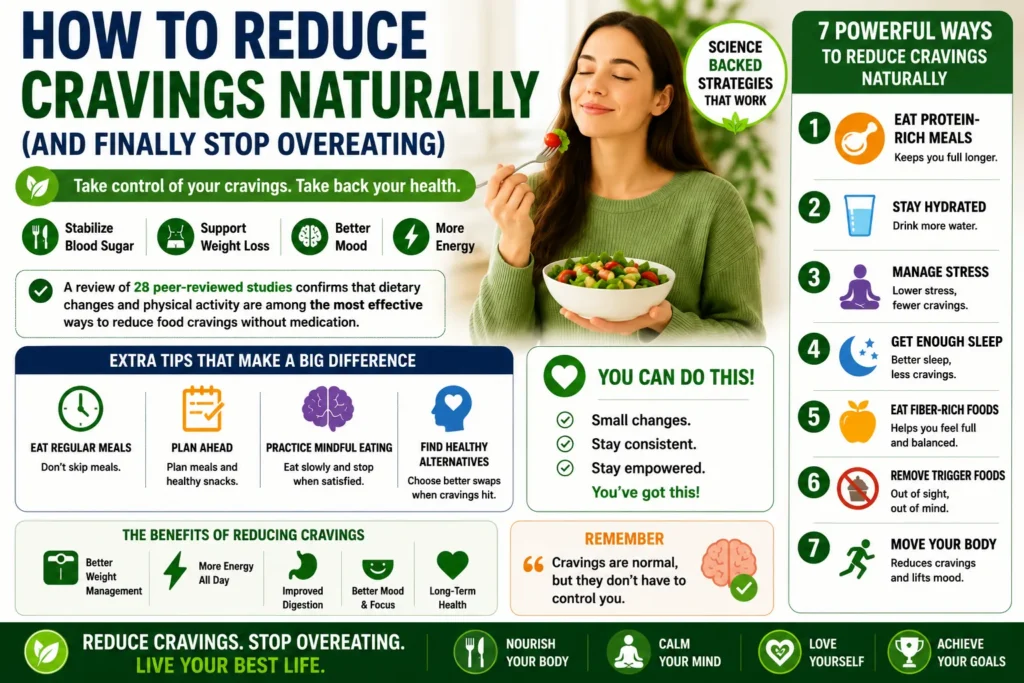
To reduce cravings naturally, focus on eating protein-rich meals, staying hydrated, managing stress, getting enough sleep, and removing trigger foods from your environment. A review of 28 peer-reviewed studies confirms that dietary changes and physical activity are among the most effective ways to reduce food cravings without medication.
Physical Hunger vs. Emotional Hunger: How to Tell the Difference
One of the most effective ways to reduce cravings naturally is learning to
distinguish true hunger from emotional hunger before you act on it.
Physical hunger:
- Builds gradually over time
- Can be satisfied by any food, not just a specific craving
- Stops when you’re full
- Comes with physical cues: growling stomach, low energy, light-headedness
Emotional hunger:
- Hits suddenly and feels urgent
- Fixates on a specific food (usually high-sugar or high-fat)
- Doesn’t stop at fullness — often leads to overeating
- Is triggered by stress, boredom, loneliness, or anxiety
Before eating, do a 2-minute check: rate your physical hunger on a scale of
1–10. If you’re above a 5, eat. Below a 5 — pause, drink water, and identify
what emotion is driving the urge.
This simple habit alone has helped many of my coaching clients break the
binge-eating cycle within 2 weeks.
The Painful Truth Nobody Tells You About Cravings
You’ve been there. It’s 9 PM. You’ve eaten a perfectly healthy dinner. And then out of nowhere your brain starts screaming for chips, chocolate, or something sweet.
You white-knuckle it for ten minutes. Then you give in.
You tell yourself you have no willpower. But here’s the thing: you don’t have a willpower problem. You have a biology problem.
Most people trying to lose weight are fighting their cravings with sheer mental force and losing. They don’t realize that cravings are driven by hormones, blood sugar spikes, poor sleep, dehydration, and stress. Until you fix those root causes, no amount of discipline will save you.
This article will show you exactly how to reduce cravings naturally using strategies backed by science, not willpower.
What Are Food Cravings, Really?
Food cravings are not a character flaw. They are your brain and body sending signals often the wrong ones based on your hormones, habits, and nutrient status.
When your blood sugar crashes, your body demands quick energy. When you’re stressed, cortisol pushes you toward calorie-dense comfort foods. When you’re sleep-deprived, your hunger hormone (ghrelin) surges while the fullness hormone (leptin) tanks. The result? Cravings that feel impossible to resist.
Learning how to reduce cravings naturally means addressing these root causes not just gritting your teeth through the urge.
In this guide, you’ll learn:
- Why cravings happen (and why willpower alone fails)
- 7 science-backed natural strategies to crush cravings
- Which mistakes make cravings worse
- How real people used these methods to lose weight
- 15 FAQs with direct, honest answers
Why Reducing Cravings Naturally Matters for Weight Loss
Cravings are one of the single biggest reasons diets fail. You can have the perfect meal plan, but if you can’t control the urge to binge at night, you’ll keep undoing your progress.
Here’s what’s at stake:
- Weight loss results: Reduced cravings are directly linked to successful weight loss. A 2025 study published in Physiology & Behavior found that craving frequency decreased significantly during a 12-month weight loss program and those reductions held steady through 12 more months of maintenance.
- Long-term health: Chronic overeating driven by cravings contributes to obesity, type 2 diabetes, and heart disease.
- Mental health: Constant battles with food take a serious emotional toll. Managing cravings naturally reduces the guilt-shame cycle that keeps people stuck.
- Sustainability: Drug-free, natural strategies have no side effects and can be maintained for life.
If you can reduce cravings naturally, losing weight stops feeling like punishment and starts feeling possible.
Data and Facts: The Science Behind Food Cravings
The research on cravings is clear, and the numbers are striking:
- A review of 28 peer-reviewed studies conducted by LSU’s Pennington Biomedical Research Center confirmed that dietary changes and increased physical activity reliably reduce food cravings.
- Food cravings typically peak during late afternoon and evening between 3–6 PM and 8–10 PM which explains why most people derail their diets after dinner.
- A 2025 study confirmed that craving frequency and craving-related traits both decrease during active weight loss and stabilize during maintenance meaning the longer you stay on track, the easier it gets.
- Research shows that most cravings naturally subside within 20 minutes if you don’t feed them with attention or action.
- A 2024 meta-analysis of 14 clinical trials found that omega-3 supplementation was linked to measurable reductions in impulsive eating behavior.
- According to Scripps Health, dehydration commonly mimics hunger, causing people to eat extra calories when all they actually needed was water.
- Tree nut snacking (almonds, walnuts, cashews) was shown in a Vanderbilt University study to reduce cravings for salty and sweet foods compared to typical high-carbohydrate snacks.
The science is on your side. You just need to use it.
Real Example: How Sarah Stopped Her 10 PM Binges
Sarah, a 38-year-old mom in Chicago, had tried every diet she could find. She’d lose a few pounds, then regain them after a week of late-night snacking. Cookies, crackers, cereal whatever was in the pantry was gone by midnight.
When she started focusing on why she craved, not just what, everything changed.
She discovered three things:
- She was barely eating enough protein at dinner, so her blood sugar crashed by 9 PM.
- She was chronically under-sleeping (5–6 hours on work nights), which spiked her ghrelin levels.
- She kept junk food in the house “for the kids” which meant it was always visible and always tempting.
She made three changes: added a palm-sized serving of protein to every meal, started a strict 10:30 PM bedtime, and removed all processed snacks from the pantry.
Within two weeks, her evening cravings dropped by roughly 70%. In four months, she lost 22 lbs without going to war with herself every night.
Her story isn’t unusual. It’s what happens when you fix the cause instead of fighting the symptom.
Looking for a complete plan? Check out SlayTheFatNow’s weight loss roadmap to get started with a strategy built around you.
Expert Insight: What Actually Works (And What Doesn’t)
After years of working with people who struggle with food cravings, some patterns show up again and again.
What actually works:
- Protein at every meal. Protein is the most satiating macronutrient. People who consistently hit 25–35g of protein per meal report far fewer cravings between meals. It’s not glamorous advice, but it’s one of the most reliable.
- Removing trigger foods from the home. You cannot crave what you can’t see. The old advice of “just eat less” assumes willpower is infinite. It isn’t. The environment always wins. Remove the food, remove the fight.
- Addressing sleep as a non-negotiable. This is the most underrated craving fix in existence. One bad night of sleep can undo weeks of dietary discipline. Lack of sleep causes your brain to literally crave junk food while disabling the impulse control you need to resist it.
- Consistent meal timing. Skipping meals to “save calories” almost always backfires in the form of intense cravings later. Eating regular meals keeps blood sugar stable and reduces the biological drive to overeat.
What doesn’t work (long-term):
- Eating a “small portion” of junk food. Research from LSU confirms it’s more effective to remove a food entirely than to eat smaller servings. Small portions reinforce the habit and trigger more cravings, not fewer.
- Relying on “cheat days.” For people with strong craving patterns, scheduled cheat days often become full-blown binges because restriction heightens desire.
- Willpower alone. It depletes. Biology always outlasts discipline unless you change the underlying conditions.
Reality Check: Myths About Reducing Cravings
Let’s cut through the noise.
Myth #1: “Cravings mean your body needs that food.” Craving sugar doesn’t mean you’re deficient in sugar. However, craving sweets can signal low chromium levels, blood sugar instability, or inadequate sleep none of which sugar will actually fix.
Myth #2: “Carb cravings mean you’re addicted to carbs.” Carbohydrate cravings are most commonly driven by insufficient protein, poor sleep, or stress not a carb addiction. Fix the root cause, and the craving often disappears.
Myth #3: “You just need to drink more water.” Hydration does help dehydration genuinely mimics hunger signals. But water alone won’t fix cravings driven by hormonal imbalances, sleep deprivation, or stress. It’s one tool, not the whole toolbox.
Myth #4: “If you crave it, eat it otherwise you’ll obsess.” This is partly true for some people, but not as a general rule. Eating trigger foods frequently can strengthen cravings through conditioning. For many people, less exposure leads to fewer cravings over time.
The Emotional Eating Triggers Nobody Talks About
Most people know stress causes cravings. Fewer people recognize the subtler
triggers:
- Boredom: When your brain isn’t stimulated, it reaches for dopamine —
and food is the fastest source. - Loneliness: Social isolation increases cortisol, which directly elevates
cravings for calorie-dense foods. - Relationship conflict: Unresolved tension triggers the same stress
hormones as physical danger. - Positive emotions: Celebrations, rewards, and “I deserve this” moments
are just as powerful triggers as negative ones.
What to do instead:
Keep a simple food-mood journal for 7 days. Write what you ate, what time,
and what you were feeling. Patterns will appear by day 3. Once you see your
specific triggers, you can interrupt the cycle before it starts — rather than
trying to fight cravings once they’ve already taken hold.
7 Powerful Ways to Reduce Cravings Naturally
1. Prioritize Protein at Every Meal
Protein suppresses the hunger hormone ghrelin and increases the satiety hormone peptide YY. Aim for 25–35g of protein per meal eggs, chicken, Greek yogurt, cottage cheese, legumes, fish. This single change eliminates most between-meal cravings within days.
Learn more: High-protein meal ideas for weight loss on SlayTheFatNow
2. Stay Hydrated Before You Feel Thirsty
Drink a full glass of water the moment a craving hit. Dehydration mimics hunger signals in the brain. Aim for at least 8–10 glasses of water per day, and drink one glass before each meal. Keep a water bottle visible at your desk and beside your bed.
3. Get 7–9 Hours of Sleep, Every Night
Sleep deprivation increases ghrelin (hunger hormone), decreases leptin (fullness hormone), and impairs the prefrontal cortex the part of your brain responsible for impulse control. According to Scripps Health, a sleep-deprived brain craves junk food and has significantly reduced ability to resist. Protecting your sleep is protecting your diet.
4. Manage Stress Before It Manages You
Cortisol the primary stress hormone directly increases appetite and drives cravings for high-fat, high-sugar foods. Identify your top stress triggers and reduce exposure where possible. Effective tools include 4-7-8 breathing (inhale 4 counts, hold 7, exhale 8), daily walks, journaling, and limiting doom-scrolling before bed.
Explore: Stress eating strategies on SlayTheFatNow
5. Eat Fiber-Rich Foods to Stay Full Longer
Fiber slows digestion, stabilizes blood sugar, and feeds beneficial gut bacteria that influence appetite hormones. Add beans, lentils, vegetables, chia seeds, and oats to your meals. The goal is 25–35g of fiber per day most Americans get half that.
Tree nuts in particular have been shown in clinical research to reduce cravings for sweet and salty foods compared to typical carbohydrate snacks. A small handful of almonds or walnuts in the afternoon is one of the most practical craving-reduction tools available.
6. Redesign Your Food Environment
Your environment is stronger than your willpower always. Clear your pantry of ultra-processed snacks. Keep fruit, nuts, and cut vegetables at eye level in the fridge. Place water bottles on your desk and counter. What’s visible gets eaten. What’s hidden gets forgotten.
This is called “environmental design,” and behavioral research consistently shows it outperforms motivational strategies for long-term food behavior change.
7. Use the 20-Minute Rule When Cravings Hit
Research shows most cravings subside within 20 minutes if you don’t act on them. When a craving strikes, delay the decision by 20 minutes and do something else take a walk, drink water, call someone, do a quick task. Most of the time, the craving will pass. This isn’t suppression; it’s interrupting the neurological loop.
Natural Craving Reduction: Strategy Comparison
| Strategy | Time to See Results | Difficulty | Cost |
|---|---|---|---|
| Increase protein intake | 2–5 days | Low | Low |
| Improve sleep | 1–2 weeks | Medium | Free |
| Hydration habits | Immediate | Very Low | Free |
| Stress management | 1–3 weeks | Medium | Free |
| Fiber-rich foods | 3–7 days | Low | Low |
| Environment redesign | Immediate | Low | Free |
| 20-Minute Rule | Immediate | Medium | Free |
All seven strategies are free or very low cost, work without medication, and produce compounding results when used together. Start with the two easiest hydration and the 20-minute rule and add others week by week.
Ready to put this into action? Try the free SlayTheFatNow weight loss starter guide and build a plan around your specific craving triggers.
When Cravings Are a Sign of Something More
For most people, the strategies in this guide will reduce cravings naturally
and significantly within 2–4 weeks.
However, cravings can sometimes signal a deeper issue worth addressing with
a professional:
- Cravings that feel completely out of control despite consistent healthy
eating and sleep may indicate binge eating disorder - Cravings paired with extreme restriction may be a sign of a restrictive
eating pattern that needs professional support - Cravings that worsen with mood may be linked to depression or anxiety,
both of which benefit from therapy alongside dietary changes
If you recognize any of these patterns, speaking with your doctor or a
registered dietitian is the right next step. There is no shame in getting
support — the biology of cravings is complex, and some people need more than
lifestyle strategies alone.
Resources:
- Your primary care physician
- A registered dietitian (RD)
- The National Eating Disorders Helpline: 1-800-931-2237
Frequently Asked Questions About How to Reduce Cravings Naturally
1. What is the fastest way to reduce cravings naturally?
Drink a large glass of water immediately and wait 20 minutes. Most cravings are driven by dehydration or habit not actual hunger and will pass if you delay acting on them.
2. Does protein really reduce food cravings?
Yes. Protein is the most satiating macronutrient and suppresses the hunger hormone ghrelin. Eating 25–35g of protein per meal is one of the most reliable ways to reduce between-meal cravings.
3. Can sleep affect food cravings?
Absolutely. Poor sleep increases ghrelin (hunger hormone), decreases leptin (fullness hormone), and impairs impulse control. Just one bad night can significantly increase cravings the next day.
4. Why do I crave sugar at night?
Evening sugar cravings are usually caused by low blood sugar from insufficient protein or carbohydrates at dinner, stress, fatigue, or habit. Fix dinner first add more protein and fiber.
5. Does drinking water reduce cravings?
Yes. Dehydration frequently mimics hunger signals. Drinking water when a craving hits can eliminate it entirely if it was driven by thirst rather than actual hunger.
6. What foods naturally suppress appetite and cravings?
High-protein foods (eggs, chicken, Greek yogurt), high-fiber foods (beans, oats, vegetables), and tree nuts (almonds, walnuts) are among the best evidence-backed options.
7. Does stress cause food cravings?
Yes. Stress elevates cortisol, which increases appetite and creates cravings for calorie-dense foods. Managing stress through breathing exercises, walks, and limiting stress triggers directly reduces craving intensity.
8. Can fiber reduce sugar cravings?
Yes. Fiber slows the absorption of glucose, preventing the blood sugar spikes and crashes that trigger sugar cravings. Eating fiber-rich foods at every meal is a highly effective strategy.
9. How long does it take to stop craving junk food?
Most people experience a significant reduction in junk food cravings within 2–4 weeks of clean eating, though individual results vary. The brain’s reward pathways adapt, and processed food starts to seem less appealing.
10. Is it better to give in to cravings or resist them?
Research suggests that for trigger foods, complete removal is more effective than eating small portions which tend to reinforce cravings rather than satisfy them. For mild preferences, occasional indulgence is fine.
11. Can exercise reduce food cravings?
Yes. Physical activity reduces appetite hormones in the short term and improves mood and stress levels, which reduces emotional eating. Even a 10-minute walk can blunt a craving.
12. What vitamins or minerals help with cravings?
Chromium (supports blood sugar balance), magnesium (reduces stress-driven cravings), and omega-3 fatty acids (reduces impulsive eating) are among the best-researched options. A 2024 meta-analysis linked omega-3 supplementation to reduced impulsive food behavior.
13. Why do I crave carbs all the time?
Constant carb cravings usually point to insufficient protein in your diet, blood sugar instability, inadequate sleep, or chronic stress not carb addiction. Fix the root cause, and the cravings typically resolve.
14. Does eating more frequently help reduce cravings?
For some people, 3–4 structured meals per day reduces the extreme hunger that triggers cravings. Skipping meals to cut calories often backfires by intensifying cravings later.
15. Are there any natural supplements that help reduce cravings?
Fenugreek seeds, Gymnema sylvestre, and omega-3 fatty acids have shown some evidence for appetite and craving management, though they work best as part of a broader lifestyle strategy, not as standalone fixes.
You Don’t Have to White-Knuckle This Anymore
Food cravings feel like the enemy but they’re actually just signals. Once you understand what’s driving them, you have real tools to quiet them.
Start tonight: eat a protein-rich dinner, drink a glass of water before bed, and commit to one extra hour of sleep. These three things alone will reduce tomorrow’s cravings more than any amount of willpower ever could.
You don’t need perfect discipline. You need the right strategy.
Visit SlayTheFatNow.com for more practical, no-nonsense weight loss guides built for real people not fitness influencers.
References
- Gilhooly CH, et al. “Food cravings and energy regulation: the characteristics
of craved foods and their relationship with eating behaviors and weight change
during 6 months of dietary energy restriction.” International Journal of
Obesity, 2007. https://pubmed.ncbi.nlm.nih.gov/17637702/ - Leidy HJ, et al. “The role of protein in weight loss and maintenance.”
American Journal of Clinical Nutrition, 2015.
https://pubmed.ncbi.nlm.nih.gov/25926512/ - Spiegel K, et al. “Sleep curtailment in healthy young men is associated
with decreased leptin levels, elevated ghrelin levels, and increased hunger
and appetite.” Annals of Internal Medicine, 2004.
https://pubmed.ncbi.nlm.nih.gov/15583226/ - Epel E, et al. “Stress may add bite to appetite in women: a laboratory
study of stress-induced cortisol and eating behavior.”
Psychoneuroendocrinology, 2001. https://pubmed.ncbi.nlm.nih.gov/11070333/ - Popkin BM, et al. “Water, hydration, and health.” Nutrition Reviews, 2010.
https://pubmed.ncbi.nlm.nih.gov/20646222/
Sources
- LSU Pennington Biomedical Research Center Food Cravings Review (ScienceDaily)
- Physiology & Behavior Reduced Food Cravings and 24-Month Weight Loss (PubMed, 2025)
- Scripps Health 7 Tips to Reduce Food Cravings
- NIH/PubMed Mental Imagery and Food Cravings
Published on SlayTheFatNow.com | Category: Weight Loss Tips | Reviewed for accuracy
