 Skip to content
Tirzepatide Weight Loss Before and After: 7 Proven Results You Need to See
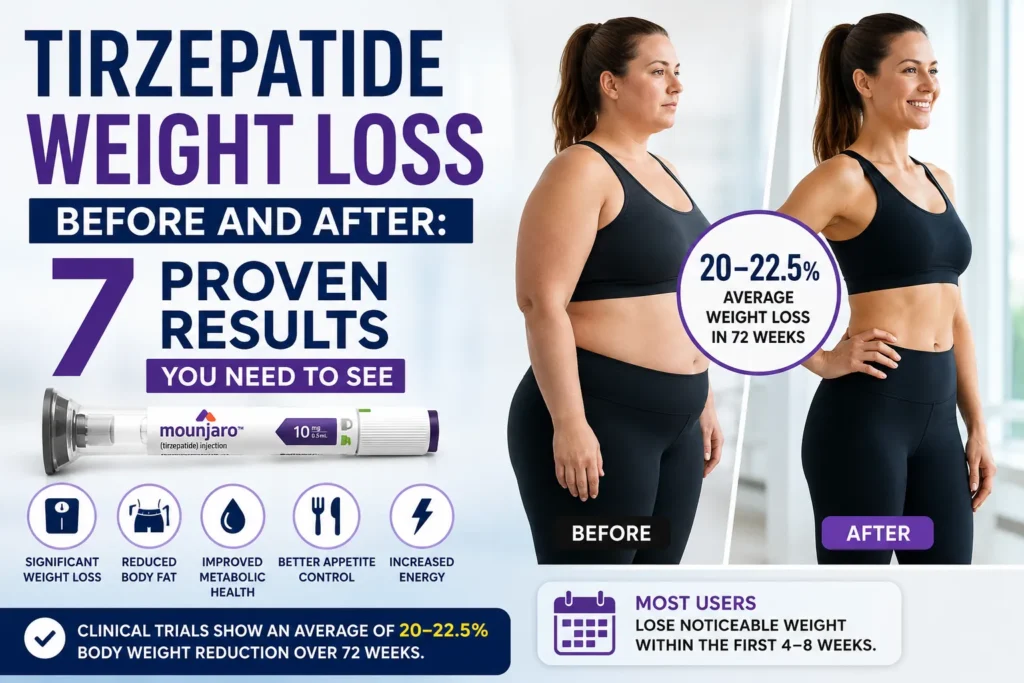
Tirzepatide (Mounjaro/Zepbound) produces significant weight loss before and after results with clinical trials showing an average of 20–22.5% body weight reduction over 72 weeks. Most users lose noticeable weight within the first 4–8 weeks. Results vary based on dose, diet, activity level, and individual metabolism.
You’ve Been Lied to About Weight Loss and Here’s the Proof
You’ve done everything “right.” You’ve counted calories, dragged yourself to the gym, and given up foods you love. But the scale barely moves or worse, it creeps back up the moment you exhale.
Here’s what nobody tells you: for many people, obesity isn’t a willpower problem. It’s a metabolic and hormonal problem. And if you’ve been grinding without results, it’s not a character flaw. It might be biology working against you.
That’s why millions of Americans are now looking at tirzepatide weight loss before and after stories and what they’re finding is changing everything they thought they knew about losing weight.
What Is Tirzepatide and Why Is Everyone Talking About It?
Tirzepatide is a once-weekly injectable medication originally developed for type 2 diabetes under the brand name Mounjaro. It’s since been FDA-approved for chronic weight management as Zepbound (approved December 2023).
What makes it different from older weight loss drugs? Tirzepatide is a dual GIP/GLP-1 receptor agonist. That means it activates two gut hormones simultaneously glucagon-like peptide-1 (GLP-1) and glucose-dependent insulinotropic polypeptide (GIP). This dual action suppresses appetite, slows stomach emptying, and improves how your body processes glucose and fat.
In plain English: your brain gets a stronger “I’m full” signal, you eat less without fighting yourself, and your body burns stored fat more efficiently.
This article will walk you through real tirzepatide weight loss before and after results, what the science says, how long it takes, and whether it might be the right tool for you.
Key Benefits of Tirzepatide for Weight Loss
The reasons people turn to tirzepatide go beyond just dropping pounds on a scale. Here’s what the medication actually delivers:
Sustained, significant fat loss. Unlike most diet drugs that fizzle out after a few months, tirzepatide users in clinical trials kept losing weight through week 72.
Reduced hunger without misery. Most users report that food cravings become manageable not through brute willpower, but because appetite genuinely decreases.
Improvements in metabolic health. Blood pressure, triglycerides, blood sugar, and cholesterol markers all showed improvement in tirzepatide trial participants, even those without diabetes.
Preservation of lean muscle (when combined with adequate protein and resistance training) a critical advantage over crash dieting, which often burns muscle alongside fat.
Better quality of life. From improved mobility and sleep to higher self-confidence, the downstream effects of losing 20%+ of body weight touch nearly every area of daily life.
The Data Doesn’t Lie: What Research Says About Tirzepatide Results
Let’s get into the numbers, because the science behind tirzepatide before and after results is genuinely remarkable.
SURMOUNT-1 Trial (2022, NEJM): This landmark study followed 2,539 adults with obesity (BMI ≥ 30) for 72 weeks. Participants received either 5 mg, 10 mg, or 15 mg of tirzepatide weekly. Results:
- 5 mg dose: Average weight loss of 15% of body weight
- 10 mg dose: Average weight loss of 19.5%
- 15 mg dose: Average weight loss of 20.9%
- Placebo group: just 3.1%
That means someone starting at 250 lbs on the 15 mg dose could expect to lose roughly 52 pounds over 72 weeks without surgery.
SURMOUNT-2 Trial (for patients with type 2 diabetes): Showed similar results 15% body weight reduction on the 15 mg dose, which far outperformed previous diabetes medications with weight loss effects.
Comparison to semaglutide (Ozempic/Wegovy): A head-to-head trial (SURMOUNT-5, 2025) showed tirzepatide outperformed semaglutide 2.4 mg by approximately 47% more weight loss a significant margin in medical terms.
A Real-World Before and After Scenario
Meet Sarah a 38-year-old woman, 5’4″, starting weight 218 lbs (BMI: 37.4). She had tried four different diets over ten years without keeping weight off. Her doctor prescribed tirzepatide (Zepbound) at the starting 2.5 mg dose, titrating up every 4 weeks.
Month 1 (2.5 mg): Down 6 lbs. Appetite noticeably reduced by week 2. Mild nausea in the first week.
Month 3 (7.5 mg): Down 22 lbs total. Clothes fitting differently. Energy up. Started walking 30 minutes daily.
Month 6 (10 mg): Down 38 lbs. Blood pressure normalized. Off one of her two blood pressure medications.
Month 12 (15 mg): Down 51 lbs now 167 lbs. BMI dropped to 28.7, out of the obese range.
Sarah’s story isn’t extraordinary it’s typical for patients who stay consistent. The medication doesn’t do all the work. But it levels the hormonal playing field in a way that diet alone rarely can.
Expert Insight: What Actually Makes or Breaks Tirzepatide Results
After seeing hundreds of weight loss journeys, one pattern stands out: the medication is a tool, not a magic bullet. The people who see the most dramatic tirzepatide weight loss before and after results share a few key behaviors:
They prioritize protein. Tirzepatide reduces total food intake. If you’re eating less, every bite needs to count. Aim for 100–130g of protein daily to preserve muscle mass during rapid fat loss.
They don’t skip the titration. The dose escalation schedule (starting at 2.5 mg) exists for a reason it minimizes nausea and GI side effects. Rushing to higher doses increases dropout rates.
They track non-scale victories. Blood pressure, A1C, energy levels, sleep quality these changes often appear before major scale movement and are powerful motivators to stay the course.
They treat alcohol and ultra-processed foods as the enemy. Tirzepatide slows gastric emptying. Combined with alcohol or high-fat, processed foods, nausea and discomfort spike dramatically. The medication essentially “punishes” poor food choices use that feedback loop.
They have a maintenance plan. Weight regain after stopping is real. Working with a doctor to either continue at a lower maintenance dose or transition to lifestyle habits strong enough to sustain results is critical.
Related: How to Speed Up Your Weight Loss Results | Best High-Protein Meal Plans for Weight Loss
Reality Check: What They Don’t Tell You in the Ads
Let’s be honest about the downsides, because they’re real.
Side effects are common, especially early. Nausea, vomiting, diarrhea, constipation, and fatigue are reported by 30–50% of users in the first 4–8 weeks. Most people tolerate them with time and dose adjustment, but some don’t.
It’s expensive without insurance. Zepbound’s list price runs $550–$1,000/month without coverage. While manufacturer coupons and compounded versions exist, cost remains a significant barrier.
It doesn’t work without lifestyle changes. The SURMOUNT trials included dietary counseling. Users who change nothing about their diet and activity see significantly smaller results.
Weight returns when you stop. A SURMOUNT-4 extension study showed participants who discontinued tirzepatide regained roughly two-thirds of lost weight within 12 months. This is a long-term commitment, not a 90-day fix.
Thyroid cancer risk (theoretical). Based on animal studies, tirzepatide carries an FDA black box warning for potential thyroid C-cell tumors. It’s contraindicated in people with a personal or family history of medullary thyroid carcinoma (MTC) or Multiple Endocrine Neoplasia syndrome type 2 (MEN 2).
Practical Steps: How to Get the Most from Tirzepatide
If you’re starting or considering tirzepatide, here’s a clear action plan:
Step 1: Qualify first. Current FDA criteria for Zepbound: BMI ≥ 30, or BMI ≥ 27 with at least one weight-related condition (hypertension, type 2 diabetes, sleep apnea, etc.).
Step 2: Work with a licensed prescriber. Telehealth platforms have made access easier, but make sure you have a real consultation not just a form and a prescription.
Step 3: Follow the titration schedule strictly. Start at 2.5 mg for 4 weeks. Increase by 2.5 mg every 4 weeks until you reach your target or maximum tolerated dose (up to 15 mg).
Step 4: Optimize your diet for the medication. Eat smaller, more frequent meals. Prioritize lean proteins (chicken, fish, eggs, Greek yogurt). Reduce fatty, greasy, and ultra-processed foods. Drink 80+ oz of water daily.
Step 5: Add movement progressively. Even walking 20–30 minutes daily accelerates results and protects lean muscle.
Step 6: Track everything. Photos, measurements, blood work not just weight. The full picture keeps you motivated when the scale slows (which it will at some point).
What to avoid:
- Skipping doses or self-adjusting your dose
- Alcohol in the first month of each new dose level
- High-fat trigger foods that cause nausea
- Stopping abruptly without a plan
Tirzepatide vs. Other Weight Loss Options
| Option | Avg. Weight Loss | Cost/Month | Requires Prescription | Sustainability |
|---|---|---|---|---|
| Tirzepatide (Zepbound) | 15–22% body weight | $550–$1,000 | Yes | High (with continued use) |
| Semaglutide (Wegovy) | 10–15% body weight | $1,300+ | Yes | High |
| Phentermine/Topiramate | 8–10% body weight | $30–$75 | Yes | Moderate |
| Diet + Exercise Alone | 5–8% body weight | Varies | No | Variable |
| Bariatric Surgery | 25–35% body weight | $15,000–$25,000 | No (insurance varies) | High |
Bottom line: Tirzepatide sits in a sweet spot better results than older medications and lifestyle-only approaches, less invasive and expensive than surgery. For the right candidate, it’s currently the most effective non-surgical weight loss tool available.
Frequently Asked Questions About Tirzepatide Weight Loss Before and After
1. How much weight can I realistically lose on tirzepatide?
Clinical trials show 15–22.5% of body weight over 72 weeks. For a 250 lb person, that’s roughly 37–56 lbs.
2. When will I start seeing results?
Most people notice reduced appetite within the first 1–2 weeks. Visible weight loss typically begins in weeks 4–8.
3. How long does it take to lose 30 pounds on tirzepatide?
At an average pace, many users reach 30 lbs lost within 5–6 months on therapeutic doses.
4. Does tirzepatide work without dieting?
It reduces appetite significantly, but users who improve their diet see far better before and after results than those who don’t change eating habits.
5. What is the maximum dose of tirzepatide?
The maximum approved dose is 15 mg weekly. This dose shows the greatest weight loss results in clinical trials.
6. Can tirzepatide cause muscle loss?
Any significant calorie deficit can cause muscle loss. Eating adequate protein (1g per pound of goal body weight) and doing resistance training can minimize this risk.
7. Is tirzepatide better than Ozempic for weight loss?
Head-to-head data (SURMOUNT-5) shows tirzepatide produces approximately 47% more weight loss than semaglutide 2.4 mg (Wegovy). Most endocrinologists consider it the more effective option.
8. Does weight come back after stopping tirzepatide?
Yes. SURMOUNT-4 data shows most people regain significant weight within 12 months of stopping. This is why long-term strategies matter.
9. Who should not take tirzepatide?
People with a personal or family history of medullary thyroid carcinoma (MTC), MEN 2 syndrome, or a history of pancreatitis. Pregnant women should also avoid it.
10. Is tirzepatide covered by insurance?
Coverage varies. Many commercial insurance plans cover Mounjaro for diabetes. Zepbound coverage for obesity is growing but not universal. Check your specific plan.
11. Can I take tirzepatide if I don’t have diabetes?
Yes. Zepbound is FDA-approved specifically for weight management in non-diabetic adults who meet BMI criteria.
12. What are the most common side effects?
Nausea, vomiting, diarrhea, constipation, and decreased appetite. These are most common when starting or increasing doses.
13. How is tirzepatide injected?
It’s a subcutaneous (under the skin) injection in the abdomen, thigh, or upper arm, given once weekly.
14. Can I drink alcohol on tirzepatide?
It’s strongly advised to minimize or avoid alcohol. Tirzepatide slows digestion and can intensify nausea with alcohol. It also increases hypoglycemia risk in diabetics.
15. How long do I need to stay on tirzepatide?
For most people, this is a long-term medication. Stopping usually leads to weight regain. Discuss a long-term plan including possible dose reduction with your prescriber.
Take the Next Step Toward Real Results
If you’ve been struggling with weight for years and traditional approaches haven’t delivered lasting change, tirzepatide represents one of the most significant medical breakthroughs in obesity treatment in decades. The before and after results aren’t hype they’re documented in peer-reviewed clinical trials with thousands of participants.
But medication alone doesn’t build lasting habits. Pairing tirzepatide with the right nutrition plan, support system, and long-term strategy is what separates people who transform their lives from those who just lose weight temporarily.
Ready to understand your full weight loss picture? Explore our complete guide to GLP-1 medications and find out whether tirzepatide could be the missing piece in your journey.
This article is for informational purposes only and does not constitute medical advice. Always consult a licensed healthcare provider before starting any prescription medication.
External Sources:
