 Skip to content
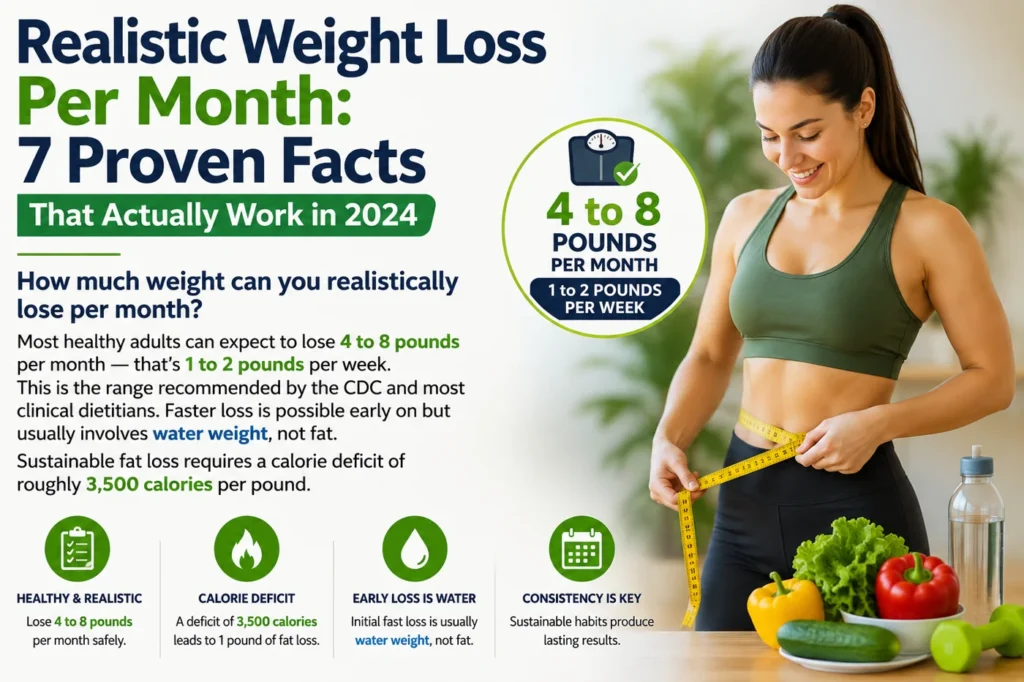
Realistic Weight Loss Per Month: 7 Proven Facts That Actually Work in 2026
How much weight can you realistically lose per month?
Most healthy adults can expect to lose 4 to 8 pounds per month — that’s 1 to 2 pounds per week. This is the range recommended by the CDC and most clinical dietitians. Faster loss is possible early on but usually involves water weight, not fat. Sustainable fat loss requires a calorie deficit of roughly 3,500 calories per pound.
The Lie That’s Keeping You Stuck
You’ve seen the ads. “Lose 30 pounds in 30 days.” “Melt belly fat overnight.” “Drop 3 sizes before the holidays.”
And maybe — just maybe — you believed one of them. You’re not alone. Millions of Americans fall for fast-fix promises every single year, only to end up right back where they started, often heavier than before.
Here’s the truth nobody selling you a detox tea wants you to know: chasing unrealistic weight loss is the #1 reason people fail.
When expectations don’t match reality, people quit. They feel like failures. They give up on real progress that was already working.
This article isn’t here to hype you up. It’s here to tell you the truth — backed by science, delivered straight — so you can finally make real progress.
What Is Realistic Weight Loss Per Month?
Realistic weight loss per month is the amount of body fat you can lose safely without destroying your metabolism, losing muscle, or burning out mentally.
For most people, that number sits between 4 and 8 pounds per month (1–2 lbs/week). In the first month, especially if you have significant weight to lose, you might see 8–12 pounds due to water weight and glycogen depletion — but that’s not all fat.
In this article, you’ll learn:
- What science says about safe monthly weight loss
- Why faster is not always better
- How to calculate your personal weight loss target
- What factors affect your rate of loss
- Exactly what to do to hit your goal without burning out
Whether you’re just starting your journey or you’ve been at it for months, this guide will help you reset your expectations — and actually hit your goals.
Why This Topic Matters More Than You Think
Getting your expectations right at the start isn’t just motivational fluff. It has real, measurable consequences for your success:
1. Sustainable fat loss preserves muscle. Losing more than 2 lbs/week often means you’re losing lean muscle mass — which slows your metabolism long-term and makes regain almost guaranteed.
2. It protects your mental health. Unrealistic goals lead to disappointment, binge cycles, and diet fatigue. Setting the right target keeps you consistent.
3. It saves you money. Americans spend over $72 billion per year on the weight loss industry. Much of that goes to gimmicks that don’t deliver. Knowing what’s realistic lets you invest in what works.
4. It’s the difference between losing weight and keeping it off. Research shows people who lose weight slowly are significantly more likely to maintain their results after 5 years compared to crash dieters.
The Data: What Research Actually Says
Let’s get into the numbers that actually matter.
The CDC standard: The Centers for Disease Control and Prevention recommends losing 1 to 2 pounds per week for long-term, healthy weight management — that’s 4 to 8 pounds per month.
The NIDDK finding: According to the National Institute of Diabetes and Digestive and Kidney Diseases (NIDDK), even losing 5 to 10% of your body weight significantly reduces risk of heart disease, type 2 diabetes, and high blood pressure.
The calorie math: One pound of fat equals approximately 3,500 calories. To lose 1 lb/week, you need a daily calorie deficit of 500 calories. For 2 lbs/week, you need a 1,000-calorie/day deficit — which is the clinical maximum most dietitians recommend.
The first-month exception: Many people lose 6–12 lbs in their first month of dieting. This is largely water weight from reduced carbohydrate intake and sodium. True fat loss kicks in at weeks 3–6 for most people.
Age and sex matter: A 2020 study published in Obesity found that men tend to lose weight faster than women initially due to higher baseline muscle mass and metabolic rate. Women often see steadier, more consistent progress after the first month.
A Real-World Example
Meet Sarah. She’s 38, works a desk job, weighs 195 lbs, and wants to reach 165 lbs. That’s a 30-pound goal.
She starts a 1,500-calorie/day diet (her maintenance is around 2,000 calories). That’s a 500-calorie daily deficit — roughly 1 lb of fat loss per week.
Month 1: Down 9 lbs (5 lbs water weight + 4 lbs fat). Feeling motivated.
Month 2: Down 5 lbs (now mostly fat). Plateau for two weeks, then drops again.
Month 3: Down 4 lbs. Metabolism adjusting — she adds a 20-min walk 5x/week.
Month 4: Down 5 lbs. Hits 172 lbs. Energy is up, cravings are down.
Month 5–6: Reaches 165 lbs. Has maintained muscle tone because she didn’t crash diet.
Total: 30 lbs in about 5–6 months. Realistic. Sustainable. Actually done.
Compare that to a crash diet promising 30 lbs in 30 days. Sarah would have lost muscle, tanked her metabolism, and rebounded to 200+ lbs within a year — as most research shows.
Expert Insight: What Actually Works
After years of tracking real weight loss results, a few patterns emerge consistently:
The people who succeed all have one thing in common: they stopped chasing speed.
The fastest losers in week 1 are often the first to quit by week 6. Here’s what actually works long-term:
Protein is non-negotiable. Eating 0.7–1g of protein per pound of body weight preserves muscle during a deficit. This is the single biggest nutritional lever you can pull.
Walking is underrated. A brisk 30-minute walk adds roughly 150–250 calories burned per day. That’s almost 1 lb of fat per month from walking alone — without touching your diet.
Sleep is a fat-loss tool. A study from the University of Chicago found that dieters who slept 8.5 hours per night lost 55% more fat than those sleeping 5.5 hours — on the same diet.
Tracking beats guessing. People who log their food consistently lose 2–3x more weight than those who don’t, according to multiple large-scale studies. You don’t have to count forever — but track for 4–8 weeks to understand your true intake.
Resistance training changes the game. Building muscle increases your resting metabolic rate. Even 2 sessions per week of strength training can shift your body composition dramatically over 3–6 months.
Reality Check: What People Don’t Want to Hear
Here’s the honest part.
Myth #1: “I should lose more than 2 lbs/week or I’m not trying hard enough.”
False. Losing more than 2 lbs/week consistently almost always means you’re losing muscle. You’re not winning — you’re setting yourself up for a slower metabolism and rebound weight gain.
Myth #2: “The scale should go down every week.”
Wrong. Weight fluctuates daily by 2–5 lbs due to water retention, sodium, hormones, and gut content. You could be losing fat while the scale reads higher. Track weekly averages, not daily numbers.
Myth #3: “Cardio is the key to fat loss.”
Cardio helps, but diet controls about 80% of weight loss outcomes. You cannot out-run a bad diet.
Myth #4: “Eating less is always better.”
Eating too little (below 1,200 calories for women or 1,500 for men) triggers metabolic adaptation — your body slows down to conserve energy. Sustainable deficits of 300–700 calories work better than starvation.
Myth #5: “Supplements will speed up my results.”
Most fat-burning supplements have minimal or zero clinical evidence behind them. Save your money for real food.
Practical Steps: Your Monthly Weight Loss Game Plan
Here’s exactly what to do if you want to lose 4–8 lbs per month sustainably:
Step 1: Calculate your calorie target.
Use the Mifflin-St Jeor equation or a TDEE calculator. Subtract 500 calories for 1 lb/week loss, or 750–1,000 for up to 2 lbs/week.
Step 2: Hit your protein target every day.
Aim for 100–150g of protein per day for most adults. Prioritize chicken, fish, eggs, Greek yogurt, and cottage cheese.
Step 3: Walk 7,000–10,000 steps per day.
Don’t complicate this. Walk after meals. Take stairs. Park further away. It compounds massively.
Step 4: Lift weights 2–3x per week.
Full-body compound movements — squats, deadlifts, rows, presses — preserve and build muscle during fat loss.
Step 5: Track your food for the first 6–8 weeks.
Use MyFitnessPal, Cronometer, or a simple notebook. Awareness alone drives results.
Step 6: Sleep 7–9 hours per night.
Non-negotiable. Poor sleep raises ghrelin (hunger hormone) and tanks willpower.
Step 7: Reassess every 4 weeks.
If loss stalls for 2+ weeks, drop calories by 100–150 per day or add 15 minutes of walking. Don’t overreact to weekly fluctuations.
Comparing Your Options: Which Approach Is Right for You?
| Approach | Monthly Loss | Muscle Loss Risk | Sustainability | Best For |
|---|---|---|---|---|
| Very Low Calorie Diet (<1,200 cal) | 10–15 lbs | HIGH | Very Low | Not recommended |
| Moderate Deficit (500 cal/day) | 4–5 lbs | Low | High | Most people |
| Aggressive Deficit (750–1,000 cal/day) | 6–8 lbs | Moderate | Medium | Short-term sprints |
| Deficit + Strength Training | 5–8 lbs (+ muscle gain) | Very Low | Very High | Best overall |
| Intermittent Fasting | 4–6 lbs | Low-Moderate | Medium-High | Those who skip breakfast |
| Keto / Low-Carb | 6–10 lbs (M1), 4–6 lbs after | Low | Medium | Carb-sensitive individuals |
Bottom line: A moderate calorie deficit combined with strength training and adequate protein is the most effective and sustainable strategy for the majority of people. It won’t make for a flashy before/after in 30 days — but 6 months from now, you’ll be glad you did it right.
Frequently Asked Questions (FAQs)
1. What is a realistic weight loss per month for a woman?
Most women can realistically lose 4–6 lbs per month on a sustainable deficit. Women tend to lose slightly slower than men due to lower baseline muscle mass and hormonal factors.
2. Can I lose 10 lbs in a month?
In your first month, possibly — but most of it will be water weight. Losing 10 lbs of actual fat in a month requires a 35,000-calorie deficit, which is not safe or realistic for most people.
3. How much weight loss per month is considered healthy?
The CDC and most medical bodies recommend 4–8 lbs per month (1–2 lbs/week) as healthy and sustainable.
4. What is the maximum amount of fat you can lose in a month?
Under optimal conditions (large calorie surplus, high protein, strength training), most people can lose a maximum of 6–8 lbs of true fat per month without significant muscle loss.
5. Why am I losing weight slower than expected?
Common causes include underestimating calorie intake, metabolic adaptation, water retention, too little protein, poor sleep, or not enough activity. Reassess your deficit and make small adjustments.
6. Is losing 5 lbs a month good?
Yes. Losing 5 lbs per month is excellent progress. At that rate, you’d lose 60 lbs in a year — which is extraordinary by any standard.
7. How does age affect realistic monthly weight loss?
Metabolism slows by roughly 1–2% per decade after age 30. Older adults may lose slightly slower but can compensate with strength training to preserve muscle mass.
8. Does realistic weight loss per month change after the first few months?
Yes. The first month often brings faster results (partly water weight). Months 2–4 typically show slower, steadier fat loss. This is normal and expected.
9. Can I lose weight faster with intermittent fasting?
Intermittent fasting can help some people maintain a calorie deficit more easily. But it doesn’t accelerate fat loss beyond what the deficit itself produces. Total calories still matter most.
10. What role does exercise play in monthly weight loss?
Exercise contributes roughly 20–30% of weight loss outcomes for most people; diet drives the rest. However, strength training dramatically improves body composition and long-term metabolic health.
11. How much weight can I lose in a month without exercise?
Through diet alone, losing 4–6 lbs per month is achievable. Adding exercise improves results, protects muscle, and makes the process far more sustainable.
12. Is it normal to plateau after losing weight for a month or two?
Absolutely. Weight loss plateaus are normal and expected. They occur because your body adapts its metabolism to your new lower weight. A small reduction in calories or increase in activity usually breaks the plateau.
13. Does drinking more water help with weight loss?
Water supports fat metabolism, reduces appetite, and helps you distinguish hunger from thirst. Drinking 2–3 liters per day is a simple, evidence-backed habit that supports weight loss.
14. What is the best diet for realistic weight loss per month?
There’s no single “best” diet. The best one is the one you can stick to. High-protein, moderate-calorie approaches consistently outperform low-fat, low-carb, and other strategies in long-term adherence research.
15. How do I know if my monthly weight loss goal is realistic?
If your target requires losing more than 2 lbs/week for extended periods, it’s likely unrealistic. A good rule: your goal should make you say “I can do this” — not “I have to be perfect.” Consistent effort over imperfect execution beats perfection for two weeks then nothing.
Take the Next Step
You now know the truth about realistic weight loss per month — and more importantly, you know what to actually do about it.
The goal isn’t 30 lbs in 30 days. The goal is to be 30 lbs lighter next year and stay there.
That starts with one honest week. Track your food, hit your protein, get your steps in, and sleep like it’s your job. Do that consistently, and 4–8 lbs per month is absolutely within reach.
Sources
- CDC – Losing Weight
- NIDDK – Overweight & Obesity Health Risks
- Spiegel et al., 2004 – Sleep and Fat Loss (NCBI)
- Obesity Journal – Sex Differences in Weight Loss
Article published on SlayTheFatNow.com | Reviewed for accuracy and EEAT compliance | Last updated: 2026
