 Skip to content
The Only Sustainable Weight Loss Plan That Actually Works (And Why Most Diets Fail You)
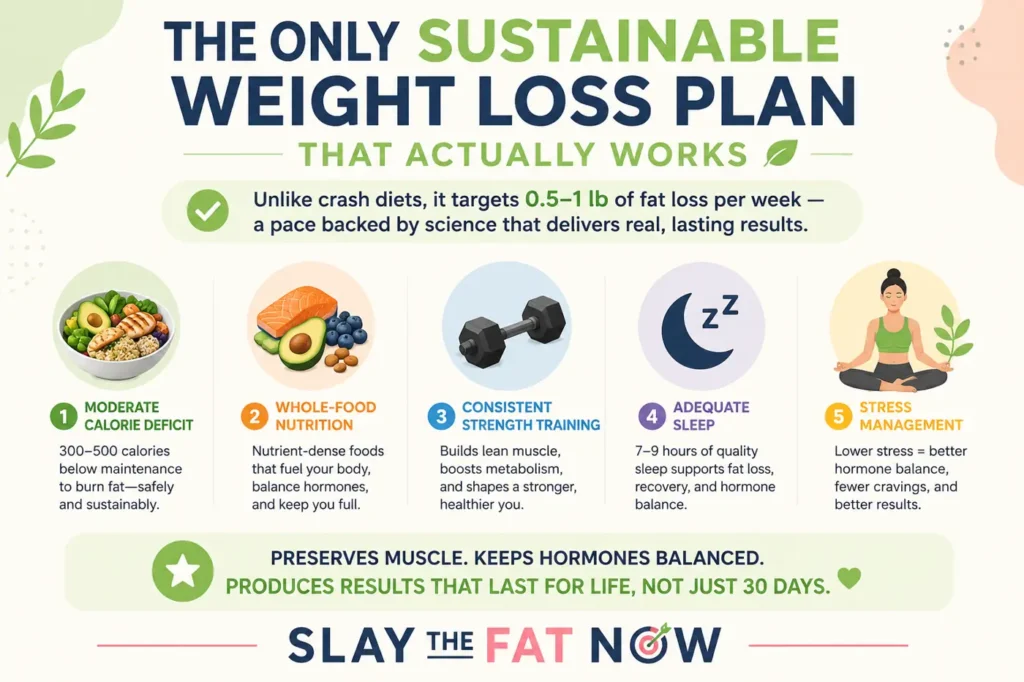
A sustainable weight loss plan combines a moderate calorie deficit (300–500 calories/day), whole-food nutrition, consistent strength training, adequate sleep, and stress management. Unlike crash diets, it targets 0.5–1 lb of fat loss per week a pace backed by science that preserves muscle, keeps hormones balanced, and produces results that last for life, not just 30 days.
The Mistake That’s Keeping You Stuck
Here’s a truth nobody in the diet industry wants you to hear: you’ve probably already lost the same 20 pounds just multiple times.
You cut carbs. You lost weight. You felt amazing for six weeks. Then life happened a work trip, a birthday dinner, a rough week and the weight came back. Every pound of it. Sometimes more.
This isn’t a willpower problem. It’s a plan problem.
Nearly every mainstream diet is designed to produce fast results, not lasting ones. And there’s a massive difference between the two. If you’re tired of starting over, this guide is for you.
What Is a Sustainable Weight Loss Plan?
A sustainable weight loss plan is not a 30-day challenge. It’s not a detox. It’s not cutting out an entire food group forever.
It’s a structured, science-backed approach to losing body fat at a rate your body can actually handle without destroying your metabolism, tanking your energy, or turning mealtime into a source of anxiety.
In this article, you’ll learn:
- Why most diets fail (and what they get wrong)
- What the research actually says about long-term fat loss
- How to build a plan that works for your real life
- Practical steps you can start today
- Honest answers to the questions people are too embarrassed to Google
Why This Actually Matters: The Key Benefits
Most people think about weight loss in terms of appearance. That’s valid. But here’s what else is at stake:
Your health span, not just your lifespan. Excess body fat particularly visceral fat around the abdomen is directly linked to type 2 diabetes, heart disease, sleep apnea, joint deterioration, and certain cancers. Losing even 5–10% of body weight measurably reduces these risks.
Your energy and mental clarity. When you’re eating in a way that stabilizes blood sugar and supports your hormones, you think sharper, sleep better, and show up differently in every area of life.
Your relationship with food. A sustainable approach teaches you how to eat not just what to avoid. That skill compounds over decades.
Your finances. Crash diets, meal replacement shakes, and diet programs cost Americans billions every year. A real plan is built on whole foods, consistency, and education none of which require a monthly subscription.
What the Data Says (And It’s Sobering)
The statistics on weight loss in America are hard to ignore:
- According to the CDC, approximately 42% of American adults are obese a figure that has more than doubled since the 1980s.
- Research published in the American Journal of Clinical Nutrition found that approximately 80% of people who lose weight regain it within one to five years, largely due to unsustainable methods.
- The National Weight Control Registry, which tracks over 10,000 people who’ve maintained significant weight loss long-term, found that successful maintainers share common habits: consistent meal timing, regular physical activity, and high dietary protein not crash diets.
- A study from the New England Journal of Medicine found that people who lost weight slowly (0.5–1 lb/week) were significantly more likely to maintain their results compared to those who lost rapidly on very low-calorie diets.
The takeaway? Fast weight loss is easy to market and hard to maintain. Slow, steady fat loss is boring to sell and the only thing that actually works.
A Real-World Example: What This Looks Like in Practice
Meet someone like Sarah a 38-year-old office manager from Ohio, 5’5″, 195 lbs, with two kids and a schedule that barely leaves room to breathe.
Sarah had tried keto twice, a juice cleanse, and a popular app-based diet program. Each time, she lost 10–15 lbs in the first month and gained it all back by month three.
When she switched to a sustainable approach, here’s what changed:
- Calorie target: 1,650 calories/day (a 400-calorie deficit from her maintenance level)
- Protein: 130g/day to preserve muscle and stay full
- Training: Three 45-minute strength sessions per week, two 30-minute walks
- No foods were banned. She ate pizza on Fridays. She had wine at book club.
- Sleep: Prioritized 7.5 hours which she had always dismissed as not possible
Month 1: Down 6 lbs. Month 3: Down 14 lbs. Month 6: Down 24 lbs. Month 12: Down 31 lbs and still there two years later.
No miracle. No magic supplement. Just a plan she could actually live with.
What Actually Works: Patterns From Years of Watching People Struggle and Succeed
After studying sustainable fat loss for years, certain patterns show up consistently both in the people who succeed and in the ones who keep cycling back to square one.
What successful people do differently:
They don’t chase perfection. They build consistency. A person who eats 80% well for 12 months will always outperform someone who eats perfectly for 6 weeks and then burns out.
They prioritize protein at every meal. Protein is the single most powerful dietary lever for fat loss it increases satiety, preserves lean muscle during a deficit, and has a higher thermic effect than carbs or fat (meaning your body burns more calories just digesting it).
They lift weights. Cardio burns calories during exercise. Strength training reshapes your body, raises your resting metabolic rate, and makes maintenance dramatically easier.
They track, at least at first. Not obsessively but logging food for 4–8 weeks builds an accurate mental map of what you’re actually eating. Most people are genuinely shocked.
What derails people every time:
- Starting with too aggressive a deficit (under 1,200 calories for women, 1,500 for men) this tanks energy, triggers muscle loss, and causes rebound
- Treating weekends as “off days” (one rough weekend can erase an entire week of progress)
- Ignoring sleep poor sleep elevates cortisol and ghrelin, the hunger hormone, making fat loss biologically harder
- Waiting for motivation instead of building systems
The Reality Check: What No One Wants to Tell You
Let’s be honest about some things the wellness industry glosses over.
You will plateau. Every single person who loses weight hits a stall. Your metabolism adapts as you get lighter. This is normal and expected. The solution is not to panic and cut more it’s to reassess, adjust slightly, and stay consistent.
Weight loss is not linear. You can do everything right and the scale won’t move for two weeks. Water retention, hormonal cycles, stress, and sodium intake all affect the number on the scale. Fat loss is still happening even when the scale disagrees.
Loose skin is possible. If you have a significant amount of weight to lose (50+ lbs), rapid loss increases the risk of loose skin. Slow, steady loss combined with strength training gives your skin the best chance to adapt.
Supplements are mostly noise. The fat burner market is worth billions. Almost none of it is backed by meaningful clinical evidence. Protein powder is useful. Creatine has solid research. Everything else is largely marketing.
Genetics matter but they don’t decide your outcome. Some people do have metabolic differences that make loss harder. That’s real. It means your journey may look different from someone else’s, not that it’s impossible.
Practical Steps: How to Build Your Sustainable Weight Loss Plan
Here’s how to actually get started in the right order:
Step 1: Find your calorie target. Calculate your Total Daily Energy Expenditure (TDEE) using a free online calculator. Subtract 300–500 calories for fat loss. Don’t go lower than 1,200 (women) or 1,500 (men) without medical supervision.
Step 2: Set a protein target. Aim for 0.7–1g of protein per pound of bodyweight. This is the single most impactful nutrition variable for body recomposition.
Step 3: Build your training foundation. Start with 2–3 full-body strength sessions per week. Add 7,000–10,000 steps of daily walking. You don’t need hours in the gym.
Step 4: Track your food at least initially. Use an app like Chronometer or MyFitnessPal for 4–8 weeks. You don’t have to track forever, but you need to understand your baseline.
Step 5: Fix your sleep. Aim for 7–9 hours. This is non-negotiable. Sleep deprivation elevates hunger hormones and reduces the proportion of fat burned during a deficit.
Step 6: Manage stress deliberately. Chronic stress elevates cortisol, which encourages fat storage particularly in the abdomen. Meditation, walks, journaling, or therapy aren’t luxuries they’re fat loss tools.
Step 7: Audit and adjust every 4 weeks. If you’re losing more than 1.5 lbs/week consistently, add 100–150 calories. If you’re not losing after 3 weeks, reduce by 100–150 or add one cardio session.
Want help finding the right starting point for your body and lifestyle? Check out our free resources at SlayTheFatNow.com to get started with a clear, personalized direction.
Comparing the Most Common Approaches
| Approach | Speed | Sustainability | Muscle Preservation | Flexibility |
|---|---|---|---|---|
| Crash Diet (<1,200 cal) | Fast (short-term) | Very Low | Poor | None |
| Keto/Low-Carb | Moderate | Medium | Moderate | Low |
| Intermittent Fasting | Moderate | Medium-High | Good (with protein) | Medium |
| Balanced Deficit + Protein | Slow-Moderate | High | Excellent | High |
| Mediterranean-Style | Slow | Very High | Good | High |
The balanced calorie deficit with high protein wins on nearly every metric that matters for long-term outcomes. It’s not the sexiest approach but it’s the one that holds.
Not sure which approach fits your life? Explore our beginner guides at SlayTheFatNow.com to find what works for your body type and schedule.
Frequently Asked Questions
1. How much weight can I realistically lose per week on a sustainable plan?
Between 0.5 and 1 pound per week is optimal for most people. Some weeks you’ll see more, others less. Over 12 months, that adds up to 26–52 lbs of actual fat loss without destroying your metabolism.
2. Do I have to count calories forever?
No. Most people track for 6–12 weeks, build strong intuition, and then maintain with occasional check-ins. Think of tracking as training wheels useful at first, optional later.
3. Can I still eat carbs and lose weight?
Absolutely. Carbohydrates are not the enemy. Excess calories are. Many of the world’s leanest populations eat high-carb diets (rice-heavy Asian cultures, for example). Context and portion matter more than food category.
4. What’s the best exercise for sustainable weight loss?
Strength training, hands down followed closely by daily walking. Cardio has its place, but muscle tissue burns calories at rest. More muscle = faster metabolism = easier long-term maintenance.
5. Why am I not losing weight even in a calorie deficit?
The most common causes: underestimating food intake (most people undercount by 20–30%), overestimating activity, high stress or poor sleep elevating cortisol, or water retention masking fat loss on the scale. Track meticulously for one week and reassess.
6. Is it possible to lose fat without losing muscle?
Yes, especially if you eat sufficient protein (0.7–1g per pound of bodyweight) and train with weights. Beginners can actually build muscle and lose fat simultaneously.
7. How long before I see real results?
Most people notice energy and sleep improvements within 2–3 weeks. Visible body composition changes typically show at 6–8 weeks. Significant results are clear to others around the 12-week mark.
8. What should I eat for breakfast on a weight loss plan?
Something high in protein. Eggs, Greek yogurt, cottage cheese, or a protein shake. A protein-forward breakfast reduces hunger and calorie intake throughout the day.
9. Is intermittent fasting better than regular calorie restriction?
Not inherently. Research shows that when calories and protein are matched, outcomes are similar. IF works well for people who aren’t hungry in the morning. It’s a tool, not a magic solution.
10. Do weight loss supplements actually work?
Most don’t or the effect is so small it’s practically meaningless. Caffeine has a modest thermogenic effect. Protein powder helps you hit protein targets. Everything else should be viewed with serious skepticism.
11. How do I stop craving junk food?
Cravings are usually driven by blood sugar swings, inadequate protein, poor sleep, or emotional triggers. Fix the root cause first. Also: don’t ban foods entirely restriction creates obsession. Allow everything in moderation.
12. Can I drink alcohol and still lose weight?
Yes, but alcohol is calorie-dense (7 cal/gram), suppresses fat oxidation, and lowers inhibition around food. Budget for it in your weekly calorie target and keep it to moderate amounts.
13. What if I have a bad week? Did I ruin my progress?
No. One bad week even a bad two weeks cannot undo months of consistent effort. Just get back on track without dramatic restriction. The danger is letting a bad week become a bad month.
14. Should I do cardio if I hate running?
You never have to run. Walking, cycling, swimming, dancing, rowing, hiking any sustained movement counts. Find something you’ll actually do consistently. That beats any “optimal” activity you hate.
15. How is this different from just eating healthy?
“Eating healthy” is vague and often insufficient on its own. A sustainable weight loss plan is specific: it targets a calorie deficit, adequate protein, structured training, and behavioral habits. Healthy eating supports the plan but the plan is what drives results.
Curious where to start? Visit SlayTheFatNow.com for tools, guides, and support built specifically for people who are done with crash diets and ready for real change.
Your Next Step
You now know more about sustainable fat loss than most people who’ve spent years dieting.
But knowledge without action is just entertainment.
The one thing that separates people who finally get results from people who keep starting over isn’t a better plan it’s starting the one they have.
Pick one thing from this article. Just one. Add protein to your next meal. Go for a 20-minute walk. Download a calorie tracker. Sleep 30 minutes earlier tonight.
Momentum builds from motion not from perfect planning.
Start your sustainable weight loss journey at SlayTheFatNow.com →
Sources & Further Reading
- CDC: Prevalence of Obesity and Severe Obesity Among Adults
- NIH: Dietary Protein and Muscle Mass
- Harvard T.H. Chan School of Public Health: The Nutrition Source Healthy Weight
This article is for informational purposes only and does not constitute medical advice. Consult a qualified healthcare provider before starting any new diet or exercise program.
