 Skip to content
Emotional Eating After 40: Why It Gets Harder (And How to Finally Stop)
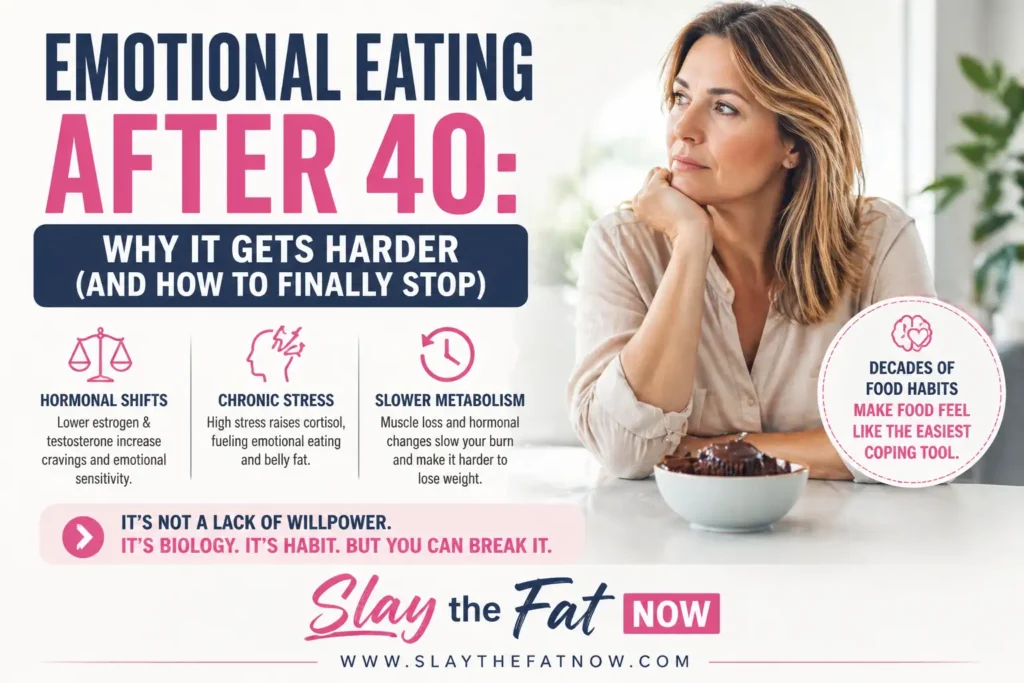
Emotional eating after 40 happens when hormonal shifts, chronic stress, and decades of food habits combine to make food feel like the easiest coping tool. After 40, lower estrogen and testosterone levels increase cravings, slow metabolism, and heighten emotional sensitivity — making emotional eating more frequent and harder to break without a targeted strategy.
The Hook: You’re Not Weak — You’re Wired Wrong (After 40)
You ate perfectly all day. Then 9 PM hit.
Before you even realized it, half a bag of chips was gone. Or the leftover cake. Or both.
You told yourself: “I’ll start fresh tomorrow.”
But tomorrow turned into next Monday. And next Monday turned into… well, you’re reading this now.
Here’s what nobody tells you: emotional eating after 40 is not a willpower problem. It’s a biology problem. A habit problem. And — if you’re being honest — an identity problem.
The frustrating truth is that the same coping strategy that “worked” in your 30s (a little stress eating here, a little comfort food there) becomes a full-blown pattern in your 40s. Your hormones change. Your stress load increases. Your recovery time slows. And suddenly food isn’t just comfort — it’s the only comfort that feels fast enough.
This article is for you if you’re over 40, you know you eat emotionally, and you’re ready for real answers — not another “just drink water instead” tip.
Overview: What Emotional Eating After 40 Really Looks Like
Emotional eating after 40 is the habit of using food to manage emotions — stress, boredom, loneliness, anxiety, or even celebration — rather than physical hunger.
It’s extremely common. But after 40, it becomes distinctly more challenging for three reasons:
- Hormones shift dramatically — especially for women approaching perimenopause and men experiencing andropause.
- Stress accumulates — career pressure, family demands, aging parents, and financial responsibilities peak in your 40s.
- Old coping habits are deeply grooved — you’ve been rewarding or numbing yourself with food for 20–30+ years.
In this guide, Benjamin Sley — weight loss coach and founder of SlayTheFatNow.com — breaks down why emotional eating intensifies after 40, what the research says, and exactly what works to stop it.
You’ll also find 15 FAQs that cover the most common questions people ask before they finally get results.
Key Benefits of Understanding and Addressing Emotional Eating After 40
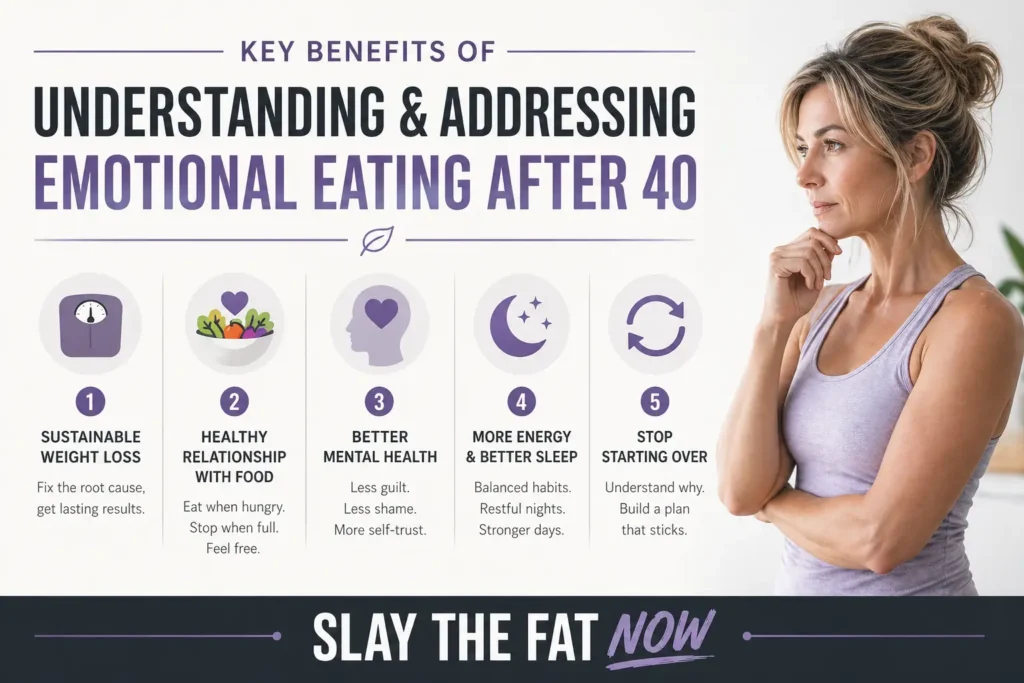
Understanding your emotional eating patterns isn’t just about losing weight. Here’s what changes when you break the cycle:
1. Sustainable Weight Loss Finally Becomes Possible Most people over 40 who struggle to lose weight aren’t failing because of their diet plan — they’re failing because emotional eating is quietly sabotaging it. Fix the root cause, and the results follow.
2. Your Relationship With Food Transforms Instead of food being an enemy or an escape hatch, it becomes neutral. You eat when you’re hungry. You stop when you’re full. Simple — and profoundly freeing.
3. Your Mental Health Improves The guilt cycle that follows emotional eating — the shame, the “I failed again” self-talk — is exhausting. Breaking the habit reduces anxiety and builds genuine self-trust.
4. Your Energy and Sleep Improve Late-night emotional eating disrupts sleep, spikes blood sugar, and leaves you foggy the next morning. Addressing it improves your entire daily rhythm.
5. You Stop Starting Over When you understand why you eat emotionally, you stop falling into the trap of “clean slate Mondays” that never stick. You build a real, durable approach to food.
Data + Facts: What Science Says About Emotional Eating After 40
This isn’t anecdotal. The research is clear:
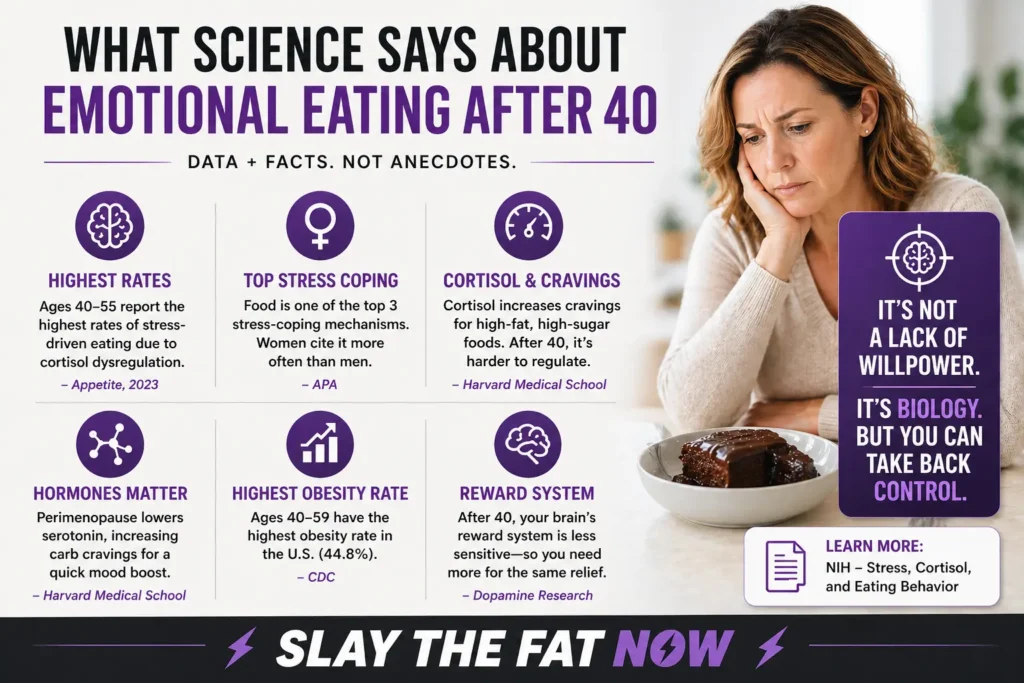
- A 2023 study published in the journal Appetite found that adults aged 40–55 reported the highest rates of stress-driven eating compared to younger and older age groups — driven largely by cortisol dysregulation.
- According to the American Psychological Association, adults report food as one of their top three stress-coping mechanisms, with women citing it more frequently than men.
- Harvard Medical School research confirms that cortisol — the stress hormone — directly increases cravings for high-fat, high-sugar foods. And after 40, cortisol is harder to regulate due to declining sex hormones.
- Perimenopause (which typically begins in the early-to-mid 40s) causes estrogen fluctuations that directly impact serotonin — the brain’s “feel-good” chemical. Lower serotonin = stronger urge to eat carbohydrates for a quick boost.
- The CDC reports that adults aged 40–59 have the highest obesity rates in the U.S. (44.8%), suggesting that the convergence of hormonal and lifestyle factors in this decade creates a perfect storm for weight gain — much of it driven by emotional eating.
- Dopamine research shows that after 40, the brain’s reward system becomes less sensitive, meaning you need more food to get the same emotional relief — a pattern that escalates quickly if unchecked.
External Resource: CDC — Adult Obesity Facts
Real Example: What Emotional Eating After 40 Actually Costs You
Meet “Linda” — a composite of dozens of clients Benjamin Sley has worked with.
Linda is 44. She works in HR, has two teenagers, and a husband who travels frequently. She’s tried Weight Watchers twice, tried keto once, and does great… until Thursday evening hits.
By 8:30 PM, after a stressful day of back-to-back meetings and helping with homework, she’s standing in front of the pantry eating crackers she didn’t even want.
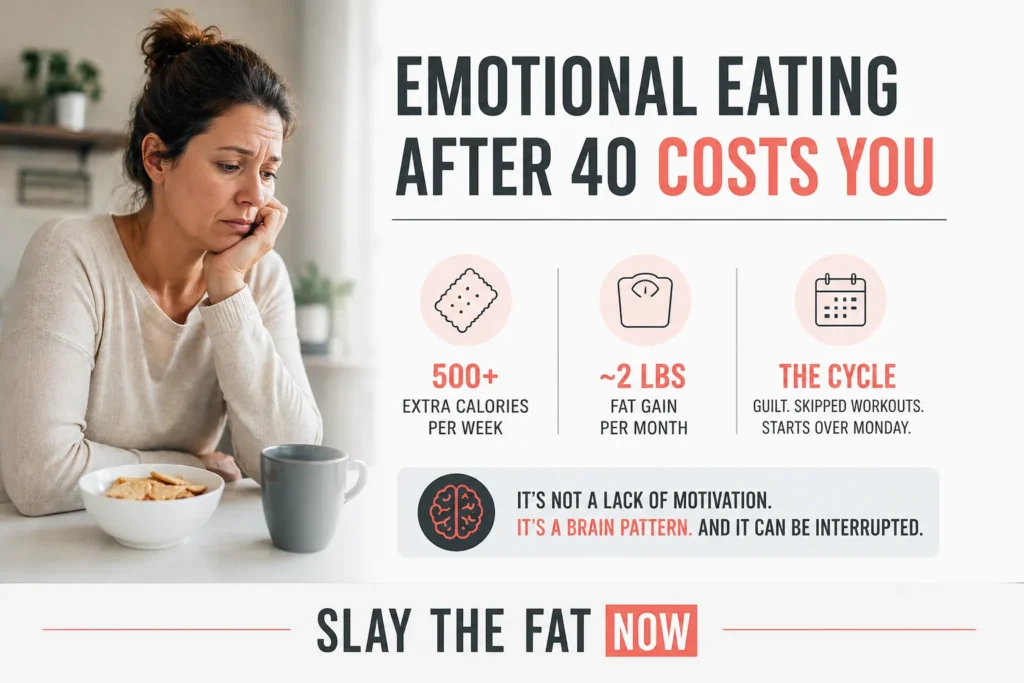
Over three months, this pattern adds up to roughly 500 extra calories per week from emotional eating alone — totaling 6,500+ calories per month. That’s almost 2 pounds of fat gain per month from snacking she doesn’t even enjoy.
But the real cost isn’t just physical. Linda wakes up every Friday morning with guilt. She skips the gym because “what’s the point.” And she starts fresh on Monday — until Thursday hits again.
This cycle isn’t a lack of motivation. It’s a brain pattern. And it can be interrupted.
Experience + Authority: What We’ve Seen Working With 40+ Clients
At SlayTheFatNow.com, Benjamin Sley has spent years working specifically with adults over 40 who struggle with emotional eating. Here’s what the real-world patterns look like — and what actually moves the needle.
Mistake #1: Treating emotional eating like a food problem. Most people try to fix emotional eating by changing what they eat. They go low-carb, remove sugar, track macros. But the trigger isn’t the food — it’s the emotion. Without addressing the emotion, every “diet” is built on sand.
Mistake #2: Using willpower as the strategy. Willpower is a finite resource. By 9 PM, after a full workday and an evening of parenting or responsibilities, willpower is depleted. Strategies that rely on it fail — every time.
Mistake #3: Waiting until they’re in the moment to decide. Emotional eating decisions happen in seconds. By the time you’re standing at the pantry, the decision is nearly made. The real intervention happens hours earlier — in how you structure your evening, your hunger, and your stress.
What actually works:
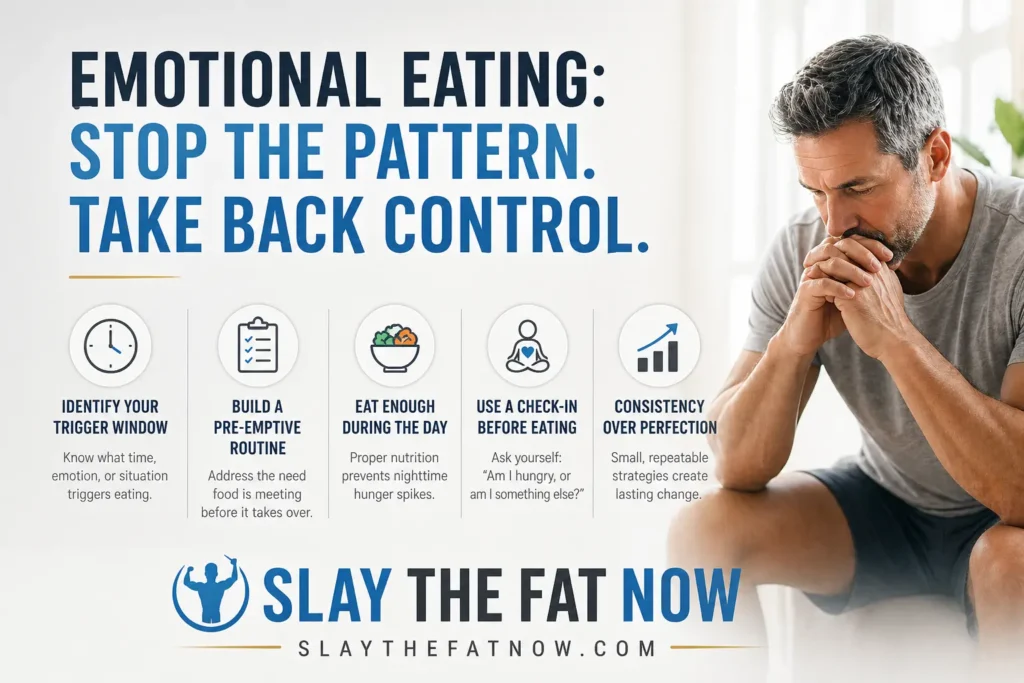
- Identifying your personal “trigger window” (the specific time, emotion, or situation that precedes eating)
- Building a pre-emptive routine that addresses the need food is meeting
- Eating enough during the day so nighttime hunger isn’t amplifying emotional urges
- Using a body-based check-in before eating: “Am I actually hungry, or am I something else?”
Explore more coaching strategies at SlayTheFatNow — Emotional Eating Coaching.
Reality Check: The Honest Truth About Breaking Emotional Eating After 40
Let’s be real with you, because you deserve honesty.
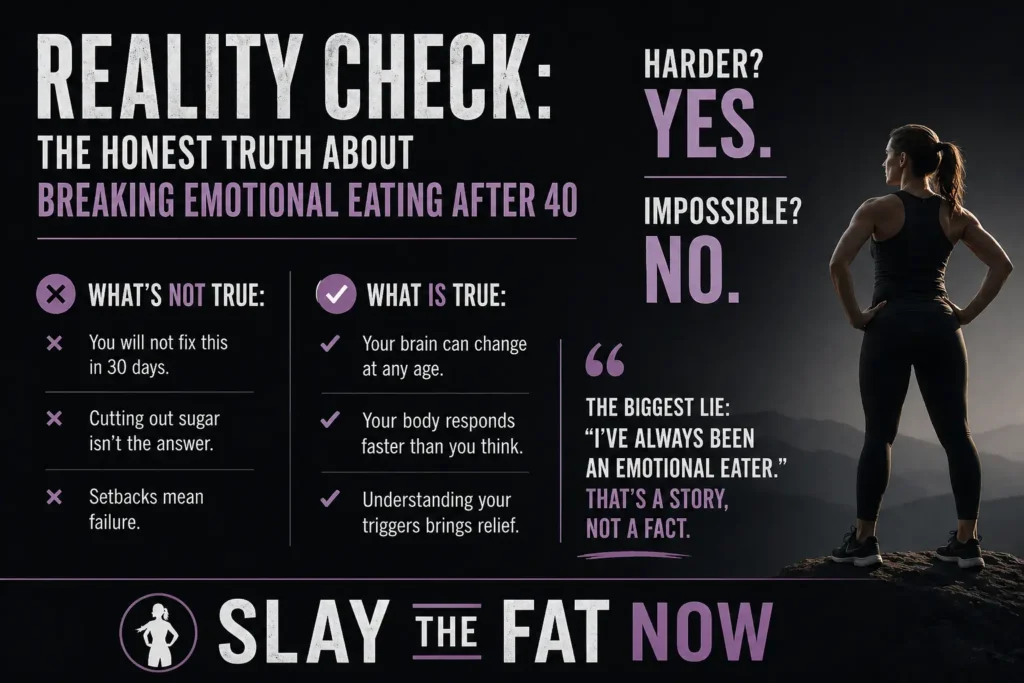
Breaking emotional eating after 40 is harder than it was at 25. The neural pathways are more established. The hormones are more volatile. The life stress is at its peak.
But harder does not mean impossible.
Here’s what’s true:
- You will not fix this in 30 days with a detox.
- Cutting out sugar entirely does not address why you reach for it.
- You will have setbacks. That’s not failure — that’s biology.
- Therapy and coaching are not mutually exclusive — many clients benefit from both.
Here’s also what’s true:
- Your brain is still plastic. You can build new habits at 40, 50, and beyond.
- Your body responds faster to changes than you think — even after years of emotional eating.
- Most people, once they identify their specific triggers, feel immediate relief — because the behavior finally makes sense.
The single most dangerous myth is: “I’ve always been an emotional eater — it’s just who I am.” That’s a story, not a fact.
Practical Advice: What to Do If You’re an Emotional Eater Over 40
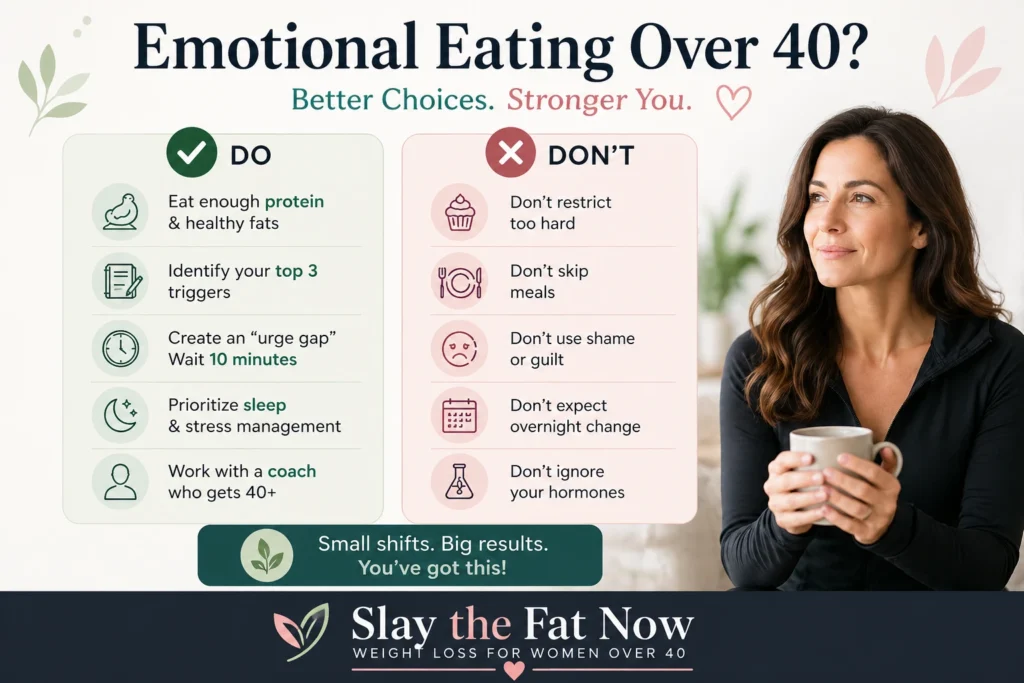
DO:
- ✅ Eat enough protein and fat throughout the day (minimum 90–130g protein for most 40+ adults) to reduce evening hunger that amplifies emotional urges
- ✅ Identify your top 3 emotional eating triggers using a simple food-mood journal — just 5 minutes a day for two weeks
- ✅ Create a “urge gap” — commit to waiting 10 minutes before eating outside of mealtimes. Most emotional urges pass or soften in this window.
- ✅ Address sleep aggressively — sleep deprivation increases ghrelin (hunger hormone) and cortisol, making emotional eating almost inevitable
- ✅ Work with a coach who specializes in the 40+ body and mindset, not generic weight loss advice
DON’T:
- ❌ Don’t restrict so hard that emotional eating becomes a relief valve for genuine deprivation
- ❌ Don’t skip meals to “save calories” — it backfires by 7 PM, every time
- ❌ Don’t use shame or guilt as motivation — it accelerates the emotional eating cycle
- ❌ Don’t try to eliminate emotional eating overnight — gradual pattern interruption works far better
- ❌ Don’t ignore the hormonal piece — get bloodwork (cortisol, thyroid, estrogen/testosterone) if you haven’t recently
For a personalized approach, visit SlayTheFatNow — Weight Loss Program.
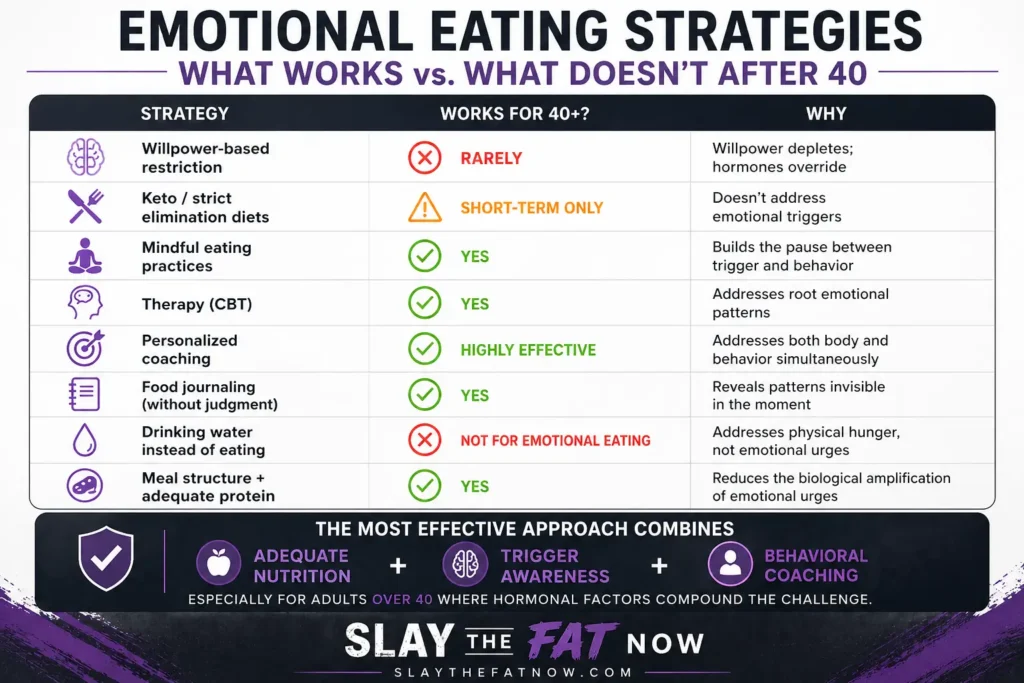
Comparison: Emotional Eating Strategies — What Works vs. What Doesn’t After 40
| Strategy | Works for 40+? | Why |
|---|---|---|
| Willpower-based restriction | ❌ Rarely | Willpower depletes; hormones override |
| Keto / strict elimination diets | ⚠️ Short-term only | Doesn’t address emotional triggers |
| Mindful eating practices | ✅ Yes | Builds the pause between trigger and behavior |
| Therapy (CBT) | ✅ Yes | Addresses root emotional patterns |
| Personalized coaching | ✅ Highly effective | Addresses both body and behavior simultaneously |
| Food journaling (without judgment) | ✅ Yes | Reveals patterns invisible in the moment |
| Drinking water instead of eating | ❌ Not for emotional eating | Addresses physical hunger, not emotional urges |
| Meal structure + adequate protein | ✅ Yes | Reduces the biological amplification of emotional urges |
The most effective approach combines adequate nutrition + trigger awareness + behavioral coaching — especially for adults over 40 where hormonal factors compound the challenge.
External Resource: APA — Stress and Eating
FAQs: Emotional Eating After 40 (People Also Ask)
1. What causes emotional eating after 40? Hormonal changes (declining estrogen, testosterone, and progesterone), elevated cortisol from chronic stress, disrupted sleep, and deeply ingrained food habits all converge in your 40s to make emotional eating more frequent and harder to resist.
2. Is emotional eating after 40 a sign of something more serious? It can be. Persistent emotional eating may co-occur with anxiety, depression, or disordered eating patterns. If it’s severely impacting your life, seek support from a therapist alongside a weight loss coach.
3. Why does emotional eating get worse during perimenopause? Estrogen fluctuations during perimenopause directly impact serotonin, the brain’s feel-good chemical. When serotonin dips, cravings for carbohydrates and sugar spike as the brain seeks a quick boost.
4. Can emotional eating cause weight gain after 40? Yes — and the weight is harder to lose than in your 20s or 30s because metabolic rate slows and fat storage patterns shift (particularly around the abdomen) with hormonal changes.
5. How do I know if I’m an emotional eater? Common signs include: eating when not physically hungry, eating in response to stress or boredom, feeling out of control around certain foods, and feeling guilt or shame after eating. A food-mood journal for two weeks is highly revealing.
6. What is the best diet for someone who emotionally eats after 40? There’s no single “best diet.” However, a high-protein, balanced-fat, moderate-carbohydrate approach eaten at regular intervals helps reduce the biological factors that amplify emotional eating.
7. Can I stop emotional eating without therapy? Yes — many people do, especially with the support of a specialized coach. However, for deeply rooted patterns tied to trauma or significant anxiety, therapy can accelerate progress dramatically.
8. How long does it take to stop emotional eating? Most people begin to notice meaningful change within 4–8 weeks of consistent behavioral intervention. Full pattern change typically takes 3–6 months — and that’s normal and healthy.
9. Does stress eating affect weight differently after 40? Yes. Higher cortisol from stress preferentially deposits fat in the abdomen — which is already a risk after 40 due to hormonal changes. Stress eating after 40 has outsized metabolic consequences.
10. What’s the difference between emotional eating and binge eating disorder? Emotional eating involves using food to cope with emotions, with some loss of control. Binge eating disorder (BED) involves recurrent episodes of eating large amounts rapidly, feeling extreme loss of control, and significant distress. BED requires clinical support.
11. Why do I crave sugar and carbs when I’m stressed after 40? Cortisol spikes drive cravings for quick-energy foods (sugars and refined carbs) because the brain registers stress as an emergency requiring fast fuel. After 40, these cortisol responses are heightened.
12. Are men more or less susceptible to emotional eating after 40? Men experience andropause — declining testosterone — in their 40s, which can increase irritability, fatigue, and emotional dysregulation, all of which are common emotional eating triggers. Men often underreport emotional eating because of social stigma.
13. Can sleep affect emotional eating after 40? Dramatically. Even one night of poor sleep increases ghrelin (the hunger hormone) by up to 24% and reduces leptin (the fullness hormone). Sleep deprivation is one of the most powerful amplifiers of emotional eating.
14. What are the best non-food alternatives to emotional eating? The most effective alternatives address the actual need: physical movement for stress release, a 5-minute breathing practice for anxiety, social connection for loneliness, and structured “wind-down” routines for evening triggers.
15. How does working with Benjamin Sley at SlayTheFatNow help with emotional eating? Benjamin’s approach is built specifically for adults over 40 — combining hormonal awareness, behavioral pattern work, and sustainable nutrition strategies. Rather than generic dieting advice, clients receive a personalized framework that addresses why they eat emotionally and builds real, lasting change. Learn more here.
📞 CTA: Ready to Finally Break the Cycle?
You’ve tried the diets. You’ve white-knuckled it through weekends. You’ve restarted more Mondays than you can count.
And you’re still here — which means you haven’t given up. That matters more than you know.
Emotional eating after 40 is not permanent. It is not who you are. And it is absolutely something you can change — with the right support.
Benjamin Sley works exclusively with adults who are done with generic advice and ready for a real approach built around their actual body, life, and patterns.
👉 Book Your Free Consultation at SlayTheFatNow.com Contact
Or explore more resources:
This article was written by Benjamin Sley, Certified Weight Loss Coach and founder of SlayTheFatNow.com. Benjamin specializes in helping adults over 40 break emotional eating patterns and achieve sustainable weight loss. Content is for informational purposes and does not constitute medical advice.
