 Skip to content
Egg Diet for Weight Loss: The Complete 2026 Guide That Actually Works
Meta Description: Discover how the egg diet for weight loss works, what science really says, a 7-day meal plan, and expert tips from coach Benjamin Sley to lose weight safely and keep it off.
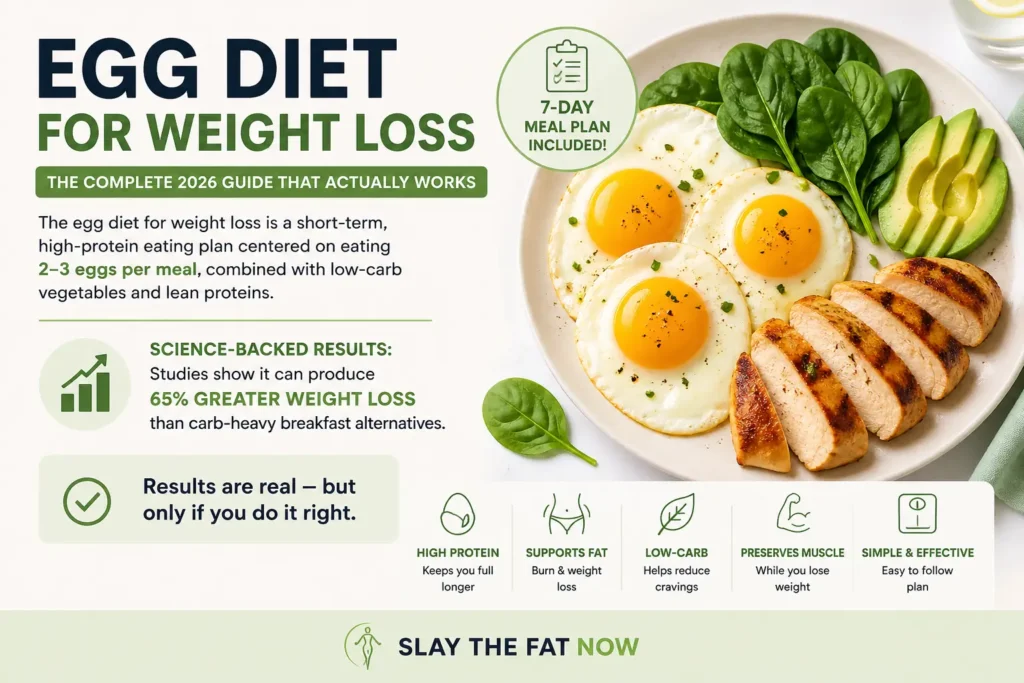
The egg diet for weight loss is a short-term, high-protein eating plan centered on eating 2–3 eggs per meal, combined with low-carb vegetables and lean proteins. When paired with a calorie deficit, studies show it can produce 65% greater weight loss than carb-heavy breakfast alternatives. Results are real — but only if you do it right.
The Mistake 73 Million Americans Are Making Right Now
You’ve probably tried it.
You stumbled across a reel showing someone dropping 10 pounds in a week on the “egg diet,” got excited, stocked up on a dozen eggs, and started eating them for breakfast, lunch, and dinner — only to feel miserable by day three, quit by day five, and gain the weight back by day ten.
Sound familiar?
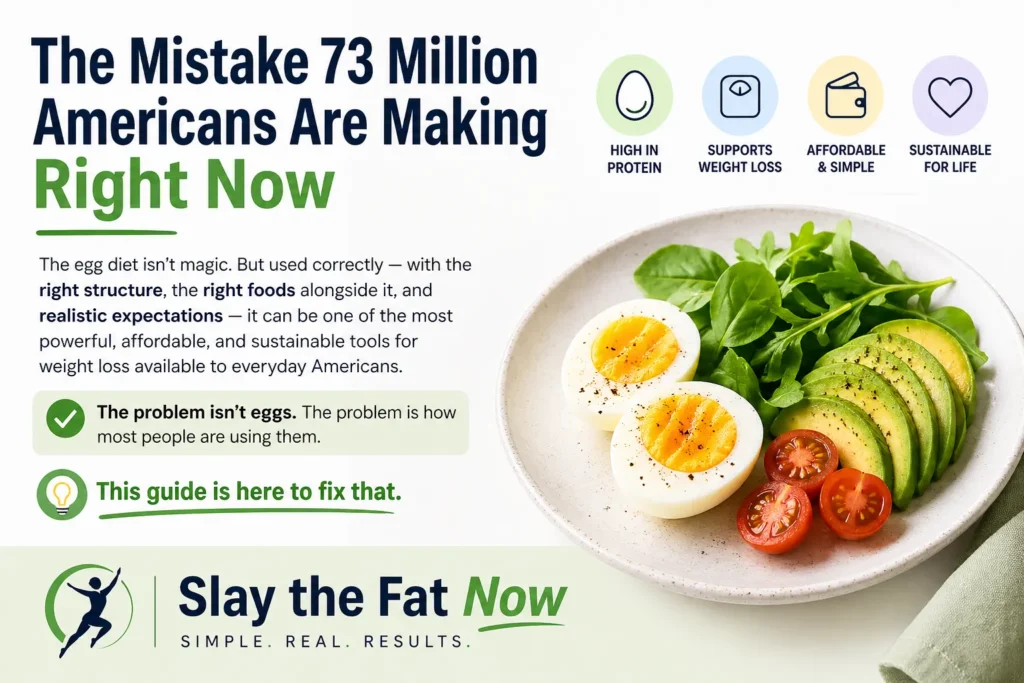
Here’s the hard truth: the egg diet isn’t magic. But used correctly — with the right structure, the right foods alongside it, and realistic expectations — it can be one of the most powerful, affordable, and sustainable tools for weight loss available to everyday Americans.
The problem isn’t eggs. The problem is how most people are using them.
This guide is here to fix that.
What Is the Egg Diet for Weight Loss? (Simple Overview)
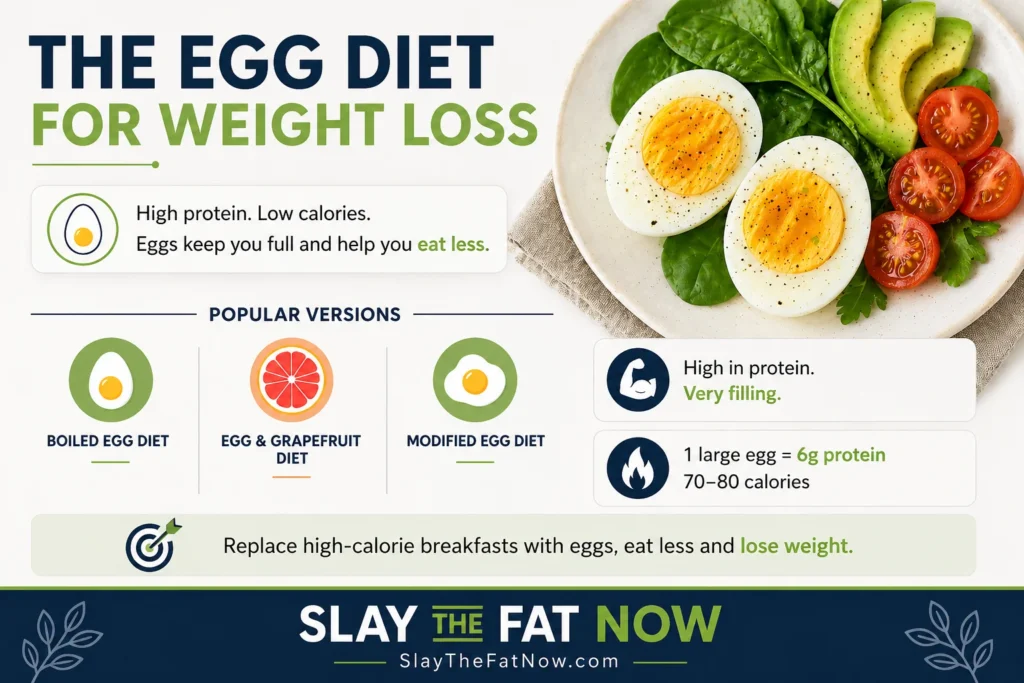
The egg diet for weight loss is a high-protein, reduced-calorie eating approach that uses eggs as its central protein source. There are several versions floating around the internet — some extreme, some sensible. The most popular formats include:
- The Boiled Egg Diet — mostly hard-boiled eggs, low-carb vegetables, and some lean protein for 14 days
- The Egg and Grapefruit Diet — pairs eggs with grapefruit at each meal
- The Modified Egg Diet — eggs at breakfast, balanced meals the rest of the day (this is what Coach Benjamin Sley recommends)
The core principle is simple: eggs are nutrient-dense, high in protein, low in calories, and extremely filling. One large egg contains about 6 grams of protein and only 70–80 calories. When you replace high-carb, high-calorie breakfast foods with eggs, you naturally eat less throughout the day — and that’s where the weight loss magic actually happens.
Want to understand the full science behind high-protein diets and fat loss? Read our deep dive on protein and weight loss at SlayTheFatNow.com.
5 Key Benefits of the Egg Diet for Weight Loss
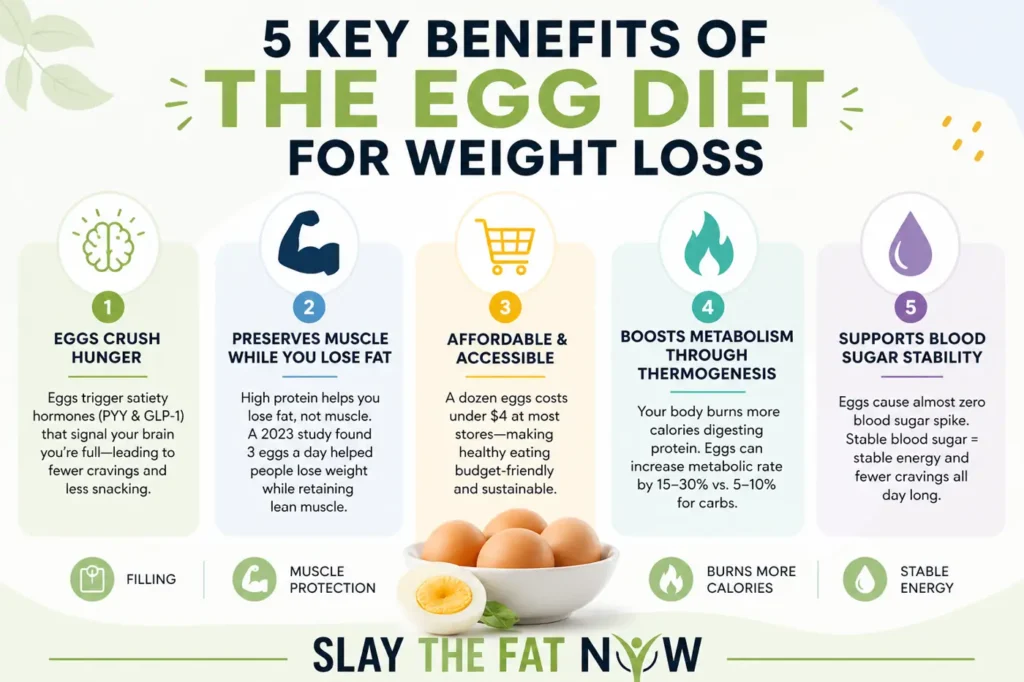
1. Eggs Crush Hunger (That’s the Real Power)
Eggs trigger the release of satiety hormones — specifically peptide YY (PYY) and glucagon-like peptide-1 (GLP-1) — the same hormones targeted by expensive weight loss injections. Eating eggs signals your brain: you’re full, stop eating. That means fewer cravings and less snacking without even trying.
2. High Protein Preserves Muscle While You Lose Fat
Most crash diets make you lose muscle along with fat. Muscle is your metabolism. Lose it, and your body burns fewer calories — making it harder to keep the weight off. A study published in Nutrients (2023) found that people who ate three eggs a day for 12 weeks lost weight while retaining lean muscle mass — a critical advantage.
3. Eggs Are Affordable and Accessible
You don’t need a gym membership, a nutritionist, or expensive supplements to start. A dozen eggs costs under $4 at most grocery stores. For budget-conscious Americans trying to lose weight without breaking the bank, this matters enormously.
4. Eggs Boost Metabolism Through Thermogenesis
Your body burns more calories digesting protein than it does digesting carbs or fat — this is called the thermic effect of food. High-protein foods like eggs can increase metabolic rate by 15–30% compared to 5–10% for carbohydrates. That means every egg-based meal is quietly working overtime for you.
5. Eggs Support Blood Sugar Stability
Unlike a bagel or bowl of cereal, eggs produce almost zero spike in blood sugar. Stable blood sugar = stable energy = fewer cravings throughout the day. For people with pre-diabetes or insulin resistance (a growing problem in the U.S.), this benefit alone can be life-changing.
What the Science Actually Says: Data + Facts
Let’s get into the numbers — because this is where most blog posts get vague. You deserve real data.
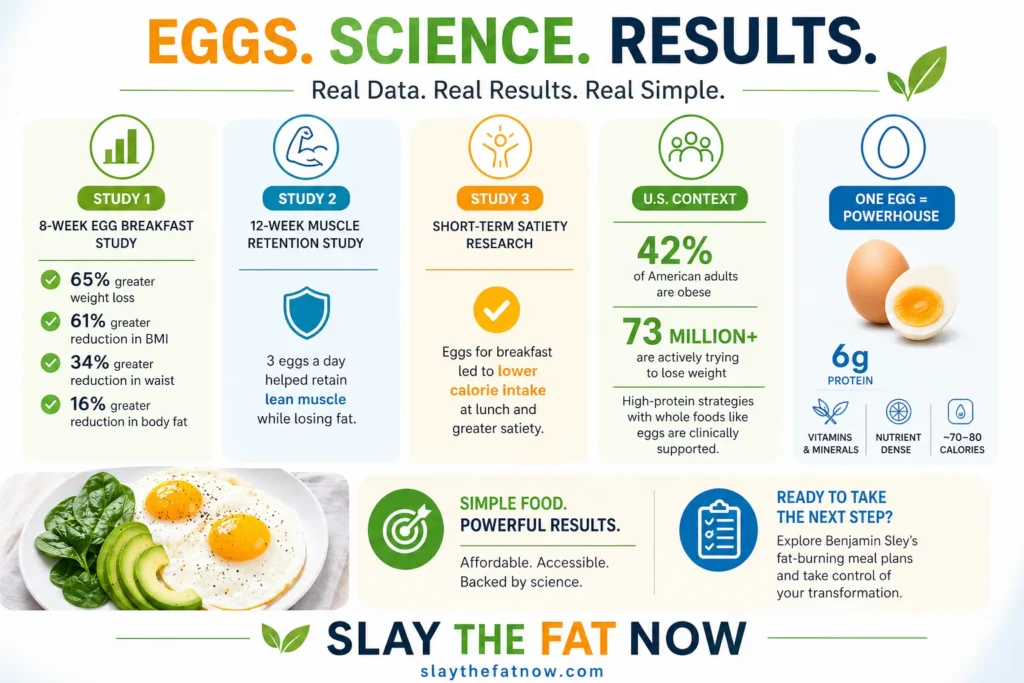
📊 Study 1 — The Pennington Biomedical Research Center (Published in the International Journal of Obesity)
In a landmark clinical trial with 152 overweight and obese participants aged 25–60, researchers compared an egg breakfast to a calorie-matched bagel breakfast over 8 weeks. The results:
- The egg diet group achieved a 65% greater weight loss than the bagel diet group
- 61% greater reduction in BMI
- 34% greater reduction in waist circumference
- 16% greater reduction in body fat percentage
The conclusion was clear: an egg breakfast, when combined with a calorie-deficit diet, significantly enhances weight loss.
📊 Study 2 — The 12-Week Muscle Retention Study (Nutrients, 2023)
Participants who ate three eggs a day for 12 weeks lost weight and retained lean muscle mass. The control group (no eggs) lost similar weight but also lost more muscle — confirming that eggs protect metabolic health during a calorie deficit.
📊 Study 3 — Short-Term Satiety Research (MedicalNewsToday review, updated May 2025)
A 2020 study found that eating eggs for breakfast led to lower calorie intake at lunch compared to eating cereal, in overweight and obese participants. Participants reported feeling less hungry and more satisfied after the egg breakfast — a direct, measurable effect on total daily calorie intake.
📊 U.S. Obesity Context
According to the CDC, nearly 42% of American adults are obese and over 73 million are actively trying to lose weight. High-protein dietary strategies — especially those built around accessible whole foods like eggs — are consistently among the most clinically supported approaches for this population.
📊 One Egg = One Nutritional Powerhouse
A single large egg provides: 6g protein, vitamins B12, D, A, folate, choline, selenium, iron, calcium, magnesium, and phosphorus — all for approximately 70–80 calories. No supplement on the market matches that nutrient density per dollar.
For more on how to combine nutrition strategy with sustainable fat loss, explore Benjamin Sley’s SlayTheFatNow fat-burning meal plans.
Real Example: What a Week on the Egg Diet Actually Looks Like
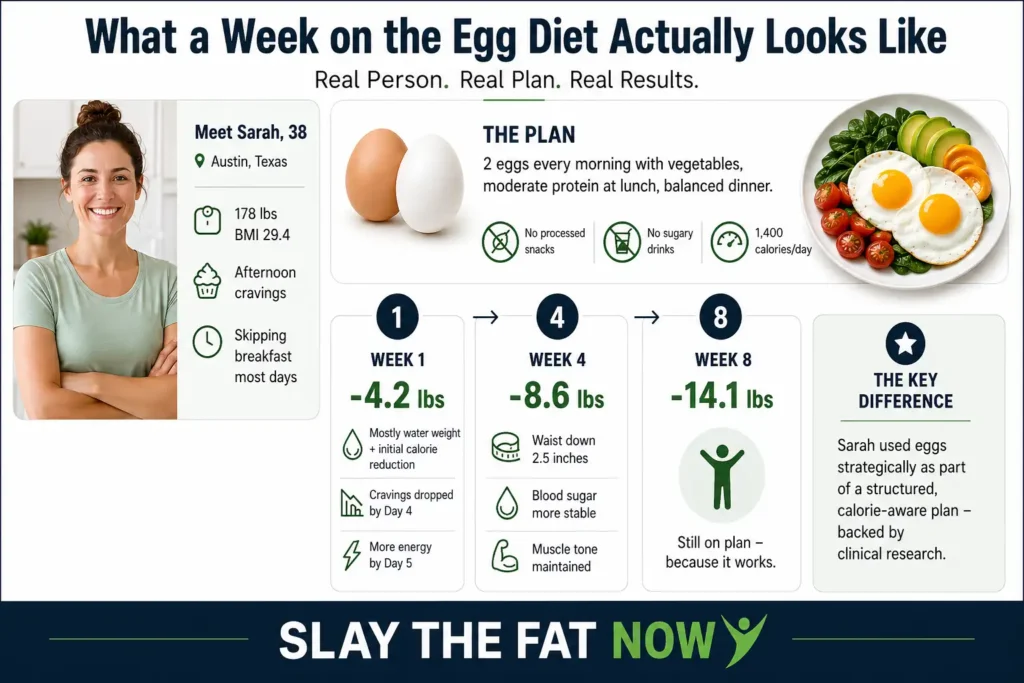
Let’s take a real-world scenario. Meet Sarah, 38, from Austin, Texas — a working mom who gained 25 pounds over three years, tried three different diets that all failed, and came to Coach Benjamin Sley frustrated and ready to quit.
Her starting point: 178 lbs, BMI 29.4, constant afternoon cravings, skipping breakfast most days.
The plan: Modified Egg Diet — 2 eggs every morning with vegetables, moderate protein at lunch, and a balanced dinner. No processed snacks. No sugary drinks. Calorie target: 1,400/day.
Week 1 Results:
- Lost 4.2 lbs (largely water weight + initial calorie reduction)
- Cravings dropped significantly by Day 4
- Energy levels improved by Day 5
- Reported feeling “actually full for the first time in years” after breakfast
Week 4 Results:
- Total loss: 8.6 lbs
- Waist circumference down 2.5 inches
- Blood sugar readings more stable
- Maintained muscle tone (confirmed via body composition scale)
Week 8 Results:
- Total loss: 14.1 lbs
- Still on plan — because it didn’t feel like a punishment
The key difference? Sarah wasn’t eating only eggs. She was using eggs strategically as part of a structured, calorie-aware approach — exactly what the clinical research supports.
Coach Benjamin Sley’s Expert Perspective: What 10+ Years in Weight Loss Coaching Has Taught Me
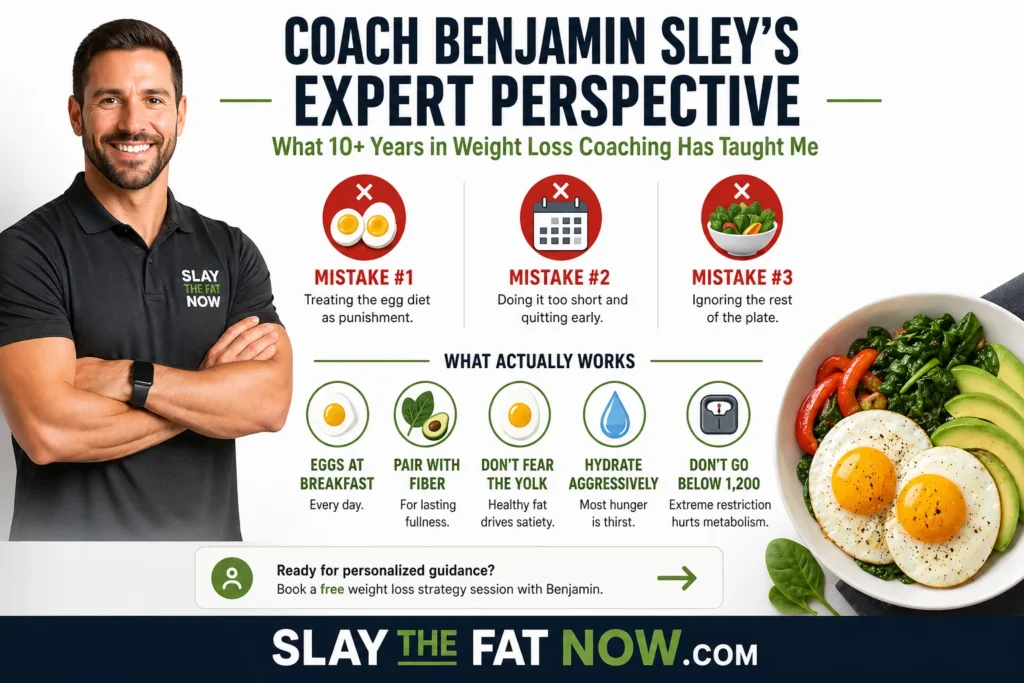
I’ve worked with hundreds of clients across the United States who came to me after trying the egg diet and either giving up or being disappointed. Here’s what I’ve consistently observed:
The #1 Mistake People Make: They treat the egg diet as a punishment instead of a tool. They eat plain boiled eggs with nothing else, feel miserable, and quit. The egg diet is not about suffering — it’s about strategic protein timing.
The #2 Mistake: They only do it for 3 days, see a 2-pound drop (mostly water), and declare it “doesn’t work” — or they only do it for 14 days, lose 8 pounds, go back to their old habits, and regain it all.
The #3 Mistake: They ignore the rest of the plate. Eggs alone won’t do it. What you eat alongside the eggs — vegetables, healthy fats, fiber — determines whether you’re building a sustainable habit or setting yourself up for failure.
What actually works, in my experience:
- Eggs at breakfast, every day — this is non-negotiable for my clients
- Pair eggs with fiber (spinach, peppers, avocado) to extend satiety further
- Don’t fear the yolk — the fat in the yolk is what triggers satiety hormones
- Hydrate aggressively — most hunger signals are actually dehydration
- Don’t go below 1,200 calories — extreme restriction kills your metabolism
The clients who’ve had the best long-term results are those who integrated eggs into a lifestyle, not those who treated it as a 2-week sprint.
Want personalized guidance from Benjamin directly? Book a free weight loss strategy session at SlayTheFatNow.com.
The Honest Reality: What the Egg Diet Can and Cannot Do
Here’s where I break some myths — because trust matters more to me than hype.
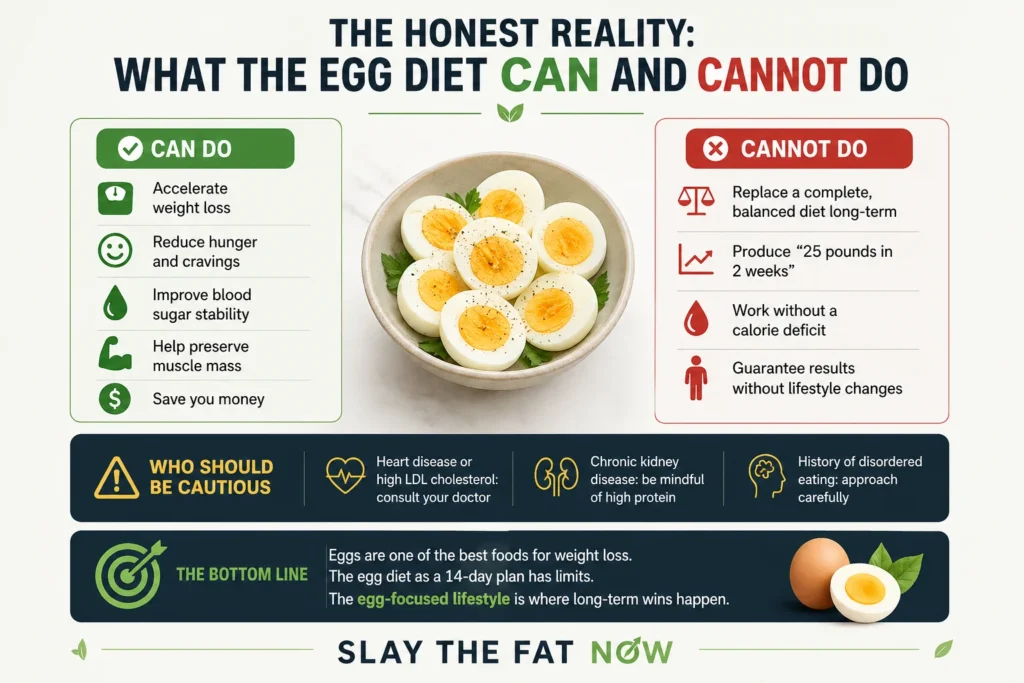
✅ What the egg diet CAN do:
- Accelerate weight loss when combined with a calorie deficit
- Reduce hunger and cravings significantly
- Improve blood sugar stability
- Help preserve muscle mass during fat loss
- Save you money compared to meal kit services or supplements
❌ What the egg diet CANNOT do:
- Replace a complete, balanced diet long-term
- Produce “25 pounds in 2 weeks” as some extreme versions claim — that’s water weight and marketing
- Work without a calorie deficit — if you eat 6 eggs on top of your regular meals, you won’t lose weight
- Guarantee results without lifestyle changes
⚠️ Who should be cautious:
- People with cardiovascular disease or high LDL cholesterol should consult their doctor before increasing egg intake significantly
- Those with chronic kidney disease should be mindful of high protein loads
- Anyone with a history of disordered eating should approach any restrictive plan carefully
The bottom line: Eggs are one of the best foods on the planet for weight loss. The egg diet as a structured, extreme 14-day plan has real limitations. The egg-focused lifestyle approach — that’s where the long-term wins are.
Practical Investment Advice: How to Do the Egg Diet Right
Whether you’re starting fresh or you’ve tried this before, here’s the actionable framework that works:
✅ DO This:
Week 1–2 (Reset Phase):
- 2–3 eggs every morning (scrambled, boiled, poached — not fried in butter)
- Pair with 1–2 cups non-starchy vegetables (spinach, peppers, zucchini, mushrooms)
- Lunch: lean protein (chicken, fish, turkey) + salad
- Dinner: similar to lunch, add ½ cup complex carbs if needed
- Water target: 90–100 oz per day
- Cut all sugary drinks and ultra-processed snacks
Week 3–8 (Sustainable Phase):
- Maintain egg breakfasts 5 of 7 days per week
- Allow flexibility on weekends (this prevents binge cycles)
- Track calories loosely — aim for a 300–500 calorie deficit daily
- Add 20–30 minutes of walking daily (not optional — movement multiplies results)
❌ DON’T Do This:
- Don’t eat only eggs — this creates nutrient deficiencies
- Don’t skip meals to compensate — it backfires every time
- Don’t ignore protein at other meals — consistency is the point
- Don’t weigh yourself daily — weekly weigh-ins are enough and less psychologically damaging
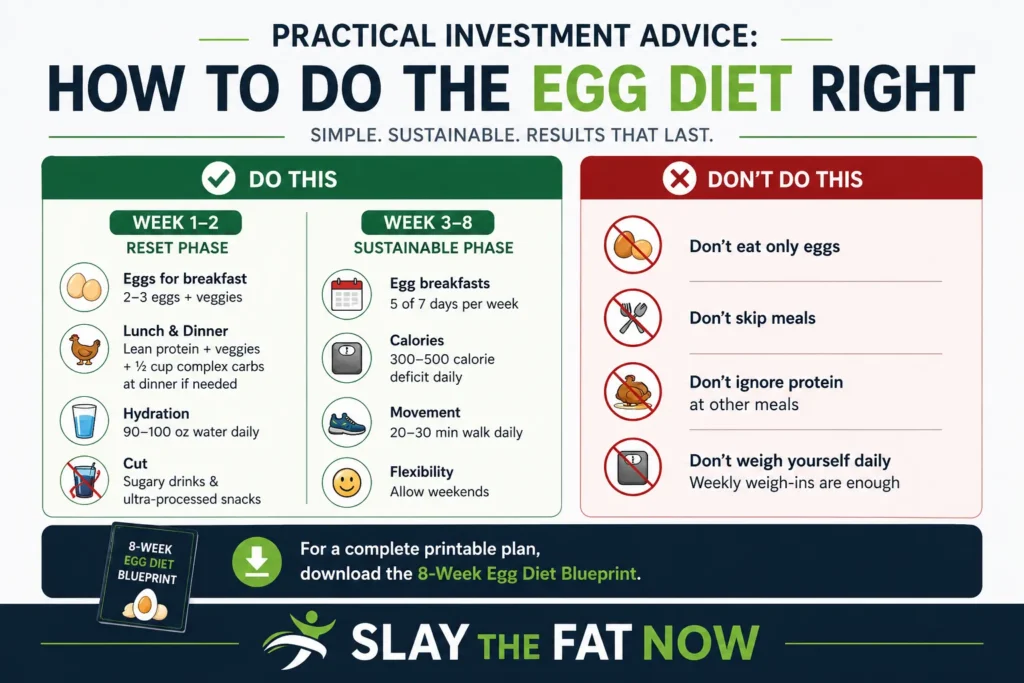
For a complete printable version of this plan, download the SlayTheFatNow 10-Day Metabolism Reset Book by Benjamin Sley.
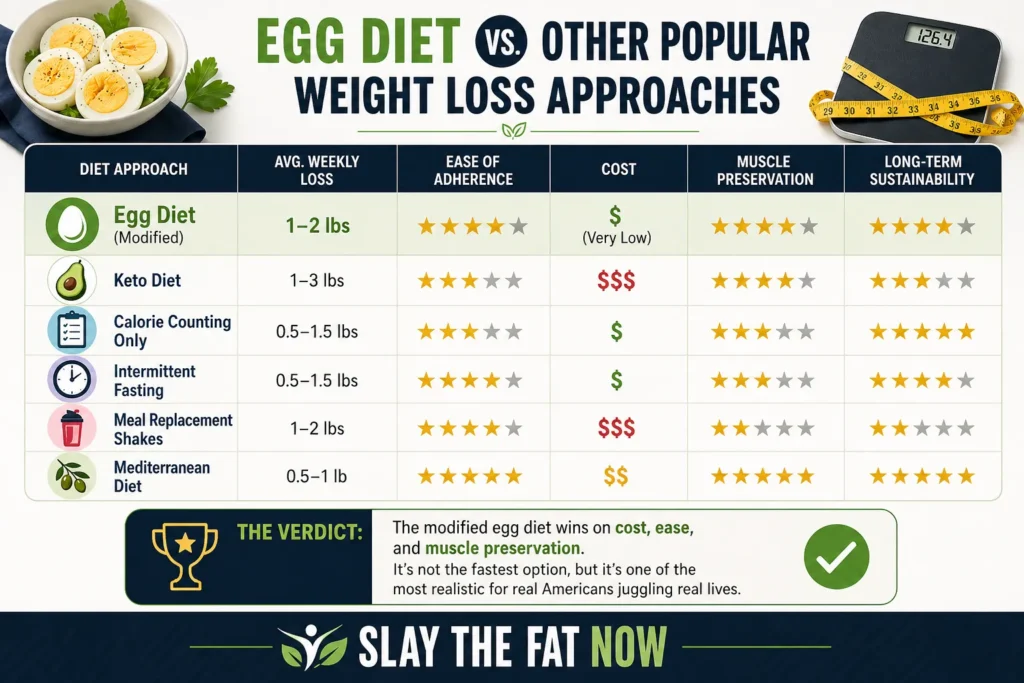
Egg Diet vs. Other Popular Weight Loss Approaches
| Diet Approach | Avg. Weekly Loss | Ease of Adherence | Cost | Muscle Preservation | Long-Term Sustainability |
|---|---|---|---|---|---|
| Egg Diet (Modified) | 1–2 lbs | ★★★★☆ | $ (Very Low) | ★★★★☆ | ★★★★☆ |
| Keto Diet | 1–3 lbs | ★★★☆☆ | $$$ | ★★★★☆ | ★★★☆☆ |
| Calorie Counting Only | 0.5–1.5 lbs | ★★★☆☆ | $ | ★★★☆☆ | ★★★★★ |
| Intermittent Fasting | 0.5–1.5 lbs | ★★★★☆ | $ | ★★★☆☆ | ★★★★☆ |
| Meal Replacement Shakes | 1–2 lbs | ★★★★☆ | $$$ | ★★☆☆☆ | ★★☆☆☆ |
| Mediterranean Diet | 0.5–1 lb | ★★★★★ | $$ | ★★★★★ | ★★★★★ |
The verdict: The modified egg diet wins on cost, ease, and muscle preservation. It’s not the fastest option, but it’s one of the most realistic for real Americans juggling real lives.
15 Frequently Asked Questions About the Egg Diet for Weight Loss
1. How many eggs should I eat per day on the egg diet? Most evidence-backed plans recommend 2–3 eggs per meal, primarily at breakfast. Eating 6–12 eggs daily (as some extreme versions suggest) is unnecessary and unsupported by science for healthy adults.
2. How much weight can I lose on the egg diet in 2 weeks? Realistically, 4–8 pounds in two weeks when combined with a calorie deficit. Claims of “25 pounds in 2 weeks” are misleading and unsustainable.
3. Is the egg diet safe long-term? The strict boiled-egg-only diet is not recommended beyond 14 days. However, making eggs a regular part of a balanced diet is safe and beneficial for most healthy adults long-term.
4. Can I eat eggs every day for weight loss? Yes. Current dietary guidelines have removed the old 7-egg-per-week cap. Research supports daily egg consumption as part of a healthy diet for most people.
5. Do I have to eat boiled eggs, or can I cook them differently? You can poach, scramble, or make omelets. Avoid frying in large amounts of butter or oil, as this adds significant calories and fat. Air frying or cooking with a small amount of olive oil is fine.
6. Will the egg diet raise my cholesterol? This is the most common concern. For most people, dietary cholesterol from eggs has minimal impact on blood cholesterol. Saturated fats (bacon, cheese, butter) are far more problematic. People with existing heart disease should consult their physician.
7. Can I lose belly fat specifically on the egg diet? You can’t spot-reduce fat, but clinical studies showed a 34% greater reduction in waist circumference in the egg diet group versus a carb-based diet group. Belly fat does respond well to the combination of protein + calorie deficit.
8. What do I eat besides eggs on the egg diet? Non-starchy vegetables (spinach, broccoli, peppers, zucchini), lean proteins (chicken, fish, turkey), healthy fats (avocado, olive oil), and limited fruits (berries are ideal). Avoid grains, sugar, and processed foods.
9. Is the egg diet good for women over 40? Yes, especially because of its muscle-preserving protein content. Women over 40 are at higher risk of muscle loss during dieting, and the egg diet’s high protein content helps counter this.
10. Can I do the egg diet if I have diabetes? Eggs have virtually no glycemic impact, making them excellent for blood sugar management. However, if you’re on diabetes medication, consult your doctor before making major dietary changes.
11. How long should I follow the egg diet? The strict version: 2 weeks maximum. The modified version (eggs at breakfast daily, balanced other meals): indefinitely — it becomes a lifestyle, not a diet.
12. What happens after I stop the egg diet? If you return to old eating habits, you will regain the weight. The key is transitioning into a balanced, calorie-aware diet — not going back to processed foods and sugary drinks.
13. Can I exercise while on the egg diet? Absolutely — and you should. Light to moderate exercise (walking, resistance training) dramatically improves results and helps preserve muscle. Don’t do intense workouts on very low calories.
14. Is the egg diet the same as keto? No. Keto is high-fat, very low-carb, and requires strict macronutrient ratios. The egg diet is high-protein and focuses on eggs as the centerpiece — most versions still allow some fruits and vegetables that keto doesn’t.
15. Why do I feel tired in the first few days of the egg diet? This is common and usually a combination of reduced carbohydrate intake (your body is adjusting fuel sources), reduced calories, and possible dehydration. Drink more water and ensure you’re not cutting calories too aggressively. It typically passes within 3–5 days.
Ready to Finally Slay the Fat? Here’s Your Next Step.
You now have more clarity on the egg diet for weight loss than most people will ever get from a 30-second social media video. You understand the science. You understand what works. You understand what doesn’t.
But here’s the truth: knowledge without action is just information.
The people who lose weight and keep it off are the ones who have a plan, accountability, and someone in their corner who has seen it all before.
That’s exactly what Coach Benjamin Sley offers.
🥚 Here’s what to do right now:
✅ Book your FREE 30-minute weight loss strategy call with Benjamin → No judgment. No hard sell. Just an honest conversation about where you are, where you want to be, and the clearest path to get there.
✅ Download the free 7-Day Egg Diet Meal Plan → Print it. Follow it. Text a friend to do it with you.
✅ Join the SlayTheFatNow community → Thousands of real Americans sharing real results. No filters. No fake transformations.
The scale doesn’t lie. Neither does Benjamin.
It’s time to stop starting over. Start finishing instead.
👉 Visit SlayTheFatNow.com to begin your journey today →
External References
- NIH/PubMed — Egg Breakfast Enhances Weight Loss (International Journal of Obesity)
- USDA FoodData Central — Nutritional Data for Eggs
- CDC — Adult Obesity Facts
- MedicalNewsToday — Can Eggs Help You Lose Weight? (Updated May 2025)
Written by Benjamin Sley, Certified Weight Loss Coach | SlayTheFatNow.com | Last Updated: April 2026
This article is for informational purposes only and does not constitute medical advice. Consult a qualified healthcare provider before beginning any new diet program.
