 Skip to content
Why Juice Diets Don’t Work (And What Actually Does, According to Science)
By Benjamin Sley, Certified Weight Loss Coach | SlayTheFatNow.com
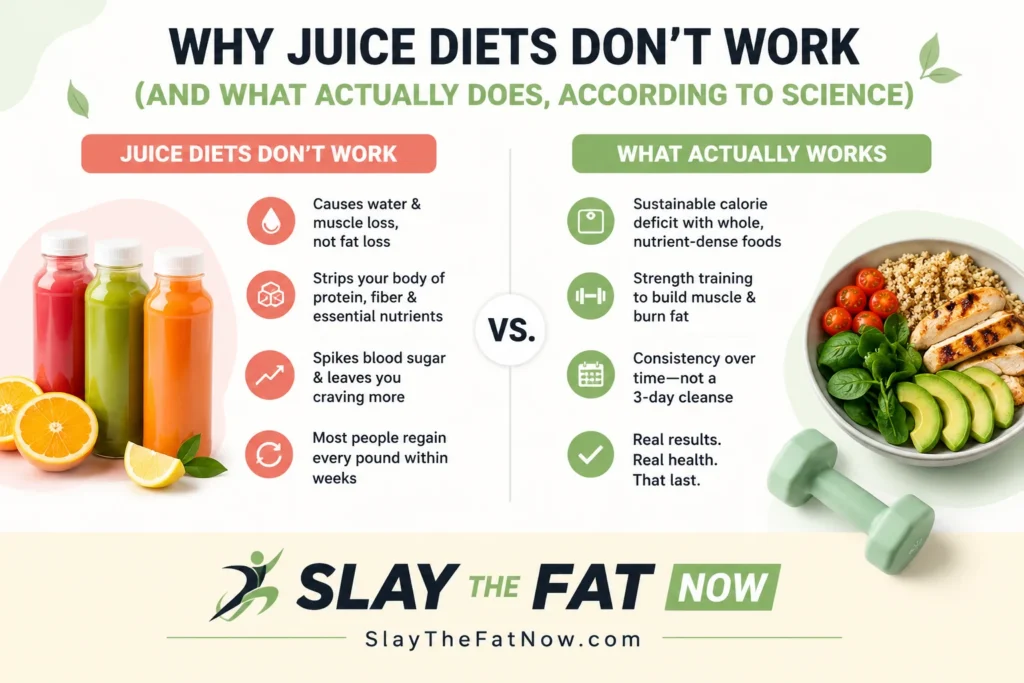
Juice diets don’t work for lasting fat loss because they cause water and muscle loss not fat loss. They strip your body of protein, fiber, and essential nutrients while spiking blood sugar. Most people regain every pound within weeks of stopping. Sustainable fat loss requires a calorie deficit built on whole foods, strength training, and consistency not a 3-day cleanse.
The Mistake Millions of Americans Make Every January
You’ve seen it. Maybe you’ve done it yourself.
January 1st hits. You feel bloated from the holidays, frustrated with your reflection, and desperate for a reset. So you spend $80 on a juice cleanse, drink nothing but green liquid for 5 days, drop 6 pounds… and feel amazing.
Then February arrives.
Every single pound is back. Plus a couple extra.
Sound familiar? You’re not alone and you’re not weak. You were simply following bad advice that’s been sold to millions of Americans for decades.
Juice diets, cleanses, and detox programs are one of the most popular and most misleading weight loss trends in the United States. And in this article, we’re going to break down exactly why they fail, what the science says, and what actually works if you want to lose fat and keep it off for good.
What Is a Juice Diet, Really?
A juice diet sometimes called a juice cleanse or detox involves replacing all solid food with fruit and vegetable juices, typically for 1 to 7 days. Some programs stretch to 30 days.
The promise is seductive: lose weight fast, flush out toxins, reset your gut, feel lighter and cleaner.
The reality? Your body doesn’t work that way.
Juice diets became mainstream in the early 2000s, fueled by celebrity endorsements and wellness influencers. By 2025, the global juice cleanse market had grown into a multi-billion-dollar industry despite mounting scientific evidence showing they simply don’t deliver on their core promise: lasting fat loss.
This article explains why juice diets don’t work, what the research actually shows, and what you should do instead. If you’ve been struggling with your weight and wondering why nothing sticks, keep reading. This changes things.
Why Juice Diets Feel Like They’re Working (But Aren’t)
The Scale Goes Down But It’s Not Fat
This is the part the wellness industry doesn’t want you to understand.
When you start a juice cleanse, you cut calories drastically. A typical juice program provides about 1,200–1,500 calories per day well below most adults’ maintenance needs. Your body responds by burning through stored carbohydrates (called glycogen). And here’s the key: every gram of glycogen holds about 3 grams of water.
When glycogen goes, water leaves with it.
That initial weight loss from a juice cleanse is very likely to be from water weight and over the long term, you’re likely to start losing muscle, not fat.
So when you step on the scale after Day 3 and see 4 pounds gone that’s not fat. That’s water. It comes back the moment you eat normally again.
You’re Also Losing Muscle
Here’s where it gets worse. When your body runs low on carbs and isn’t getting enough protein (most juice programs provide only 20–30 grams per day a fraction of the 60–100 grams most adults need), it turns to muscle tissue for energy.
Muscle loss is dangerous for your metabolism. Muscle burns calories at rest. The less muscle you have, the fewer calories your body burns making future weight loss even harder.
Juice-only diets eliminate essential nutrients like protein, healthy fats, and fiber, increasing the risk of fatigue, muscle loss, and nutrient deficiencies.
What the Data Actually Shows
Let’s look at the research because this is where juice diet marketing completely falls apart.
Study 1: Northwestern University, 2025 New research published in the journal Nutrients found that juice cleanses may induce negative changes to the gut microbiome. The study found increased levels of bacteria associated with inflammation and reduced levels of beneficial bacteria.
This is the opposite of what juice brands promise. Your gut health gets worse, not better.
Study 2: Microbiome Disruption After a 3-day juice fast, participants showed significant changes in their oral microbiota including an increase in Proteobacteria, which are associated with many inflammatory diseases, and a decrease in Firmicutes.
Study 3: Blood Sugar Spikes Continuous glucose monitoring during a 3-day cleanse revealed an average of 6.3 hyperglycemic episodes per participant potentially worsening insulin resistance and compromising weight regulation. A standard 250ml serving of orange juice can contain approximately 23 grams of sugar, equivalent to nearly six teaspoons.
Study 4: Long-Term Weight Regain A 2017 review found that while juice cleanses may cause initial weight loss due to calorie restriction, they lead to overall weight gain once a person resumes a full, healthy diet.
Study 5: Whole Foods Win By a Landslide A 2024 randomized controlled trial showed that participants following whole-food, plant-predominant diets lost 3.2 kg over 12 weeks while preserving muscle mass representing a 220% improvement over juice cleanse outcomes. Moreover, these participants maintained their weight loss at one-year follow-up, while juice cleanse participants had typically regained all lost weight plus additional kilograms.
The data is clear. Juice diets don’t just fail they can actively set you back.
A Real-World Example: Sarah’s Story
Sarah, a 34-year-old nurse from Dallas, came to us in March 2024. She had completed four juice cleanses in the previous 18 months each time losing 5–7 pounds, then regaining 8–10 pounds within six weeks.
After the fourth cleanse, her energy was lower than ever. She was tired all the time. Her metabolism had slowed. She’d lost muscle. And her relationship with food had become anxious and all-or-nothing.
We put her on a structured program: a moderate calorie deficit (400 calories below maintenance), 130 grams of protein per day, three strength sessions per week, and 8,000 steps daily.
In 12 weeks, she lost 14 pounds of actual body fat verified by body composition tracking. More importantly, she kept it off. At her 6-month check-in, she had lost an additional 6 pounds without any “program.” She had simply built sustainable habits.
No juice. No suffering. No rebound.
The Detox Myth Let’s Kill It Completely
One of the biggest selling points of juice cleanses is “detoxification.” The idea that you need to flush toxins out of your body with liquid vegetables.
This is not how human biology works.
The concept of detoxing by eating or drinking certain diets is a myth. The liver and kidneys already remove toxins and waste from your body all you need to support these organs is a well-balanced diet and being mindful of excess alcohol and added sugars.
Your liver works 24/7. It doesn’t take a vacation until you drink celery juice. Drinking cold-pressed beet juice doesn’t make it work harder or better. Eating nutrient-dense whole foods over time does.
There is no scientific mechanism by which a juice cleanse removes toxins faster than your body already does.
What Actually Works: The Evidence-Based Path to Real Fat Loss
Now for the part that matters most. If juice diets are out what actually works?
Here’s what 2025’s best research, combined with real coaching experience, tells us:
1. A Sustainable Calorie Deficit
Fat loss requires burning more calories than you consume period. A pound of fat contains approximately 3,500 calories, meaning a deficit of 500 calories daily theoretically results in 1 pound of fat loss per week.
This doesn’t mean starving. A 300–500 calorie daily deficit is enough to produce steady, sustainable fat loss without triggering metabolic slowdown.
Start by finding your maintenance calories (your body weight in pounds × 14–15 for moderately active adults), then subtract 400–500.
2. High-Protein Eating
Protein is the most powerful nutritional lever for fat loss. It keeps you full. It preserves muscle. It has a higher thermic effect than carbs or fat meaning your body burns more calories just digesting it.
Aim for 0.7–1 gram of protein per pound of body weight daily. Chicken, eggs, Greek yogurt, fish, cottage cheese, and lean beef are your best friends.
3. Strength Training (Non-Negotiable)
Lifting weights boosts your resting metabolic rate meaning you burn more calories even while you sleep. Each pound of muscle burns approximately six calories per day at rest, compared to only two calories per pound of fat tissue.
Three to four strength sessions per week targeting major muscle groups is enough to transform your body composition. You don’t need to become a bodybuilder. You need to become stronger.
This is the single most underused tool in weight loss especially by women who fear getting “bulky.” Strength training reveals the lean body underneath the fat. It’s not optional.
4. Daily Movement (NEAT)
Beyond formal exercise, your total daily movement matters enormously. Non-Exercise Activity Thermogenesis (NEAT) walking, fidgeting, taking stairs, doing chores can account for 300–500 additional calories burned per day.
A brisk 30-minute walk burns 150 to 200 calories. It needs no equipment, causes little fatigue, and you can do it every day without worrying about overtraining.
Aim for 8,000–10,000 steps per day as your baseline. Use a phone or smartwatch to track it.
5. Sleep and Stress Management
This one shocks people. When you don’t get enough rest, your hunger hormones ghrelin and leptin get out of balance. You crave more sugar and carbs, and your metabolism slows down. Chronic stress has a similar effect, raising cortisol levels and encouraging fat storage around the belly.
Prioritize 7–8 hours of sleep per night. Manage stress through walking, journaling, or breathwork. These aren’t “soft” recommendations they directly affect your ability to lose fat.
6. Consistency Over Perfection
The biggest secret of every success story is consistency. Science shows that small, sustainable habits compound over time. Missing a workout or indulging in dessert won’t derail your progress giving up will.
The people who reach their goals aren’t perfect. They’re consistent.
Juice vs. Whole Food: A Direct Comparison
| Factor | Juice Diet | Whole-Food Approach |
|---|---|---|
| Fat Loss | Minimal (mostly water) | Real, sustained fat loss |
| Muscle Preservation | Poor (low protein) | Strong (high protein) |
| Hunger | Extreme | Manageable |
| Energy Levels | Crashes and fatigue | Stable throughout the day |
| Gut Health | Worsens (per 2025 research) | Improves over time |
| Sustainability | Days to weeks | Months to years |
| Long-Term Results | Weight regain almost universal | Maintenance achievable |
| Cost | $60–$150 per cleanse | No extra cost |
The comparison isn’t even close. A whole-food, protein-rich, calorie-controlled approach beats a juice cleanse in every single category.
The Honest Truth About Quick Fixes
We’re going to be direct with you here even if it’s not what you want to hear.
There is no quick fix for fat loss. Not juice. Not detox teas. Not 7-day shakes. Not any product marketed with before-and-after photos of people who lost 30 pounds in 30 days.
Real, permanent fat loss takes time. It takes 3–6 months of consistent effort to see a meaningful physical transformation. It takes 12–18 months to truly rewire your habits and metabolism.
But here’s the other side of that truth: when you do it right, the results last. You don’t spend the next decade yo-yo-ing between cleanses and binges. You build a body and a lifestyle you can maintain without suffering.
That’s what we teach at SlayTheFatNow.com. Not quick fixes. Real results.
Investment in Yourself: The ROI of Getting This Right
Consider the math. The average American spends $50–$150 per juice cleanse 3–4 times per year. Over 5 years, that’s $750–$3,000 spent on something that produces zero long-term results.
Add the hidden costs: slowed metabolism from repeated muscle loss, medical issues from nutrient deficiencies, the psychological toll of constant yo-yo dieting, and lost productivity from chronic fatigue.
Now consider the alternative. A structured fat loss program with coaching, a meal plan, and a training guide typically costs $100–$300 one time. The results compound. You get leaner, healthier, and more energetic with each passing month.
The ROI of doing this correctly is extraordinary. Visit our coaching programs page to see how we help Americans build lasting fat loss results without the gimmicks.
Frequently Asked Questions (15 Questions)
1. Why don’t juice diets work for permanent weight loss?
Juice diets cause water weight and muscle loss not fat loss. Without protein and solid food, your metabolism slows and weight returns rapidly once normal eating resumes.
2. Can a juice cleanse help you lose belly fat?
No. Belly fat (visceral fat) is reduced through a sustained calorie deficit, strength training, and reduced sugar intake not juice cleanses. Any belly reduction you see during a cleanse is mostly water loss.
3. Do juice cleanses detox your body?
No. Your liver and kidneys already detoxify your body continuously. There is no scientific evidence that juice cleanses accelerate or enhance this process. The “detox” claim is a marketing myth.
4. How much weight can you lose on a 3-day juice cleanse?
You may lose 2–5 pounds on a 3-day cleanse, but virtually all of it is water weight. Most people regain it within 3–5 days of returning to normal eating.
5. Is juicing good for weight loss at all?
Juicing can be a useful way to increase micronutrient intake, but it should supplement a whole-food diet not replace it. As a primary weight loss strategy, it fails.
6. What is the best diet for sustainable weight loss in 2025?
A high-protein, whole-food diet with a moderate calorie deficit (300–500 calories below maintenance) combined with strength training is consistently the most effective approach according to current research.
7. How much protein do I need to lose fat and keep muscle?
Aim for 0.7–1 gram of protein per pound of body weight daily. For a 160-pound person, that’s 112–160 grams of protein per day.
8. Why do people regain weight after a juice cleanse?
Because juice cleanses don’t teach new habits, don’t preserve muscle, and don’t address the root causes of overeating. The moment you return to normal food, your body refills glycogen stores and water and weight returns.
9. What are the risks of doing a juice cleanse?
Risks include muscle loss, blood sugar instability, microbiome disruption, nutrient deficiencies (especially protein, B12, iron, and calcium), fatigue, and disordered eating patterns.
10. Is intermittent fasting better than a juice cleanse?
Yes. Intermittent fasting (such as the 16:8 method) allows solid food within an eating window, preserves muscle when combined with adequate protein, and has strong research support for metabolic health improvements.
11. How long does real fat loss take?
Expect to see noticeable physical changes after 6–10 weeks of consistent effort. Significant transformation typically takes 3–6 months. Permanent results require 12+ months of sustainable habits.
12. Can I drink juice while still losing weight?
Yes as part of a balanced diet. A daily vegetable juice alongside solid meals is not harmful. The problem is replacing all food with juice. Drink green juice; don’t live on it.
13. What’s the fastest healthy way to lose weight without a juice cleanse?
Track your calories, hit your daily protein target, walk 8,000–10,000 steps, lift weights three times per week, and sleep 7–8 hours. This approach can produce 1–2 pounds of real fat loss per week.
14. Are juice cleanses safe?
Short-term cleanses (1–3 days) are unlikely to cause serious harm for healthy adults. Longer cleanses carry real risks including nutrient deficiency, muscle loss, and blood sugar dysregulation. Anyone with diabetes, eating disorders, or metabolic conditions should avoid them entirely.
15. Where can I get help losing weight the right way?
Benjamin Sley and the team at SlayTheFatNow.com offer personalized weight loss coaching built on science no juice cleanses, no gimmicks, and no yo-yo dieting.
Ready to Slay the Fat For Real This Time?
If you’ve tried juice cleanses, detox programs, or fad diets and you’re tired of starting over every few months, you’re in the right place.
At SlayTheFatNow.com, weight loss coach Benjamin Sley works directly with Americans who are done with quick fixes and ready to build a body they’re proud of permanently.
Here’s what you get when you work with us:
- A personalized calorie and protein target based on your body and goals
- A strength training plan you can do at home or in the gym
- Weekly accountability check-ins so you never fall off track
- No juice. No suffering. No guessing.
Ready to start?
📲 Book a Free Consultation 15 minutes, no pressure, no sales pitch.
Your body is capable of incredible change. You just need the right plan.
Benjamin Sley is a certified weight loss coach and the founder of SlayTheFatNow.com. He has helped hundreds of Americans lose fat sustainably without fad diets, cleanses, or quick fixes. All content is for educational purposes only and does not constitute medical advice. Consult a physician before beginning any weight loss program.
