 Skip to content
Tirzepatide for Weight Loss: What It Actually Does, How It’s Dosed, and Whether It’s Right for You
If you’ve been scrolling weight loss content lately, you’ve probably heard the word tirzepatide thrown around like confetti. And honestly? The hype is not entirely undeserved — but it’s also not magic. Let’s break this down in plain language, with real science and zero fluff.
This guide covers everything: how tirzepatide works, what the dosage chart looks like, realistic before-and-after expectations, where compounding pharmacies fit in, and who actually qualifies. Whether you’re a woman over 40 in Memphis or a busy professional in Lahore who hasn’t had time to read a 40-page clinical study — this one’s for you.
What Is Tirzepatide — And Why Is Everyone Talking About It?
Tirzepatide is an injectable medication made by Eli Lilly. It’s sold under two brand names:
- Mounjaro — FDA-approved for type 2 diabetes
- Zepbound — FDA-approved for chronic weight management (obesity or overweight with a related health condition)
What makes tirzepatide different from older weight loss drugs is its dual hormone action. Most GLP-1 medications (like semaglutide/Wegovy) target one receptor. Tirzepatide hits two — the GLP-1 receptor and the GIP (glucose-dependent insulinotropic polypeptide) receptor.
Think of it this way: semaglutide sends one signal telling your brain you’re full. Tirzepatide sends two. And that extra signal makes a measurable difference in how much weight people actually lose.
How Does Tirzepatide Work for Weight Loss?

Tirzepatide mimics two hormones your gut naturally produces after eating. Here’s what it does in plain terms:
- Slows down how fast food leaves your stomach (so you stay full longer)
- Reduces appetite signals in the brain
- Increases insulin release after meals
- Lowers glucagon (which would otherwise raise blood sugar)
The result? People eat less without feeling deprived — or at least significantly less hungry. That’s the mechanism. That’s it. No secret.
The real-world weight loss results from clinical trials back this up convincingly. The SURMOUNT-1 trial, published in the New England Journal of Medicine, showed that participants on 15 mg of tirzepatide lost an average of 22.5% of their body weight over 72 weeks, compared to 3.1% in the placebo group.
Tirzepatide vs. Semaglutide: Which Wins?

This is the question people ask most. The answer, according to a landmark 2025 study, is tirzepatide — but context matters.
The SURMOUNT-5 trial published in the New England Journal of Medicine (May 2025) was the first head-to-head comparison. It ran for 72 weeks with 751 participants with obesity but without diabetes.
The results:
- Tirzepatide group lost an average of 20.2% of body weight
- Semaglutide group lost 13.7%
That’s a meaningful gap — roughly 47% more weight loss with tirzepatide. The difference in waist circumference was also significant in favor of tirzepatide.
So yes, in a direct comparison, tirzepatide outperformed semaglutide. But both are effective. Your doctor’s recommendation should still be based on your health profile, cost situation, and tolerance.
Tirzepatide Dosage Chart for Weight Loss

This is one of the most searched topics — and rightly so. Dosing tirzepatide correctly is not optional. Too fast = side effects. Too slow = frustration. Here’s the standard FDA-approved titration schedule for weight loss:
| Week | Dose | Notes |
|---|---|---|
| Week 1–4 | 2.5 mg once weekly | Starting/acclimation dose |
| Week 5–8 | 5 mg once weekly | First increase |
| Week 9–12 | 7.5 mg once weekly | If tolerated |
| Week 13–16 | 10 mg once weekly | Mid-range maintenance |
| Week 17–20 | 12.5 mg once weekly | Higher dose range |
| Week 21+ | 15 mg once weekly | Maximum dose |
Key rules to know:
- Always start at 2.5 mg — the low starting dose exists to minimize nausea and other GI side effects
- Increase by no more than 2.5 mg at a time
- Wait at least 4 weeks between dose increases
- Not everyone needs to reach 15 mg — the 10 mg and 12.5 mg doses still deliver strong results
- The maximum dose is 15 mg per week
Per the StatPearls clinical reference published via the NCBI, if a dose is missed, take it within 4 days (96 hours). If more than 4 days have passed, skip it and return to your regular weekly schedule. Do not take two doses within 3 days of each other.
Note for Slaythefatnow readers: We are a weight loss coaching program, not a medical clinic. The dosage chart above is based on FDA-approved prescribing guidelines for informational purposes only. Always work with a licensed healthcare provider to determine your personal dosage plan.
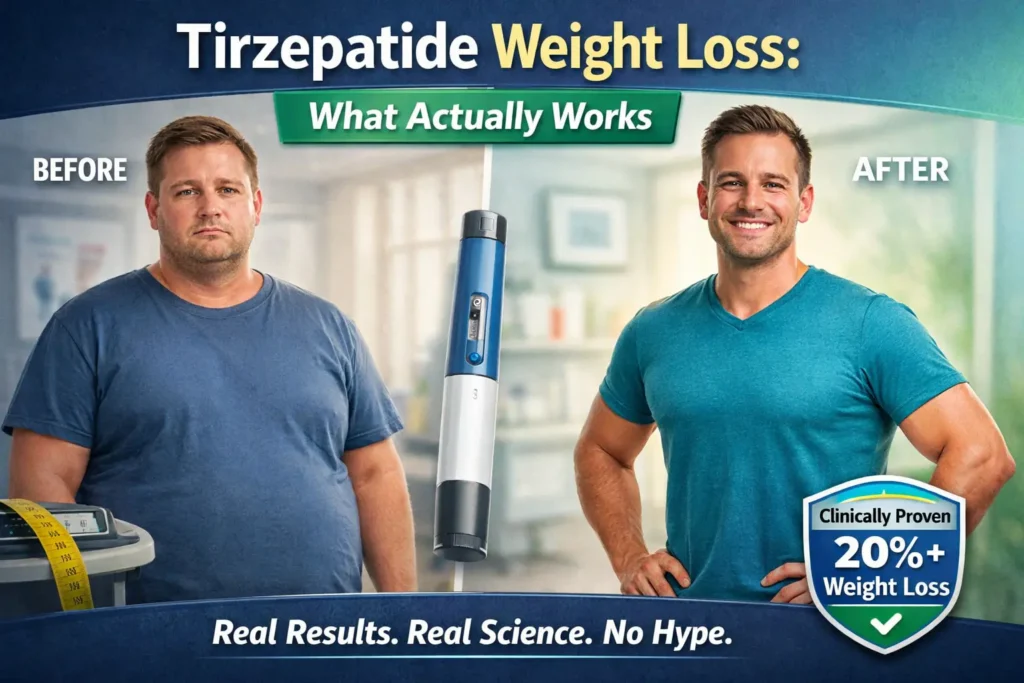
Tirzepatide Weight Loss Before and After: What Real Results Look Like

People want to know: “Will this work for me?” Fair question.
Let’s use actual data rather than cherry-picked testimonials.
The SURMOUNT-4 trial (published in JAMA, 2024) tracked participants over 88 weeks. People who continued tirzepatide maintained 89.5% of their weight loss. Those who switched to placebo regained most of what they lost. The overall mean weight reduction for those staying on tirzepatide was 25.3% from baseline.
A 2025 real-world study covering 209 patients on a 12-month remote weight management program (tirzepatide + behavioral coaching) showed a mean weight loss of 22.9 kg, representing about 22.1% of starting body weight.
What does “before and after” look like in practice? Someone weighing 100 kg (220 lbs) could realistically expect to lose 18–25 kg over 72 weeks with consistent treatment, proper diet, and physical activity.
Before tirzepatide (what most people experience):
- Constant hunger despite calorie restriction
- Weight plateaus despite effort
- Fatigue and low motivation
After tirzepatide (what clinical trials show):
- Significantly reduced appetite
- Steady, sustained weight loss over months
- Improved energy, blood sugar, and cardiovascular markers
This is not overnight. The SURMOUNT-1 data shows clinical studies ran for 72 weeks — that’s nearly a year and a half. Patience is part of the plan.
Who Qualifies for Tirzepatide?
Zepbound (tirzepatide for weight loss) is FDA-approved for adults who have:
- A BMI of 30 or higher (obesity), OR
- A BMI of 27 or higher with at least one weight-related health condition (high blood pressure, type 2 diabetes, high cholesterol, sleep apnea)
Note: For people from South Asian backgrounds (including Pakistani communities), some clinical guidance recommends applying BMI thresholds about 2.5 points lower, since the health risks associated with excess weight tend to appear at lower BMI values in South Asian populations.
Tirzepatide is not approved for:
- Type 1 diabetes
- Children (though pediatric use for Mounjaro in type 2 diabetes has been studied for children aged 10+)
- People with a personal or family history of medullary thyroid carcinoma
- Those with Multiple Endocrine Neoplasia syndrome type 2 (MEN 2)
What About Compounded Tirzepatide?
You’ve probably seen the phrase “best tirzepatide compounding pharmacy” circulating in weight loss conversations. Here’s the reality check you need.
Compounded tirzepatide refers to versions of the medication mixed by compounding pharmacies — often at lower cost and in different concentrations than the branded Zepbound or Mounjaro.
The FDA has allowed compounded tirzepatide during shortage periods, but as of late 2024, with branded tirzepatide supply improving, the FDA issued guidance that compounded versions may no longer qualify for shortage-based exemptions.
What you need to know:
- Compounded medications are not FDA-approved for safety, quality, or efficacy
- They may differ in concentration, device, and dosing schedule from branded products
- They require a prescription from a licensed provider
- They may be significantly cheaper than branded versions
The GoodRx prescribing guidance (updated March 2026) specifically notes that compounded medications present potential safety issues and recommends discussing risks with your healthcare team before proceeding.
If you’re considering this route — do it with full information and medical supervision. Not because we’re trying to scare you, but because the difference in formulation actually matters when you’re injecting something weekly.
Side Effects: What to Expect
Most side effects with tirzepatide are gastrointestinal and tend to be worse during dose increases. The most common ones include:
- Nausea
- Diarrhea
- Constipation
- Vomiting
- Reduced appetite (this is also the mechanism — so it’s doing its job)
In clinical trials, GI effects were described as mostly mild to moderate and often decreased over time. The “start low, go slow” dosing protocol exists precisely to reduce how bad these feel during adjustment periods.
More serious but rare risks include:
- Pancreatitis
- Gallbladder problems
- Low blood sugar (especially if used alongside insulin or sulfonylureas)
- Thyroid tumors (seen in animal studies; clinical significance in humans is not yet fully established)
Will You Regain Weight If You Stop?
Yes — and this is important to understand before starting.
The SURMOUNT-4 trial showed clearly that stopping tirzepatide leads to weight regain. When participants switched from tirzepatide to placebo after 36 weeks, they regained the majority of their lost weight within a year, along with a reversal of the cardiometabolic improvements (blood sugar, blood pressure, etc.).
A 2026 analysis published in JAMA Internal Medicine found that most participants who stopped tirzepatide experienced 25% or greater weight regain within 12 months.
This doesn’t mean tirzepatide is a trap — it means obesity is a chronic condition, and tirzepatide is a chronic treatment. Just like blood pressure medication stops working when you stop taking it.
Tirzepatide and Lifestyle: You Still Have to Show Up
Let’s be honest about something: tirzepatide works best when paired with lifestyle change. Every major clinical trial combined tirzepatide with a calorie-reduced diet and physical activity. The drug reduces hunger. It does not replace movement.
At Slaythefatnow.com, the coaching approach works around exactly this reality. Medication or not, sustainable fat loss requires habits — consistent ones. Tirzepatide can be an incredible tool. But tools don’t work without the person holding them.
Frequently Asked Questions
How long does it take to see results with tirzepatide? Most people start noticing reduced appetite within the first 1–4 weeks. Visible weight loss typically becomes more apparent after 8–12 weeks. Clinical trials tracked results over 72 weeks for the full picture.
Is tirzepatide safe for women over 40? Tirzepatide has been studied in broad adult populations including women with hormonal-related weight challenges. It is not contraindicated based on age or gender alone. However, women on oral contraceptives should note that GLP-1 medications may slow absorption of oral medications — your doctor may recommend switching to a non-oral contraceptive method.
Can men use tirzepatide for weight loss? Yes. Clinical trial populations included male participants as well, though the majority of SURMOUNT trial participants were women. Efficacy and safety apply across genders with individual variation.
What is the best dose of tirzepatide for weight loss? According to clinical data, the 10 mg and 15 mg doses produced the strongest results — approximately 19% and 21–22% body weight reduction, respectively, in the SURMOUNT-1 trial. However, the best dose for you is the highest dose you can tolerate without unacceptable side effects. Not everyone needs 15 mg to achieve meaningful results.
Is a weight loss clinic needed to get tirzepatide? Tirzepatide requires a prescription from a licensed healthcare provider. A weight loss clinic that offers medically supervised GLP-1 programs is one avenue — but telehealth platforms, endocrinologists, and general practitioners can also prescribe it depending on your health profile and location.
The Bottom Line
Tirzepatide is one of the most clinically significant weight loss developments in decades. The data from the SURMOUNT trials, published in reputable peer-reviewed journals, shows real, substantial weight loss — not the 5–7% you used to see from older drugs, but 20%+ sustained reductions.
It is not a permanent fix on its own. It requires consistent use, medical supervision, lifestyle commitment, and realistic expectations. The before-and-after stories you see online reflect real outcomes — but they also reflect months of work, proper titration, and dietary changes.
If you want support building the habits that make tirzepatide (or any weight loss approach) actually stick, that’s what Slaythefatnow is built for. Real coaching. Real accountability. No shortcuts sold as magic.
Sources
- Aronne L. et al. Tirzepatide as Compared with Semaglutide for the Treatment of Obesity. NEJM, May 2025. https://www.nejm.org/doi/full/10.1056/NEJMoa2416394
- Aronne L. et al. Continued Treatment With Tirzepatide for Maintenance of Weight Reduction in Adults With Obesity: The SURMOUNT-4 Randomized Clinical Trial. JAMA, Jan 2024. https://pubmed.ncbi.nlm.nih.gov/38078870/
- Jastreboff A. et al. Tirzepatide Once Weekly for the Treatment of Obesity (SURMOUNT-1). NEJM, 2022. https://www.nejm.org/doi/full/10.1056/NEJMoa2206038
- Farzam K, Patel P. Tirzepatide. StatPearls via NCBI, 2024. https://www.ncbi.nlm.nih.gov/books/NBK585056/
- Zepbound (tirzepatide) Dosage Guide. GoodRx, updated March 2026. https://www.goodrx.com/zepbound/dosage
- Tirzepatide Dosage Chart. EdenHealth (FDA prescribing reference summary). https://www.tryeden.com/post/tirzepatide-dosing-chart
- Horn D. et al. Cardiometabolic Parameter Change by Weight Regain on Tirzepatide Withdrawal: SURMOUNT-4 Post Hoc Analysis. JAMA Internal Medicine, Feb 2026. https://pubmed.ncbi.nlm.nih.gov/41284285/
- Second Nature: Semaglutide and Tirzepatide in a Remote Weight Management Program (12-Month Study). PMC, 2025. https://pmc.ncbi.nlm.nih.gov/articles/PMC12475876/
This article is for informational purposes only and does not constitute medical advice. Slaythefatnow.com is a weight loss coaching program. Always consult a licensed healthcare provider before starting any medication or weight loss treatment.
